Find a Search Engine Optimization Agency for Startups (2026)
Most advice on hiring an SEO agency is backwards. It tells founders to compare packages, ask for case studies, and pick the team with the cleanest pitch deck. That’s how startups burn cash.
The task isn’t hiring a vendor. It’s finding a partner that can turn search into pipeline, while adapting to a world where buyers discover brands through Google, AI Overviews, ChatGPT, Perplexity, and whatever comes next. If an agency still talks only about rankings and blog volume, it’s already behind.
The market is large enough to attract serious operators and plenty of noise. The global SEO services market was valued at $92.74 billion in 2025 and grew to $108.28 billion in 2026, with projections reaching $203.83 billion by 2030 according to Research and Markets coverage of the SEO services market. That growth creates opportunity for startups. It also creates a crowded agency environment where polished sales processes often mask weak execution.
Why Most Startups Fail at Hiring SEO Agencies
The harsh truth is that many startup-agency SEO relationships disappoint for predictable reasons. Recent benchmarks show that up to 70% of startup-agency SEO contracts underdeliver on promised results, often because KPIs are vague and business goals were never aligned properly on day one, according to HVSEO’s analysis of startup SEO agency fit.
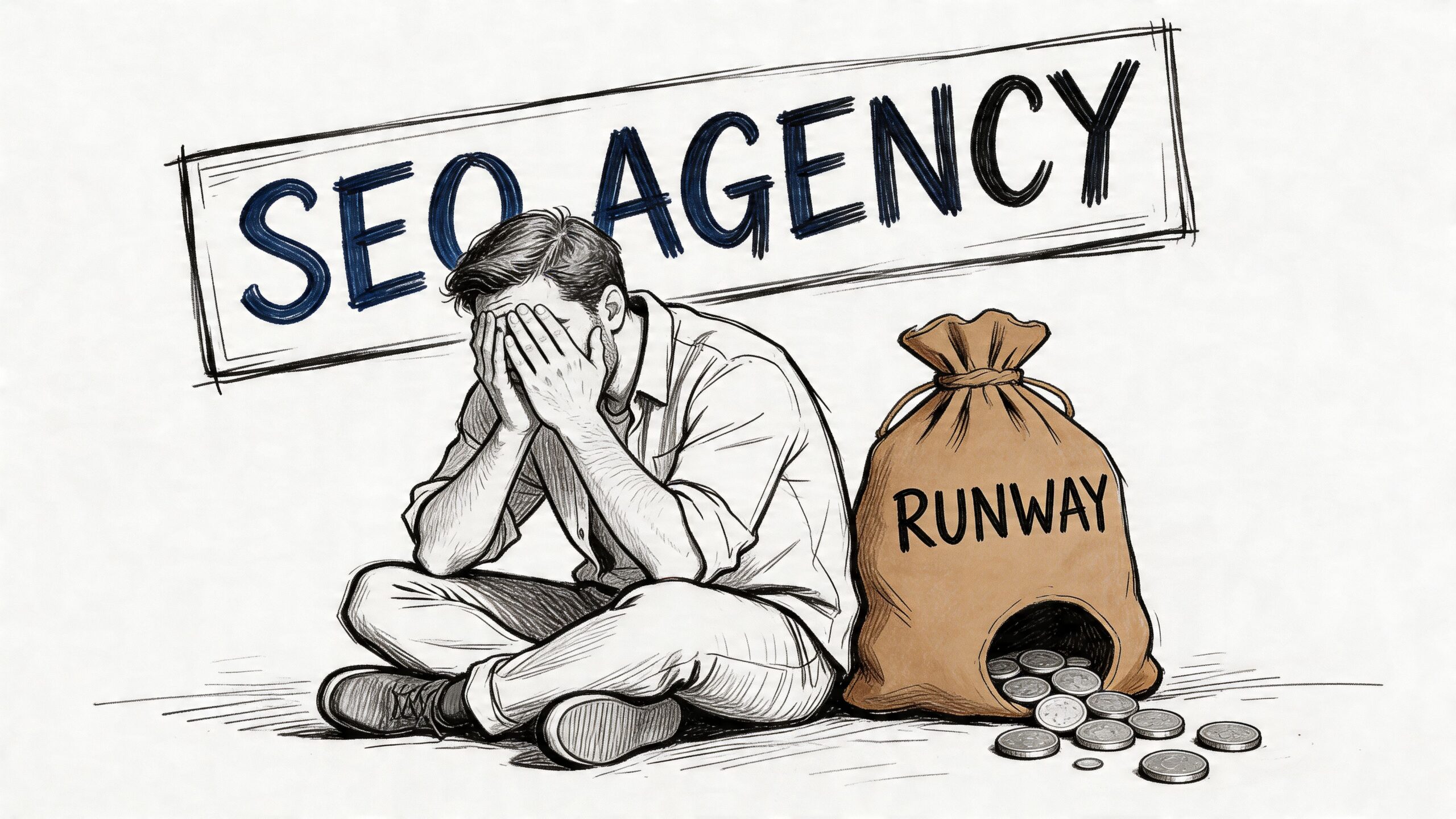
Startups usually fail here because they buy outputs instead of outcomes. They ask for blog posts, backlinks, and technical audits. They don’t ask how those activities will support demo requests, qualified pipeline, expansion revenue, or branded demand in AI search.
What founders get wrong
A startup doesn’t need “more traffic” in the abstract. It needs the right visitors landing on the right pages with the right conversion path.
Common mistakes look like this:
- Vanity metric obsession: The agency reports ranking gains for keywords nobody buys from.
- Scope confusion: The founder assumes the agency will fix positioning, conversion flow, analytics, and content ops. The contract only covers basic SEO tasks.
- Blind trust in guarantees: “Page one in a month” is usually a sales tactic, not a strategy.
- No internal owner: Nobody on the startup side reviews briefs, approves pages, or connects SEO work to revenue data.
Practical rule: If an agency can’t explain your SEO program in terms your sales leader and CFO would respect, it’s not ready to manage startup runway.
What underdelivery looks like early
You don’t have to wait half a year to spot trouble. Weak agencies reveal themselves fast.
Watch for these signals in the first few conversations:
| Signal | Healthy agency | Risky agency |
|---|---|---|
| Goals | Ties SEO to business model and buyer intent | Talks mostly about traffic |
| Discovery | Asks hard questions about product, margins, sales cycle | Sends a generic proposal fast |
| Reporting | Defines what will be tracked before kickoff | Says “we’ll figure that out later” |
| AI search | Has a view on LLM visibility and brand authority | Treats AI search like a fad |
The point isn’t to become cynical. It’s to stop treating a search engine optimization agency for startups like a commodity purchase. Good agencies don’t just ship tasks. They help the company make smarter growth bets.
Define Your SEO Blueprint Before You Search
Before you evaluate agencies, write down what SEO is supposed to do for the business. Most bad hires start with a loose brief like “we need more visibility.” That’s not a strategy. It’s a placeholder for confusion.
An SEO blueprint should answer three questions: what matters, what resources exist, and what constraints are real. If your team hasn’t done this work, even a competent agency will spend the first months translating chaos.
Start with the business objective
Different startup models need different SEO motions.
For example:
- B2B SaaS: Prioritize bottom and mid-funnel pages such as alternatives, integrations, use-case pages, and comparison content.
- Product-led growth: Focus on educational content that earns trust, then route visitors into trials or product interactions.
- Ecommerce or transactional models: Improve collection pages, product pages, and category architecture before expanding content production.
- New category creation: Invest in thought leadership and category definition only if the site already communicates the product clearly.
A useful way to pressure test your plan is to review how experienced teams describe search engine optimization (SEO) services in terms of technical work, content, and authority building. You’re not looking for a vendor script. You’re checking whether your own needs are defined enough to match a real service scope.
Build the blueprint on one page
Keep it short. A one-page document is enough if it’s specific.
Include:
Primary goal
Examples include qualified demos, signups from non-brand search, or revenue from a defined page set.Ideal customer segments
Name the audiences, not just industries. Early-stage founder searching for software is different from an ops manager comparing vendors.Critical pages
List the pages that should rank and convert. Homepage, solution pages, integration pages, comparison pages, templates, or help docs.Internal constraints
Who writes? Who approves? Who owns analytics? Where are the bottlenecks?Success window
Define how long you can support the program before it must justify expansion.
A startup with weak messaging should fix positioning before scaling SEO. Search can amplify clarity. It can also amplify confusion.
Decide what your team can support
Many founders underestimate the operating load. Good SEO work needs product input, customer language, engineering help for technical fixes, and someone who can review content without disappearing for three weeks.
If you need help structuring editorial priorities before agency conversations, this content strategy example is a practical way to think about page types, themes, and execution order.
A clear blueprint changes the agency search immediately. You stop asking, “Who is the best?” and start asking, “Who is best for this exact growth problem?”
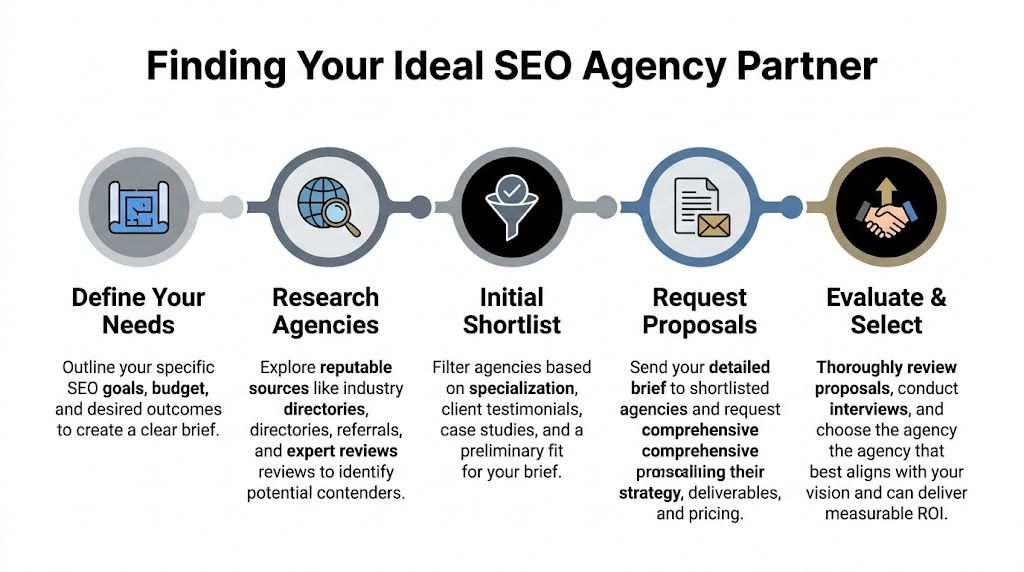
Finding and Shortlisting Your Agency Contenders
Most founders start in the worst possible place. They search “best SEO agency for startups,” click a listicle, and assume visibility equals credibility. It doesn’t. Some excellent firms appear there. Many average ones do too.
A better shortlist comes from pattern matching. You want agencies that understand startup constraints, can work across technical SEO and content, and can explain how search supports revenue, not just rankings.
Where to look for serious contenders
Useful sources tend to be less glamorous:
- Founder and operator referrals: Ask people who’ve managed the agency relationship directly, not people who just know the founder.
- Specialist directories: Clutch can help, especially if you filter for startup or SaaS experience rather than broad agency prestige.
- Niche operators: Smaller specialist firms often outperform large agencies because they have tighter process discipline.
- An agency’s own site: Their blog, service pages, and point of view tell you a lot about how they think.
When you review agencies, inspect their own marketing. If their thought leadership reads like generic AI sludge, expect the same standard in your content program.
What strong process looks like
Competent agencies usually show a recognizable operating model. They don’t jump straight into publishing. They start with discovery, diagnostics, and prioritization.
That matters because top agencies deliver first-page rankings within 90 days, and 86% of clients reach top-10 positions within 6 months by using structured methods that include technical audits, content strategy, and AI-integrated optimization, according to Concurate’s review of startup SEO agencies.
A strong shortlist candidate should talk comfortably about tools like Ahrefs, Google Search Console, and SEMrush. It should also be able to show how it moves from audit findings to implementation, not just from audit to another meeting.
If you want a sharper lens for evaluating whether an agency’s reporting mindset is advanced enough, these rank tracker features are a useful benchmark for what modern monitoring should include beyond superficial ranking snapshots.
Shortlist by evidence, not charm
Use this filter before sending an RFP:
| Question | Keep on shortlist if yes |
|---|---|
| Do they show startup-specific experience? | Yes |
| Can they explain their discovery process clearly? | Yes |
| Do they connect SEO work to conversion and revenue? | Yes |
| Do they acknowledge AI search and LLM visibility? | Yes |
| Do they avoid magical guarantees? | Yes |
Shortlist the agency that asks the best questions, not the one with the most polished deck.
Your RFP doesn’t need to be elaborate. It needs enough detail to force specificity. Include your business model, sales cycle, target customer, current content footprint, technical constraints, top competitors, and what success would mean in business terms. Weak agencies hate precise briefs because they expose generic proposals.
The Critical Questions to Ask Potential SEO Agencies
Founders often treat agency interviews like a pitch contest. That is how weak SEO retainers get signed.
A real evaluation sounds closer to an operating review. You are testing whether the agency can make decisions under constraints, work with imperfect data, and produce search gains that matter to revenue now and brand visibility in AI systems next. If they cannot explain their choices in plain English, they probably cannot execute them well either.
Ask questions that reveal judgment
A useful reference before interviews is this checklist of 10 Crucial Questions to Ask a Marketing Agency. For startup SEO, the sharper questions are the ones that expose prioritization, execution discipline, and whether the team understands how AI search optimization changes what visibility actually means.
Ask these early:
How do you define success for a startup at our stage?
Strong agencies tie SEO to qualified demos, trials, pipeline, or revenue influence. Weak agencies stay at the level of rankings and traffic without explaining business impact.What will you do in the first 30 days, and what will you not do yet?
Good answers include audit work, analytics validation, search intent mapping, and a clear order of operations. The phrase "it depends" is fine if they can explain what it depends on.Which parts of your plan need our product, sales, or engineering team?
This question matters because SEO slows down fast when agencies pretend cross-functional work is optional. Mature teams know where founder input is needed and where they can move independently.How do you decide a content topic is not worth pursuing?
Every startup has more keyword ideas than resources. A competent agency filters by buying intent, differentiation, authority gap, and likelihood of compounding returns.What is your link acquisition approach?
Look for a method that sounds boring and defensible. Digital PR, partnerships, cited research, and selective outreach are fine. Secret networks and guaranteed link volumes are not.How do you measure visibility beyond Google rankings?
Weaker agencies still show their age with this metric. Ask how they monitor branded mentions, citations, and inclusion in AI-generated answers, not just SERP positions.
Good answers versus red flags
| Question | Strong answer | Red flag |
|---|---|---|
| How fast will we see movement? | Breaks expectations down by authority, page type, and implementation speed | Promises fast wins across everything |
| How do you report performance? | Shows work shipped, changes observed, business impact, and next bets | Sends ranking snapshots with no decisions attached |
| How do you handle disagreement? | Explains trade-offs and recommends a path with rationale | Says yes to every request |
| What happens if content does not perform? | Refreshes, consolidates, or changes intent targets based on evidence | Keeps publishing more of the same |
| How do you account for AI search? | Tracks brand presence, citations, and answer-level visibility alongside search data | Dismisses AI search as hype |
If an agency protects its method more than it explains its workflow, leave the call.
Pricing models and startup reality
Startup SEO budgets are usually tighter than agency proposals suggest. Recent pricing benchmarks from WebFX's SEO pricing guide show many small businesses buying SEO in the lower monthly retainer bands, which lines up with what early-stage teams can feasibly support without starving product or paid acquisition.
That budget pressure makes pricing structure matter as much as price.
Monthly retainer
Best for ongoing execution across technical fixes, content, internal linking, and iteration. It becomes a problem when the scope is loose and the agency hides behind "ongoing optimization."Project-based work
Useful for audits, migrations, site architecture, or a defined content sprint. It works poorly when nobody owns implementation after the deliverables land.Performance-linked pricing
Appealing on paper. Messy in practice. Attribution lag, sales cycles, and branded search lift can distort incentives fast.
For many startups, the safest option is a tightly scoped initial engagement with explicit outputs, named owners, reporting cadence, and a decision point after the first phase. Founders do not need an agency that sounds strategic. They need one that can explain what gets done, what gets measured, and what changes if the numbers stall.
Future-Proof Your SEO with AI Search Analytics
Google rankings still matter. They’re no longer the whole map.
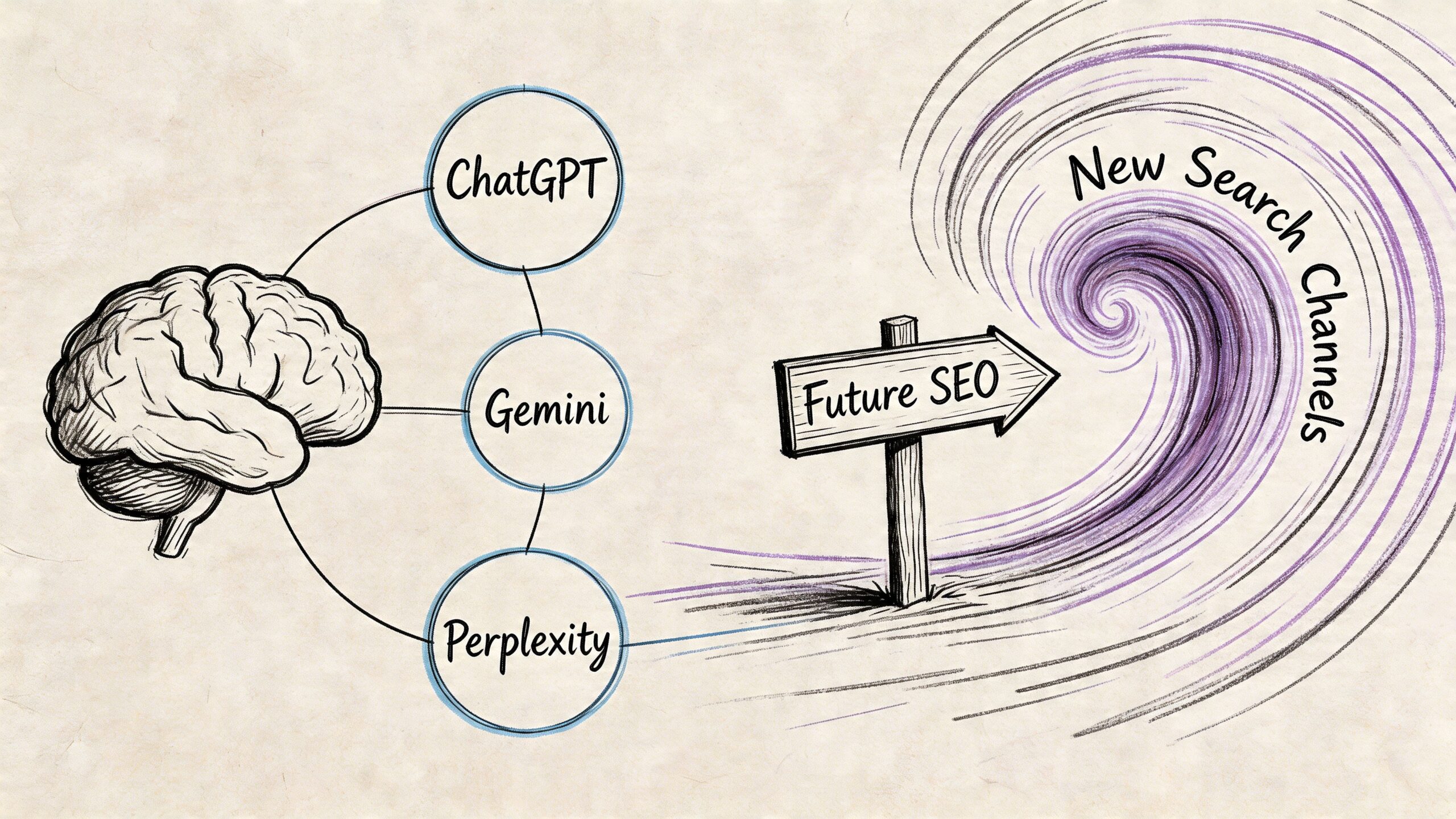
Buyers now ask questions directly inside AI systems, compare vendors in conversational interfaces, and absorb summaries without ever opening a traditional search result. A search engine optimization agency for startups that ignores this shift is building for a shrinking definition of visibility.
Why AI search now belongs in the brief
Generative Engine Optimization, often shortened to GEO, is the practical extension of SEO into AI-mediated discovery. Instead of optimizing only for links and snippets, brands now need to influence how AI systems describe them, compare them, and cite them.
That shift already has measurable consequences. Recent analysis found that homepage traffic increased by an average of 10.7% for websites featured in AI Overviews and LLM responses, according to Artios data on GEO and AI visibility.
That doesn’t mean every startup should chase every AI mention. It means your agency should understand that authority now shows up in more places than the classic results page.
What to ask agencies about AI visibility
Most agencies talk about AI in slogans. Ask for mechanics instead.
A serious answer should address:
- Prompt and query mapping: Which buyer questions matter in LLMs?
- Source influence: Which pages, reviews, lists, docs, and articles are shaping brand mentions?
- Message control: How will the agency improve how your company is described?
- Competitive comparison: How often do rivals appear when your category is discussed?
- Measurement cadence: What gets reviewed regularly, and how are shifts interpreted?
A useful primer on the broader discipline is this guide to AI search engine optimization. It’s worth reading before agency calls because it sharpens the difference between firms doing real adaptation and firms merely rebranding old SEO services.
Your brand can rank well on Google and still be absent from the AI conversations shaping buyer perception.
A short explainer helps clarify what modern search visibility now includes:
The deliverable most startups forget
Ask the agency to define AI search visibility as a reporting line item, not a future experiment. That means tracking presence, positioning, and recurring themes in model-generated answers, then tying findings back to content, PR, and on-site updates.
What won’t work is a team that says, “We’re monitoring the space.” That’s not a deliverable. It’s a placeholder for drift.
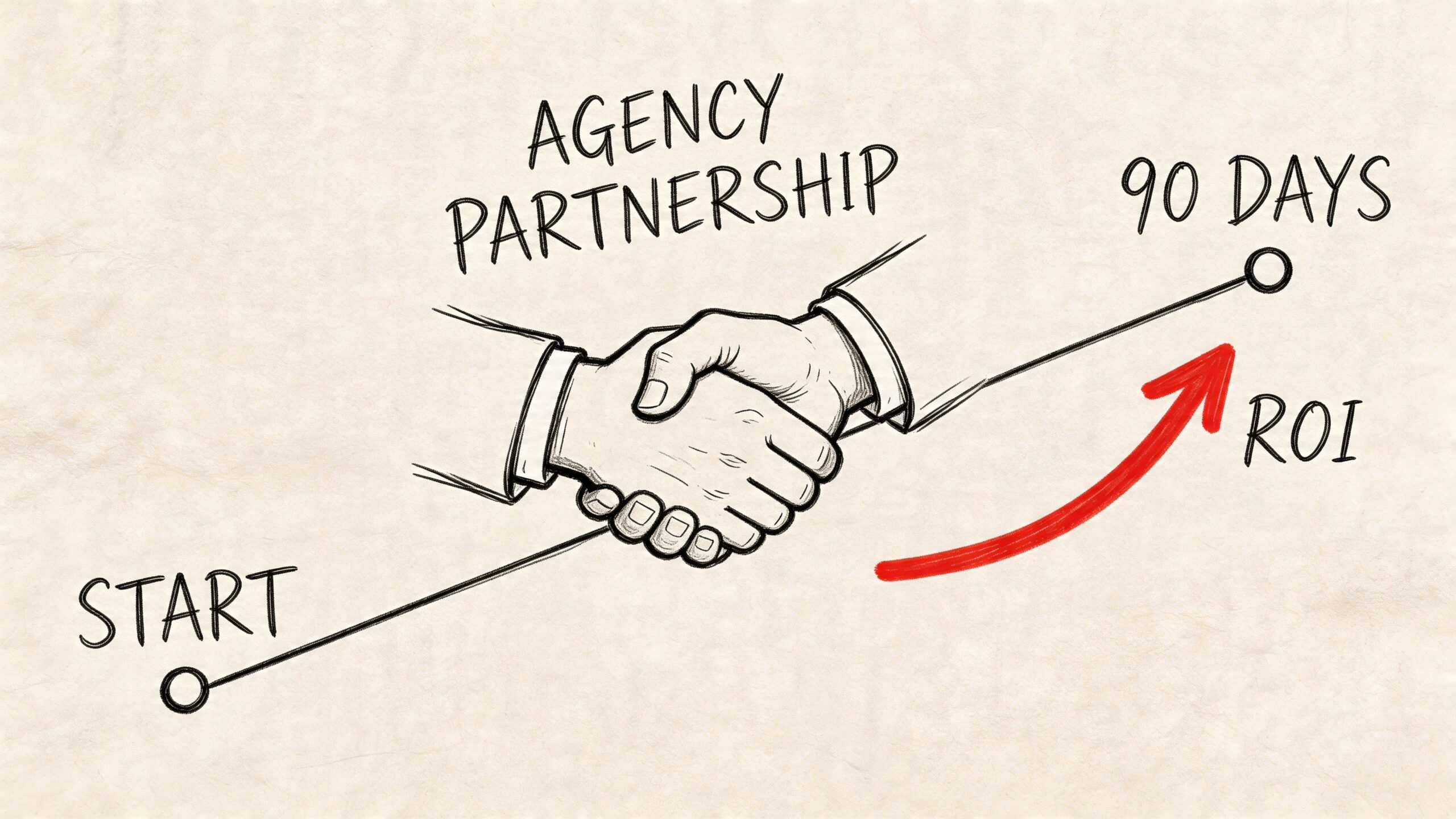
The First 90 Days and Beyond Driving ROI
Most SEO contracts don’t fail because the strategy was impossible. They fail because nobody operationalized the partnership.
The first three months should create traction, trust, and a baseline for ROI. If the relationship feels vague by then, it usually gets worse, not better.
What should happen in the first 90 days
A good startup agency uses the opening period to remove blockers and prove that it can execute.
Look for this pattern:
- Kickoff and access: Analytics, Search Console, CMS, CRM context, product messaging, and stakeholder map are sorted early.
- Audit and prioritization: Technical issues, page opportunities, content gaps, and authority needs are ranked by impact.
- Early implementation: Important fixes and high-intent page work start quickly. The agency doesn’t hide behind endless planning.
- Reporting discipline: You see completed work, observed effects, and next actions.
Many startups often make a mistake. They tolerate activity reports instead of decision reports.
Measure ROI like an operator
The benchmark worth holding in mind is business return, not “SEO progress.” Successful startup SEO investments should show traction within 90-day cycles, with a 12-month investment expected to yield a 2.6x ROI on average, and campaigns focused on thought leadership achieving returns as high as 748%, according to SEO Circular’s startup SEO ROI benchmarks.
That doesn’t mean your startup automatically gets those outcomes. It means the relationship should be managed against economics, not hope.
Review performance through a lens like this:
| KPI type | Better measure | Weak measure |
|---|---|---|
| Acquisition | Qualified leads from organic | Raw sessions |
| Commercial | Revenue influenced by organic | Ranking count |
| Efficiency | Reduced dependence on paid capture | Published page volume |
| Authority | Better conversion from intent-matched pages | Impressions without action |
If you need a more disciplined way to connect these signals, this framework on how to measure marketing performance is a useful operating reference.
The agency should help you make decisions each month. If the report doesn’t change what you do next, it’s not good reporting.
What happens after the first window
Once the basics are working, the program should mature. That often means expanding from quick-win fixes into stronger content systems, richer commercial pages, and a clearer authority strategy. It may also mean narrowing focus if the early data shows that entire topic clusters attract attention but not customers.
That’s the discipline founders need. Not more SEO. Better selection, tighter execution, and a ruthless link between search effort and business outcome.
Frequently Asked Questions
Should I hire an agency or build an in-house SEO team?
Early-stage startups usually benefit more from an agency. You get broader experience across technical SEO, content strategy, and analytics without taking on the overhead of a full internal team. In-house starts to make more sense when SEO becomes a core growth channel and you need daily coordination across product, content, and demand generation.
What’s a reasonable SEO budget for a pre-seed or seed-stage startup?
Start smaller than most agencies want you to. A focused audit, a limited content sprint, or a clear technical cleanup is often safer than a broad retainer before your messaging and funnel are stable. The right budget is the one your team can support operationally, not just financially.
How do I know when it’s time to fire my SEO agency?
Fire the agency when communication gets vague, priorities stay fuzzy, deadlines slip repeatedly, or reporting emphasizes activity over business impact. Another strong signal is strategic rigidity. If the agency keeps pushing the same playbook despite weak results or changing search behavior, it’s not managing your business. It’s protecting its process.
Can one agency handle both Google SEO and AI search visibility?
Some can. Many can’t yet. Ask for a clear explanation of how they approach AI-generated search answers, source visibility, and brand positioning in LLM responses. If the answer sounds improvised, assume the capability is immature.
If your team wants to understand how AI models present your brand before choosing an agency or changing strategy, promptposition gives you a direct view into visibility, sentiment, positioning, competitor gaps, and the sources shaping those answers across major LLMs. It’s a practical way to turn AI search from a black box into something you can measure and improve.