ChatGPT Knowledge Cutoff Date: What Marketers Need to Know
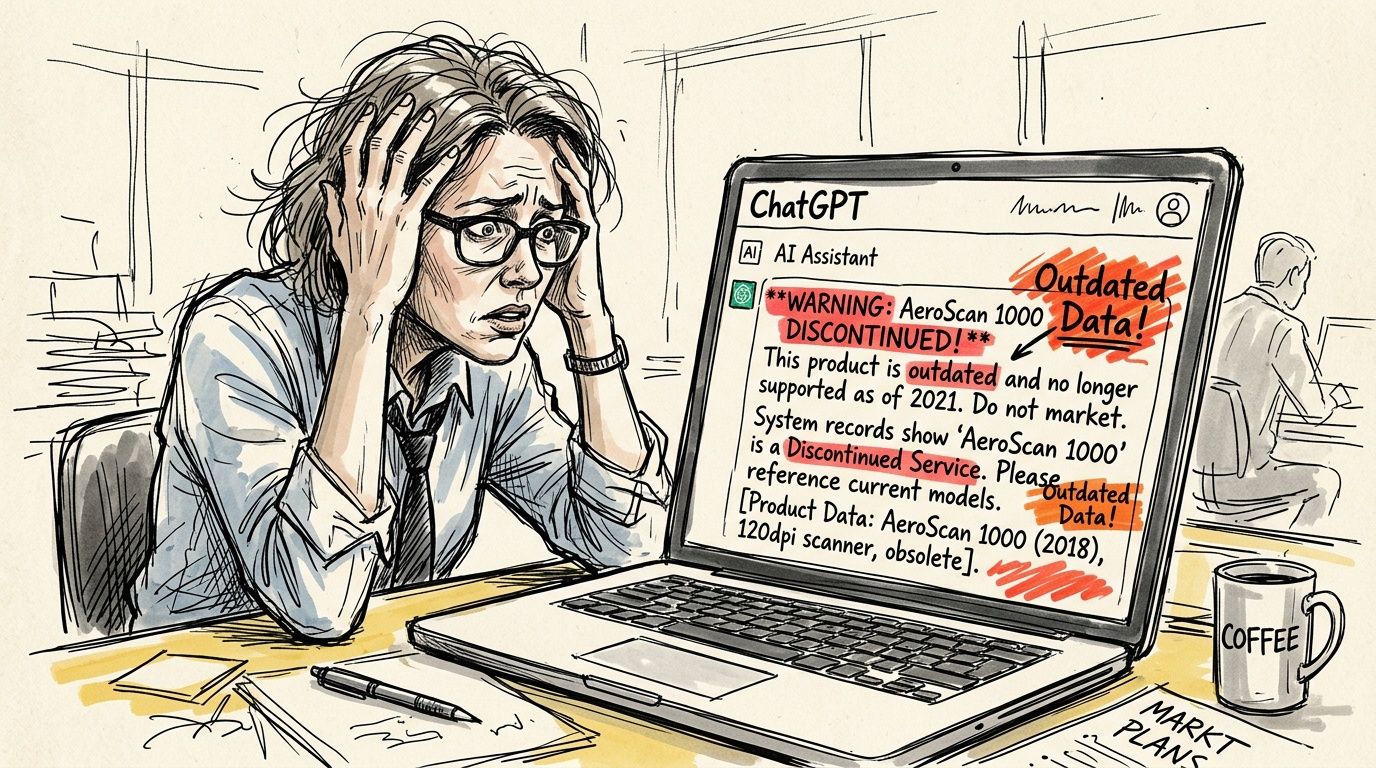
A lot of marketing teams run into the same unsettling moment. Someone asks ChatGPT about their company’s newest product line, pricing, leadership, or category position, and the answer sounds polished but stale. It mentions a discontinued offer, misses a recent launch, or frames a competitor as if nothing changed in the last year.
That’s not a minor content issue. It’s a brand governance issue.
The phrase chatgpt knowledge cutoff date gets treated like a trivia fact, as if the only thing that matters is memorizing one date per model. In practice, that view is too simple. A core issue is that ChatGPT can behave inconsistently across prompts, sessions, and tool use. Sometimes it relies on static training knowledge. Sometimes it pulls in fresher information through browsing. Sometimes it even reports conflicting cutoff dates when asked directly. For brand, SEO, PR, and product marketing teams, that unpredictability is the operational risk.
Why Your Brand Appears Outdated in AI Search
A common scenario looks like this. A marketer tests ChatGPT with a simple prompt about their own brand. The answer comes back with old messaging, outdated product details, or a legacy service that was retired months ago. Then they ask again with slightly different wording and get a better answer.
That inconsistency is the problem.
Why this happens
A knowledge cutoff date is the point after which a model’s training data no longer includes new information. Think of it as the publication date on a printed reference set. If your company changed its name, launched a new feature, replaced an executive team, or updated pricing after that point, the model may not know that from training alone.
But marketers get tripped up because ChatGPT doesn’t always behave like a static reference book.
One documented example showed that ChatGPT 4o reported conflicting cutoff dates, changing from October 2023 to June 2023 within days, and still answering questions about events beyond both stated dates, according to this analysis of ChatGPT cutoff instability. That means the issue isn’t just stale training. It’s also unreliable self-reporting.
Practical rule: Don’t treat the model’s answer about its own limits as ground truth. Test what it actually says about your brand in live prompts.
What brand leaders usually miss
Many teams still evaluate AI visibility as if it were classic SEO. They check a few prompts, save screenshots, and assume they understand the situation. That approach misses how variable LLM output can be.
Three things usually sit behind an outdated brand mention:
- Static training knowledge: The model leans on older information baked into training.
- Prompt sensitivity: A slight wording change can trigger a different answer path.
- Retrieval behavior: The model may or may not pull current web content into the response.
That’s why one-off checks are weak diagnostics. If you only spot check, you won’t know whether your brand is consistently underrepresented or whether the model had one bad turn.
Teams working on structured AI discoverability should also pay attention to machine-readable content signals such as LLMs.txt implementation guidance, because the way systems interpret brand information increasingly depends on source accessibility and clarity, not just ranking position.
Understanding the AI Knowledge Cutoff
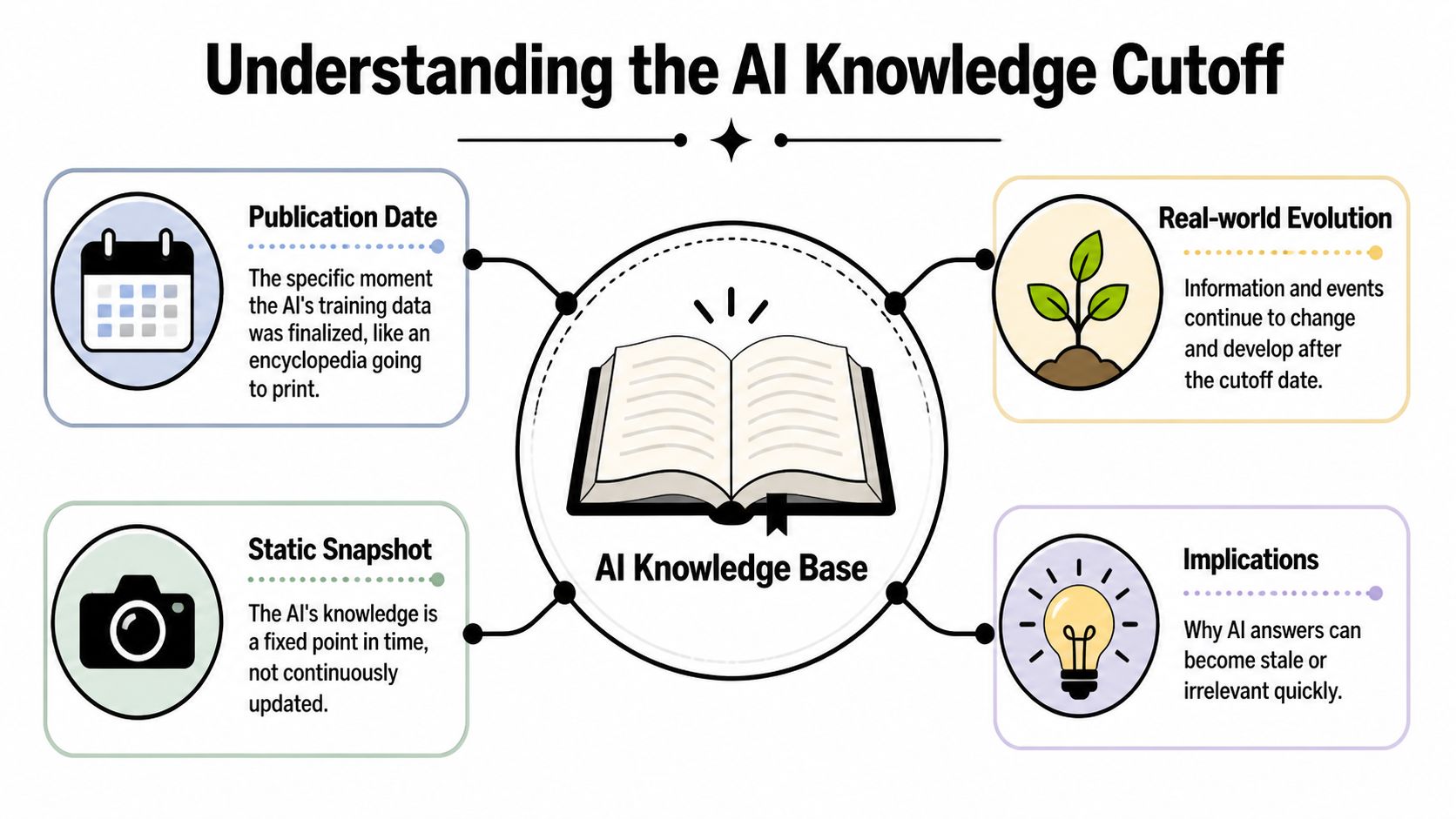
The easiest way to understand the chatgpt knowledge cutoff date is to compare it to a printed encyclopedia. Editors stop accepting new entries on a certain day. The book goes to print. From that moment on, the world keeps changing, but the book doesn’t.
That’s how model training works at a high level. The model absorbs a massive corpus of text up to a boundary, then gets released later. The result is a built-in lag between what the model knows natively and what’s happening now.
The cutoff is not the release date
Many teams make bad assumptions. A newly released model can still be months behind on native knowledge.
One review of OpenAI model timing describes a 6 to 18 month gap between knowledge cutoff and deployment, and notes that GPT-5.4, released March 5, 2026, carries an August 31, 2025 cutoff. The same source also states that 95%+ of factual recall depends on pre-cutoff data, which is why the cutoff remains a primary constraint for real-time reliability in marketing use cases, as outlined in this discussion of ChatGPT knowledge cutoff lag.
That changes how you should interpret model freshness. The label on the model picker tells you less than is commonly assumed.
For a broader strategic view of how AI interfaces are changing discovery behavior, it helps to read this guide to the LLM search engine landscape.
Why answers can still look current
ChatGPT may still answer newer questions accurately if browsing or retrieval is active. That’s why users often see mixed behavior. A model can be outdated in its native memory but current in a given response because it fetched live information.
That creates two separate systems inside one user experience:
| Mode | What powers the answer | Main risk |
|---|---|---|
| Static recall | Training data before cutoff | Old brand facts |
| Browsing-assisted response | Retrieved web sources | Uneven source selection |
Here’s the practical implication. If your site, newsroom, product pages, comparison content, and third-party mentions are weak, browsing won’t save you. Retrieval can only surface what’s available, crawlable, and persuasive.
A short explainer helps if you need to align non-technical stakeholders before changing your workflow.
Browsing doesn’t erase the cutoff. It layers retrieval on top of it.
What works and what doesn’t
What works is separating native model knowledge from retrieved web knowledge in your analysis. What doesn’t work is asking, “What’s ChatGPT’s cutoff date?” and assuming that one answer tells you how the system will represent your brand tomorrow.
If you manage launches, category education, or executive reputation, this distinction matters. A model’s training memory may still lean on old narratives even when a live search can access newer ones.
A Map of ChatGPT Knowledge Cutoff Dates
If you need a working reference, the useful question isn’t “What’s the one chatgpt knowledge cutoff date?” It’s “Which model is in play, and how far behind was it at release?”
OpenAI’s model lineage shows rapid movement in cutoff boundaries, but also a recurring lag between training and launch. One compiled review notes that GPT-5.4, GPT-5.3, and GPT-5.2 all share an August 31, 2025 training boundary, while older models such as GPT-3.5 Turbo were trained through September 1, 2021, as summarized in this list of large language model cutoff dates.
OpenAI model knowledge cutoff dates as of 2026
| Model Version | Knowledge Cutoff Date | Release Date |
|---|---|---|
| GPT-3.5 Turbo | September 1, 2021 | January 24, 2024 |
| GPT-4 | September 2021 | Not listed here |
| GPT-4 Turbo | December 2023 | Not listed here |
| GPT-4o | October 2023 | Not listed here |
| GPT-4o-mini | June 1, 2024 | April 16, 2025 |
| o4-mini | June 2024 training data | April 16, 2025 |
| GPT-5.2 | August 31, 2025 | December 11, 2025 |
| GPT-5.3 Instant | August 31, 2025 | March 3, 2026 |
| GPT-5.4 | August 31, 2025 | March 5, 2026 |
How to read this table
Don’t use it as a promise of what the model will or won’t say. Use it as a risk map.
A few patterns matter:
- Older models can anchor old narratives: If a system relies mostly on training, your pre-cutoff brand footprint carries unusual weight.
- Newer releases still launch with stale memory: A current release can still miss recent category shifts.
- Tool access changes outcomes: The same family of models can produce different answers depending on whether browsing is triggered.
The strategic takeaway
If your team asks, “Will ChatGPT know about our latest launch?” the honest answer is: maybe, depending on the model, the interface, the prompt, and whether retrieval activates.
That’s why static date lists help only at the planning layer. They’re useful for setting expectations, but they don’t replace live testing. For launch planning, PR response, and category page strategy, treat cutoff dates as directional context, not final truth.
The Business Risks of Stale AI Answers
Stale AI output creates business problems long before anyone notices a technical one. A buyer doesn’t care whether an answer came from training memory or browsing. They only see whether the answer sounds trustworthy.
When ChatGPT leans on outdated information, the damage usually shows up in three places: factual accuracy, reputation framing, and competitive comparison.
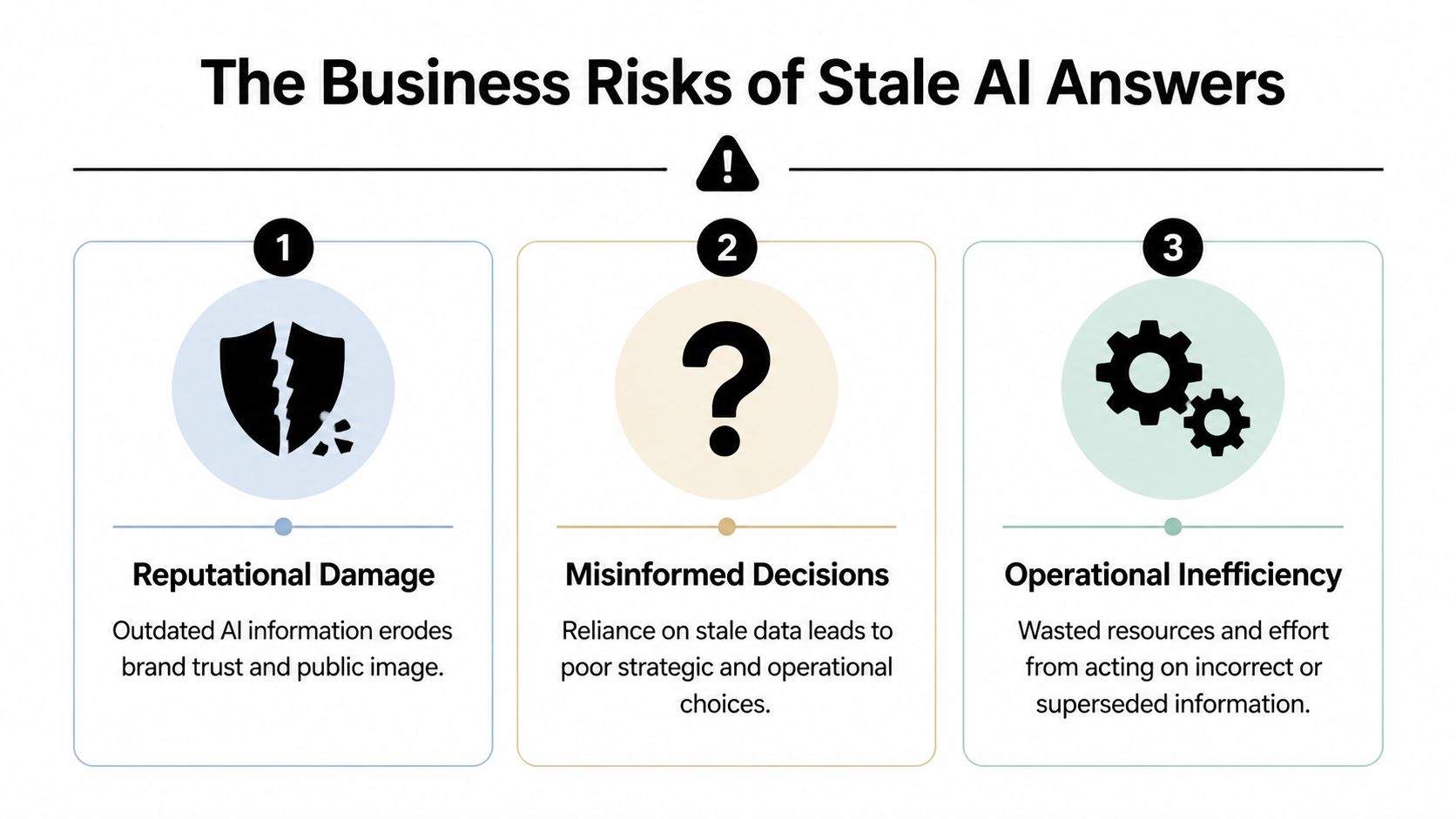
Risk one is bad factual representation
If the model relies on stale memory, it may cite old pricing logic, retired products, outdated use cases, or previous leadership. The issue gets worse when teams assume fluent language means current knowledge.
The GPT-4o model maintains a fixed knowledge cutoff of October 2023 without external tools, and that limitation introduces risks including hallucinations, information gaps, and temporal bias, according to this explanation of AI knowledge cutoff behavior. That’s not abstract. It affects category pages, analyst-style summaries, buying comparisons, and support-related prompts.
Risk two is reputation drag
Reputation in AI systems isn’t just about what’s true. It’s about which facts get selected.
If a model knows about an old controversy but not your more recent remediation, awards, positioning shift, or product maturity, the answer can skew negative without explicitly being wrong. Brand teams often discover this too late because they test broad prompts instead of the exact language prospects use.
A stale answer can still be internally consistent. That’s what makes it persuasive.
Risk three is competitive disadvantage
At this point, the issue becomes operational. If your competitor published cleaner explainer content, earned better press coverage, or structured their site so retrieval systems can parse it more easily, they may appear current while you appear frozen.
That creates an uneven comparison in prompts like:
- Best vendors in a category
- Alternatives to a known competitor
- Enterprise tool comparisons
- “Who is leading in…” discovery questions
The practical impact is straightforward. The model doesn’t have to rank you badly in the traditional SEO sense to hurt you. It just has to describe your rival in sharper, more current language than it uses for you.
Why teams miss the warning signs
Most companies still rely on episodic checks from brand, SEO, or PR. That approach fails because AI representation is not static. One prompt can look healthy while another exposes a serious positioning gap.
A better internal review process checks for variation across:
| Check type | What to inspect |
|---|---|
| Brand prompt | Does the model describe your current offer accurately? |
| Comparison prompt | Does it favor a competitor with fresher framing? |
| Executive prompt | Does it surface outdated leadership or old narratives? |
| Product prompt | Does it mention retired features or miss new ones? |
If you don’t test all four, you can easily miss where stale AI answers are undermining trust.
Actionable Strategies to Manage Cutoff Risks
Teams typically cannot control model training cycles. They can control how visible, legible, and current their information is across the web. That’s the workable side of this problem.
The key is to stop looking for a single fix. There isn’t one. Managing cutoff risk takes a stack of practices, with monitoring at the base.
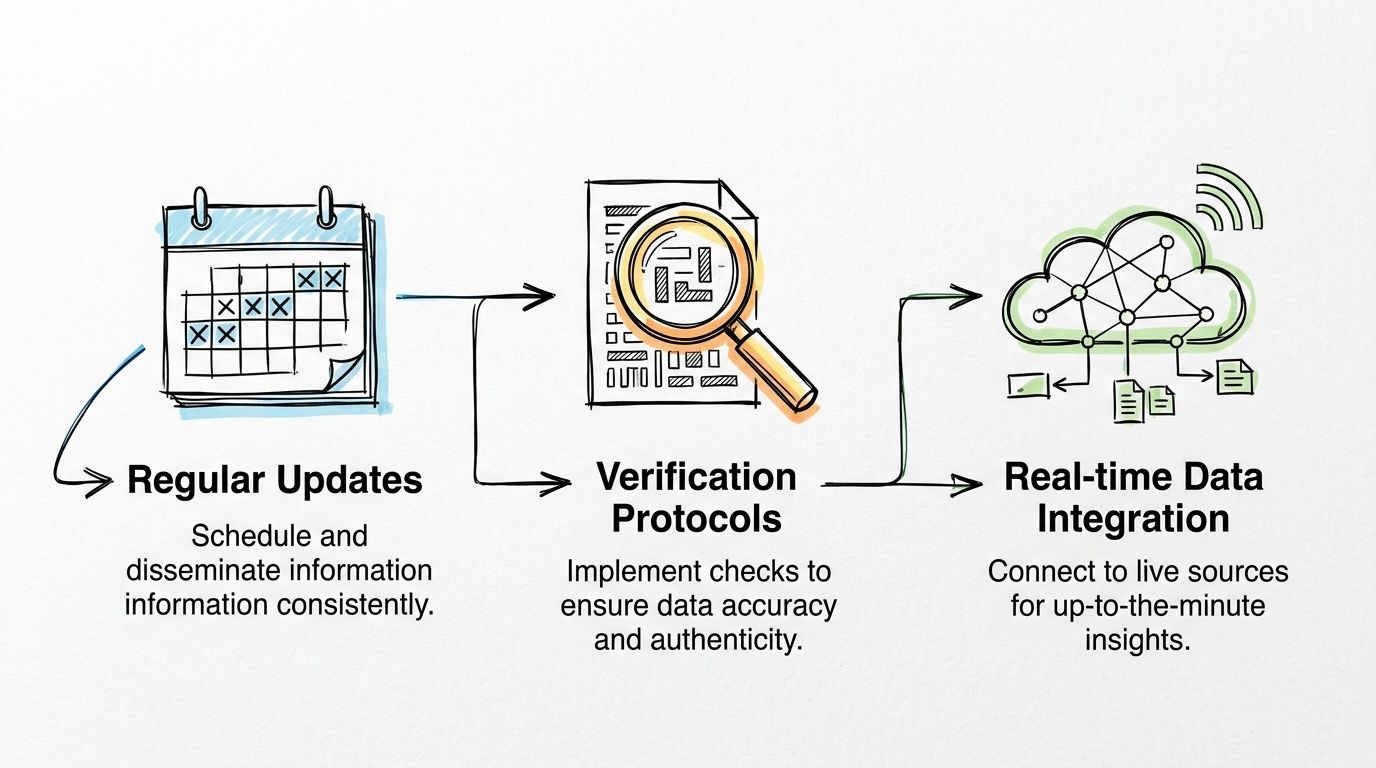
Start with external observation, not model self-reporting
ChatGPT models don’t have explicit metadata fields for cutoff dates, which is why they can claim an October 2023 cutoff and still show awareness of November 2023 events. That transparency gap means brands can’t rely on the model’s self-description and need continuous outside monitoring to understand practical knowledge range, as described in this analysis of why ChatGPT gets cutoff dates wrong.
That should change how your team works. Don’t start with “What does the model say its cutoff is?” Start with “What does the model currently say about us, our category, and our competitors?”
Teams comparing platforms for this work should look at dedicated LLM monitoring tools rather than relying on ad hoc screenshots and spreadsheets.
Use prompts that force freshness checks
Prompting can help, but only if you use it intentionally. Vague prompts often trigger generic recall. Specific prompts are more likely to produce current, source-grounded responses.
Useful patterns include:
- Ask for browsing explicitly: Request that the model use web search or current sources.
- Anchor to a recent event: Reference a launch, release, or announcement and ask for current context.
- Request source-aware verification: Ask which pages or documents support the answer.
What doesn’t work is asking broad vanity prompts like “Tell me about Company X” and assuming the answer reflects your real AI visibility.
Improve the source layer the model can retrieve
If browsing is active, the quality of your source ecosystem matters. Marketing teams usually need to tighten a few basics:
- Product pages: Current naming, positioning, and differentiation need to be unambiguous.
- Press and newsroom content: Major announcements should be easy to crawl and understand.
- Comparison and alternative pages: If competitors frame the category better than you do, retrieval systems may borrow their language.
- Third-party references: Listings, profiles, interviews, and earned media often shape brand summaries.
Field note: Models often sound most confident when repeating the clearest available phrasing, not the most official phrasing.
Know when to use RAG
If you’re building your own AI layer for sales enablement, support, or internal knowledge, retrieval-augmented generation is often the right answer. It gives the model access to approved, current sources instead of depending on stale background knowledge.
For external AI search visibility, though, you don’t get to install RAG inside ChatGPT. Your equivalent move is to improve the source environment that public-facing systems can access.
Building an AI Search Visibility Workflow
The most effective teams treat AI visibility as an operating rhythm, not a one-time audit. That means content, PR, product marketing, and SEO need one shared workflow for how they inspect, fix, and recheck model output.
A workable process has four parts.
Benchmark your current representation
Start by documenting how major AI systems describe your brand across a stable set of prompts. Include branded prompts, competitor comparisons, category prompts, executive prompts, and product-specific prompts.
This baseline matters because AI visibility can drift subtly. Without a benchmark, teams argue from anecdotes. With one, they can spot patterns in wording, omissions, and source dependence.
If you’re designing prompt libraries and reporting around this work, an AI visibility platform evaluation guide can help frame what to track beyond simple mention counts.
Find the gaps that matter commercially
Not every AI error deserves action. Prioritize the gaps that affect pipeline, trust, or category positioning.
A practical review usually sorts findings into three buckets:
- High risk: Wrong product facts, wrong category placement, or negative framing in commercial prompts
- Medium risk: Missing differentiation, vague descriptions, weak leadership or use-case coverage
- Low risk: Minor wording issues that don’t change buying perception
Many teams improve speed when they stop trying to “fix AI” in general and focus on the prompts that shape buyer decisions.
Target the sources behind the answer
Once you know where the model is getting your story wrong, work backward to the source layer. Update owned pages. Strengthen supporting content. Improve comparison pages. Refresh executive bios. Add clear launch summaries. Coordinate with PR on high-authority mentions that reinforce your current positioning.
Structured content helps here too. If your team is revisiting how information is packaged for search systems, this resource on a comprehensive FAQ schema strategy is useful because it sharpens how recurring buyer questions get expressed in machine-readable form.
Treat every recurring AI misconception as a source problem before you treat it as a prompt problem.
Monitor, refine, and repeat
This is the part that separates disciplined teams from everyone else. After updates go live, keep checking whether model language changes. Watch for improvements in branded prompts, comparison prompts, and category prompts. Keep an eye on competitors too, because their source environment changes your results.
The workflow is cyclical:
| Step | Team question |
|---|---|
| Benchmark | How are models describing us now? |
| Diagnose | Where are we missing, stale, or losing to competitors? |
| Influence | Which sources need to change? |
| Recheck | Did output improve after content and PR updates? |
When teams adopt this rhythm, the chatgpt knowledge cutoff date becomes less of a mystery and more of a planning constraint. You stop asking for one definitive date and start managing the live conditions that shape AI answers.
If your team needs a practical way to track how ChatGPT and other models present your brand, promptposition gives marketing, SEO, and PR teams a measurable view of AI visibility, sentiment, competitor positioning, verbatim answers, and the sources behind them. That makes it easier to catch stale narratives early, prioritize fixes, and improve how your company appears before buyers see the wrong story.