Answer Engine Optimization Services: Master AI Search In
You open ChatGPT, Gemini, or Perplexity and ask a simple question about your company. The answer is mostly right, but not right enough. It describes your category the way a competitor would. It cites an old article. It skips the product line you want buyers to know. Worse, your sales team has already heard the same framing on calls.
That's the moment most marketing leaders realize search has changed. You're no longer optimizing only for a click. You're optimizing for the version of your brand that an AI retells when a prospect asks for advice, comparisons, or recommendations.
Your Brand Story Told by an AI
A familiar pattern is playing out in marketing teams right now. Search visibility still matters, but the first thing many buyers see is no longer a list of links. It's a synthesized answer. If that answer is incomplete, stale, or pulled from the wrong sources, your brand loses ground before the visit even happens.

The shift is big enough that it needs a new operating model. According to MarketingProfs on AEO vs SEO in zero-click search, only 36% of U.S. searches in 2024 resulted in a click to the open web, while 64% stayed inside Google's ecosystem. That's why answer engine optimization services moved from niche curiosity to active budget line. Visibility can happen without traffic, and influence can happen before a session is ever recorded in analytics.
Where the risk shows up first
The problem usually appears in one of three places:
- Brand definition drift. AI tools describe your company using outdated positioning, generic category language, or third-party summaries you didn't shape.
- Competitor-led framing. A rival publishes clearer comparison pages, better FAQs, or stronger thought leadership, and the models borrow their language.
- Answer surface blindness. Your team still measures ranks and sessions, while buyers are consuming summaries, snippets, and citations that never produce a click.
If you're building internal AI literacy, practical roundups like best AI tools for small UK businesses can help teams understand how quickly user behavior is changing beyond classic search.
Why traditional SEO isn't enough on its own
SEO still matters. Technical health, crawlability, authority, and relevance still feed discoverability. But answer engines add another layer. They need content that can be extracted, summarized, and trusted.
Practical rule: If your best page hides the answer in paragraph six, an AI system may never use it the way you intended.
That's where newer assets such as LLMs.txt guidance become part of the conversation. They reflect a broader shift. Marketers aren't just trying to rank pages anymore. They're trying to make their source material easier for AI systems to interpret accurately.
What Exactly Are Answer Engine Optimization Services
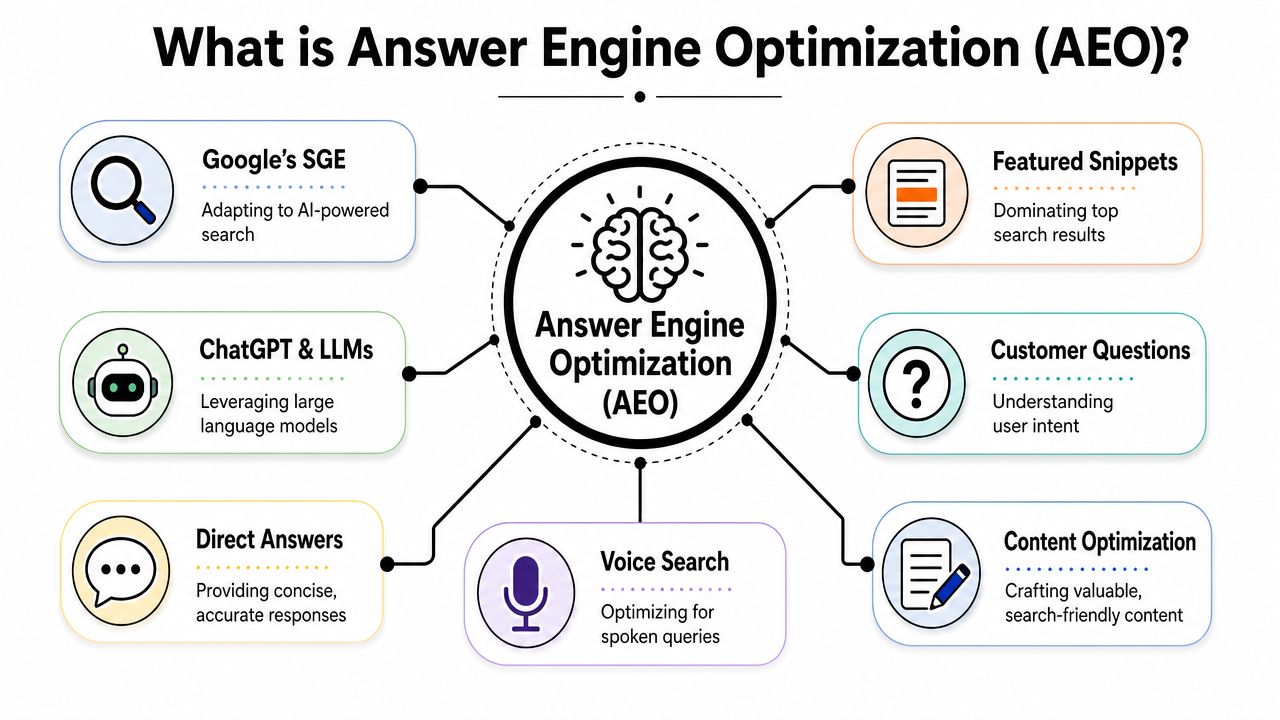
Answer engine optimization services are the mix of strategy, content, technical implementation, and monitoring used to help your brand appear accurately inside AI-generated answers.
The simplest way to explain it is this. SEO gets you invited to the party. AEO helps make sure the host quotes you in the toast.
What you're actually buying
A good AEO engagement is not “SEO with AI added to the proposal.” It's work designed around a different outcome. The goal is to increase the chance that systems such as ChatGPT, Perplexity, Gemini, Microsoft Copilot, and Google AI Overviews use your content, your facts, and your framing when they generate answers.
That changes the service model. Instead of asking only, “Can we rank this page?” teams also ask:
- Can an answer engine extract the core point fast
- Does the content clearly state who we are and what we do
- Are our claims easy to attribute to a trusted source
- Will the model repeat the wording we want associated with the brand
A practical explainer on optimizing for AI Overviews is useful here because it shows how search presentation is becoming more answer-led and less click-led.
Where AEO sits in the stack
AEO doesn't replace SEO, PR, content strategy, or brand messaging. It forces them to work together.
In practice, answer engine optimization services usually sit across four working areas:
| Area | What changes under AEO |
|---|---|
| Content | Pages answer questions directly, early, and cleanly |
| Technical SEO | Structured signals help machines classify the page |
| Brand messaging | Category language gets tightened so AI retells it correctly |
| Measurement | Teams track answer visibility, citations, and message accuracy |
Most teams don't need more content volume first. They need clearer source material.
The trade-off is real. If you write only for machines, the content becomes flat and forgettable. If you write only for people, the answer can become too indirect for extraction. Strong AEO work keeps both audiences in view.
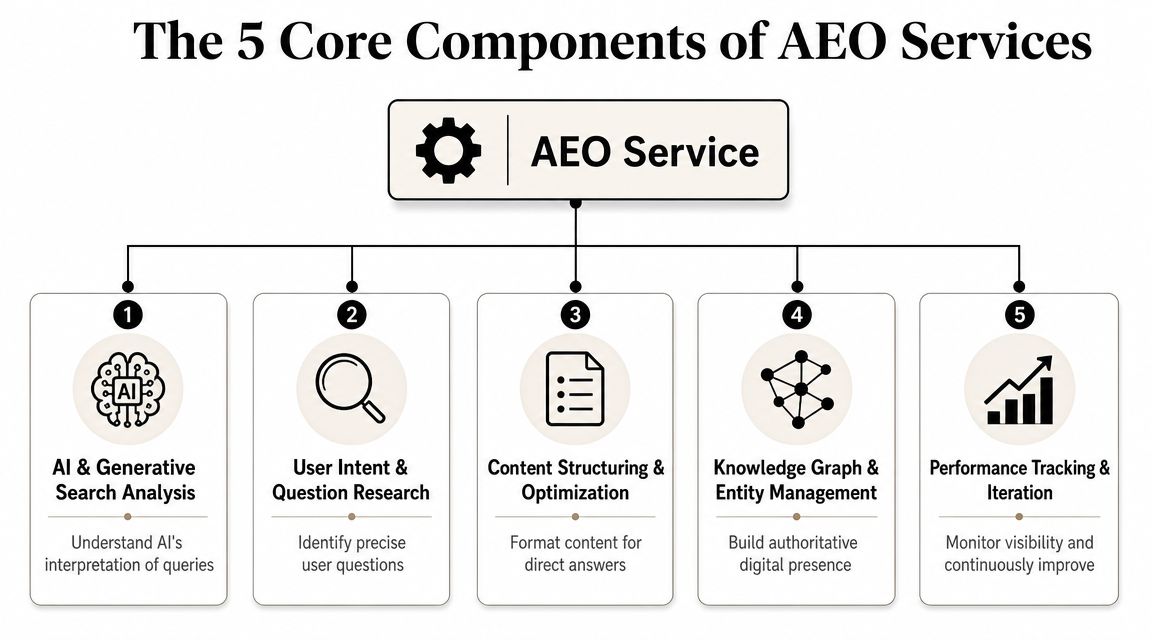
The Five Core Components of an AEO Service
When a provider sells answer engine optimization services, you should be able to point to the actual work. If the proposal sounds abstract, the program usually drifts into generic SEO tasks plus a few AI buzzwords.
Content optimization for machine comprehension
This is the foundation. The team rewrites or creates pages so the primary answer appears early, supporting detail follows logically, and key claims are easy to isolate.
That usually means cleaner headings, tighter definitions, FAQ sections that answer real sales questions, comparison formats, and less brand theater. “Transform your workflow” doesn't travel well into AI responses. Specific explanations do.
A useful companion topic is AI-powered content SEO, because it highlights the same underlying reality. Content has to perform both as a persuasive asset and as extractable source material.
Prompt and FAQ engineering
AEO providers should research the prompts buyers use. Not just keywords. Actual question formats.
The strongest programs pull from sales calls, support logs, internal search, competitor comparisons, review language, and category misconceptions. Then they build pages and sections that answer those prompts directly.
Three prompt families tend to matter most:
- Definition prompts such as what a category means or how a solution works
- Comparison prompts such as “X vs Y” or “best tools for”
- Decision prompts such as implementation, pricing model, fit, risks, and alternatives
Citation and source shaping
If answer engines don't trust or encounter your material, they won't lean on it. This part of the work is often under-scoped.
Source shaping includes improving publishable thought leadership, strengthening category pages, earning mentions in relevant publications, cleaning up inconsistent brand descriptions, and making sure the most cite-worthy pages are the ones that represent your current strategy. It also means removing weak pages that confuse your entity footprint.
AEO often fails because brands publish answers in the wrong places. The model can only reuse what it can reliably find and interpret.
Structured data and knowledge graph work
This is where technical discipline matters. According to Marcel Digital on answer engine optimization, answer engines favor content built as a machine-readable knowledge source, using direct answers, clear entity relationships, and schema markup. The practical implication is straightforward. Schema types such as FAQPage, Article, Product, Organization, or HowTo help systems classify a page, identify answer spans, and improve the odds of citation in AI-generated responses.
That's one reason serious teams review not just page copy, but page intent and markup together. A page can be well written and still be harder than necessary for a model to parse.
For content teams adjusting editorial workflows, AI-driven content optimization is part of the same shift toward building cleaner, more reusable source pages.
Monitoring and measurement
This is the component many agencies still underplay. You can't improve what you don't observe.
At minimum, teams should monitor:
- Where the brand appears across major answer engines
- How the brand is described
- Which sources are cited
- Which competitors are repeatedly surfaced
- Which prompts produce inaccurate or weak answers
Without that layer, optimization turns into hopeful publishing. With it, teams can prioritize which pages, claims, and source relationships need work first.
How to Measure AEO Success with New KPIs
The old SEO scoreboard is still useful, but it's incomplete. Rankings, clicks, and sessions tell you what happened on the website. They do not fully tell you what happened in the answer layer before the visit.
That matters because the audience is already there. According to CXL's guide to answer engine optimization, ChatGPT serves 800 million users weekly, zero-click Google searches rose from 56% in 2024 to 69% in 2025, 72% of B2B buyers see Google AI Overviews, and 89% of B2B buyers use at least one Google product during their research process. For marketing leaders, that means AEO measurement isn't an experiment. It's how you track visibility in research moments that increasingly happen before the click.
The KPI shift
Here's the comparison that helps teams reset expectations.
| Metric Focus | Traditional SEO KPIs | Answer Engine Optimization (AEO) KPIs |
|---|---|---|
| Discovery | Keyword rankings | Visibility share across AI answers |
| Traffic | Organic sessions, CTR | Answer presence even without clicks |
| Authority | Backlinks, page authority | Citation frequency in generated responses |
| Brand perception | Indirect, often post-click | Sentiment score and message accuracy |
| Competition | SERP position | Share of mentions against named rivals |
The KPIs that actually help
The useful AEO KPIs are less glamorous than traffic charts, but they're closer to the business question.
- Visibility share tracks how often your brand appears for a defined set of prompts.
- Citation frequency tracks how often your owned or earned sources get referenced.
- Message accuracy tracks whether the answer uses the positioning your team wants repeated.
- Sentiment score tracks whether the answer frames your company positively, neutrally, or negatively.
AEO work gets sharper when teams review these KPIs by prompt cluster. “What is it,” “who is it for,” “best options,” and “alternatives” rarely behave the same way.
What not to do
Don't force AEO into a pure traffic ROI model in the first month. That leads teams to ignore the value of being cited, named, or framed correctly in zero-click environments.
If an AI answer recommends your category, explains your differentiator correctly, and places you in the shortlist, that has strategic value even when analytics can't tie it to a single session.
For teams building a measurement layer around these questions, AI visibility tracking is the right frame. The goal is to make brand representation inside answer engines observable enough to manage.
A Buyer's Checklist for Evaluating AEO Services
Most buyers don't need another visionary pitch. They need to know whether a provider can do the work, report it clearly, and adapt when models change.
Questions that reveal competence
Start with methodology. Ask the provider to walk through how they handle prompt research, content restructuring, citation building, structured data, and monitoring. If they can't explain those pieces plainly, they probably don't have a repeatable process.
Then look at the team shape. Good AEO work usually needs a mix of technical SEO, editorial strategy, brand messaging, and analytics. If the provider leans too far toward one discipline, you'll feel the gaps fast. Technical-only teams often underdeliver on message control. Content-only teams often miss extractability and source structure.
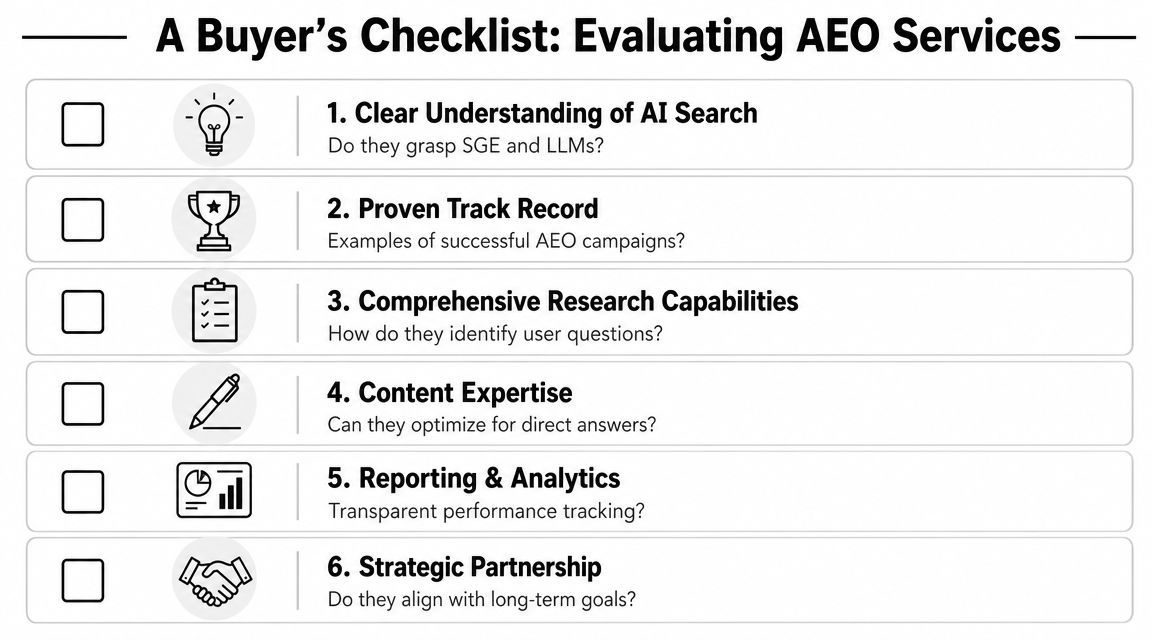
A practical buyer checklist
Use this short list in procurement or agency review calls.
- Ask for workflow detail. What happens in the first month, and what changes on the site, in content, and in reporting?
- Ask how they choose prompts. If the answer is “keyword tools,” keep pushing. You want buyer questions, comparison prompts, and category framing prompts.
- Ask how they validate sources. Providers should care which pages, articles, listings, and publications AI systems seem to rely on.
- Ask what gets measured. If reporting stops at rankings and traffic, the service is probably rebranded SEO.
- Ask who owns implementation. Recommendations without execution support tend to stall.
- Ask how they handle brand inaccuracies. You want a clear process for correcting recurring misrepresentation.
Signs the service is mature
Mature providers usually show you examples of prompt sets, answer audits, source analysis, content rewrites, and executive reporting. They can describe trade-offs. For example, a homepage may be important for brand definition, but a detailed glossary or comparison page may be more likely to shape an answer for specific prompts.
They should also be comfortable discussing monitoring platforms, because AEO without tracking is mostly opinion. If you're comparing specialist partners, what to look for in an AI SEO agency is a useful benchmark for the capabilities a modern provider should bring.
The strongest AEO partner won't promise universal control. They'll show you where influence is realistic, where evidence is thin, and how they'll iterate.
How promptposition Powers Your AEO Strategy
AEO becomes manageable when the work moves out of ad hoc screenshots and into a repeatable operating system.

The practical workflow starts with visibility. You need to know how major models describe your company, where you appear, where you don't, and whether competitors are shaping the answer more effectively than you are. That gives the team a current-state view, not a guessed one.
From observation to action
The next step is source analysis. Once you can see the wording models use and the sources behind those answers, the work becomes much more specific. You can identify which articles, listings, product pages, comparison pages, or third-party mentions are reinforcing the wrong message and which owned assets deserve expansion.
That changes how content and PR teams prioritize. Instead of publishing broadly, they can focus on pages that answer repeated prompts, clean up entity confusion, and strengthen source quality around the topics that matter most.
How the loop closes
AEO programs improve when they run as a loop:
- Audit current answers across the models that matter to your buyers.
- Review sources and wording to find gaps, inaccuracies, and competitor advantages.
- Update content and source strategy so the brand's preferred framing is easier to extract and cite.
- Track the change over time using visibility, sentiment, citations, and positioning trends.
That's where promptposition fits best. It gives marketing and brand teams a way to monitor AI visibility as an ongoing function, not an occasional spot check. Instead of debating whether AI search matters, the team can see how the brand is presented and decide what to fix next.
Common Questions About Answer Engine Optimization
Is AEO just another name for SEO
No. SEO is still focused on discoverability in search results and website traffic. AEO is focused on whether your brand and content are selected, cited, or reflected inside generated answers. The two overlap, but they don't solve the same problem.
How long does AEO take to show results
Some changes can influence answer quality quickly, especially when the issue is obvious and the source content is weak or outdated. Broader gains usually take sustained work because you're improving how multiple systems interpret your brand over time. It's better to treat AEO like an operating discipline than a one-off campaign.
Is AEO only for large companies
No. Smaller teams often do well when they have sharper expertise and cleaner content. Large brands usually have more authority but also more messaging sprawl, old pages, and inconsistent brand descriptions across the web.
Which pages should be optimized first
Start with pages that define the category, explain the product clearly, answer common objections, and handle comparisons. If a sales rep answers the same question every week, that topic should usually exist in a form that answer engines can use.
Will AEO reduce the value of website traffic
It changes how you value visibility. Some influence will happen before the click. That doesn't make traffic less valuable. It means your brand needs to win in both places: in the answer itself and on the site after the visit.
If your team wants a clearer view of how AI platforms present your brand, promptposition gives you the measurement layer most AEO programs are missing. You can track visibility, sentiment, positioning, competitor presence, and the exact sources shaping model outputs, then turn that insight into content and brand actions that improve how AI tells your story.