Competition Tracking Software: A Complete 2026 Guide
You're probably already tracking competitors. Someone on the team checks ranking reports. Someone else watches LinkedIn launches, pricing pages, review sites, or ad libraries. Sales drops notes into Slack when a rival comes up in calls. It feels like coverage.
Then a prospect asks ChatGPT for the top vendors in your category, and the answer frames your company in a way your team has never seen. Or a competitor changes its positioning, and your campaign starts sounding stale before anyone notices. The problem isn't lack of effort. It's that competitive signals now move across too many surfaces for manual tracking to keep up.
Competition tracking software exists to solve that gap. At its simplest, it's software that continuously monitors rival activity and turns scattered signals into something a marketing, PR, SEO, or product team can use. In 2026, that job goes far beyond keyword rankings and website alerts. It includes messaging shifts, sentiment changes, source patterns, and how AI systems describe your brand versus everyone else in the market.
Why Your Competitors' Blind Spots Are Your Biggest Opportunity
It's common for teams to use competitor analysis as defense. They notice a campaign after it launches. They react to a pricing page after sales flags it. They update a battlecard after deals start slipping.
The smarter use is offense. Good competition tracking software helps you see what rivals are missing, where buyers are confused, and which channels are shaping your category before your team has fully recognized them.

That matters because this category is no longer niche. 90% of Fortune 500 companies utilize competitive intelligence tools, including competition tracking software, to secure a competitive advantage in their markets, according to Evalueserve's competitive intelligence statistics roundup. Enterprise teams aren't treating this as optional research anymore. They're treating it as operating infrastructure.
What changed
Traditional SEO tools still matter. So do social listening tools, review monitoring tools, and ad libraries. But each one shows only part of the picture.
Today's market signals spread across places like:
- Search results where competitors win attention before buyers ever visit your site
- Review platforms where positioning gets reinforced by customer language
- Social channels where launches and narratives move fast
- Sales conversations where objections reveal what buyers are hearing elsewhere
- AI answer engines where brands appear inside synthesized responses, not just blue links
That last category is where many teams still have a blind spot.
Practical rule: If buyers can form an opinion about your brand without visiting your website, you need a way to track that environment.
Competition tracking software is the system that connects these signals. It watches changes, groups them, prioritizes them, and routes them to people who can act. Instead of asking, “What happened?” after the fact, teams start asking, “What are we seeing early enough to use?”
For teams building a stronger process around this, competitive intelligence best practices for modern marketing teams is a useful complement to the software side of the problem.
The Four Pillars of Modern Competition Tracking
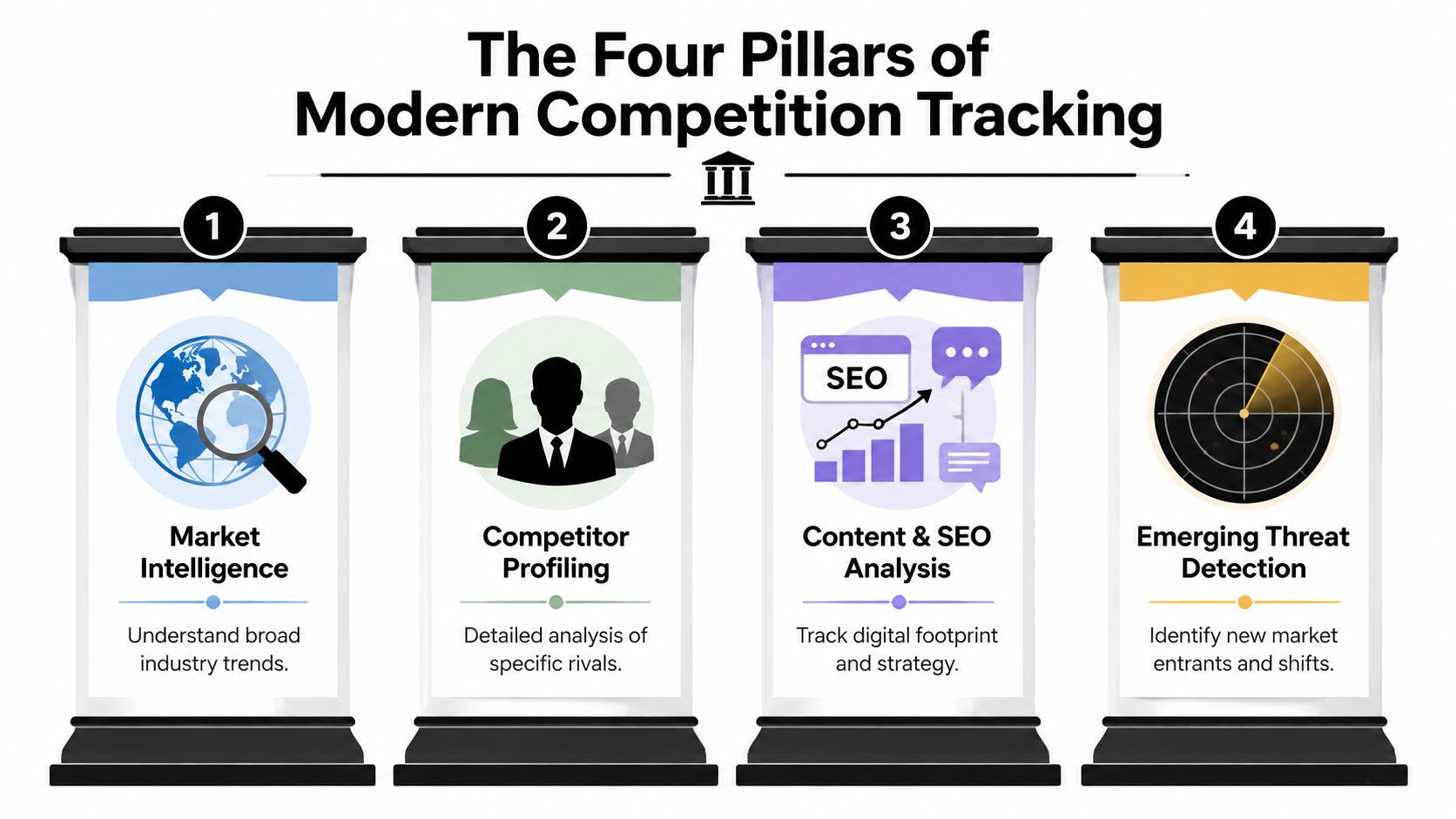
A lot of teams buy competition tracking software and still struggle to use it well because they think in tool features instead of decision categories. The cleaner way to understand the category is through four pillars: visibility, sentiment, positioning, and source attribution.
Visibility
Visibility is the digital version of shelf space.
If a buyer searches Google, scans LinkedIn, reads reviews, or asks an AI assistant for recommendations, how often does your brand appear compared with your competitors? This is the first question competition tracking software should answer.
In classic SEO, visibility means rankings, featured snippets, backlinks, and keyword coverage. In broader monitoring, it includes ad presence, media mentions, social reach, and review-site prominence. In AI search, it also means whether your brand appears in generated answers for important prompts.
A simple example: your team may rank well for branded keywords but barely appear when buyers ask broad category questions in AI tools. Traditional dashboards can miss that entirely.
Sentiment
Visibility alone can mislead.
A competitor can be mentioned often but in the wrong context. Your brand can appear in plenty of places but be described as expensive, limited, risky, or outdated. That's why the second pillar is sentiment.
Think of sentiment as tone plus implication. Not just whether the mention is positive or negative, but what emotional and practical message a buyer is likely to absorb.
Here's where teams often get confused. Sentiment isn't only a social listening concept. It also matters in:
- Review analysis, where recurring complaints shape category expectations
- PR coverage, where wording influences trust
- Sales call summaries, where buyer objections expose reputation patterns
- AI-generated responses, where models may place your brand next to flattering or unfavorable descriptors
A mention isn't a win if the language pushes the buyer toward someone else.
Positioning
Positioning is how the market explains you when you're not in the room.
This pillar looks at the claims, comparisons, and category labels attached to your brand and your rivals. Are you framed as premium? Easier to use? Better for enterprise? Better for startups? More advanced? Safer? More specialized?
Competitors don't just compete for clicks. They compete to define the terms of evaluation.
A useful analogy is election coverage. Visibility tells you who is being talked about. Positioning tells you what story voters hear about each candidate. In software markets, that story shapes shortlists.
Teams often discover a gap here when a rival consistently owns a message you also deserve credit for. The issue may not be product truth. It may be narrative repetition.
For teams comparing broader stacks, marketing intelligence platforms that unify signal collection can help clarify where competition tracking software fits.
Source attribution
Source attribution is the most underrated pillar, especially in AI search.
It answers a practical question. What content, websites, listings, reviews, or documents are driving the narrative? If you don't know that, you can see the outcome but not influence it.
A search ranking report already gives partial attribution through ranking URLs. Modern competition tracking goes further by tracing repeated claims back to likely sources such as:
- Competitor landing pages
- Industry listicles
- Review sites
- Press coverage
- Documentation and help centers
- Directory listings
- Citations inside AI-generated answers
Without source attribution, teams tend to overreact. They rewrite homepage copy when the underlying issue is weak third-party coverage. Or they chase a social narrative that's originating from review content.
The strongest competition tracking software doesn't just tell you that you're behind. It gives you a path to change the inputs.
Strategic Use Cases for Marketing PR and SEO Teams
Teams often don't need another dashboard. They need faster judgment. The value of competition tracking software shows up when a team takes a signal, interprets it, and changes a decision before the market fully moves.

Marketing teams refining message before a campaign slips
A demand gen team is preparing a new campaign for a crowded software category. The old workflow would focus on search volume, competitor ad copy, and recent homepage changes. That's useful, but incomplete.
With competition tracking software, the team can see where rival messages are clustering. Maybe two competitors are leaning hard into speed, while another is owning compliance language. The team notices something more interesting: buyers keep discussing implementation friction in reviews and community posts, but no one is clearly addressing ease of rollout.
That creates a message opening.
Instead of matching what the biggest competitor says, the team shifts the campaign around onboarding clarity, proof of adoption, and lower operational drag. The point isn't to sound louder. It's to sound more relevant.
This is also where adjacent tools help. If your team needs a simple way to track keywords effectively while layering in broader competitor signals, that kind of focused monitoring can complement a wider intelligence setup.
PR teams watching narrative shifts during launch windows
A competitor launches a major product update. Press coverage looks positive at first glance, but your PR team keeps monitoring the second wave. Reviewers and social discussions start repeating a subtle concern: the new feature set feels broad, but confusing.
That's a real opening if your brand stands for clarity.
The PR team doesn't need to attack the launch directly. Instead, they can brief spokespeople, update talking points, and pitch bylined content that emphasizes transparent workflows, customer fit, and practical adoption. They can also monitor whether your brand starts appearing in comparison language as buyers search for alternatives.
Here, competition tracking software acts like an early-warning narrative tool. It shows not just that a competitor is getting attention, but what shape that attention is taking.
Later, when teams want a broader workflow for mentions, reviews, and reputational cues, brand monitoring strategies for online channels fit naturally alongside competitor tracking.
SEO teams building a content moat instead of chasing rankings
An SEO lead notices a rival gaining traction. The old response would be to export keywords, identify gaps, and publish matching pages. That still has value, but it can lead to copycat work.
A stronger approach looks at source patterns and framing. Which pages are repeatedly cited? What questions keep surfacing around the category? Which third-party pages seem to shape recommendation language?
The SEO team then creates content designed to become a source, not just a ranking asset. That might mean deeper comparison pages, glossary content that clarifies category language, or structured pages that answer the exact questions buyers ask in AI tools.
A lot of modern competition tracking software also helps revenue teams connect these signals to outcomes. In AI-driven competition tracking software, aggregating public and internal data can generate deal-specific competitive intelligence, achieving up to a 28% increase in competitive win rates as reported by users, according to Klue's overview of competitor monitoring.
That's worth studying because it changes the role of competitive data. It's no longer just a research asset. It becomes a workflow input for campaigns, PR responses, and content strategy.
A quick walkthrough helps make that real:
Use cases become valuable when the insight changes a brief, a pitch, a page, or a sales conversation within days, not months.
How to Choose the Right Competition Tracking Software
The hardest part of buying competition tracking software usually isn't vendor discovery. It's resisting shiny features that your team won't operationalize.
A platform can look impressive in a demo and still fail in practice if alerts don't fit your workflow, data arrives too late, or nobody trusts the outputs. The right evaluation process is less about “Who has the most features?” and more about “What can our team reliably use every week?”
Start with the workflow, not the vendor list
Before comparing tools, answer three internal questions:
- Who will use it first. Marketing ops, SEO, PR, product marketing, sales enablement, or leadership.
- What decisions it needs to improve. Messaging updates, launch monitoring, campaign planning, review response, or AI search visibility.
- Where outputs need to land. Email, Slack, CRM, BI dashboard, content calendar, or recurring reports.
If you skip this step, you'll probably buy overlapping tools that create more noise than clarity.
That risk is common. A 2025 Gartner report on martech stacks notes that 68% of marketing teams experience tool sprawl, where new competitor tools fail to integrate with existing CRMs or analytics platforms, leading to 40% abandonment rates within 6 months, as cited in 42Signals' guide to competitor tracking tools.
Vendor evaluation checklist
| Criteria | What to Look For | Why It Matters |
|---|---|---|
| Data coverage | Monitoring across search, websites, reviews, social, news, and AI outputs if relevant | Narrow coverage creates blind spots and forces tool stacking |
| Data freshness | Clear update cadence for alerts and dashboards | Slow data reduces the value of timely responses |
| Signal prioritization | Filters, relevance scoring, alert tuning, and summaries | Teams abandon tools that dump everything into one feed |
| Source visibility | Evidence for why the tool surfaced an insight | People act faster when they can verify the underlying source |
| Collaboration | Notes, exports, sharing, tagging, and stakeholder views | Competitive insight dies when it stays with one analyst |
| Integrations | Connections to Slack, CRM, analytics, BI tools, or API access | This is what turns software into workflow |
| AI search support | Prompt tracking, model comparison, answer analysis, source tracing | Important if your buyers increasingly use AI tools in research |
| Governance | Admin controls, access management, auditability, and privacy review | Essential for larger teams and regulated environments |
| Pricing model | Clarity on seats, usage, markets tracked, and add-ons | Hidden limits create friction after rollout |
What's non-negotiable for most teams
Some features are nice. Others decide whether the tool survives procurement.
Look closely at these:
- Alert quality. If alerts are noisy, people stop reading them.
- Searchability. Your team should be able to retrieve past competitive signals quickly.
- Integration flexibility. Even a strong interface won't help if insights can't flow into your existing systems.
- Evidence trail. You need to see the article, page change, quote, or prompt result behind the summary.
- Role fit. A sales-first tool may not solve PR needs. A social tool may not solve AI visibility.
If your use case leans heavily toward social channels, this guide to finding social media competitor software can help narrow that subcategory before you evaluate broader platforms.
How to test a tool without fooling yourself
Don't ask the vendor for a polished demo path only. Bring your own competitive questions.
Try prompts like:
- Show me a competitor messaging shift from the past month
- Find a source that repeatedly shapes comparison language in our category
- Alert me only when a pricing, positioning, or launch signal is likely to affect active demand
- Compare how our brand and a rival appear across search and AI answers
- Export something my team can use in a meeting
That last point matters. Pretty dashboards don't win internal adoption. Useful outputs do.
For teams where rankings still matter alongside broader intelligence, enterprise rank tracking software and workflow fit is a helpful lens. It keeps the evaluation grounded in how data gets used, not just how it gets collected.
Beyond Google Tracking Competitors in AI Search
Most competition tracking software was built for a web that people could inspect directly. You could see rankings, crawl pages, compare backlinks, monitor ads, and watch social posts. AI search changes that environment.
When a buyer asks ChatGPT, Claude, Gemini, or Perplexity for recommendations, the answer is often synthesized. Multiple sources get compressed into one authoritative-sounding response. The user may never see every underlying citation. They may not click through at all.
That means a competitor can win mindshare without winning the traditional click.
Why AI search is a different discipline
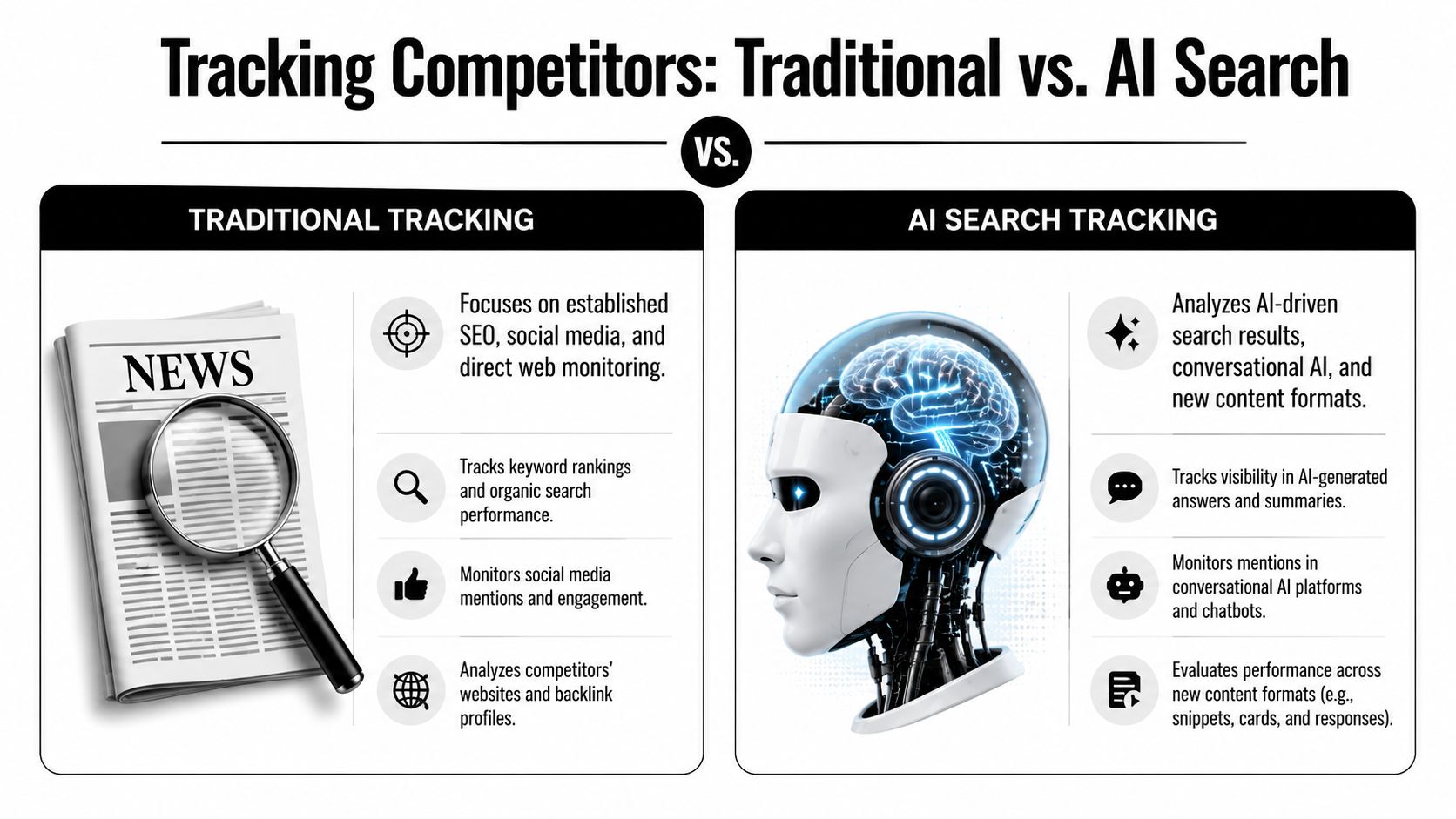
Traditional SEO asks questions like:
- Which page ranks?
- What keyword is moving?
- Which domain earned the backlink?
- Where did traffic come from?
AI search adds a different set:
- Which brands are mentioned in generated answers?
- How are those brands described?
- Which competitor gets recommended first in category prompts?
- What wording keeps appearing around our company?
- Which sources seem to influence the model's answer?
That's not a small extension of SEO. It's a different observation layer.
What standard competitor tools miss
Many established tools can monitor search positions, traffic estimates, website changes, review sentiment, and ads. They remain useful. But they usually weren't designed to capture the full structure of AI-generated answers.
Three gaps show up quickly.
First, verbatim language matters. If an AI model repeatedly describes your company as complex, niche, expensive, or better suited to a specific segment, that wording can shape buyer perception long before a salesperson enters the conversation.
Second, comparison framing matters. A model may mention your competitor alongside favorable attributes and mention your brand only as an alternative or a secondary option.
Third, source opacity matters. The visible answer may hide the mix of review content, editorial mentions, listicles, documentation, or stale pages that informed it.
Teams that monitor only rankings can miss the moment when AI answers start redefining the category in someone else's language.
What modern AI search tracking should capture
If your buyers use AI assistants during research, competition tracking software should help you monitor:
- Prompt-level visibility across important category and comparison questions
- Sentiment and descriptive language attached to your brand and rivals
- Positioning patterns such as “best for enterprise” or “easiest to use”
- Source attribution clues that reveal what content appears to shape outputs
- Gaps by prompt where competitors appear and your brand does not
Purpose-built AI search analytics platforms become useful in these scenarios. For example, promptposition helps teams track visibility, sentiment, positioning, verbatim quotes, and underlying sources across major models so they can compare their brand with competitors and spot gaps in AI search coverage.
That kind of tooling matters because AI answers don't behave like SERPs. You're not just trying to rank a page. You're trying to understand and influence how a system summarizes your company.
How to act on what you find
Once you can observe AI search, the work becomes familiar again. You improve the inputs.
A team might:
- Strengthen pages that answer category-defining questions clearly
- Publish comparison and glossary content that helps shape model language
- Improve third-party coverage and directory listings
- Coordinate PR to influence trusted sources
- Identify prompts where competitors dominate and create targeted content around those gaps
The opportunity is early, but it's already strategic. Teams that treat AI search as a side project will be reacting to narratives they didn't help create.
Key Metrics for Your Competitive Intelligence Dashboard
A dashboard becomes useful when every metric points to a decision. That sounds obvious, but many teams still collect competitive data without deciding what action each chart should trigger.
That's part of the measurement problem. HubSpot's 2025 State of Marketing report reveals that 73% of brand teams struggle to tie competitive intelligence to KPIs, with only 22% reporting positive ROI, as cited in AskAttest's competitor tracking tools article.
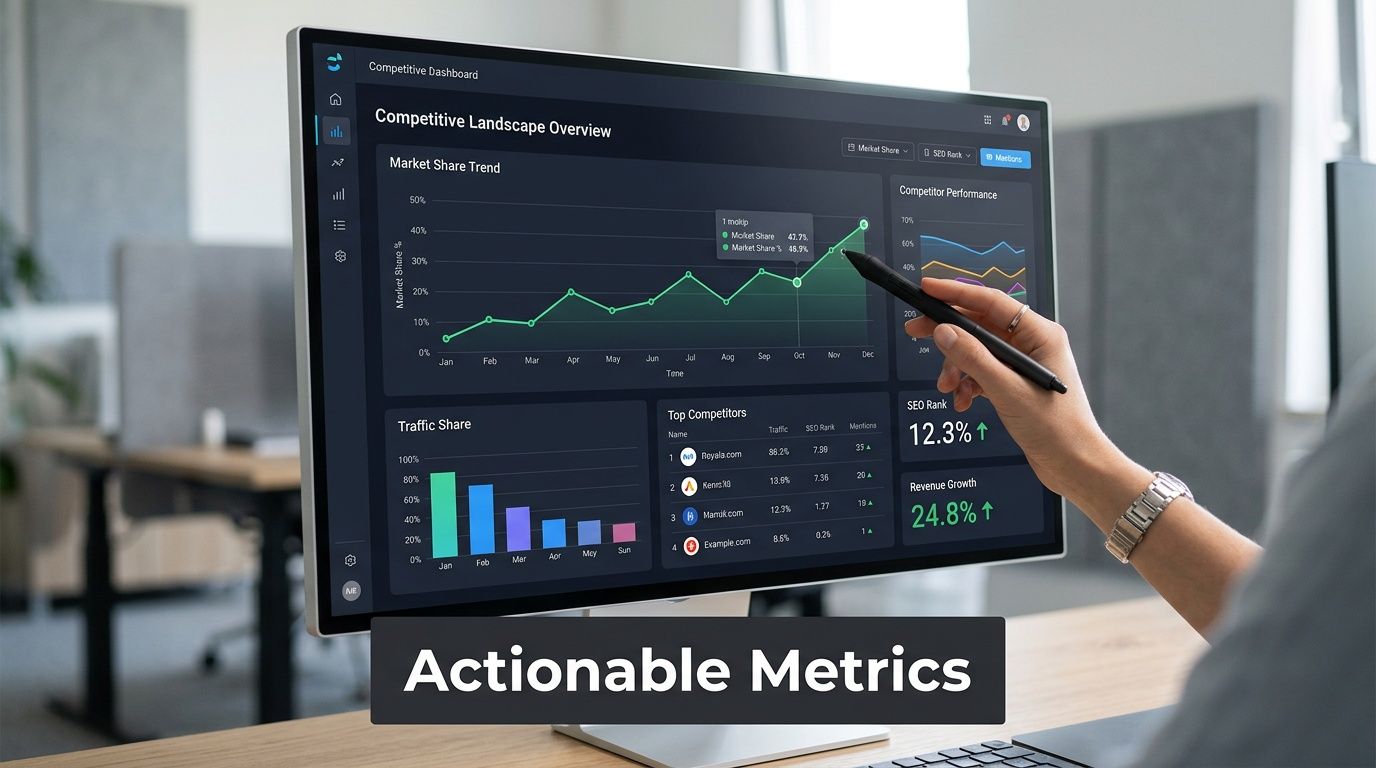
A starter dashboard that teams can actually use
Build your dashboard around the four pillars, then add AI-specific views where relevant.
Visibility share
Track how often your brand appears versus key competitors across the channels that matter to you. In search, that might mean rankings and topic coverage. In AI search, it means presence across important prompts.Sentiment trend
Watch whether language around your brand is improving, flattening, or slipping. This is especially useful after launches, PR moments, or review spikes.Message penetration Measure whether your preferred value propositions are showing up in market-facing language. If you want to be known for reliability but competitors own the “easy to implement” narrative, that's a positioning issue.
Source diversity
Check whether your visibility depends on too few source types. A healthy pattern is spread across your site, reviews, editorial mentions, partner content, and supporting pages.
AI-specific metrics worth adding
These don't replace classic SEO metrics. They sit beside them.
| Metric | What it tells you | Why it matters |
|---|---|---|
| Visibility in key prompts | Whether your brand appears in the AI questions buyers actually ask | Shows competitive presence before clicks happen |
| Verbatim description trend | The exact phrases models use about your company | Helps identify narrative drift |
| Competitor adjacency | How often you're mentioned next to a rival | Reveals comparison pressure |
| Negative adjacency | Whether your brand appears near unfavorable language or caveats | Useful for PR and brand risk detection |
| Source influence pattern | Which types of sources seem to shape outputs | Tells content and PR teams where to intervene |
Keep the dashboard tied to action
If a metric doesn't change behavior, cut it.
For example:
- If visibility in key prompts drops, your team should review prompt gaps and source coverage.
- If sentiment trend weakens, PR and content teams should inspect the underlying wording.
- If message penetration falls behind, campaign and homepage language may need revision.
- If source diversity narrows, you may be overdependent on a few pages or external mentions.
Better dashboards don't track more. They make it obvious who needs to do what next.
This is also where retrieval quality matters. If you're exploring technical ideas around improving search precision with Cohere, it's a useful example of how ranking and relevance systems affect what people ultimately see and trust.
Building Your Competition Tracking Implementation Plan
The easiest way to waste a good tool is to turn it on everywhere at once. Teams get flooded with alerts, nobody agrees on priorities, and the software becomes another tab that people ignore.
A better rollout is narrow, deliberate, and tied to operating rhythms your team already has.
Step 1 through 3
Start with a competitive set that reflects reality, not just the companies you dislike most.
Define your market set
Include direct competitors, indirect alternatives, and aspirational brands that shape category expectations. Your sales team can help here because they hear comparison language first.Choose the questions buyers ask Don't monitor everything. Pick the high-value keywords, review topics, and AI prompts that influence pipeline, positioning, or reputation.
Set alert rules before volume arrives
Decide what deserves an immediate alert versus a weekly digest. Pricing changes, launch signals, or negative adjacency may need fast escalation. Routine content updates usually don't.
Step 4 and 5
Once the monitoring is live, focus on habit formation.
Create a reporting cadence that fits the audience
Executives need concise trend summaries. SEO teams need source and visibility detail. PR teams need fast context around language shifts. Sales enablement needs usable takeaways, not raw feeds.Build a feedback loop into existing work
If the tool identifies a prompt gap, send it to content planning. If review sentiment shifts, route it to customer marketing or PR. If a competitor changes positioning, update campaign briefs and sales talk tracks.
A simple operating rhythm
A lightweight implementation plan often works better than a grand program launch.
- Weekly review for marketing, SEO, and PR leads
- Immediate alerts for major competitor changes
- Monthly synthesis for leadership
- Quarterly reset to refine prompts, rivals, and thresholds
This keeps the software connected to active work.
Treat alerts as assignments, not notifications. Every meaningful signal should have an owner.
The implementation test is straightforward. When the software surfaces an insight, can your team route it to the right person within the same workday, and can that person use it without needing a separate analyst to interpret it? If yes, your setup is probably healthy. If not, reduce scope and simplify the workflow.
Frequently Asked Questions About Competition Tracking
Is competition tracking software only for large enterprises
No. Large enterprises use it heavily, but smaller teams often get value faster because they can act on insights without as much internal friction.
A startup doesn't need a giant command center. It needs clear visibility into a few real competitors, a few important channels, and a few recurring buyer questions. A focused setup can outperform a sprawling one.
How is this different from Google Alerts
Google Alerts is a mention notification tool. Competition tracking software is an analysis and workflow system.
Google Alerts may tell you that a brand name appeared somewhere. It usually won't help you compare positioning, monitor messaging shifts, analyze sentiment, trace likely sources behind narratives, or track how AI models describe competitors. It's a narrow input, not a full operating layer.
How much time should a team spend on it each week
Less than most teams fear, if the setup is disciplined.
The time sink usually comes from poor alert design. If your software sends everything to everyone, the weekly burden expands fast. If alerts are scoped well, relevant departments can review signals inside existing meetings and only spend extra time when something significant changes.
What should a team do first after logging in
Don't start with a dashboard tour. Start by building a watchlist.
Pick your direct competitors, your highest-stakes prompts or keywords, and the narrative questions that matter most. Examples include how your brand is described, where rivals are showing up, and what sources seem to shape those outcomes. Once that foundation is in place, the rest of the reporting becomes more meaningful.
Can one tool cover SEO, PR, social, and AI search
Sometimes, but usually not perfectly.
The majority of teams eventually adopt a primary platform alongside several specialized tools. The objective is not complete consolidation. Instead, the aim is to minimize fragmentation sufficiently so that members can rely on the data and take action. While coverage is significant, workflow integration is more important.
What's the biggest mistake teams make
They collect too much before defining what would count as a useful signal.
Good competition tracking software should help your team decide faster. If it only increases observation without improving action, the issue usually isn't the market. It's the setup.
If your team needs to understand how large language models present your company versus competitors, promptposition gives you a focused way to monitor visibility, sentiment, positioning, verbatim quotes, and source patterns across major AI platforms so you can turn AI search from a blind spot into a measurable channel.