A Marketer’s Guide to AI Search Optimization Tools in 2026
If your SEO strategy still revolves exclusively around keyword rankings, you're already behind. The rise of AI search engines like ChatGPT, Gemini, and Perplexity has fundamentally changed how users find information and discover brands. Traditional search is about finding web pages; AI search is about getting direct answers. This distinction creates a new battleground for brand visibility, one where success isn't measured in blue links but in direct mentions and cited authority within AI-generated responses.
This new reality requires a different set of tools and a new strategy. While traditional search optimization remains important, winning in this evolving landscape requires a deep understanding of AI search engine optimization. This guide is built for marketers, brand managers, and SEO professionals who need to adapt now. We will move past theory and into practical application, detailing what to look for in AI search optimization tools and which platforms can help your team compete.
Inside this resource, you will find a guide to understanding this new category of software and a curated list of tools designed for this new era of search. We will explore platforms built to:
- Track your brand’s visibility and sentiment across prompts in major AI models.
- Identify the exact sources LLMs use to formulate answers about your industry.
- Strengthen your brand’s knowledge graph to feed AI accurate information.
For each tool, we provide a detailed breakdown of its core features, ideal use cases, and how it fits into a modern marketing stack. You'll see screenshots and get direct links, helping you understand what good looks like and how to ensure your brand is recommended, not ignored, by the AI models shaping your customers’ decisions.
What Are AI Search Optimization Tools and Why Do You Need Them?
Traditional SEO tools are built to measure and improve performance on search engines like Google. They track keyword rankings, analyze backlinks, and audit website code. While many of these tasks are still relevant, they don't address the core challenge of AI search: prompt-based visibility.
AI search optimization tools are fundamentally different. They are designed to answer questions that traditional tools can't:
- When a user asks ChatGPT, "What's the best software for project management?", is my brand mentioned?
- If so, what is the sentiment of the mention? Is it positive, negative, or neutral?
- Most importantly, which websites, articles, or forum threads did the AI cite to formulate that answer?
This last point is the game-changer. Winning in AI search isn't just about creating good content; it's about creating content that feeds the AI models. That means getting your brand mentioned on the specific sources that LLMs trust and reference.
What to Look For in an AI Search Optimization Tool
When evaluating tools, focus on capabilities that provide actionable insights for this new paradigm. A great tool should offer:
- Cross-Model Tracking: Your customers aren't just using one AI. A robust tool must track your brand’s presence across major LLMs like ChatGPT, Gemini, Claude, and Perplexity.
- Daily, Automated Monitoring: Manually testing prompts is tedious and not scalable. The right platform should provide automated daily tracking, freeing up your team to focus on strategy, not data entry. As one marketing team found, automating this process saved 4–5 hours per week that were previously spent logging results in spreadsheets.
- Source Attribution: This is the most critical feature. The tool must show you which sources the LLM used to generate its answer. Knowing that a competitor's mention is driven by a specific Reddit thread or a TechCrunch listicle gives your content and PR teams a precise roadmap for action. This insight can completely change how you prioritize digital PR efforts.
- Actionable Metrics: Look for clear KPIs like Visibility (how often you're mentioned), Sentiment (the tone of the mention), and Position (where you appear in the answer). This turns ambiguous AI responses into a measurable performance dashboard.
Now, let's explore some of the platforms leading the charge in this new category.
1. promptposition
As the world of search expands beyond traditional keyword rankings, promptposition establishes itself as an essential platform for brands that need to understand and influence their presence in AI-driven answers. While many tools still focus exclusively on Google, promptposition is built specifically for the new reality of tracking prompt-based visibility across conversational AI models. It provides the critical data layer for marketing, brand, and PR teams to measure, benchmark, and improve how Large Language Models (LLMs) like ChatGPT, Gemini, and Claude portray their company. It answers the fundamental question: when a potential customer asks an AI about your market, is your brand part of the conversation?
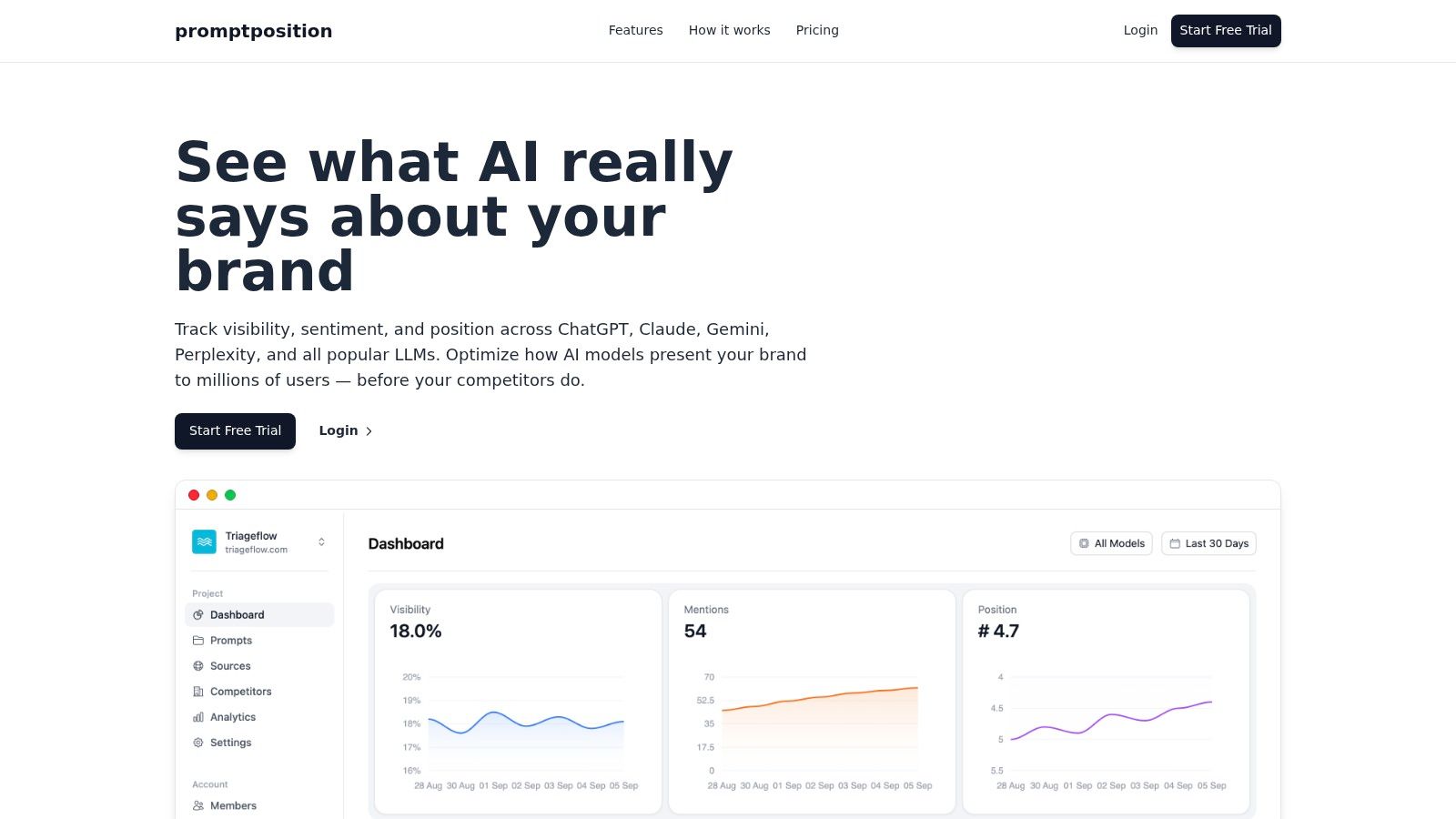
The platform converts the ambiguous nature of AI responses into a clear set of actionable KPIs: Visibility (how often your brand is mentioned), Sentiment (the positive or negative tone of the mention), and Position (where you appear in the answer). This structure provides a tangible framework for a successful AI search engine optimization strategy.
Why It Stands Out
What makes promptposition one of the most effective ai search optimization tools is its direct focus on source attribution. The platform doesn't just show you what an LLM said; it reveals the specific web sources (like a Reddit thread, a TechCrunch article, or a G2 review page) the model cited to form its answer. This insight is game-changing. Instead of guessing, your content and PR teams can execute a precise strategy to influence the very materials that shape AI-generated narratives. As one user noted, "That insight changed how our team prioritizes content and digital PR efforts entirely, because you're optimizing for the sources that feed AI answers, not just Google's algorithm."
Real-World Impact: A B2B SaaS client had zero mentions across ChatGPT and Gemini for their core product prompts despite ranking well on Google. Using PromptPosition's daily tracking, we identified which sources the LLMs were pulling competitor recommendations from. After a focused three-month push on those exact platforms — mainly Reddit threads and industry comparison articles — their AI visibility went from 0% to appearing in roughly 40% of tracked prompts.
Key Features and Use Cases
- Cross-Model Monitoring: Track your brand’s performance daily across all major LLMs (ChatGPT, Gemini, Claude, etc.) in one unified dashboard. This replaces hours of manual, repetitive prompt testing.
- Source Attribution: See verbatim quotes from each AI and, more importantly, the underlying web sources it used. This allows teams to prioritize which platforms to target for content and digital PR.
- Competitive Benchmarking: Directly compare your AI visibility, sentiment, and positioning against competitors for the same set of prompts. Identify and close critical gaps where rivals are winning the AI narrative.
- Actionable Workflow: Organize prompts into logical groups, discover new high-volume queries with AI suggestions, and focus your efforts on the opportunities with the highest potential impact.
Pricing and Access
promptposition offers scalable plans suitable for various team sizes and needs. All tiers include unlimited seats and country tracking, which is a significant advantage for collaborative or global teams.
- Starter: $49/month for 2,250 AI responses.
- Pro: $119/month for 9,000 AI responses.
- Enterprise: Starts at $299/month for 27,000+ responses, with optional API access for deeper integrations.
Annual subscriptions provide a discount of up to 20%.
Pros & Cons
| Pros | Cons |
|---|---|
| Specialized focus on prompt-based visibility across multiple LLMs. | Insights are prompt-driven, so effectiveness depends on setting up a comprehensive and relevant set of queries. |
| Daily monitoring with source attribution gives teams a precise, actionable roadmap. | High-volume tracking for many brands or extensive prompt lists may require a Pro or Enterprise plan to accommodate response quotas. |
| Strong competitive benchmarking features to find and act on visibility gaps. | |
| Scalable plans with unlimited seats and API access make it suitable for teams of any size. |
Website: https://www.promptposition.com
2. Conductor AI
Conductor AI positions itself as an enterprise-grade platform designed to unify traditional SEO with the emerging discipline of Answer Engine Optimization (AEO) and Generative Engine Optimization (GEO). It's built for large organizations that need a single, coherent workflow to manage their visibility across both classic search engines and AI-driven answer engines like ChatGPT, Gemini, and Perplexity. The platform's core function is to connect the dots from initial research and content planning to on-page optimization and, finally, to enterprise-level reporting that ties AI visibility directly to business outcomes.
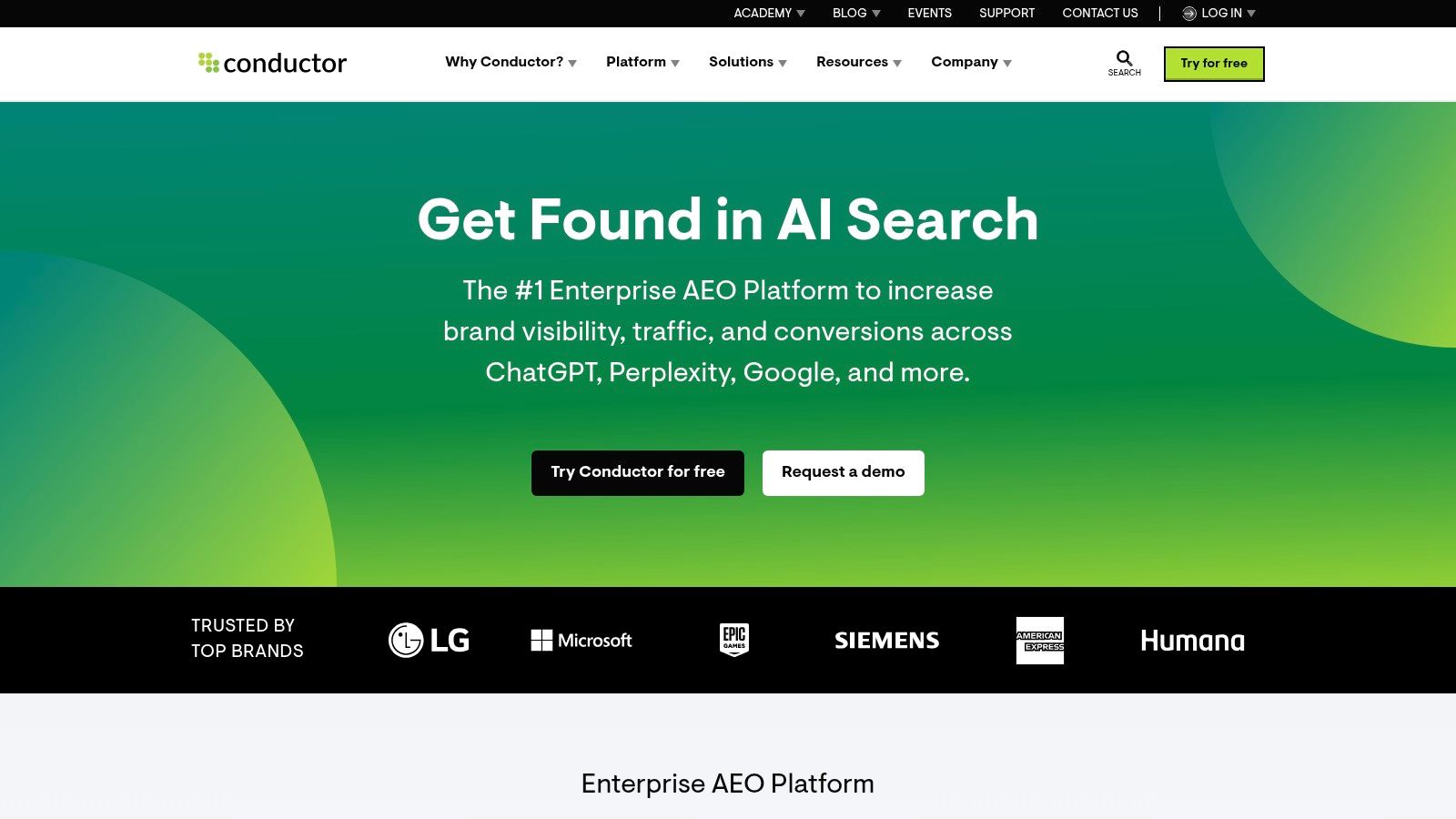
Unlike point solutions that focus only on AI prompt tracking, Conductor integrates its AI capabilities into a broader organic marketing suite. This makes it a strong contender for teams wanting to avoid tool fragmentation. A key differentiator is its emphasis on providing an end-to-end AEO/GEO framework, complete with educational resources and defined workflows. This structure is particularly helpful for enterprise teams who need to operationalize and scale their AI search optimization tools and strategies across multiple departments or global markets.
Key Features & Use Cases
- AI Search Performance: Tracks topics and prompts to measure your brand’s visibility, citations, and competitive context within supported AI engines.
- Integrated Content Workflow: Moves teams from AI-informed topic discovery to content creation, on-page SEO, and performance measurement without leaving the platform.
- Enterprise Reporting: Creates detailed reports that connect AI search presence with tangible results, helping justify budget and demonstrate ROI to leadership.
Pricing and Access
Conductor is an enterprise solution, and its pricing is not public. Access requires engaging with their sales team for a custom quote and contract, which typically includes onboarding and dedicated support.
Pros & Cons
- Pro: The platform offers a clear, structured workflow from research to measurement, ideal for large, process-driven marketing teams.
- Pro: It has robust, documented support for multiple AI engines and is used by major enterprise brands, indicating its scalability.
- Con: The enterprise focus means a significant setup and onboarding effort is required, making it less suitable for smaller teams or quick projects.
Website: https://www.conductor.com
3. seoClarity
seoClarity is an enterprise-grade SEO platform that has expanded its deep analytical capabilities to address Google's AI Overviews (AIO). While many platforms are still adapting, seoClarity provides direct, quantifiable data on how AIO affects organic visibility. Its core strength lies in connecting the appearance of AI-generated answers in the SERP to specific keywords and URLs, allowing teams to measure the real-world traffic impact of this major shift.
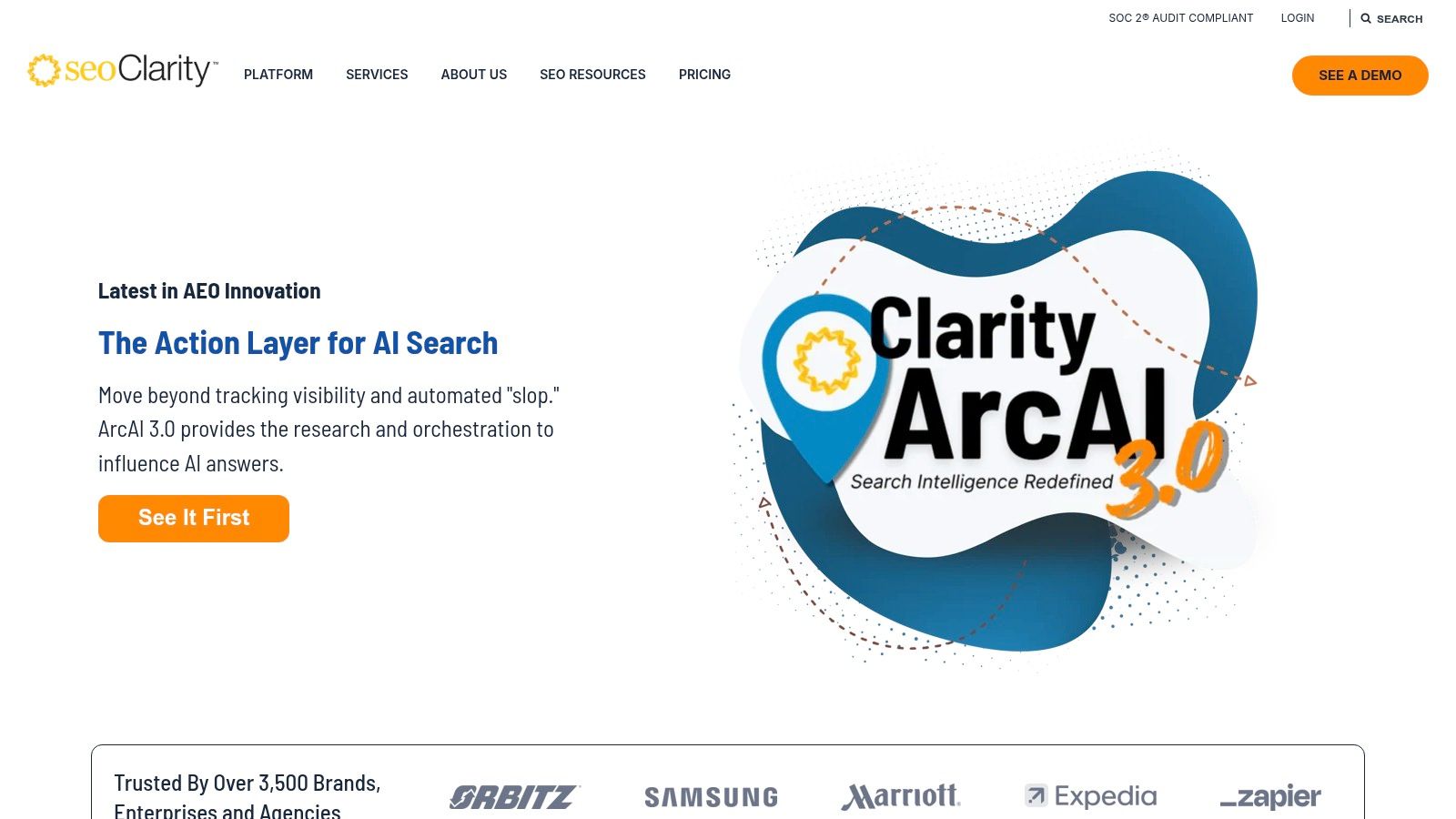
Unlike tools focused broadly on multiple conversational LLMs, seoClarity zeroes in on the most immediate threat to organic traffic: Google's own AI integrations. It provides daily tracking to detect when an AIO is present for a tracked keyword, whether your domain is cited as a source, and how this correlates with your ranking and traffic. This data-first approach makes it one of the most practical ai search optimization tools for enterprises needing to justify SEO strategy and budget allocation to leadership by demonstrating the precise risk or opportunity AIO presents.
Key Features & Use Cases
- AI Overviews Tracking: Daily monitoring of AIO presence and your brand's citation status for your most important keywords.
- Impact Analysis: Connects AIO appearances directly to your traffic and ranking data at the URL level to quantify the business impact.
- Historic Research Data: Leverages a massive dataset to provide context on AIO prevalence across different industries and query types, helping teams prioritize their response.
Pricing and Access
seoClarity is an enterprise solution with custom, quote-based pricing. Gaining access involves a sales consultation to tailor a package that fits your organization's scale and specific needs, which typically includes onboarding and dedicated support.
Pros & Cons
- Pro: Offers granular, defensible measurement of AIO's impact on traffic and visibility, backed by large-scale data studies.
- Pro: The insights are integrated directly into a comprehensive SEO workflow, helping teams prioritize actions based on concrete data.
- Con: The primary focus is on Google's AI Overviews; brands concerned with visibility in ChatGPT, Gemini, or Perplexity will need complementary tools.
Website: https://www.seoclarity.net
4. BrightEdge
BrightEdge approaches AI search optimization by positioning it as a direct extension of foundational, enterprise-level SEO. Its focus is on Generative Engine Optimization (GEO), a framework designed to help large organizations adapt their existing SEO practices to secure visibility within AI-generated answers, such as Google's AI Overviews. The platform's methodology connects core SEO activities, like technical health and structured data, to the new challenge of getting cited in generative responses. It's built for established marketing teams looking to integrate AI optimization into their current, mature workflows rather than adopting a separate, standalone tool.
Unlike specialized AI prompt trackers, BrightEdge's strength lies in its unified approach. It treats GEO as a component of a broader organic marketing strategy, appealing to teams that want to standardize operations under a single platform. A key differentiator is its emphasis on structured data and entity alignment, providing guidance to help search engines and AI models better understand a brand's content. This makes it one of the more practical ai search optimization tools for companies that want to build a long-term, scalable program that aligns traditional and generative search efforts.
Key Features & Use Cases
- Generative Engine Optimization (GEO) Playbooks: Offers structured guidance and workflows that tie fundamental SEO tasks directly to improving inclusion and citations in AI answers.
- Structured Data & Entity Guidance: Provides specific recommendations for implementing schema and optimizing content entities to improve how AI models interpret and use your information.
- Integrated SEO & GEO Reporting: Allows teams to track classic SEO metrics alongside performance in AI-driven features within a single reporting environment.
Pricing and Access
BrightEdge is an enterprise platform, and pricing is not publicly available. Gaining access requires a sales consultation to receive a custom quote, which typically includes implementation support and ongoing training for marketing teams.
Pros & Cons
- Pro: The platform’s guidance connects familiar SEO concepts to new GEO requirements, making adoption easier for established teams.
- Pro: As a mature enterprise vendor, it offers a stable and scalable solution for large organizations standardizing their organic marketing stack.
- Con: The quote-based pricing and significant implementation process make it less accessible for smaller businesses or those needing a quick, focused solution.
Website: https://www.brightedge.com
5. SEOmonitor (AI Overview/SGE tracking)
SEOmonitor brings a practical, data-driven approach to AI search by focusing on what many SEO professionals need today: daily tracking of Google's AI Overviews (AIO). Its strength lies in providing repeatable, granular measurement of AIO presence, allowing agencies and in-house teams to connect the dots between their SEO efforts and their visibility within Google's generative answers. The platform clearly distinguishes AIO rank tracking from broader AI search monitoring, making it a pragmatic choice for teams focused on Google-centric performance.
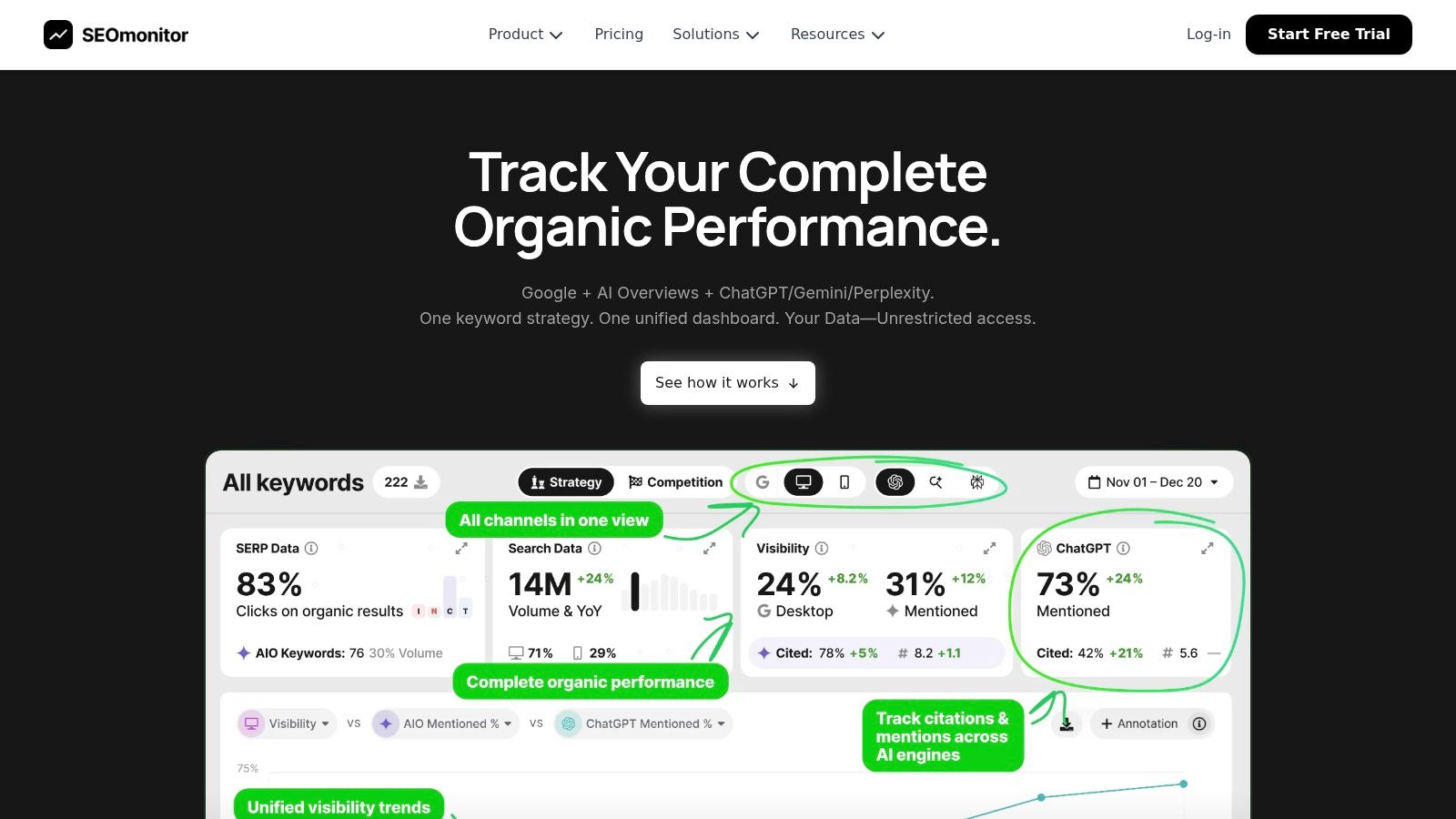
Unlike tools built for broad, multi-LLM prompt tracking, SEOmonitor integrates AIO data directly into a familiar SEO workflow. This makes it one of the more straightforward ai search optimization tools for teams that want to adapt their existing keyword and content strategies for AI Overviews without adopting an entirely new framework. The platform's ability to report on AIO's impact on specific keywords and content pieces helps teams defend their strategies and demonstrate the direct effects of Google's generative shift on organic traffic and visibility.
Key Features & Use Cases
- Daily AIO Monitoring: Tracks your website's presence in Google AI Overviews, including citation ranking and visibility against competitors for target keywords.
- Integrated SEO Reporting: Connects AIO performance data directly to traditional keyword rankings and content analytics, showing how generative results affect your overall SEO.
- Agency-Focused Tools: Built with features that help agencies report on AIO visibility and its impact on client campaigns, with clear metrics and visuals.
Pricing and Access
SEOmonitor offers flexible, transparent pricing based on the number of domains and keywords tracked. A public pricing calculator is available on their site, and they provide a free trial and onboarding resources to help new users get started.
Pros & Cons
- Pro: Provides practical, daily measurement specifically for Google AIO, which is immediately actionable for most SEO teams.
- Pro: Transparent pricing with a free trial allows teams to evaluate the tool's fit without a lengthy sales process.
- Con: The primary focus on Google AIO means coverage of non-Google models like ChatGPT or Claude is lighter, potentially requiring a complementary tool for multi-LLM monitoring.
Website: https://www.seomonitor.com
6. SE Ranking (AI Search Add-on + AI Results/Overviews trackers)
SE Ranking positions itself as a comprehensive SEO suite for SMBs and agencies, now extended with AI search tracking capabilities. Rather than a standalone product, it offers an AI Search Add‑on and integrated AI Overviews tracking, making it a pragmatic choice for teams already using or considering their platform for traditional SEO. This approach allows users to monitor brand visibility across AI platforms like ChatGPT, Gemini, and Google's AI Overviews directly within their existing rank monitoring workflows.
Unlike enterprise-only AI search optimization tools, SE Ranking provides a more accessible entry point. Its key differentiator is bundling these new AI-centric metrics alongside classic SEO data. This allows marketing teams to view keyword rankings, competitor positions, and AI-generated answer appearances in a unified interface. For many small businesses and agencies, this integration is a significant advantage, reducing the need for another specialized tool and keeping costs manageable while still gaining crucial insights into emerging search formats.
Key Features & Use Cases
- AI Results/Overviews Tracking: Monitors your domain's presence, position, and competitor appearances within Google's AI Overviews and other generative results. You can find more detail on this topic in this AI Overview tracker guide.
- Project-Level Prompt Setup: Allows you to define and track specific prompts in AI systems like ChatGPT, providing historical data on how your brand's visibility trends over time.
- Augmented Keyword Research: Enriches keyword and competitive research data by showing which terms are likely to trigger AI-generated answers, helping prioritize content strategy.
Pricing and Access
SE Ranking is a subscription-based service with multiple tiers. The AI search features are available as an add-on, with pricing and limits tied to the main subscription plan. This model offers a lower cost of entry compared to dedicated enterprise platforms, and a trial is available.
Pros & Cons
- Pro: The cost of entry is lower than many enterprise tools, and the features are quick to trial and implement within an existing SEO workflow.
- Pro: The company has demonstrated an active and fast rollout cadence for its AI-search features, suggesting continued investment.
- Con: As an add-on, the AI functionality has limits that depend on your plan, which may be restrictive for heavy users. Data coverage and quality can vary by the specific AI surface being tracked.
Website: https://seranking.com
7. Morningscore (AI Overviews Tracker)
Morningscore offers a lightweight and accessible entry point into AI search optimization, specifically focusing on Google's AI Overviews (AIO). It is designed as an easy-to-use SEO tool that integrates AIO tracking directly into its core dashboard, making it ideal for smaller teams, agencies, and marketers who need a simple, direct way to monitor their visibility within Google's generative results without the complexity of an enterprise-grade platform. The tool alerts users when an AI Overview appears for their tracked keywords, shows if their domain was cited, and identifies which specific URLs are being used as sources.
Unlike comprehensive platforms that cover multiple LLMs, Morningscore’s strength is its focused simplicity and speed. It provides practical, daily updates on AIO presence and offers guidance on how to structure content to increase the likelihood of being cited. This makes it a great starting point for teams that want to get their feet wet with generative engine optimization on Google before expanding to a broader, multi-engine strategy. Its transparent pricing and positive user reviews highlight its value for those who need actionable data without a significant investment.
Key Features & Use Cases
- AI Overviews Tracking: Delivers daily reports on whether AIO is present for your keywords and if your site is featured as a source.
- Citation Source Identification: Pinpoints the exact URLs from your site and competitors that Google is using to build AI Overviews.
- Actionable On-Page Guidance: Provides practical advice on content structure and on-page formatting to better align with AIO citation criteria.
Pricing and Access
Morningscore offers several transparent, tiered pricing plans aimed at freelancers, small businesses, and agencies. All plans include the AI Overviews tracker, with tiers differing by the number of keywords and websites you can track. A free trial is available to test the platform's features.
Pros & Cons
- Pro: Setup is very fast, and the interface is intuitive, making it suitable for users without deep technical SEO expertise.
- Pro: Affordable plans with an all-features-in-each-plan approach provide excellent value for smaller teams and budgets.
- Con: It focuses primarily on Google's AI Overviews, lacking the multi-LLM monitoring found in dedicated ai search optimization tools like PromptPosition.
Website: https://morningscore.io
8. Authoritas (AI Overviews rank tracking + SERPs API)
Authoritas operates as a technical SEO platform and SERPs API provider that extends its capabilities into the AI search space. It directly addresses the need to track Google's AI Overviews by integrating AIO presence and rank analytics into its core rank-tracking and SERP study tools. This makes it a valuable resource for teams that want to monitor AI-generated answers within the familiar context of traditional search engine results pages. The platform is especially useful for in-house data teams and agencies that require programmatic access to build custom dashboards or perform large-scale analysis.
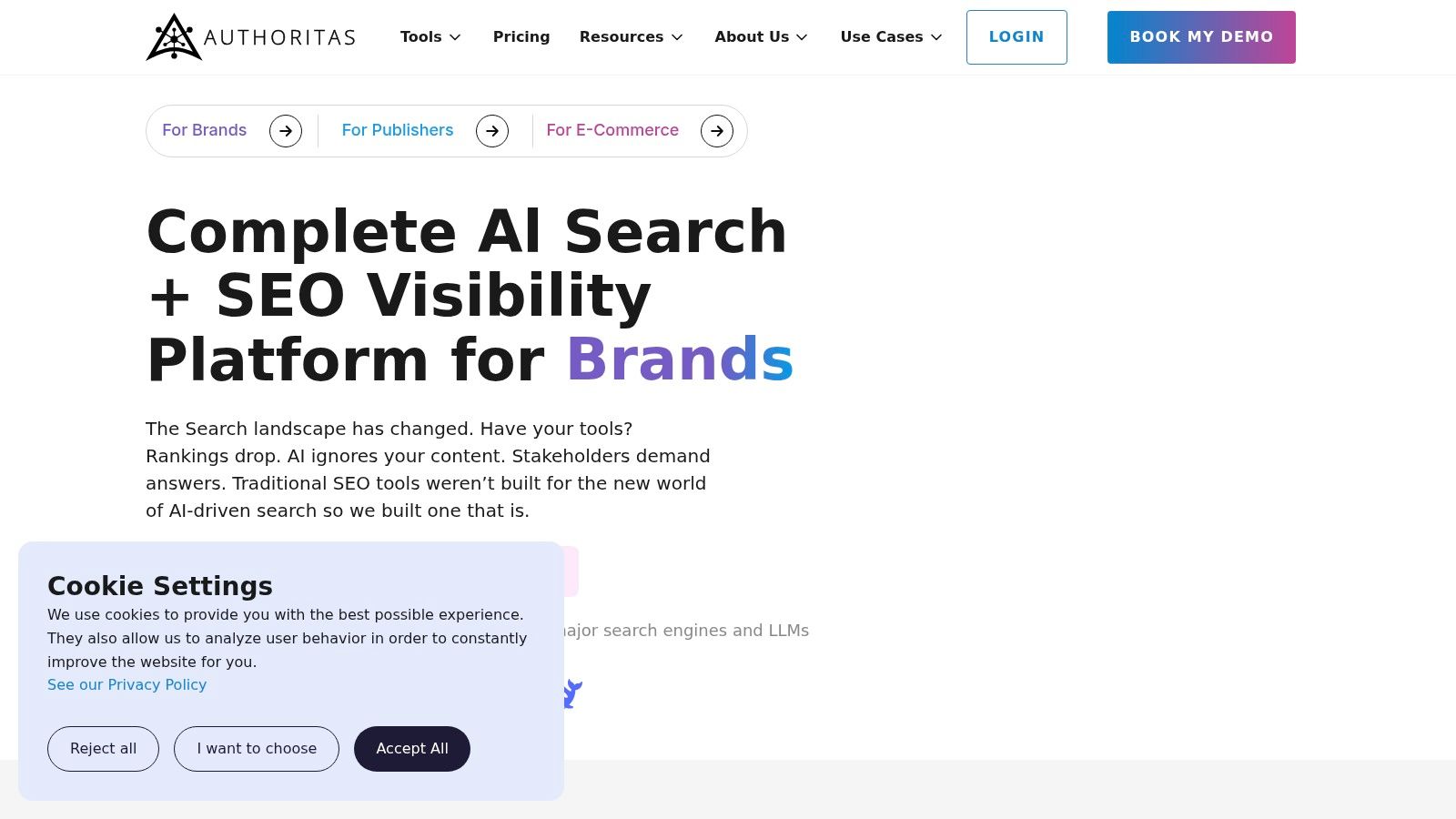
Unlike pure-play prompt-tracking tools, Authoritas focuses its AI capabilities on the Google ecosystem. A key differentiator is its SERPs API, which includes a specific parameter to pull SGE/AIO data. This allows technical SEOs and data scientists to programmatically integrate AI Overviews data into their own systems and models. By combining this API access with ongoing research reports on AIO behavior, Authoritas serves teams that need both a user interface for daily monitoring and raw data for deeper, custom investigations into Google's AI-powered search features.
Key Features & Use Cases
- AI Overviews Tracking: Measures your brand's presence and rank within Google's AI Overviews directly inside its rank tracker and SERP analysis tools.
- SERPs API with AIO Data: Provides programmatic access to SERP data, including a parameter to fetch AI Overviews content for integration into custom tools and analysis.
- AIO Impact Research: Publishes frequent research and reports on how AI Overviews are impacting different query types and industries, offering strategic insights.
Pricing and Access
Authoritas is a B2B solution with pricing available upon request. Access requires contacting their sales team for a custom quote, which depends on the modules selected and API usage volume. API access is typically billed based on the number of calls made.
Pros & Cons
- Pro: Strong for teams that need raw data access and programmatic analysis via a well-documented API.
- Pro: Offers transparent methodology and publishes valuable research on AI Overviews behavior and market impact.
- Con: Requires technical resources or a data team to fully capitalize on the platform's API capabilities.
Website: https://www.authoritas.com
9. STAT Search Analytics (by Moz) – AI Overviews Tracking
For large organizations already invested in high-volume keyword tracking, STAT Search Analytics (now part of Moz) introduces AI Overviews reporting as a natural extension of its enterprise SERP analysis. This feature is not a standalone AI chat engine tracker but is instead deeply integrated into STAT’s core function: monitoring search engine results pages at a massive scale. It's designed for brands and agencies that need to understand how Google's AI-generated snapshots are impacting their existing organic visibility across thousands of keywords.
The platform’s strength lies in its ability to add AI Overviews data into a familiar workflow. Teams using STAT for rank tracking can now see how often AIOs appear for their keyword sets, who "owns" those features, and which sources are being cited. This makes it one of the more practical ai search optimization tools for SEO teams focused specifically on Google's ecosystem. Its value comes from connecting AI snapshot performance directly to traditional SERP metrics, complete with daily HTML SERP archives for auditing and historical evidence.
Key Features & Use Cases
- AI Overviews Visibility: Measures how frequently AIOs appear for your tracked keywords and reports on your domain's ownership share and cited sources.
- Large-Scale SERP Data: Continues STAT's core offering of daily SERP tracking across immense keyword sets with local, device, and language granularity.
- Data Export & API Access: Allows teams to pull raw data for custom analysis, build internal dashboards, and integrate AIO insights into other business intelligence tools.
Pricing and Access
STAT is an enterprise-grade product with pricing based on keyword volume. Plans are reported to start around $720 per month for tracking 6,000 keywords. Access requires a custom quote and contract with the Moz/STAT sales team.
Pros & Cons
- Pro: Built for massive scale and integrates seamlessly into existing STAT workflows, making adoption easy for current users.
- Pro: Provides powerful data export and API options for advanced auditing, custom reporting, and internal analysis.
- Con: Focus is exclusively on Google AI Overviews and does not provide visibility into performance on separate LLM chat engines like ChatGPT or Gemini.
Website: https://getstat.com
10. Seobility (AI Overview Tracker)
Seobility is known as an all-in-one SEO suite for small to medium-sized businesses, and it has adapted by integrating AI search visibility into its core toolset. Its AI Overview Tracker allows users to monitor their presence in Google's AI-generated answers directly alongside their traditional organic keyword rankings. This approach is designed for teams who want to dip their toes into AI search optimization without adopting a separate, specialized platform, making it a practical first step.
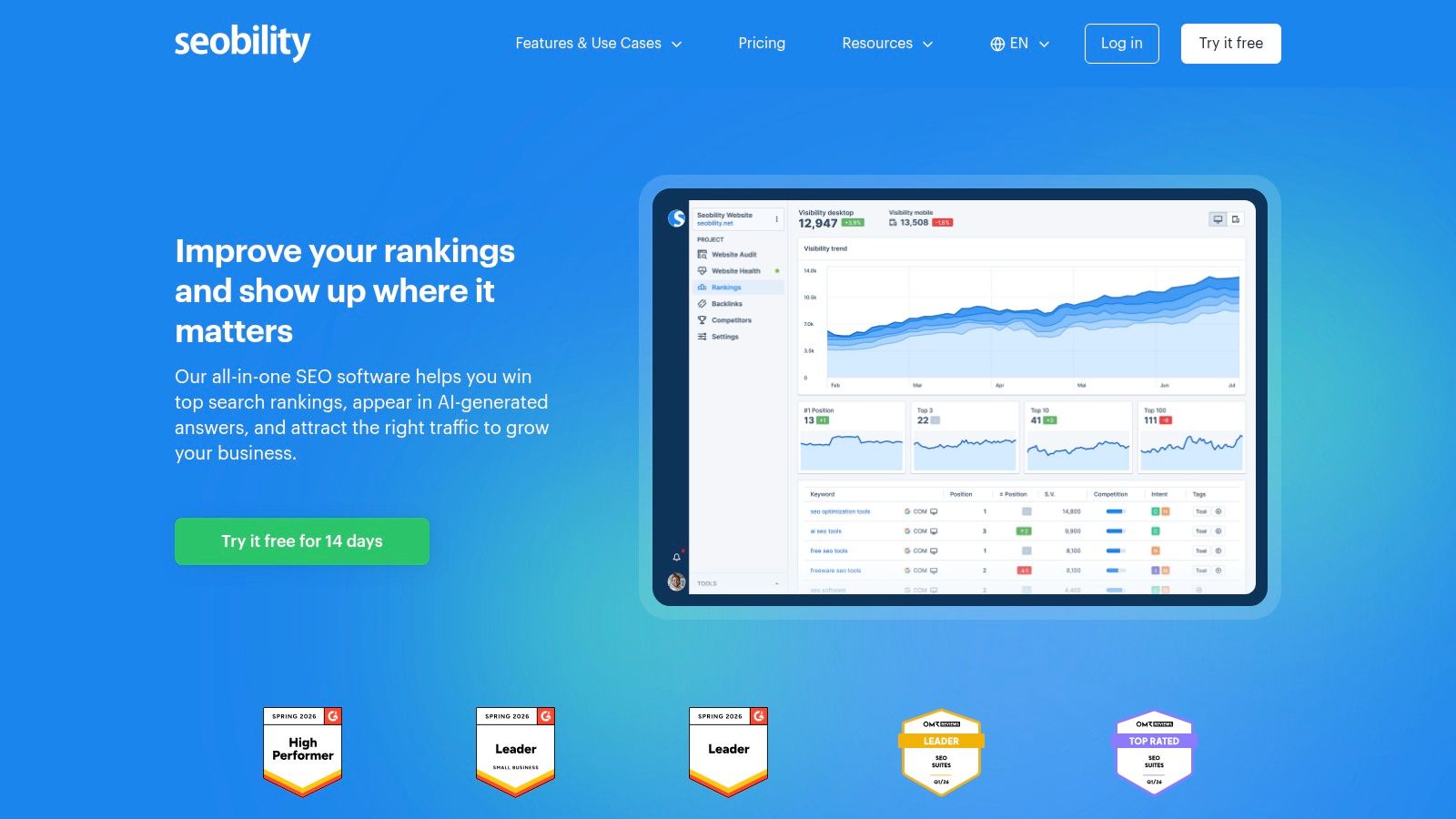
Unlike dedicated Generative Engine Optimization platforms that cover multiple LLMs, Seobility focuses exclusively on Google's SGE/AI Overviews. Its strength lies in convenience. For a marketer already using Seobility for site audits, backlink analysis, and rank tracking, the ability to see if their domain is cited in an AI Overview for a target keyword is a seamless addition. This makes it an excellent, budget-friendly entry point for SMBs looking to understand how AI is affecting their SERP visibility within the familiar Google ecosystem.
Key Features & Use Cases
- Integrated AIO Tracking: Monitors if your domain appears as a source or citation within Google's AI Overviews for your tracked keywords.
- Unified SEO Dashboard: Combines AIO visibility data with traditional metrics like keyword rankings, site health, and backlink profiles in a single interface.
- Cost-Effective Monitoring: Provides a way to start tracking AI search performance without the cost of a dedicated, enterprise-level tool.
Pricing and Access
Seobility offers transparent pricing with a free basic plan and paid tiers starting at around $50/month. The AI Overview tracking is included in its paid plans, which come with a free trial, making it highly accessible for testing.
Pros & Cons
- Pro: A very easy and affordable way to begin tracking Google AI Overview visibility, perfect for small businesses and solo SEOs.
- Pro: Consolidates core SEO tasks and initial AI search monitoring into one platform, simplifying the marketing tech stack.
- Con: The tool is limited to Google's AI Overviews and does not track visibility across other important AI engines like ChatGPT, Perplexity, or Claude.
Website: https://www.seobility.net
11. Yext (Listings, Knowledge Graph, AI search readiness)
Yext addresses AI search optimization from a foundational, data-first perspective. Instead of focusing on tracking prompts, it helps large brands build a "single source of truth" for their factual information. The platform's core is its Knowledge Graph, a centralized repository for structuring brand facts like locations, hours, products, services, FAQs, and policies. This structured data is then syndicated across a vast network of listings, directories, and the brand’s own digital properties, creating a consistent and authoritative footprint for AI models and traditional search engines to consume.
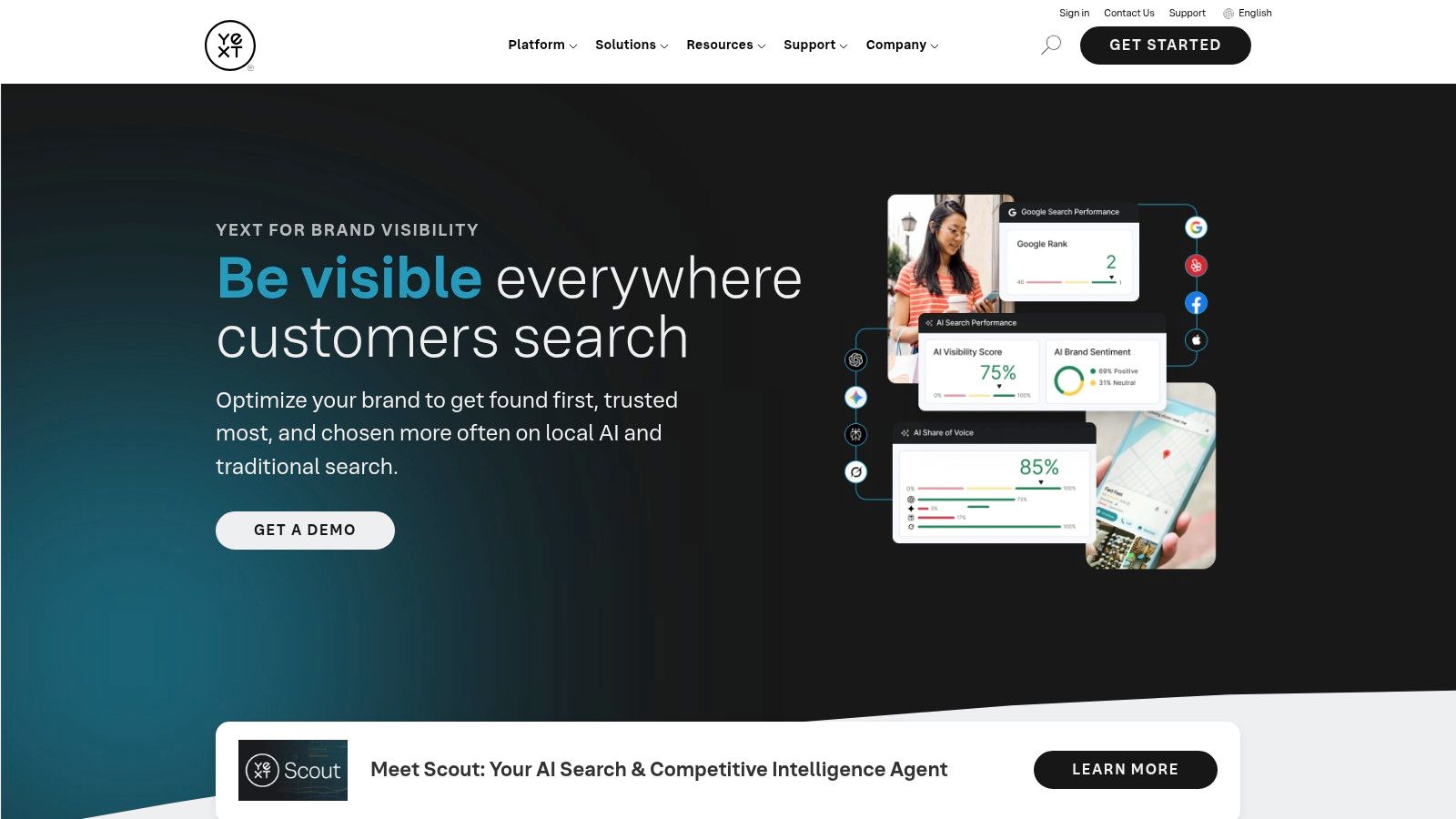
This approach is different from other AI search optimization tools as it is not about monitoring outputs but about controlling the factual inputs that Large Language Models (LLMs) rely upon. For multi-location businesses or companies in regulated industries, ensuring AI systems pull accurate, up-to-date information is critical for brand trust and operational integrity. Yext works on the principle that if your brand’s data is structured, accurate, and widely distributed, LLMs are more likely to cite it correctly when answering user prompts.
Key Features & Use Cases
- Knowledge Graph: Centralizes all entity-level brand facts, making them machine-readable and easily digestible for AI systems and search crawlers.
- Listings & Pages: Distributes consistent, accurate business information across hundreds of global directories, search engines, and maps to correct and control your brand’s factual footprint.
- On-Site AI Search Readiness: Provides the structured data backbone needed to power a brand's own on-site AI search or chatbot, ensuring it delivers accurate answers.
Pricing and Access
Yext is an enterprise-grade platform with custom, quote-based pricing. Contracts typically involve an annual subscription, and access requires engaging with their sales team. The pricing structure is often based on the number of locations, entities, or specific product suites required.
Pros & Cons
- Pro: Excellent for multi-location brands and regulated industries that require strict control over factual business information.
- Pro: Offers extensive enterprise-level integrations and governance features to manage data at scale.
- Con: The platform can be expensive compared to SMB-focused listing management tools, reflecting its enterprise focus.
Website: https://www.yext.com
12. WordLift
WordLift takes a foundational approach to AI search optimization, focusing on making your website’s content machine-readable for Large Language Models (LLMs) and traditional search engines. It operates on the principle that for an AI to trust and cite your brand, it must first understand who you are, what you do, and how your concepts relate. The platform achieves this by helping you build a Knowledge Graph, a structured database of your site's key entities, and injecting it into your site using schema.org markup.
Unlike tools focused purely on tracking AI outputs, WordLift is a preparatory AI search optimization tool designed to make your site a better, more authoritative source for AI systems to begin with. It directly addresses the core need for entity clarity, a critical factor in both Answer Engine Optimization (AEO) and Generative Engine Optimization (GEO). By structuring your data, you are not just hoping to be found; you are actively feeding LLMs the factual, organized information they need to generate accurate and trustworthy responses that feature your brand.
Key Features & Use Cases
- Knowledge Graph Creation: Automatically builds a site-level Knowledge Graph by identifying and connecting key entities (people, products, services) within your content.
- Automated Schema Markup: Injects sophisticated, linked schema.org data across your entire website, clearly communicating your content's meaning to search engines and AI.
- AI-Powered Content Tools: Provides AI assistance for content writing and automated internal linking based on the relationships established in your Knowledge Graph.
- LLM & Vector Search Integration: Offers developer documentation and connectors to link your Knowledge Graph directly to LLMs or power on-site vector search applications.
Pricing and Access
WordLift offers several public pricing tiers. The "Business" plan starts at around $108/month, with the more robust "Business+" plan at approximately $1,100/month. Access is available directly through their website, with higher tiers including dedicated onboarding and support.
Pros & Cons
- Pro: Directly improves the underlying data structure that LLMs and AI Overviews rely on, setting a strong foundation for AEO.
- Pro: It is one of the more mature platforms in the market that combines Knowledge Graph tech, schema, and AI content features.
- Con: Achieving the best results requires strategic planning and ongoing governance of your entities, representing a significant commitment beyond simple installation.
Website: https://wordlift.io
AI Search Optimization: 12-Tool Comparison
| Tool | Core features ✨ | Coverage & differentiators | UX/Quality ★ | Target 👥 | Pricing/Value 💰 |
|---|---|---|---|---|---|
| 🏆 promptposition | ✨ Multi-LLM visibility, sentiment & position; verbatim quotes & source attribution | Real-time cross-model benchmarking, AI-suggested prompts, unlimited seats, API | ★★★★★ | 👥 Marketing, brand & PR teams (SMB→Enterprise) | 💰 Starter $49/mo (2,250), Pro $119, Ent $299+; annual -20% |
| Conductor AI | ✨ AEO/GEO framework + content planning & reporting | Enterprise SEO + AI answer engine unification, multi-engine support | ★★★★ | 👥 Enterprises wanting end‑to‑end SEO→AI workflows | 💰 Quote-based (enterprise) |
| seoClarity | ✨ Daily AIO presence & citation tracking by keyword/URL | Granular historic AIO measurement; Google AIO focus for impact analysis | ★★★★ | 👥 Enterprise teams measuring AIO impact | 💰 Quote-based (enterprise) |
| BrightEdge | ✨ GEO playbooks, structured-data & entity alignment | Combines SEO fundamentals with AI answer inclusion guidance | ★★★★ | 👥 Large SEO teams standardizing GEO | 💰 Quote-based (enterprise) |
| SEOmonitor | ✨ Daily AIO monitoring, citation rank & competitor context | Practical UI for day‑to‑day AIO ops; transparent onboarding | ★★★★ | 👥 Agencies & in‑house optimization teams | 💰 Transparent pricing + free trial |
| SE Ranking | ✨ AI Search add‑on, AI results & project prompts | Value option for AI-results tracking; fast to trial | ★★★★ | 👥 SMBs & agencies looking for low-cost entry | 💰 Lower-cost add‑on; plan limits apply |
| Morningscore | ✨ AIO alerts, snippet guidance & simple dashboards | Lightweight, fast setup focused on Google AIO | ★★★ | 👥 Small teams & SMBs needing quick insights | 💰 Affordable entry plans; all-features per plan |
| Authoritas | ✨ AIO rank analytics + SERPs API for programmatic use | Strong API & raw SERP/AIO data for custom dashboards | ★★★★ | 👥 Data teams & agencies building custom analysis | 💰 Sales/volume-based API pricing |
| STAT (by Moz) | ✨ High-scale SERP + AIO visibility metrics, daily HTML archive | Built for scale, audits, exports & integration with STAT workflows | ★★★★ | 👥 Brands needing large-scale rank tracking & audits | 💰 Indicative start ~ $720/mo (6k keywords) |
| Seobility | ✨ AIO tracker + site audits & rank monitoring in one UI | All-in-one SMB tool; simple integration of AIO visibility | ★★★ | 👥 SMBs wanting budget-friendly SEO + AIO | 💰 Transparent pricing; free trial available |
| Yext | ✨ Knowledge Graph, listings & syndication for factual signals | Structures enterprise facts for LLMs; governance & integrations | ★★★★ | 👥 Multi-location & regulated brands | 💰 Quote-based; premium positioning |
| WordLift | ✨ Site Knowledge Graph, schema markup & AI content helpers | KG→LLM connectors to improve entity clarity & citations | ★★★★ | 👥 Content/SEO teams focused on entity optimization | 💰 Higher-tier plans (e.g., Business ~$1,100/mo) |
Building Your AI Search Optimization Stack: From Measurement to Action
The shift from traditional search engine results pages to conversational AI answers represents the most significant change in search behavior in over a decade. As we've explored, the tools and strategies that secured top rankings on Google are not enough to guarantee visibility inside ChatGPT, Gemini, or Perplexity. Winning in this new arena requires a dedicated approach and a new category of ai search optimization tools built for this specific challenge.
Throughout this guide, a clear pattern has emerged. There are two primary fronts in the battle for AI visibility: tracking AI Overviews within traditional search (the SGE-style features from Google) and monitoring your brand's presence in standalone conversational AI models. Tools like SE Ranking, STAT, and Authoritas are rapidly adapting to the first challenge, giving SEOs much-needed data on how their content surfaces in Google’s AI-generated snippets. This is a critical, defensive measure to protect existing search traffic.
However, the real growth opportunity lies in understanding and influencing the second front: the standalone LLMs. This is where your brand is either recommended or ignored in direct response to a user's problem. Without a tool designed specifically for this, you are effectively blind to these new discovery journeys.
Constructing Your Action Plan
Choosing the right platform is not about finding one tool to do everything; it's about building a smart, complementary stack. Your selection process should follow a logical progression from measurement to diagnosis to action.
Establish a Baseline with Specialized Measurement: Before you can improve your AI search presence, you must measure it. This is the non-negotiable first step. A platform like PromptPosition is essential here, providing the foundational data on how often and how favorably your brand is mentioned across multiple AI models for your most important prompts. It answers the fundamental question: "Do we even show up?"
Diagnose the 'Why' with Source Attribution: Once you have visibility data, the next question is "Why are we (or our competitors) being mentioned?" The source attribution feature within PromptPosition is your diagnostic tool. It pinpoints the exact articles, forum discussions, and review sites that the AIs are citing. This insight is gold, turning a vague goal like "improve AI visibility" into a concrete action plan for your content and digital PR teams.
Strengthen Your Foundation with Structured Data: While monitoring gives you direction, foundational tools ensure AIs can easily understand your brand's core information. Platforms like WordLift and Yext play a vital role here. By creating a robust knowledge graph and ensuring your business data is structured and consistent, you make your brand a more reliable and authoritative source for LLMs to pull from. For teams that want to dive deeper into parsing source data themselves, building custom solutions can be effective. To build an effective AI search optimization stack, gathering and intelligently parsing search engine results is fundamental. Consider leveraging a Google Search Scraper with AI Autoparse for this purpose.
Execute and Iterate: With your stack in place, the cycle begins. Use your monitoring tool to track progress daily. Feed the source insights to your content team for targeted outreach. Refine your structured data to address information gaps. The B2B SaaS client who went from 0% to 40% visibility didn’t get there by accident; they followed this exact process.
The era of AI search is not on the horizon; it is here. The marketers and brands who act now, who invest in the right ai search optimization tools, and who adapt their strategies to focus on sources and sentiment will build a defensible competitive advantage. Those who wait, relying on yesterday's SEO tactics, risk becoming invisible to an entire generation of search users. The choice is yours.
Ready to stop guessing and start measuring your brand's visibility in AI search? The promptposition platform was built from the ground up to give you the data you need to win in this new channel. See exactly how ChatGPT, Gemini, and other models talk about your brand with automated daily tracking and source attribution. Start your journey with promptposition today.