A Practical Guide to Generative Engine Optimization (GEO) in 2026
If you’re a marketer, you’ve probably heard whispers about Generative Engine Optimization, or GEO. It sounds like another buzzword, but stick with me—it’s one of the most important shifts happening in our field. A generative engine optimization course can get you up to speed, but let's break down what it really means in plain terms.
In short, GEO is about optimizing your brand's presence in the answers AI assistants like ChatGPT, Gemini, and Claude give people. It’s not about ranking on Google anymore; it’s about becoming a trusted, citable source that AI models recommend directly.
What Is Generative Engine Optimization?
You’ve poured years into mastering SEO. You can land your brand at the top of Google for your most important keywords. But what happens when your customers stop looking at a list of blue links? What if they're just asking ChatGPT for a recommendation or getting a direct answer from Gemini?
This is exactly where Generative Engine Optimization (GEO) comes into play.
Simply put, GEO is all about optimizing your brand’s visibility within AI-generated responses. The goal isn't to rank #1; it's to become the authoritative source an AI model trusts enough to quote or recommend directly to a user.
To help clarify the distinction, here’s a quick comparison table.
Traditional SEO vs Generative Engine Optimization (GEO)
| Aspect | Traditional SEO | Generative Engine Optimization (GEO) |
|---|---|---|
| Primary Goal | Rank high on a Search Engine Results Page (SERP). | Be cited or mentioned as a trusted source in an AI-generated answer. |
| Focus | Keywords, backlinks, technical website health, user experience. | Authority, factual accuracy, citable content, presence in diverse sources. |
| Measurement | Keyword rankings, organic traffic, click-through rate (CTR). | Brand mentions, citation frequency, sentiment in AI responses. |
| Source Focus | Primarily your own website and authoritative backlinks. | A wide net of sources: forums, reviews, blogs, and expert content. |
As you can see, while SEO focuses on getting search engines to like your website, GEO is about getting AI models to trust your brand's information, wherever it lives online.
Moving Beyond Traditional Tactics
Let’s think about it another way. Traditional SEO is like preparing your store for a visit from a food critic (Google's crawlers) who will then recommend your restaurant on a list. GEO, on the other hand, is about building such a great reputation across the entire culinary community that chefs (AI models) naturally name you when someone asks, "Where's the best place to eat?" It's a fundamental shift in mindset.
We saw this happen with a B2B SaaS company. They were in the top three on Google for all their core keywords but were completely invisible in AI answers. Why? Because the AI models weren't just looking at their website; they were pulling information from all over the web. The question of Will Generative AI Replace Search Engines and SEO is on every marketer's mind, and understanding this dynamic is crucial.
Focusing on New Sources of Truth
This gets to the heart of what a generative engine optimization course teaches: you have to focus on the sources that AI models actually learn from and cite. Instead of just fixating on keyword tactics, a solid GEO strategy involves:
- Understanding the AI's "Information Diet": You need to learn where models like ChatGPT and Gemini get their data. This often includes community hubs like Reddit, independent review sites, and niche industry blogs—not just top-ranking pages.
- Building Citable Content: This means structuring your content with clear facts, hard data, and direct answers that are incredibly easy for an AI to pull from and attribute back to you.
- Tracking and Measuring Visibility: You have to use the right tools to monitor your brand's presence across different AI platforms. This is the only way to know if your efforts are actually working.
As of 2026, a staggering 78% of organizations reported active AI use. This massive jump is fueling the demand for specialized courses that bridge the gap between old-school SEO and the new world of AI search. For a closer look at this shift, you can explore the latest generative engine optimization trends.
The goal is no longer just to be found; it's to be the definitive answer. To get a better handle on how these AI models process information, check out our guide on what conversational AI is.
What A Real GEO Course Teaches
Trying to wrap your head around Generative Engine Optimization (GEO) can feel like you’re learning a new language. But a genuinely useful course isn't about memorizing jargon or high-level theories. It's about giving you a practical, step-by-step playbook for getting your brand seen and recommended in AI-generated answers.
A proper training program breaks this down into three core areas. It walks you from understanding how these new "answer engines" think to actively shaping how they talk about you.
Module 1: Understanding How LLMs Generate Answers
Before you can influence an AI, you have to understand how it forms its "opinions." This first module is all about deconstructing how Large Language Models (LLMs) like ChatGPT, Gemini, and Claude actually build their answers.
A good course will show you where they pull data from, how they rank sources, and why traditional SEO alone doesn’t cut it. This is a whole new ballgame.
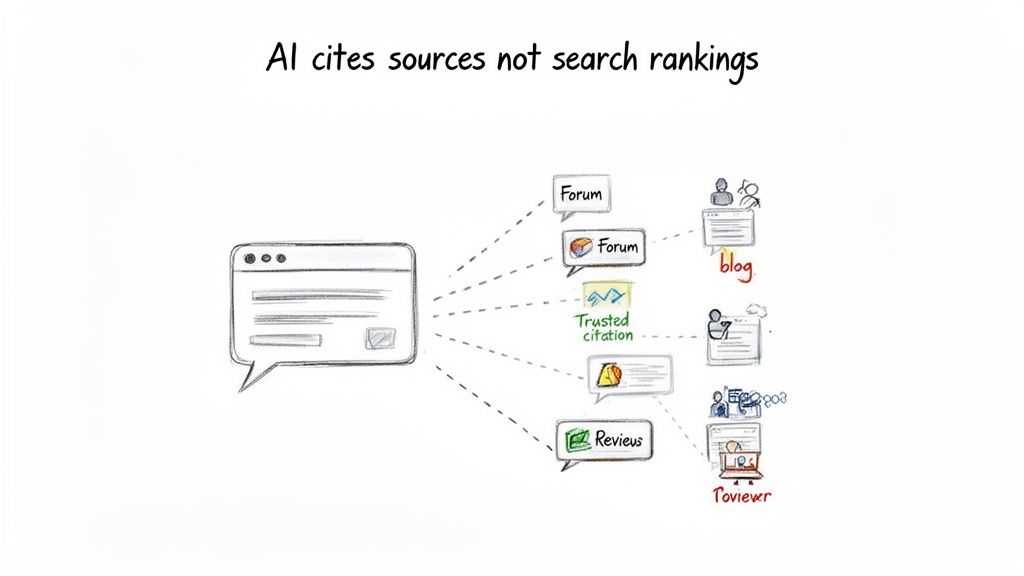
The key lesson here is that LLMs create responses by pulling together information from sources they trust. And often, those sources are places many marketers ignore:
- Community Hubs: Think forums like Reddit or Quora, where real people are having candid conversations about what works and what doesn't.
- Niche Publications: The deep-dive industry blogs and specialist news sites that offer expert analysis, not just surface-level fluff.
- Authoritative Reviews: Detailed comparison posts and platforms filled with genuine user feedback.
Figuring out this "information diet" is your first move. It’s how you start placing your brand's story exactly where the AI is already looking for answers.
Module 2: Hands-On Prompt Research
Once you know how the AI thinks, you need to find out what your customers are asking it. This is where you get your hands dirty with prompt research—think of it as the 2026 version of keyword research, but for conversations.
A great generative engine optimization course teaches you to pinpoint the exact questions and prompts that signal a customer is ready to buy. You learn to identify the exact questions your target audience asks AI assistants, anticipating the "job to be done" that sends someone to an AI for a recommendation, a how-to guide, or a product comparison.
This isn't a guessing game. It’s a systematic process for finding those high-intent questions where having your brand mentioned can be the difference between a sale and a missed opportunity. To get a better sense of how this differs from traditional SEO, you can dig into the specifics of AI search engine optimization.
Module 3: Measurement and Iteration
You can't get better if you're flying blind. The final, and arguably most important, module is all about measurement. This is where a dedicated GEO platform becomes non-negotiable, turning your efforts from hopeful shots in the dark into a predictable, data-backed strategy.
Using a tool like PromptPosition, you can finally get concrete answers. You track your visibility, sentiment, and position across ChatGPT, Claude, Gemini, and other models so you can see what’s working and adjust.
You can monitor your share of voice for your most important prompts, benchmark yourself against competitors, and see exactly which sources are feeding the AI its information about you. This data-first mindset is what elevates GEO from a marketing experiment to a measurable and repeatable discipline.
From Invisible To Influential: A GEO Case Study
Theory is one thing, but seeing Generative Engine Optimization (GEO) in the wild is another. Nothing drives the point home like a real-world story, so let's walk through an example that perfectly captures the growing gap between traditional SEO success and true AI visibility.
This story, centered on how a generative engine optimization course provides a blueprint for success, involves a B2B SaaS company we often reference. By every metric that mattered just a few years ago, they were crushing it. They held top-three Google rankings for their most valuable keywords, enjoyed a steady stream of organic traffic, and ran a solid content program.
But then their customers started turning to AI assistants for advice, and the company vanished. They were completely invisible.
Diagnosing The Invisibility Problem
The funny thing was, the team didn't even know they had a problem. All their trusted tools—Google Analytics, Ahrefs, Semrush—were flashing green. The issue only surfaced when they started running their key prompts through PromptPosition to track how they appeared (or didn't) in AI-generated answers to key questions.
The data told a brutal story. For prompts like "best software for X" or "compare Y and Z," their competitors were getting all the praise. The company’s brand wasn't just missing; it was being actively ignored in the new conversational search space.
Using the platform, they traced the AI models’ citations back to the source. It wasn't the big-name tech blogs or industry publications they'd spent years courting. Instead, the AI was learning from two very different places:
- Niche Reddit communities where real users were sharing honest, unfiltered product experiences.
- Hyper-detailed comparison articles tucked away on smaller, specialized review sites.
Suddenly, their hard-won Google rankings felt hollow. The AI's sources of truth were different, and they had absolutely no footprint there.
The Three-Month Turnaround Strategy
Once they knew where the real conversations were happening, the team launched a surgical, three-month campaign. They didn't try to boil the ocean. They just focused on the influential sources that PromptPosition had flagged.
- Genuine Reddit Engagement: They stopped broadcasting marketing messages and started participating. Team members jumped into relevant subreddits, answered questions with real expertise, and built a reputation for being helpful, not pushy.
- Targeted Blogger Outreach: They identified the exact comparison posts the AI was referencing and connected with the authors. They offered demo accounts, provided clear product details, and made a case for being included in the next update.
- Creation of Citable Assets: They built simple one-pagers and data sheets. This made it incredibly easy for reviewers and community members to grab accurate specs and features, ensuring the information being shared was correct.
This process perfectly mirrors the core tenets of any good GEO strategy: understanding how the AI thinks, digging into its sources, and measuring your impact relentlessly.
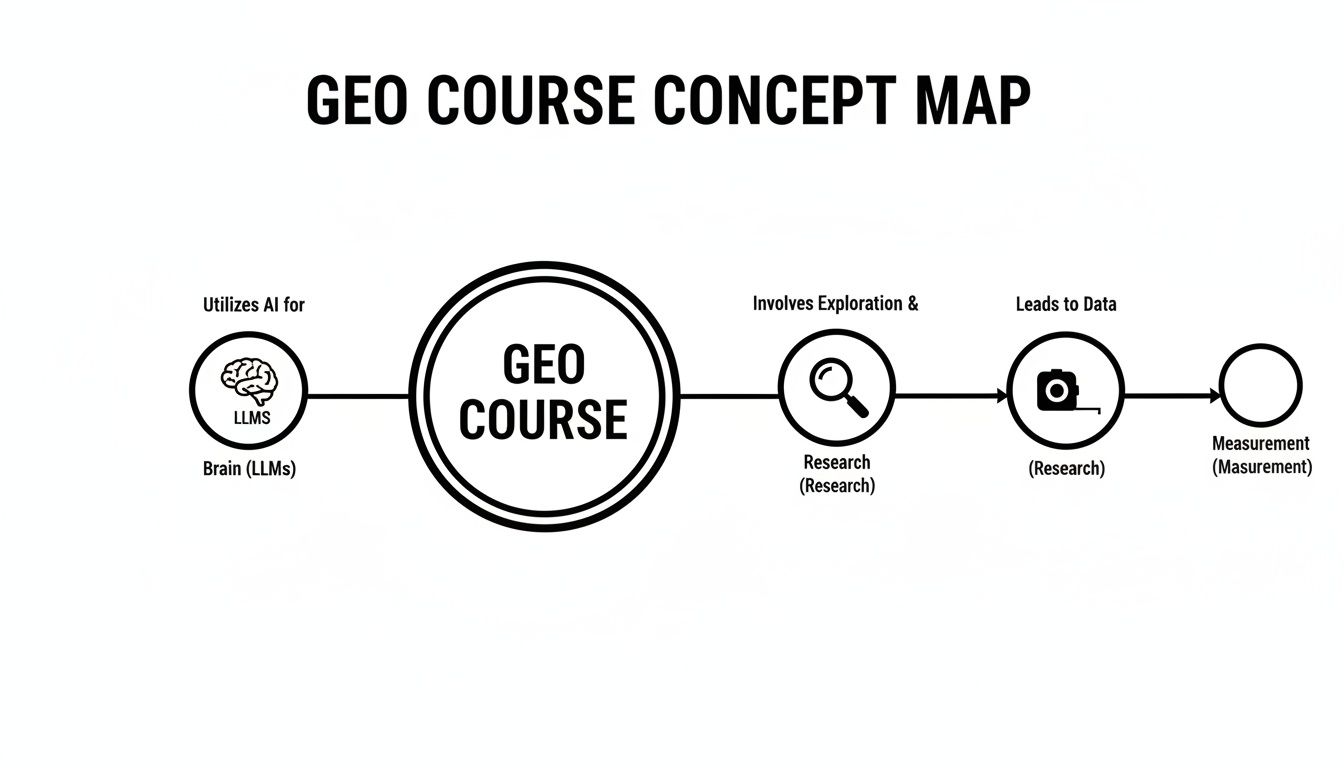
The results were stunning. After just three months of focused work, the company shot from having zero AI mentions to appearing in roughly 40% of their tracked prompts. While their Google rankings stayed the same, their influence in AI-powered search went from non-existent to unavoidable.
It’s a powerful lesson in the necessity of improving your brand's AI visibility with a strategy built for this new reality.
Optimizing Your Content For AI Models
So, how do you actually get your brand to show up in AI-generated answers? The good news is, it has less to do with gaming an algorithm and more to do with becoming a genuinely trustworthy source of information. This is where a generative engine optimization course helps you pivot from old-school SEO tactics to building a web of authority.
The playbook is surprisingly down-to-earth. You need to be present and helpful in the places AI models already look for information.
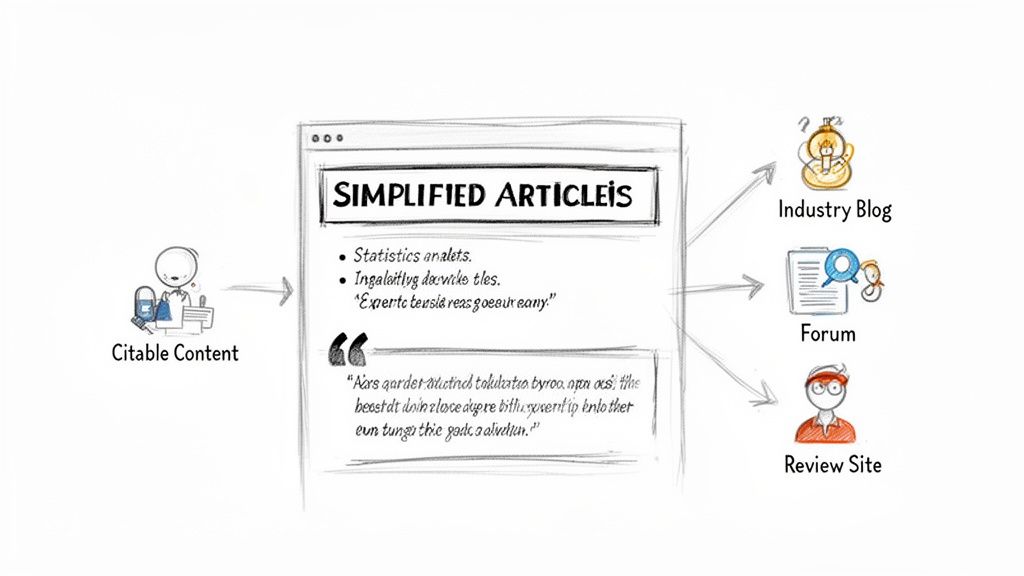
Think of it less as a technical hack and more as a digital PR strategy. Your new target audience? The AI itself. This means creating content that is "citable" by design—clear, factual, and structured so a machine can easily pull out a key insight and attribute it back to you.
Go Where The AI Goes: The Power of Source Hacking
To influence an AI, you first have to understand where it gets its information. While every model’s training data is its own "secret sauce," they consistently favor certain types of sources that go far beyond a company's own website.
Your content strategy needs to prioritize being seen in these key places:
- Niche Industry Blogs: These are the publications that offer deep, expert analysis. AI models turn to them for credible commentary and product comparisons.
- Forums like Reddit and Quora: These platforms are goldmines of authentic user conversations, debates, and product recommendations. Answering questions here establishes your brand as a helpful expert.
- Authoritative Review Sites: Platforms like G2 or Capterra, and even detailed personal blog reviews, provide the third-party validation that AI models weigh heavily.
The goal is to stop shouting into the void on your own blog and start participating where your customers—and the AIs learning from them—are already listening. A tool like PromptPosition is incredibly useful here, helping you pinpoint which sources are influencing AI answers in your industry. This allows you to focus your content and PR efforts for maximum impact.
Making Your Content More Citable
Once you’ve identified the right channels, the next step is creating content that AI models can easily parse and trust. This involves a few practical tweaks to how you present your information.
The core of citable content is simple: make your facts easy to find and your expertise easy to quote. Structure your content with clear language, hard statistics, and expert insights that an AI can grab and reference without ambiguity.
For instance, we know from research that GEO methods can significantly boost visibility. A 2023 study showed that including statistics can provide a 37% lift and adding citations can result in a 9% lift, leading to an overall visibility increase of up to 40%. The demand for this knowledge is only growing; projections show that 56% of marketers will integrate generative AI into their work by 2026.
To create and distribute this kind of optimized content effectively, you might explore various AI course builder platforms, which often support creating structured, citable information. For more specific strategies, check out our guide on AI-driven content optimization.
Actionable GEO Content Tactics
Getting started with Generative Engine Optimization doesn't require a total overhaul of your content strategy. By focusing on a few practical techniques, you can significantly improve your brand's visibility in AI-generated answers.
The table below summarizes some of the most effective tactics you can implement right away.
| Tactic | Description | Example |
|---|---|---|
| Answer-First Structure | Place the direct answer to a user's likely question within the first few sentences of your content. | For a post on "best CRM for startups," start with: "The best CRM for a startup is one that balances affordability with scalability…" |
| Include Expert Quotes | Weave in quotes from internal experts or industry leaders to add credibility and provide easily citable soundbites. | "According to our lead data scientist, Jane Doe, 'The key is to focus on clean, well-structured data from the outset.'" |
| Use Hard Data | Sprinkle in specific, verifiable statistics and data points throughout your content to demonstrate factual authority. | Instead of "many users prefer X," write "72% of our users reported a preference for X in a recent survey." |
| Engage in Forums | Actively participate in relevant Reddit or Quora threads, offering genuine advice and linking to deeper resources when appropriate. | Find a thread asking for software recommendations in your niche and provide a helpful, non-promotional answer. |
Ultimately, each of these tactics serves the same core purpose: to make your brand the most reliable, citable, and helpful source of information in your field.
How To Measure Your GEO Success
There’s an old business saying: if you can't measure it, you can't improve it. That’s never been more true than in the often-murky world of AI models. Unlike traditional SEO, where we have concrete metrics like keyword rankings and organic traffic, Generative Engine Optimization (GEO) demands a completely new way of looking at performance.
The objective here isn't just about driving traffic; it’s about shaping the conversation. This means we have to move past simple vanity metrics and start tracking what really moves the needle: your share of voice in AI-generated answers, the sentiment surrounding your brand, and how you stack up against the competition.
Fortunately, we can now turn the "black box" of AI into a clear dashboard of actionable KPIs. Modern marketing teams are using specialized tools to finally see what’s working, what isn't, and where they need to point their efforts next.
Setting Up Your GEO Dashboard
First things first, you need to establish a baseline. You won't know if the lessons from your generative engine optimization course are making a difference until you know exactly where you stand right now. This is where a dedicated tracking platform like PromptPosition becomes absolutely essential.
Using a tool like PromptPosition, you can start tracking your most important prompts across all the major LLMs. We’re not just talking about simple brand name searches here. Think about the high-intent questions your ideal customers are asking right before they decide to buy.
Your initial setup should concentrate on three core areas:
- Visibility: In what percentage of answers for your target prompts does your brand get mentioned?
- Sentiment: When your brand is mentioned, is the tone positive, negative, or just neutral?
- Source Analysis: Which specific websites, articles, or forum threads are the AI models referencing when they talk about you or your industry?
This initial data pull gives you a crystal-clear starting point. One marketing team came in thinking their AI visibility was fine because they had a strong brand. In the first session, they set up tracking in PromptPosition and realized they weren't mentioned in a single ChatGPT or Gemini response for their top five product prompts. That was a wake-up call.
Core Metrics to Track for GEO
Once your tracking is live, you can start monitoring the KPIs that signal real progress. For a moment, forget about clicks and impressions. Instead, your focus should shift to these foundational GEO metrics.
The single most powerful GEO metric is Share of Voice—the frequency your brand is mentioned for a set of target prompts versus your competitors. This one number tells you how much of the AI-driven conversation you actually own.
Here are the vital signs of a healthy GEO strategy:
- Brand Mention Frequency: Simply put, how often does your brand show up in responses to relevant queries? A platform like PromptPosition can monitor this across models like ChatGPT, Gemini, and Claude, letting you see if your mentions are trending up over time.
- Competitive Benchmarking: How does your mention frequency compare to your top three rivals? Seeing this data in real-time reveals exactly who is winning the AI recommendation game.
- Sentiment Trend Lines: Are the mentions of your brand becoming more positive? Tracking sentiment allows you to gauge if your messaging and PR initiatives are successfully shaping how AI perceives your company.
- Citation Source Tracking: Which specific articles or Reddit threads are feeding the AI its answers? Knowing this helps you double down on what works, whether that means getting more active in certain communities or building stronger relationships with key publishers.
By focusing on these metrics, GEO transforms from a guessing game into a data-driven discipline. You can draw a direct line from your efforts—like getting your product featured in a major review article—to a measurable lift in positive brand mentions within AI assistants.
Your First Generative Engine Optimization Project
Alright, let's get our hands dirty. Theory is one thing, but the real insights come from doing. This guide is your starting block—a simple, practical plan to launch your first Generative Engine Optimization (GEO) project and start making a real impact on how AI sees your brand.
And don't worry, you don’t need to be a data scientist or a developer to get started. If you have a solid grasp of your brand, your customers, and who you're competing against, you have everything you need. A little SEO or content marketing experience is a bonus, but not a dealbreaker.
Step 1: Identify Your "Money" Prompts
First things first, we need to figure out which questions actually matter. I'm not talking about simple searches for your brand name. I’m talking about the high-stakes questions your ideal customer asks an AI assistant right before they pull out their credit card.
These are your "money" prompts.
Start by brainstorming 5-10 of these critical queries. You'll find they usually fit into a few common patterns:
- Comparison Prompts: "What is the best alternative to [Competitor Product]?"
- Recommendation Prompts: "What is the best software for [specific job]?"
- Problem/Solution Prompts: "How can I solve [specific business pain point]?"
- Best-Of Prompts: "Top 5 tools for [specific industry]"
These prompts are the new battlegrounds where business is won or lost. Nailing them is the first step to owning the conversation.
Step 2: Set Up Tracking and Establish a Baseline
Now that you have your list of prompts, it’s time to see how you stack up. Flying blind isn't a strategy, it's a liability. You need data, and that means you need a tool built for GEO.
Using a platform like PromptPosition, you can track your money prompts across all the major AI models—ChatGPT, Gemini, Claude, you name it. This isn't just about spotting your brand name; it's about getting the full picture.
You'll want to measure:
- Visibility: In what percentage of answers does your brand even appear?
- Sentiment: When you are mentioned, is it positive, negative, or just neutral?
- Position: Are you mentioned first, or only after three of your biggest competitors?
This initial data gives you an honest, unfiltered look at your starting line. It will immediately show you where you're invisible and where your biggest opportunities are hiding.
Step 3: Analyze and Act on the Data
With your baseline set, the real work begins. It's time to dig into the 'why'. Where are your competitors showing up that you aren't? More importantly, what specific sources are the AI models citing to back up their answers—Reddit threads, niche blogs, review sites?
This data becomes your roadmap.
By the end of their course, one marketing team we worked with had built a targeted content strategy around the sources LLMs actually cite. Within two months of implementing what they learned, their AI visibility went from near-zero to consistent mentions across three major models. That's the power of a focused GEO project—it takes you from hoping you'll be mentioned to making sure you are.
Your Top GEO Questions, Answered
Jumping into Generative Engine Optimization is a smart move, but it's bound to bring up some questions. If you're wondering what it takes to get started and how this all differs from the marketing you already know, you're not alone. Here’s what marketers like you are asking.
What Do I Need to Know Before Taking a GEO Course?
Honestly, the most important thing you can bring to the table is a deep understanding of your brand’s place in the market. You need to know who your real competitors are and what your customers are really trying to solve.
Sure, a background in content marketing or SEO helps, but you don't need to be a coding whiz. The students who get the most out of these courses are strategic thinkers who are obsessed with their brand’s narrative.
Want a head start? Sign up for a free PromptPosition trial before the course. You’ll be able to work with your own brand's data from day one, turning every lesson into a practical, real-world strategy session.
How Is Generative Engine Optimization Different From SEO?
This is the big one. Traditional SEO is a race to rank your website on a list of blue links. Generative Engine Optimization (GEO) is entirely different—it's about becoming a trusted source cited directly inside an AI-generated answer.
Think of it like this: SEO gets your restaurant on the city's top 10 list. GEO makes you the secret ingredient the city's best chef recommends by name in their own recipes.
The goal shifts from just ranking for keywords to building so much authority that AI models can't ignore you. That means focusing on the places LLMs learn from—think niche blogs, respected forums, and detailed product reviews, not just Google's front page.
Do I Really Need a Special Tool for GEO?
You can brainstorm a GEO strategy on a whiteboard, but you can't measure or scale it without a dedicated tool. Trying to track your brand's presence in AI manually is like trying to count raindrops in a storm. It’s just not possible.
A platform like PromptPosition is your command center. It’s built to track your visibility, sentiment, and share of voice across major AI models like ChatGPT, Gemini, and Claude. It takes the guesswork out of the AI "black box" and gives you clear KPIs. Without it, you're flying completely blind.
Ready to stop guessing and start measuring your brand's true AI visibility? With PromptPosition, you can track your share of voice, benchmark against competitors, and discover the exact sources shaping your narrative in AI.