A Beginner’s Guide to Answer Engine Optimization (AEO)
For years, we've all been laser-focused on one thing: ranking on Google. But the ground is shifting beneath our feet. The new goal isn't just to appear in a list of search results—it's to become the answer itself. This is the world of Answer Engine Optimization (AEO).
Simply put, AEO is the practice of optimizing your brand’s presence in AI-generated answers, not just traditional search results. It’s how you get recommended by AI assistants like ChatGPT, Claude, Gemini, and Perplexity, winning in a new era where the AI provides the complete answer directly to the user.
What Is Answer Engine Optimization?
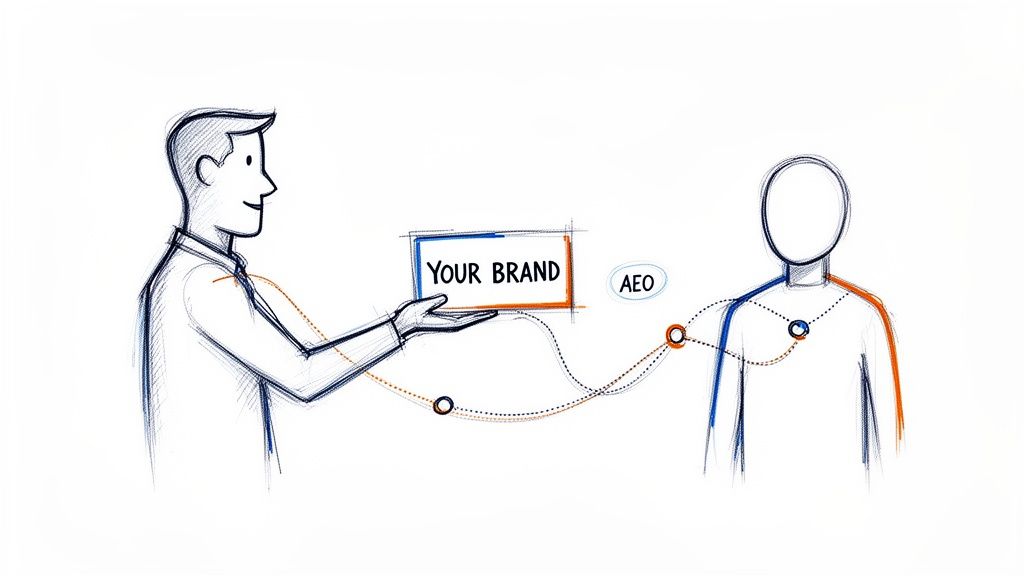
Think of it this way: when you ask a personal research assistant a question, you don't want a long list of books to read. You want a direct, synthesized answer. That’s exactly how millions of people are now using AI chatbots and voice assistants.
Answer Engine Optimization (AEO) is the craft of ensuring your brand is the expert this new generation of digital assistants trusts and quotes. This is a huge shift from traditional Search Engine Optimization (SEO). While SEO is about climbing a list of links, AEO is about getting your brand's information woven directly into the AI's response.
The goal isn’t just visibility in a list—it's becoming the answer.
How AEO Differs from Traditional SEO
The distinction is critical. SEO success is measured by your rank on a Search Engine Results Page (SERP), like Google. But with AEO, success is measured by how often an AI model like ChatGPT mentions your brand, cites your data, and reflects your messaging in its answers.
Here's a quick breakdown to see the differences side-by-side.
Quick Guide: SEO vs AEO At a Glance
| Aspect | Traditional SEO | Answer Engine Optimization (AEO) |
|---|---|---|
| Primary Goal | Rank on a list of search results (Google). | Get recommended in AI-generated answers (ChatGPT, Claude, etc.). |
| Target | Search engine crawlers and ranking algorithms. | Large Language Models (LLMs) and their knowledge base. |
| Key Metric | Keyword rankings, organic traffic, backlinks. | Brand mentions, citations, and sentiment in AI responses. |
| Main Arena | Your website and its direct backlinks. | The entire information ecosystem (web, forums, wikis, review sites). |
This table really just scratches the surface, but it highlights the fundamental change in mindset required.
The new digital divide is simple: either you are the source for AI answers, or you are invisible. When a user gets a complete answer from an AI, their search journey ends. If your brand wasn't part of that answer, you never even existed.
This reality calls for a whole new playbook. Instead of just tinkering with your own website, you need to influence the entire ecosystem of information that AI models—or Large Language Models (LLMs)—learn from. For more on this, you might find our guide on the related concept of Generative Engine Optimization helpful.
The Practical Pillars of AEO
So, where do you even start? Getting into AEO doesn't mean you should abandon your SEO efforts. It’s more like adding a new, crucial layer to your strategy, focused on three core pillars.
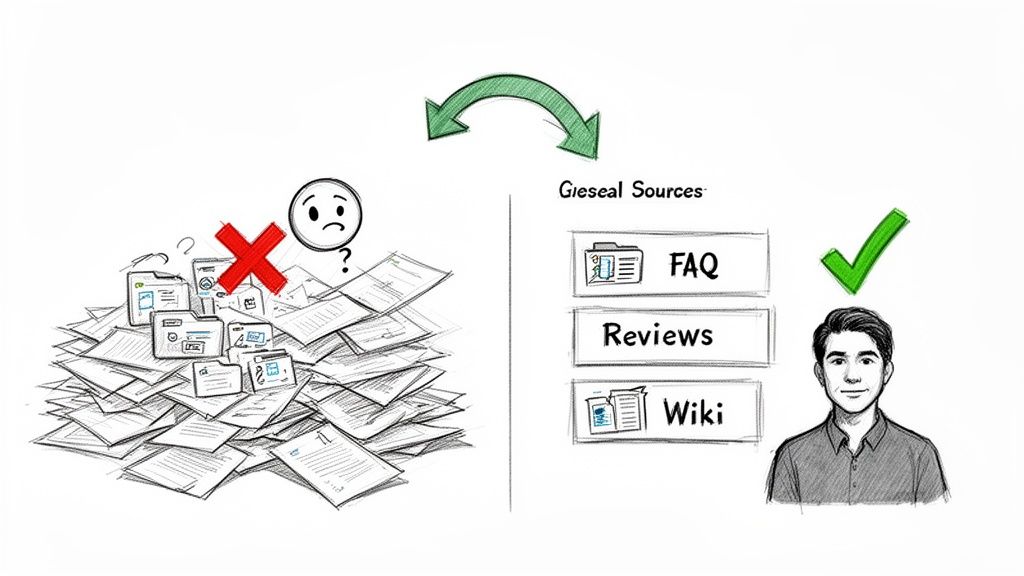
Focus on the Sources LLMs Cite: LLMs build their knowledge from a huge pool of digital content, but they give special weight to authoritative sources like Wikipedia, top-tier industry publications, and massive forums like Reddit and Quora. Building a credible, factual presence on these platforms is a cornerstone of any AEO strategy.
Build Presence on Community & Review Platforms: AI models learn about real-world consensus from review sites and community discussions. Positive mentions, detailed reviews, and helpful discussions on platforms like G2, Capterra, or even niche industry forums can directly influence how an AI perceives and talks about your brand. AEO involves optimizing content for the very AI agent for customer service that are changing how businesses operate.
Create Content AI Can Easily Reference: AI models prefer content that is factual, well-structured, and easy to parse. By creating clear FAQs, detailed data sheets, and articles that directly answer specific user questions, you make it incredibly easy for an AI to grab your information and cite it accurately.
Of course, the final piece of the puzzle is measurement. How do you know if your AEO efforts are actually working? It’s practically impossible to manually check your brand’s visibility across every major AI model every day. This is where a specialized tool like PromptPosition becomes indispensable. It helps teams measure whether their AEO efforts are actually working by tracking visibility and sentiment across all major models daily.
Why AEO Is the Critical Marketing Shift of 2026
For the better part of two decades, we all played the same game: get to the top of Google's first page. That was the singular goal. But that game is quickly becoming obsolete. The ground has shifted under our feet with the arrival of AI-powered answer engines like Google's AI Overviews, ChatGPT, and Perplexity, completely changing how people get information.
This isn't some far-off prediction; it's happening as we speak. When someone asks a question and gets a perfect, complete answer right then and there from an AI, their search is over. No click. No website visit. No chance for you to make your case. If your brand wasn't in that AI's answer, you're now digitally invisible.
Being ignored by AI is the new 'page two of Google.' If you aren't cited as a source or mentioned in the response, your brand effectively doesn't exist for that user's query.
This demands a completely new playbook. We've entered a new "zero-click" world where the fight isn't for a spot on a list, but for a direct mention in an AI-generated answer. It’s why you absolutely need to understand what is answer engine optimization and why it's now a business-critical priority.
The Vanishing Click and the Rise of Citations
The data tells a pretty stark story. As AI-driven search becomes the norm, we're seeing a dramatic collapse in the traditional click-through rates (CTR) we've relied on for years. That coveted number one organic ranking just isn't the prize it used to be.
Take a look at what happened in the year after AI Overviews were fully rolled out. The average CTR for the top organic result took a nosedive, falling from around 0.73 in March 2024 to just 0.26 by March 2025. That’s a staggering 64% drop. The message is clear: ranking high is no longer a guarantee you'll get any traffic. You can dig deeper into the numbers in the state of Answer Engine Optimization in 2026 report.
But it’s not all bad news. There's a new prize to be won. That same data shows brands that get cited within these AI answers have a huge leg up, enjoying a 35% higher CTR than brands that are left out. The goalposts have officially moved from ranking to citation.
A New Strategic Imperative for Brands
Failing to make this pivot isn't just a missed opportunity—it's a fast track to losing authority, traffic, and the trust you've built with your audience. When AI engines consistently name your competitors as the experts, your voice gets drowned out and your relevance starts to fade.
This is all part of a larger trend where powerful AI content strategy services are reshaping how companies fight for attention. A smart AEO strategy is what ensures your business stays in the conversation.
To win in 2026 and beyond, you have to start thinking with an AEO-first mindset. This really boils down to a few key actions:
- Prioritizing Factual, Citable Content: Your content needs to be authoritative, well-structured, and easy for an AI to digest and reference as a trustworthy source.
- Building Presence on Key Platforms: LLMs pull heavily from community forums and review sites, so establishing your brand's credibility on these platforms is no longer optional.
- Measuring What Matters: It's time to stop obsessing over keyword rankings and start tracking brand mentions, sentiment, and your share of voice inside AI answers.
Trying to manually track your brand's performance across every AI model is a massive headache. This is exactly where a dedicated platform like PromptPosition comes in. It gives you the tools to see if your AEO efforts are actually paying off by tracking your visibility, sentiment, and competitive standing across all major models, every single day. It turns the black box of AI into clear, actionable insights for your brand.
How AI Answer Engines Find Their Information
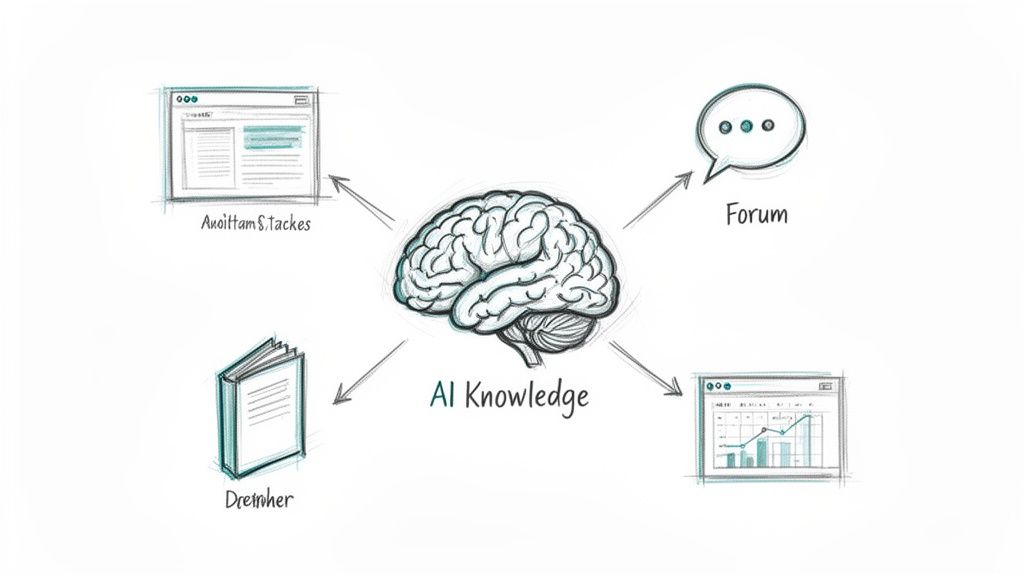
If you want to win at Answer Engine Optimization, you first have to get inside the "mind" of an AI like ChatGPT or Gemini. The key thing to realize is that they don't work like a typical search engine, fetching live results for every single question. It's more like talking to someone who has already read a massive library of human knowledge and is giving you a summary.
Large Language Models (LLMs) aren't browsing the web in real time. Instead, they’re trained on a vast, static snapshot of the internet—billions of web pages, articles, books, and forum discussions. This massive dataset becomes their entire worldview, their core knowledge base.
When you ask a question, the AI pulls its answer primarily from this internal, pre-existing knowledge. For very recent events, some models might do a quick, limited search to get fresh information, but the foundation is already set. This is exactly why what is answer engine optimization has become such a critical discipline; your job is to make sure your brand is a fundamental, trusted part of that foundation.
The Importance of Sources
This brings us to the most crucial concept in AEO: sources. An LLM doesn't just invent information. It synthesizes what it has learned from the specific websites, documents, and data it was trained on. These are the sources it trusts and cites.
Think of it like a brilliant research assistant who has read nearly every book in the library. When you ask them a question, they don't go re-read every book. They synthesize an answer based on the most credible and consistent information they've already consumed.
This is precisely how answer engines operate. They give more weight to information that is authoritative, appears consistently across multiple platforms, and is laid out clearly. If an AI sees your brand mentioned accurately and positively on high-authority sites, it learns to trust you.
How AI Prioritizes Information
Of course, not all information is created equal. AI models have gotten pretty sophisticated at figuring out which sources are reliable and which ones aren't. A smart AEO strategy is all about feeding the AI the right signals from the right places.
The AI gives top priority to content that is:
- Authoritative: Information from respected publications, official company websites, and established expert sources will always carry more weight.
- Consistent: When an AI finds the same facts about your brand on your website, your Wikipedia page, and major industry review sites, its confidence in that information skyrockets.
- Clearly Structured: Content that uses simple headings, lists, and direct Q&A formats is much easier for an AI to understand, process, and reference accurately.
Your job as a marketer is to make sure your brand's information checks all these boxes. The goal is to become such a reliable source that the AI naturally includes you in its answers. Part of this involves understanding the complex ways LLMs break down questions, sometimes using a technique called query fan-out to pull from different kinds of information at once.
Trying to manually track how your brand is being portrayed across all these different AI models is practically impossible. This is where a platform like PromptPosition comes in. It automates the entire process, tracking your brand's visibility, the sentiment of the mentions, and specific phrases used across all the major AI models, every single day. It turns the black box of AI answers into clear, actionable data so you can see if your AEO efforts are actually paying off.
The AEO Playbook: A Practical Guide
Alright, let's move from theory to practice. Knowing how AI models find information is one thing, but actually getting your brand into their answers is another. This is where you build a real AEO playbook. It’s not about finding a few quick hacks; it’s about systematically building a digital footprint so strong that AI engines can't help but trust and cite you.
Your strategy boils down to three main areas of focus: showing up on the right sources, creating content that AI can actually understand, and keeping your brand messaging consistent everywhere. If you can get these right, you’ll have a repeatable process for becoming an authority that AI assistants like ChatGPT and Claude rely on for their answers.
Pillar 1: Optimize Your Sources
First things first: you need to build a credible presence on the platforms that LLMs already trust. Think of it as establishing your credentials with the AI’s most influential teachers. This isn't just about your own website—you have to meet the AI where it's already learning.
Recent data shows just how important this is. AI is starting to send real traffic, now accounting for 1.08% of all website visits in some key industries. And where is that traffic coming from? The sources are telling. An incredible 47.9% of ChatGPT's referrals originate from Wikipedia, while Reddit shows up in 21% of Google's AI Overviews. These numbers, pulled from a recent AEO benchmarks report, make it clear: ignoring these third-party platforms is no longer an option.
So, your action plan for source optimization should include:
- Community Platforms: Get active on sites like Reddit and Quora. Dive into relevant conversations, answer questions genuinely, and make sure your brand is part of the discussion in a helpful, accurate way.
- Review Sites: Go out of your way to encourage detailed, honest reviews on platforms like G2, Capterra, or Trustpilot. AI models scan these sites to understand how products perform and what real customers think.
- Authoritative Publications: Earn mentions or contribute content to top-tier industry publications. A citation from a well-respected journal or news outlet is a massive trust signal for an LLM.
Pillar 2: Create Content for AI Consumption
Once you're building a stronger presence on key external sites, the next step is to shape your own content so that AI models can easily parse, understand, and use it. An LLM doesn’t “read” an article for its beautiful prose; it processes it for facts, structure, and clarity. Your job is to make your information as easy as possible for a machine to digest.
This often means shifting away from purely narrative-driven blog posts and toward more structured, fact-based formats.
An AI model is looking for the most efficient path to a correct answer. Well-organized, factual content is a superhighway for it, while dense, unstructured prose is a confusing side road. Make it easy for the AI to choose your content.
To create content that AI models love, start focusing on these formats:
- Detailed FAQs: Build out comprehensive FAQ pages that answer common questions directly. Use the question itself as a subheading and provide a clear, concise answer right below it.
- Data Sheets and Spec Pages: For any product or service, present the facts. Tables, lists, and clear specifications are perfect for this.
- "What Is" and "How To" Articles: Develop content that explicitly defines key concepts in your industry or offers clear, step-by-step instructions. This format directly mirrors the kind of informational queries people bring to AI.
Creating this kind of content is a huge part of what some people are calling AI search engine optimization, because it works double-duty, serving both your human audience and the AI models that are learning from you.
Pillar 3: Measure and Refine Your Efforts
Finally, no playbook is complete without a way to keep score. How do you know if all this work on your sources and content is actually paying off? Manually searching every major AI model every day for mentions of your brand is not just inefficient—it’s impossible.
This is where a dedicated tool becomes essential. A platform like PromptPosition, for example, is built specifically for this challenge. It lets you track your brand’s visibility, the sentiment of those mentions, and your overall share of voice across all the major AI models, with daily updates. By monitoring these metrics, you can quickly see which strategies are working and where you need to make adjustments. It turns the black box of AI answers into a marketing channel you can actually measure and improve.
How to Measure Your AEO Performance
So, you've put together a smart AEO strategy. That’s a great start, but how can you tell if it's actually paying off? In the new world of AI-generated answers, our old friends—keyword rankings and organic traffic—only tell a sliver of the story. Success isn't about climbing a list of blue links anymore. It's about becoming the trusted source inside the answer itself.
This shift means we need a completely new set of metrics built for the AI era. You can't just log into Google Analytics to check your AEO performance. Instead, you have to find a way to measure your brand’s presence within AI responses, which requires a total mindset change around how we track visibility and influence.
AEO success isn't measured by where you rank, but by whether you are mentioned at all. In this new landscape, the key metrics are your share of voice, the sentiment of your mentions, and the attribution of your sources.
Let's be realistic: manually checking every major AI model for your brand mentions every single day is a non-starter. The outputs are dynamic, complex, and can change from one minute to the next. This is exactly why dedicated AEO analytics tools are becoming so critical.
The New Benchmarks for AEO Success
To get a real handle on your performance, you have to look beyond old SEO habits and embrace metrics that actually reflect your influence on AI. The three most important KPIs for answer engine optimization are Share of Voice, Sentiment Analysis, and Source Attribution.
Share of Voice (SoV): This is your brand's turf. It measures how often your brand is mentioned in AI answers for a specific set of prompts compared to your competitors. A high SoV signals that you're seen as the dominant authority. For example, if you ask "what is the best CRM for a small business?" and your brand pops up in 7 out of 10 responses, your SoV is incredibly strong. You can learn more about calculating share of voice in our detailed guide.
Sentiment Analysis: Getting mentioned is one thing, but how you're mentioned is just as important. Sentiment analysis tracks whether the AI is framing your brand in a positive, negative, or neutral light. A positive mention builds your reputation, but a negative one is a flashing red light that you need to address immediately.
Source Attribution: This is where the rubber meets the road, connecting your efforts to tangible results. Source attribution tells you exactly which of your owned or earned media assets—blog posts, case studies, or even that Wikipedia page you've been curating—are being cited by the AI. It shows you precisely which content is doing the heavy lifting.
The AEO playbook for improving these metrics is a continuous loop of optimizing your sources and creating content that AI models can easily understand and trust.
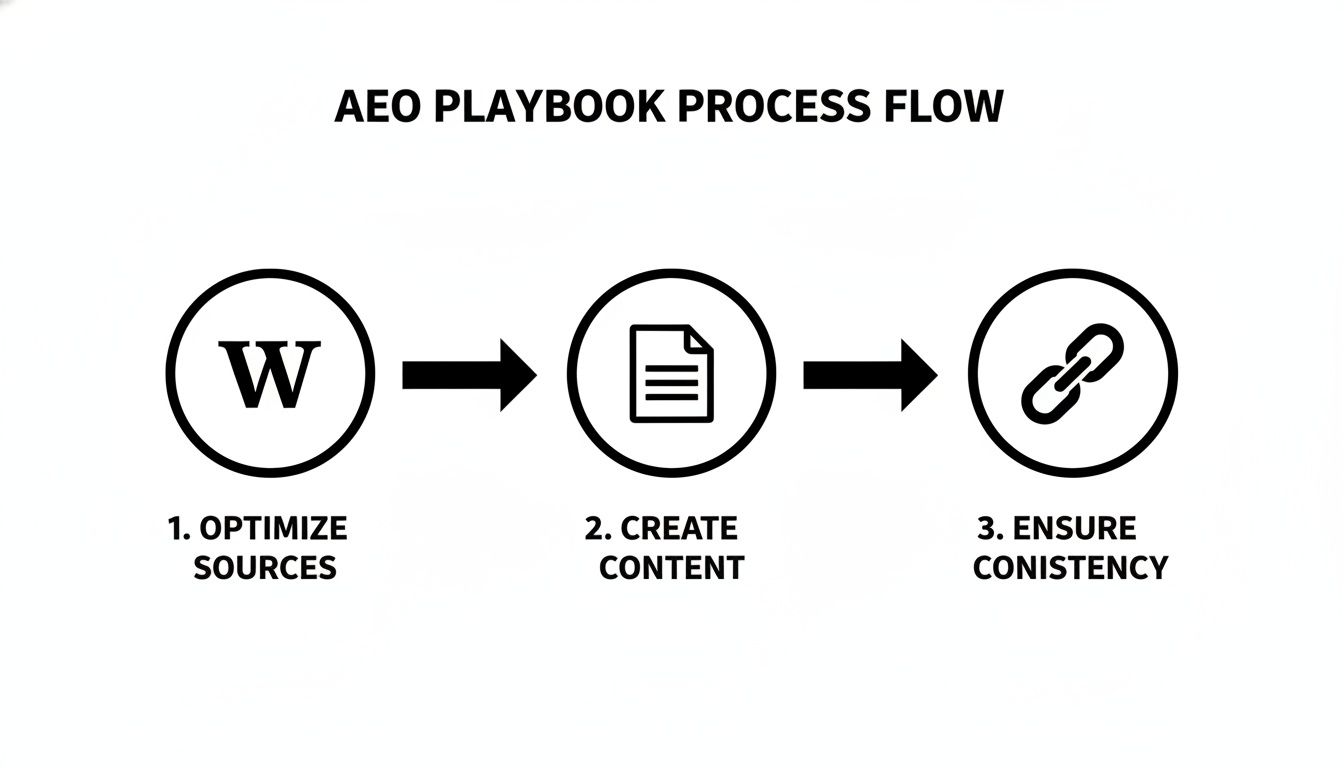
As you can see, this process directly feeds your ability to get cited and recommended, which in turn boosts your SoV and sentiment.
Turning Opaque AI Answers into Actionable Data
Without the right tools, these new metrics are practically impossible to track. Manually prompting different AIs will only give you spotty, anecdotal evidence—hardly enough to build a strategy on. You need a purpose-built platform to get reliable, structured data.
A platform like PromptPosition was designed to solve this very problem. It automates the daily tracking of your brand's visibility, sentiment, and competitive standing across all the major answer engines like ChatGPT, Claude, Gemini, and Perplexity.
By serving up daily data on mentions and sentiment, the platform turns the "black box" of AI answers into clear, measurable KPIs. This gives marketing teams the visibility they need to prove the ROI of their AEO strategy and make data-driven decisions to cement their brand's presence before competitors can get a foothold.
Common AEO Mistakes and How to Avoid Them
As everyone rushes to figure out what is answer engine optimization, I'm seeing the same predictable traps catch even savvy marketing teams. The most common misstep, by far, is trying to cheat the system with low-quality, mass-produced AI content. It's a shortcut that leads directly off a cliff.
The temptation is real—churn out tons of articles to blanket every possible question. But this strategy always backfires. Search engines and AI models are built to spot and penalize thin, unhelpful content. They’re getting better at it every single day.
The proof is in the data. After Google's major March 2024 update, a staggering 100% of websites that received a manual penalty were caught using AI-generated content. Worse, half of those were flagged as the 'lowest quality' imaginable, causing a devastating collapse in both rankings and AI visibility. You can read more about these answer engine optimization trends on blog.hubspot.com.
Focusing Only on Your Own Website
Another critical error is tunnel vision—concentrating exclusively on your own website. Your site is absolutely a cornerstone of your strategy, but it's just one piece of a much larger puzzle. AI models learn about your brand from conversations happening all over the web.
If you ignore what's being said on third-party platforms, you’re essentially making your brand invisible. LLMs learn about real-world perception and brand reputation from places where genuine conversations happen, like:
- Community Forums: Threads on Reddit and Quora give a raw, unfiltered look at what real users think.
- Review Sites: Platforms like G2 and Capterra offer direct feedback on your products and customer service.
- Authoritative Publications: A single mention in a major media outlet can be a massive signal of trust and authority.
Think about this: for many brands, 50% of their AI citations originate from just 20 major media outlets. By neglecting your presence on these external sources, you're willingly giving up control over half of your brand's narrative.
The heart of AEO is building a distributed digital identity. The goal isn't just to have a great website; it's to create a consistent, authoritative presence everywhere AI models are learning.
Treating AEO as a One-Time Setup
Finally, too many brands fall into the "set it and forget it" mindset. They’ll tweak a few pages, publish a new FAQ, and check AEO off their to-do list. This completely misunderstands the nature of AI.
Answer engines are alive. They are constantly ingesting new information and refining their understanding. Meanwhile, your competitors are busy creating content and building their authority every single day. AEO isn't a project with an end date; it's a continuous cycle of monitoring, analyzing, and acting.
Without ongoing tracking, you’re flying blind. You won't know if your efforts are paying off, where competitors are pulling ahead, or how public sentiment is shifting. This is precisely where a tool like PromptPosition becomes indispensable. It gives you the daily visibility you need to treat AEO as the ongoing strategic discipline it truly is.
Frequently Asked Questions About AEO
Stepping into a new discipline like Answer Engine Optimization always kicks up a lot of questions. Let's walk through some of the most common ones we hear from brands trying to get a handle on this new reality.
What’s the Main Difference Between AEO and SEO?
This is the big one. I like to explain it this way: SEO gets you on the list, while AEO gets you in the answer.
Traditional SEO is all about clawing your way up the rankings on a search results page—that familiar list of blue links. The goal is simple: get high enough to earn a click.
AEO is a completely different ballgame. Here, the objective is to have your brand's information and expertise woven directly into an AI-generated answer. You want models like ChatGPT, Gemini, and Perplexity to cite and recommend you, earning the user's trust before they've even thought about clicking.
Do I Still Need a Website for AEO?
Yes, without a doubt. Your website is still your digital home base and the single most important source of truth about your brand.
Think of it as the hub where you publish the well-structured, factual content that AI models crave. However, AEO forces you to think beyond your own domain. You also need to build a strong, credible presence on third-party platforms—think community forums, respected review sites, and key industry publications. This external validation is what LLMs look for to verify that you are who you say you are.
Your website is your core asset, but your presence on external platforms is what builds the ecosystem of trust around it. AEO requires both to be effective.
How Long Does It Take to See AEO Results?
AEO is a long-term strategy, not a quick-win tactic. You can’t just flip a switch like you would with a PPC campaign. Building the authority, content, and network of citations needed to influence AI models takes time and consistent effort.
You might start seeing some initial brand mentions within a few months. But to establish a consistent, authoritative presence, you should plan for a timeline of six months or more.
The key is to monitor your progress from day one. Tracking your visibility allows you to see the gradual improvements and connect them back to your efforts. This is where a platform like PromptPosition becomes indispensable. It gives you daily updates on how your brand is being portrayed across all major models, turning the waiting game into an active feedback loop. You'll know if your AEO work is paying off and have the data to prove it.
Ready to stop guessing and start measuring your brand's visibility in AI search? PromptPosition gives you the daily insights you need to see how ChatGPT, Claude, and Gemini are talking about your brand. Optimize your AI presence today.