Rank Tracker Features That Boost Visibility and Insights
If you’re still relying on a classic keyword rank tracker to understand your SEO, you're navigating with a paper map in the age of GPS. Sure, it shows your static position on a list, but it tells you nothing about the actual journey—the live traffic, the detours, or the best route to your customer's attention.
The destination itself has been completely redefined by AI search engines like ChatGPT and Google's AI Overviews. This is a new field in SEO, and understanding it is critical to driving action and getting results.
Why Your Old Rank Tracking Is Obsolete

Winning today isn’t about hitting #1 in a list of blue links anymore. It's about how your brand is mentioned, described, and recommended within the conversational, authoritative answers that AI generates. This new reality demands a whole new toolkit, with rank tracker features built for this fluid, dynamic environment.
This isn't some far-off trend; it's here now. The AI search engine market is projected to explode from USD 18.5 billion in 2025 to a staggering USD 66.2 billion by 2035. That explosive growth is exactly why brand and marketing teams need to start measuring visibility where opinions and perceptions are now being shaped.
The New Rules of Visibility
Traditional SEO was a simple, one-to-one game: one keyword, one ranking position. But AI search is a one-to-many affair. A single user prompt can trigger dozens of related informational needs in a phenomenon known as query fan-out. A modern rank tracker has to see beyond single keywords to capture this complexity.
Think about how the game has changed:
- From Keywords to Conversations: People are asking complex questions and getting back nuanced, synthesized answers. Just tracking "best running shoes" misses the entire conversation happening around foot type, terrain, and budget.
- From Position to Perception: Your ranking is now secondary to how you're being talked about. Is your brand mentioned positively? Negatively? Or just neutrally? Sentiment analysis is no longer a "nice to have."
- From Links to Sources: It's not enough to know your URL is somewhere in the mix. You need to know which specific article, study, or customer review the AI used to form its opinion about your brand.
The goal has fundamentally shifted. It's no longer just about ranking; it's about becoming woven into the fabric of AI-generated knowledge as a trusted, authoritative voice.
Trying to measure this new world with old tools is like trying to measure a river with a ruler. The rank tracker features that matter today are the ones that help you understand the flow, depth, and direction of this powerful new current.
Foundational Features for AI Visibility Tracking
If you want to compete in this new AI-driven search world, your old tools just won't cut it. The basic rank tracker features we’ve relied on for years are officially outdated. A modern strategy has to start by monitoring what people are actually asking, where they're asking it, and how often the AI's answers change.
These core capabilities aren't just nice-to-haves anymore; they're the absolute baseline for any brand, PR, or marketing team serious about understanding their digital presence. This is how you stop guessing and start taking informed action.
Tracking Full User Prompts, Not Just Keywords
The first big mental shift is to stop thinking in single keywords. In conversational AI, people don't just type "running shoes." They ask questions like, "What are the best running shoes for a beginner with flat feet who runs on trails?" That full prompt is packed with intent and context that a simple keyword completely misses.
Tracking the entire prompt is the only way to grasp the user's true situation. It gives you a direct look into how AI models interpret nuance and what they recommend for very specific needs. Without this, you're missing the most important part of the conversation. If you want to dive deeper, you can learn more about what is rank tracking in this new context.
Multi-LLM and SERP Monitoring
Your audience doesn't stick to one platform, so your tracking can't either. Someone might use ChatGPT for initial research, then jump over to Perplexity for answers with cited sources, and finally see Google’s AI Overviews for a quick summary. Each model can spit out a wildly different answer, leaving you with massive blind spots.
Relying on data from only one Large Language Model (LLM) is like only reading one newspaper and assuming it represents the entire world's perspective. You get an incomplete and potentially biased view.
You need a tool that can watch your brand’s visibility across multiple AIs and traditional search results all at once. Our own tool, PromptPosition, was built specifically for this multi-platform view, which is critical for seeing your complete AI footprint and spotting where your story is strong, weak, or inconsistent.
High-Frequency Updates
Finally, you have to remember that the world of AI search is constantly in flux. Models are retrained, algorithms are tweaked, and what an AI says about your brand today could be completely different tomorrow. A glowing recommendation can turn neutral—or even negative—overnight, with zero warning.
This is why monthly or even weekly tracking is dangerously slow. Daily or near real-time updates are the new standard. This frequency gives your team the power to react instantly to reputational threats, catch emerging trends before they take off, and see the immediate impact of your marketing and PR efforts.
Advanced Features That Create a Competitive Edge
Once you've nailed down the basics of tracking your brand in AI search, it's time to level up. We need to move from just monitoring what's happening to actually mastering the environment. The best rank tracker features don't just show you where you stand; they give you the strategic intel to outmaneuver the competition. They turn a flood of data into a clear plan of attack.
These capabilities are becoming non-negotiable. The AI-powered search engine market was valued at USD 5 billion in 2025 and is on track to explode to USD 25 billion by 2033—that's a staggering 25% CAGR. This isn't some far-off trend; it's happening right now. With AI search poised to become the main way consumers find information by 2026, tools like PromptPosition aren't just a nice-to-have, they're essential.
Competitor Benchmarking in AI
In the old world of SEO, checking on competitors was simple. You just looked to see who ranked above you for a keyword. Easy. But in AI search, that comparison is a whole different beast. A truly advanced rank tracker lets you benchmark your brand against rivals right inside the AI's generated answers, helping you figure out:
- Who is the AI recommending alongside you? You'll quickly identify your real digital competitors, and they might not be the ones you think.
- What is your share of voice? You can finally measure how often your brand gets mentioned versus everyone else for your most critical prompts. Our guide on how to calculate your share of voice in this new context breaks it down.
- Where are competitors getting mentioned, but you're invisible? This pinpoints your biggest blind spots and hands you a list of your best growth opportunities.
This diagram really clarifies how foundational features are the bedrock for these advanced insights. You can't get to competitor analysis without first tracking the right prompts across multiple LLMs with daily updates.
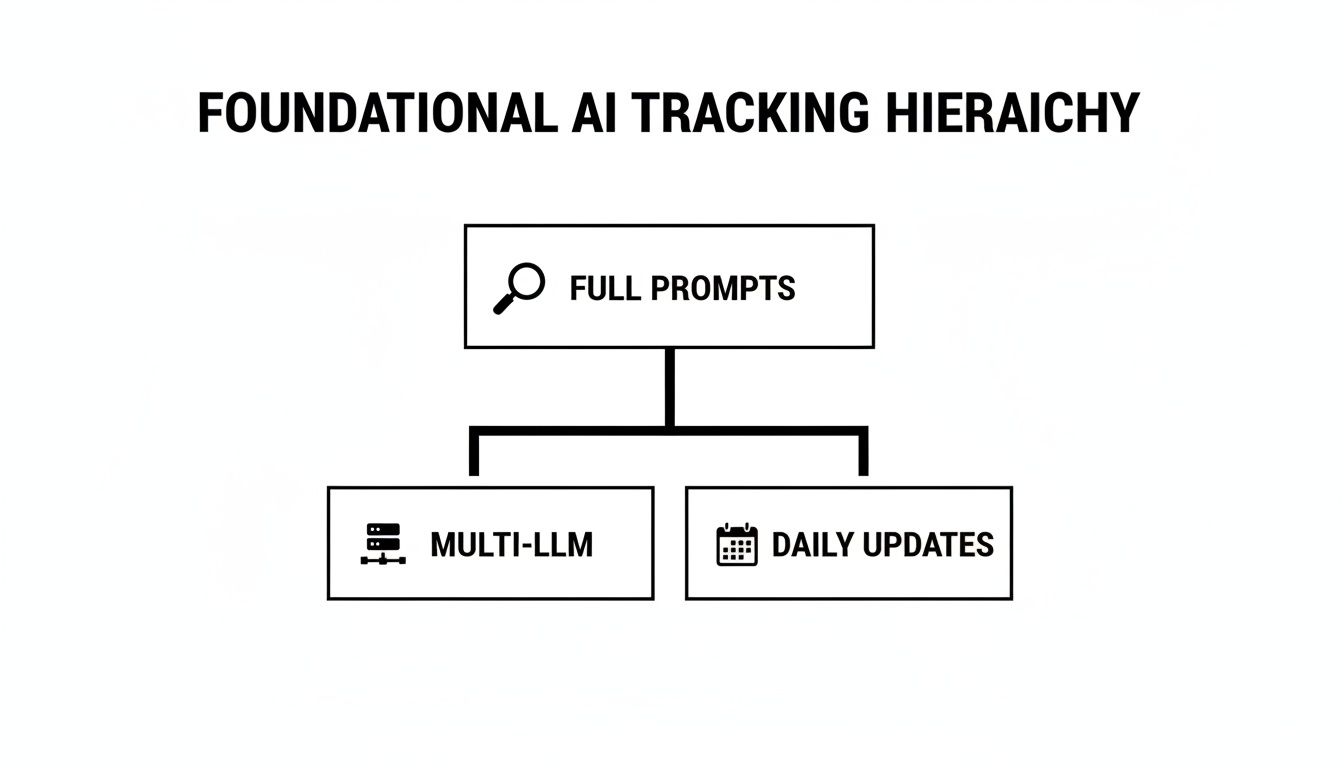
It's a simple hierarchy: without a solid base of comprehensive and timely data, any attempt at advanced benchmarking is just guesswork.
To fully appreciate the shift, it's helpful to see how these tools have evolved.
Comparison of Traditional vs AI-Powered Rank Tracker Features
| Feature | Traditional SEO Rank Tracker | Modern AI Search Rank Tracker (e.g., promptposition) |
|---|---|---|
| Primary Focus | Keyword ranking on a SERP | Brand/product inclusion and sentiment within AI-generated answers |
| Competitor Analysis | Tracks which domains rank for specific keywords | Identifies which competitors are mentioned alongside you in responses |
| Data Source | Scrapes traditional search engine results pages (e.g., Google, Bing) | Queries multiple Large Language Models (LLMs) directly (e.g., ChatGPT, Gemini) |
| Key Metric | Keyword position (e.g., "Ranked #3") | Share of Voice, Sentiment Score, Source Attribution |
| Update Frequency | Weekly or daily at best | Daily or even real-time to catch rapid changes in AI outputs |
| Reporting | Static reports on keyword position changes | Dynamic dashboards showing visibility, sentiment trends, and source influence |
This table highlights that while the goal—visibility—is the same, the mechanics of tracking it have fundamentally changed.
Visibility and Sentiment Analysis
Getting a mention is great, but it's only half the story. The other, more important half is understanding how you were mentioned. This is where sentiment analysis comes in, and it's easily one of the most powerful features you can have. It takes the qualitative nature of an AI's response and puts a number on it, telling you if the story being told about your brand is positive, negative, or just neutral.
This feature is your brand's early-warning system. A sudden nosedive in sentiment can alert your PR team to a simmering issue long before it boils over into a full-blown crisis.
By tracking sentiment over time, you can draw a direct line between your marketing campaigns or PR efforts and how they actually shape the AI's perception of your brand.
Uncovering Source Attribution
Now for the real game-changer: source attribution. This is the ability to see the exact articles, studies, reviews, and data points an LLM relied on to form its answer about you. It's like peeling back the curtain and looking directly at the AI's "brain."
For content and PR teams, this is pure gold. You can stop guessing which content might influence the AI and instead see a direct list of the sources that are already shaping the narrative. This lets you build a hyper-focused strategy to promote positive sources, create new content to fill information gaps, and directly influence what the AI says about you next.
Operational Features for Scaling Your Strategy
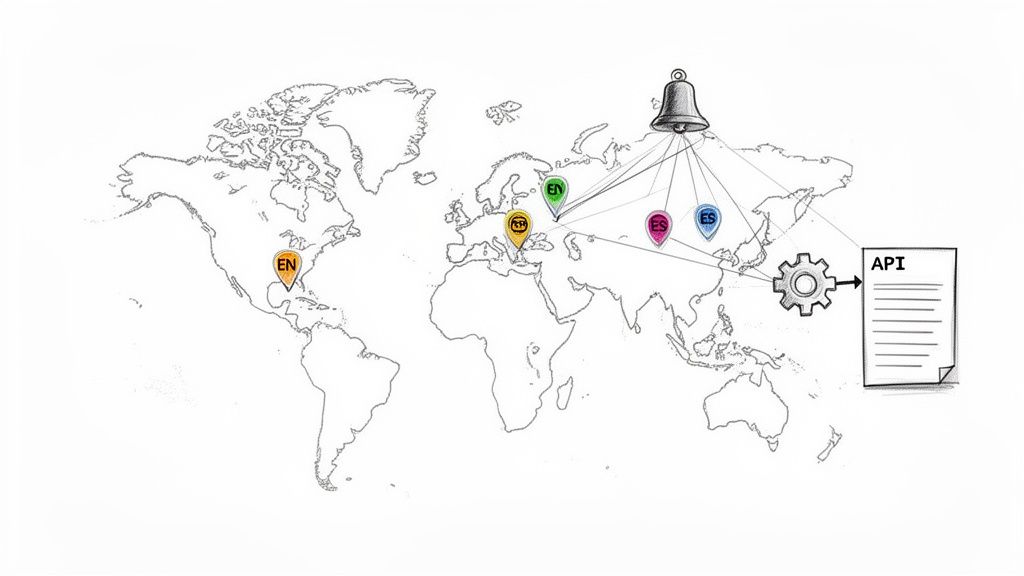
All the advanced analytics and competitive intelligence in the world mean very little if they're siloed away. To be truly effective, the data has to plug directly into your team's day-to-day workflow. This is where the operational nuts and bolts come in—the rank tracker features that turn raw data into a company-wide asset that everyone can act on.
For brands with a global footprint, this isn't just a nice-to-have. Tracking your AI visibility is a worldwide challenge, and you need tools built to handle that complexity.
Multi-Region and Language Support
Your customers don't all live in one place or speak one language, and modern AI models are starting to reflect that reality. A user’s prompt in London will get a very different answer than the same prompt in Tokyo. That’s why robust multi-region and language support isn’t just an option; it’s a necessity for any serious global brand.
Having this capability allows you to:
- Pinpoint Cultural Nuances: You can see firsthand how AI models interpret prompts and position your brand differently based on local language and cultural context.
- Validate Global Campaigns: Finally, you can measure the real impact of international marketing and PR by tracking sentiment and visibility shifts in specific countries.
- Uncover Regional Competitors: Discover which local players AI models are recommending in one market but not another, revealing competitive threats you never knew you had.
This kind of functionality takes you beyond simple monitoring and gives you the strategic oversight needed to manage a global brand’s reputation in the age of AI.
Alerting, Reporting, and API Access
Data is only useful when it gets to the right people at the right time. Automated alerting is your early-warning system. It can instantly flag significant shifts in sentiment or visibility, letting your PR and brand teams jump on opportunities or threats in hours, not weeks.
Then there’s reporting. A good platform lets you distill complex AI visibility data into clean, digestible dashboards for leadership. This is how you translate nuanced metrics into clear KPIs, prove ROI, and get the entire organization on the same page.
For larger organizations, API access is the final piece of the puzzle. It’s what lets you pipe AI visibility data directly into your company’s internal business intelligence tools, like a CRM or a data warehouse. This weaves AI insights right into the fabric of your business operations.
These operational features are becoming more critical by the day. With the global AI market projected to hit USD 3,497.26 billion by 2033, the volume of AI-driven search traffic is only going one way. Features like unlimited country tracking and API access are what will separate the teams that react to change from the ones that proactively stay ahead. You can dive deeper into these market shifts and what they mean for AI-powered brand monitoring.
How to Choose the Right AI Rank Tracker
You’ve got a solid grasp of the features that matter, from the basics to the advanced stuff. Now for the hard part: picking the right tool. The market is getting crowded with platforms claiming to track AI visibility, but let's be honest, many are just traditional SEO tools with a fresh coat of "AI" paint.
To see past the marketing hype, you need a game plan. It’s about asking sharp questions that expose whether a tool can actually deliver on its promises in this new world of generative search. Think of this less like buying software and more like hiring a strategic partner—one that feeds you clear, actionable data that actually helps your brand.
Critical Questions for Potential Vendors
When you're sitting down for a demo or a sales call, have this list of questions ready. The answers you get will quickly tell you if you're dealing with a serious platform or a pretender. Don't let them off the hook with fuzzy answers; press for specifics.
Here are the deal-breakers to ask about:
- Source Attribution: "Show me exactly how you trace an AI-generated answer back to the original source." A top-tier tool should be able to pinpoint the specific articles, research, or data points the LLM referenced. This gives your content team a clear target to aim for.
- Data Update Frequency: "How often does your data refresh?" In the world of AI, yesterday's data is ancient history. If they can't promise daily updates, you're always going to be a step behind.
- Competitor Benchmarking: "Can I track my visibility and sentiment against as many competitors as I need to?" Your competitive set isn't static, and your analytics tool shouldn't force you to pick and choose who you monitor.
- Multi-LLM Support: "Which LLMs and SERP features do you actually cover?" Make sure their list includes the platforms your audience uses, like ChatGPT, Perplexity, and Google's AI Overviews.
Evaluating a Tool for Strategic Value
Beyond the technical checklist, you need to think about how this platform fits into your team's day-to-day work and contributes to the bigger picture. A great tool doesn't just dump data on you; it helps you connect the dots and make smarter decisions.
The right AI rank tracker is more than just a reporting dashboard. It becomes the command center for your brand's entire AI strategy, bridging the gap between your PR, content, and marketing teams. It should prove its worth by clearly showing how your efforts are shaping your brand's story in AI.
This is why specialized solutions built from the ground up for this challenge are often a better bet. Look for platforms like promptposition that live and breathe this stuff, rather than a legacy SEO tool that has simply added a few AI features as an afterthought.
Finally, think long-term. Does the platform have the muscle to grow with you? Features like API access for custom integrations and unlimited country tracking might not be day-one needs, but they ensure your investment today will still be paying dividends tomorrow.
2. Your Action Plan for Mastering AI Search
All this information is useless unless you do something with it. Knowing what a modern rank tracker can do is one thing, but actually putting that knowledge to work is what will protect your brand's future in this new AI-driven world.
Here’s a simple, three-step plan to get you from thinking to doing—starting right now.
Step 1: Audit Your Current Toolkit
First things first, take a hard look at what you’re using today. How does your current tracking setup handle the features we’ve covered, like sentiment analysis or source attribution? This quick audit will instantly show you where your biggest blind spots are. Are you flying blind when it comes to how AI models perceive your brand?
Step 2: Pinpoint Your Visibility Gaps
Next, figure out where it hurts the most. Don't try to track every possible keyword or prompt under the sun. Instead, prioritize the most critical questions and user prompts that your customers are actually asking. Focus on the conversations where your brand absolutely must show up.
Step 3: Establish a Clear Baseline
Finally, it’s time to get a dedicated tool in place and draw a line in the sand. You simply can't improve what you don't measure.
A platform like promptposition gives you that crucial starting point. It provides the hard data on your visibility, sentiment, and where you stand against competitors—everything you need to build a strategy that actually works in AI search.
Frequently Asked Questions
Figuring out how to navigate AI search brings up a ton of questions. As marketers and PR pros start to wrap their heads around this new reality, getting a grip on modern rank tracker features is the key to staying in the game. Here are the answers to the questions we're hearing most often.
How Do AI Rank Trackers Differ from Traditional SEO Tools?
The fundamental shift is from tracking position to tracking perception. Old-school SEO tools were built for a world of blue links. Their job was to tell you if you ranked #5 for a keyword—a straightforward, but very one-dimensional, data point.
AI rank trackers, on the other hand, have a completely different job. They dig into the conversational, AI-generated answers to understand what's actually being said. This means they measure things traditional tools were never designed to see:
- Sentiment: Is your brand mentioned in a positive, negative, or neutral light?
- Share of Voice: Within a single AI answer, how much of the conversation are you owning compared to your competitors?
- Source Attribution: What specific articles or pages did the AI lean on to come up with its answer?
It’s no longer about a number on a list. It’s about understanding the story the AI is telling about you.
How Often Should I Check My Visibility in AI Models?
Honestly? You should be checking daily. Large language models (LLMs) are anything but static. Their answers can—and do—change constantly, sometimes from one day to the next. New training data gets folded in, algorithms get tweaked, and the online information landscape shifts. That glowing recommendation for your product could simply disappear overnight.
Checking your visibility daily is the new standard. If you’re only looking weekly or monthly, you’re flying blind with outdated intel. You could miss a huge reputational threat or a golden opportunity that just popped up.
This kind of frequent monitoring lets you respond in real-time and see the immediate effects of your latest content marketing or PR push.
Can I Actually Influence What AI Models Say About My Brand?
Yes, you absolutely can. This is where modern rank tracker features really start to shine. While you can't just log in and edit an AI's brain, you can be very strategic about influencing the sources it trusts and learns from.
Tools like promptposition give you that crucial source attribution, pointing to the exact web pages the AI used to form its opinion. This becomes a treasure map for your content and PR teams. You can focus your energy on creating genuinely helpful, authoritative content that directly answers your audience's questions, or work to amplify existing content that already paints you in a positive light.
By methodically feeding the AI's information diet with great sources, you can steer the narrative in your favor over time.
Ready to see how your brand really shows up in AI search? promptposition provides the critical rank tracker features you need to measure, understand, and influence your visibility across all major AI models. Start your free trial at https://www.promptposition.com.