Your Guide to the LLM Search Engine Revolution
You've probably noticed a big shift in how we find information online. We're moving from typing keywords into a search bar and sifting through links to simply asking questions and getting a direct, synthesized answer. This is the world of the LLM search engine.
This guide will walk you through what LLM search engines are, how they work differently from Google, and what this new landscape means for your brand.
What Is an LLM Search Engine?
An LLM search engine is any AI-powered interface—like ChatGPT, Perplexity, or Gemini—where you can ask questions in natural language and receive a synthesized, narrative answer instead of a list of blue links.
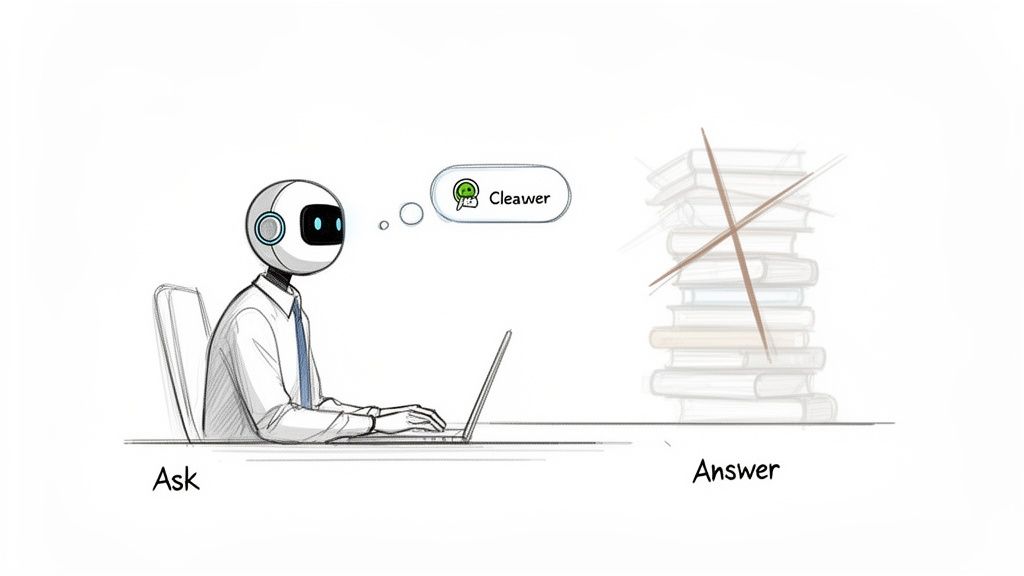
This fundamental change from "searching" to "asking" has massive implications for how brands get discovered. Instead of just aiming for the top of a links list, the new goal is to be featured favorably within the AI's generated response.
How They Differ from Traditional Search
The biggest difference is what you get back. Google’s primary job is to index the web and show you a ranked list of relevant pages. An LLM search engine tries to understand your question and then build a brand-new, conversational answer using its vast knowledge.
This table breaks down the core differences:
Traditional Search vs LLM Search Engine
| Aspect | Traditional Search (e.g., Google) | LLM Search Engine (e.g., ChatGPT, Perplexity) |
|---|---|---|
| User Input | Keywords and short phrases ("best running shoes") | Full questions in natural language ("What are the best running shoes for a beginner with flat feet?") |
| Core Function | Indexes websites and ranks links based on relevance and authority. | Synthesizes information from multiple sources to generate a single, direct answer. |
| Output Format | A list of blue links, ads, and featured snippets. | A narrative, conversational paragraph or list, often with cited sources. |
| User Goal | To find the best resources to research an answer. | To get an immediate, comprehensive answer without further research. |
| Brand Goal | Rank #1 for target keywords. | Be mentioned positively and cited as a source within the AI's answer. |
For brands, this means being the top link isn't the only game in town anymore. The new "front page" is being woven directly into the fabric of the AI's response. You can explore more on the specifics of this technology in our guide to what conversational AI is and how it works.
At PromptPosition, we treat every one of these models—whether it's ChatGPT, Claude, or Perplexity—as a separate search channel that needs its own monitoring and optimization strategy.
Why Every Model Tells a Different Story
Here’s where it gets tricky for brands: each LLM search engine tells a slightly different story about you. Because each AI model is trained on different data sets, uses different sources, and is updated at different times, they all have a slightly different "opinion" of your brand.
One model might pull information from recent press releases and highlight your latest product, while another might focus on older forum discussions and mention your customer service. This means your brand's story is fragmented across the AI ecosystem.
This is exactly why we built PromptPosition. It's a way to see these differences side-by-side, tracking how each model mentions and frames your brand. This allows you to optimize for the full landscape rather than guessing.
Why High Google Ranks No Longer Guarantee Visibility
For over two decades, the marketing playbook had a golden rule: rank on the first page of Google, and you owned your audience. That certainty is gone. The rise of LLM search engines has completely changed the game, and the biggest mistake we see brands making is assuming their hard-won SEO dominance will carry over.
An AI-powered search engine just doesn't follow the same logic. Google's algorithm relies on signals like backlinks and domain authority to rank a list of links. An LLM’s job is to synthesize information from all over the web and construct an actual answer. It’s drawing from a much wider, more eclectic pool of data where the narrative and context around your brand are what really matter.
From Links to Narratives
Here’s a simple way to think about the change. Google acts like a librarian, pointing you to the most authoritative books (websites) on a shelf. An LLM, on the other hand, is like a dedicated researcher who skims through those books, plus academic journals, forum debates, and customer reviews, then writes a custom summary of what they found.
If your brand's story isn’t woven into that diverse mix of sources, you simply won't be mentioned in the final summary. This shift means your old SEO tactics aren't enough, and it’s time to make your website AI friendly for this new reality.
The #1 misconception is that good Google rankings automatically mean good AI visibility—they don't. LLMs pull from a completely different mix of sources and weigh brand signals differently than traditional search algorithms. We always tell new PromptPosition users: check your actual AI visibility first, then decide where to invest, because the gap between your Google presence and your LLM presence is almost always bigger than you think.
The Real-World Visibility Gap
A SaaS client came to us confident about their market position—strong Google rankings, solid review scores. When we ran their key prompts through PromptPosition, they were completely absent from ChatGPT and Gemini responses while two smaller competitors were being recommended consistently. That single dashboard view turned their entire content strategy on its head overnight.
This isn’t some future-gazing prediction; it's happening right now. Companies relying solely on Google Analytics are flying blind, completely unaware that they’re invisible on what is quickly becoming the new front page of the internet. You can see a direct comparison of these systems in our deep dive on Perplexity vs. Google. The only way to know where you really stand is to get in there and measure your brand’s presence directly inside each AI model.
Where LLMs Learn Your Brand's Story
So, how does an LLM search engine decide what to say about your company? It doesn't just read your website's "About Us" page. It digs through everything: news articles, product documentation, and most importantly, the places where real people are talking. Every forum thread, every blog comment, and every social media discussion is fair game.
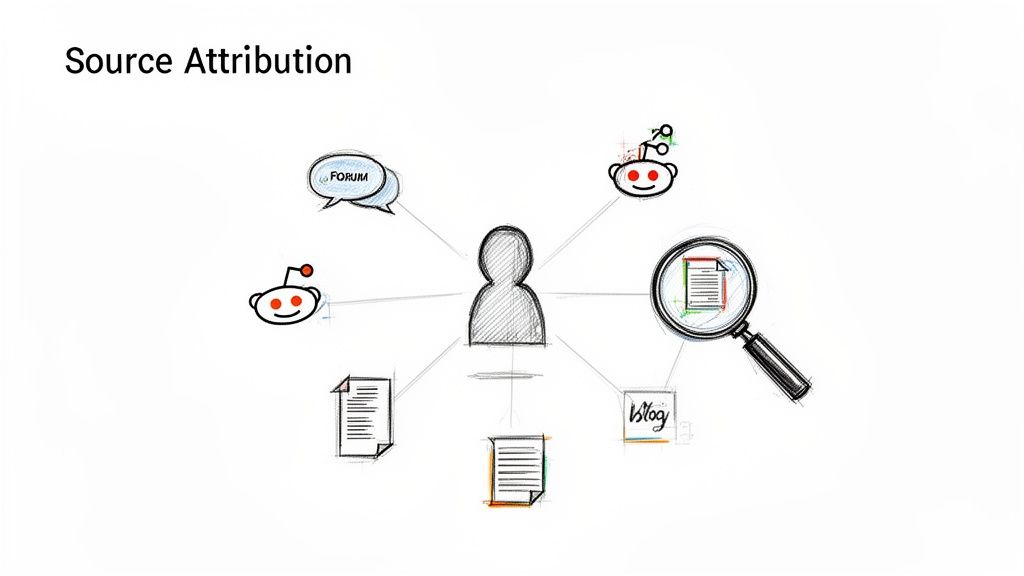
The image above nails this new reality. The AI's understanding of your brand is a mosaic built from all these different conversations. To have any hope of influencing the final picture, you first have to know where the pieces are coming from.
The Surprising Power of Community Platforms
You might assume that your official, polished marketing content would be the most important source. It has its role, but what we're seeing is that LLMs often trust raw, candid feedback far more.
Reddit. Over and over again. Our source attribution feature in PromptPosition consistently shows Reddit threads as one of the top-cited sources across models—often outweighing polished corporate content or even major publications. Brands that ignore community platforms are essentially invisible to the models that matter most.
A single, highly-upvoted thread where users rave about a competitor or hash out a problem with your product can dramatically influence how millions of people perceive your brand through an AI answer. These platforms provide the kind of unfiltered, real-world context that models are trained to find valuable. You can learn more about getting your content ready by reading our guide on preparing your site for LLM consumption.
Why Source Attribution Is Non-Negotiable
This is exactly why source attribution is no longer a "nice-to-have." It’s essential. Source attribution is the process of tracing an AI’s generated answer back to the original documents it used for information. Without it, you’re just guessing where the AI got its ideas.
With proper source attribution, you can finally answer the questions that matter:
- Which specific websites are shaping our brand’s narrative?
- Where are competitors getting all their positive mentions?
- What outdated or wrong information is the AI surfacing?
By pinpointing these sources, you can stop playing defense and start shaping the story yourself. Tools like PromptPosition make this happen by showing you exactly which sources are influencing the AI for any given prompt. It gives you a clear roadmap of where to focus your content and PR efforts to make sure the AI tells the story you want.
One of the most dangerous assumptions we see brands make is treating "AI search" as a single, monolithic entity. The reality is, there's no such thing as the LLM search engine. We're navigating a highly fragmented market where every model—from OpenAI's ChatGPT to Google's Gemini—is its own distinct search channel.
Each of these platforms tells a slightly different story about your brand. They’re all built on different training data, run on unique algorithms, and get updated on their own schedules. Ask the same question on ChatGPT, Perplexity, and Gemini, and you'll almost certainly get three different answers.
Every Model Creates a Unique Brand Persona
Imagine one AI model has learned about your company primarily from glowing press releases. It's going to sing your praises. But what if another model’s understanding is shaped by a mix of ten-year-old forum discussions and a handful of negative Reddit threads? That AI might paint a picture of your brand as outdated. This isn't a hypothetical—it's a daily reality for companies right now.
You might be the celebrated market leader in one AI’s answer, a minor footnote in another’s, and completely invisible in a third. This is exactly why you can't just check one model and call it a day.
A SaaS client came to us confident about their market position—strong Google rankings, solid review scores. When we ran their key prompts through PromptPosition, they were completely absent from ChatGPT and Gemini responses while two smaller competitors were being recommended consistently. That single dashboard view turned their entire content strategy on its head overnight.
A Growing and Divided User Base
This problem is only getting bigger as the user base for AI tools grows and fractures. Looking at early 2026 projections, we already see significant splits in audience preference. While ChatGPT holds a massive lead, platforms like Perplexity AI and Google's Gemini have their own loyal audiences, commanding hundreds of millions of monthly queries and users. You can explore more of these LLM statistics and user trends to see just how fast this is happening.
What this really means is that different segments of your target audience are getting entirely different information about you, all depending on which AI tool they prefer.
From Siloed Guesswork to a Unified Strategy
For most brands, manually typing prompts into every platform one by one is not just inefficient; it's completely unsustainable. This is where a unified dashboard becomes non-negotiable. A tool like PromptPosition consolidates all these disparate conversations into one clear, actionable view. It lets you:
- See your brand stories side-by-side: Directly compare how ChatGPT, Gemini, Claude, and other models talk about your company for the exact same prompts.
- Identify gaps and opportunities: Instantly spot where you’re being ignored and competitors are getting all the attention.
- Track narrative shifts over time: Get alerts and monitor how model updates impact your brand’s visibility and the sentiment around it.
By seeing the full picture, you can finally move from siloed guesswork to a truly holistic optimization strategy. You can tailor content to fix weaknesses on one platform while capitalizing on your strengths on another—a powerful technique we dive into in our guide to the query fan-out effect. This comprehensive approach is the only way to build and protect your brand's reputation in the fragmented new world of the LLM search engine.
How to Optimize Your Brand for AI Search
So, you now understand that every LLM is telling a slightly different story about your brand. What are you going to do about it? Getting a handle on that narrative isn’t about luck; it’s about having a repeatable game plan to improve how your brand shows up in AI-generated answers.
This calls for a fundamental shift in thinking. Forget just chasing keywords and backlinks. The new game is narrative optimization—actively influencing the sources and conversations that these AI models learn from. The whole process can be broken down into a simple, three-step loop: monitor your AI visibility, build a strategy based on insights, and optimize your content to fill the gaps.
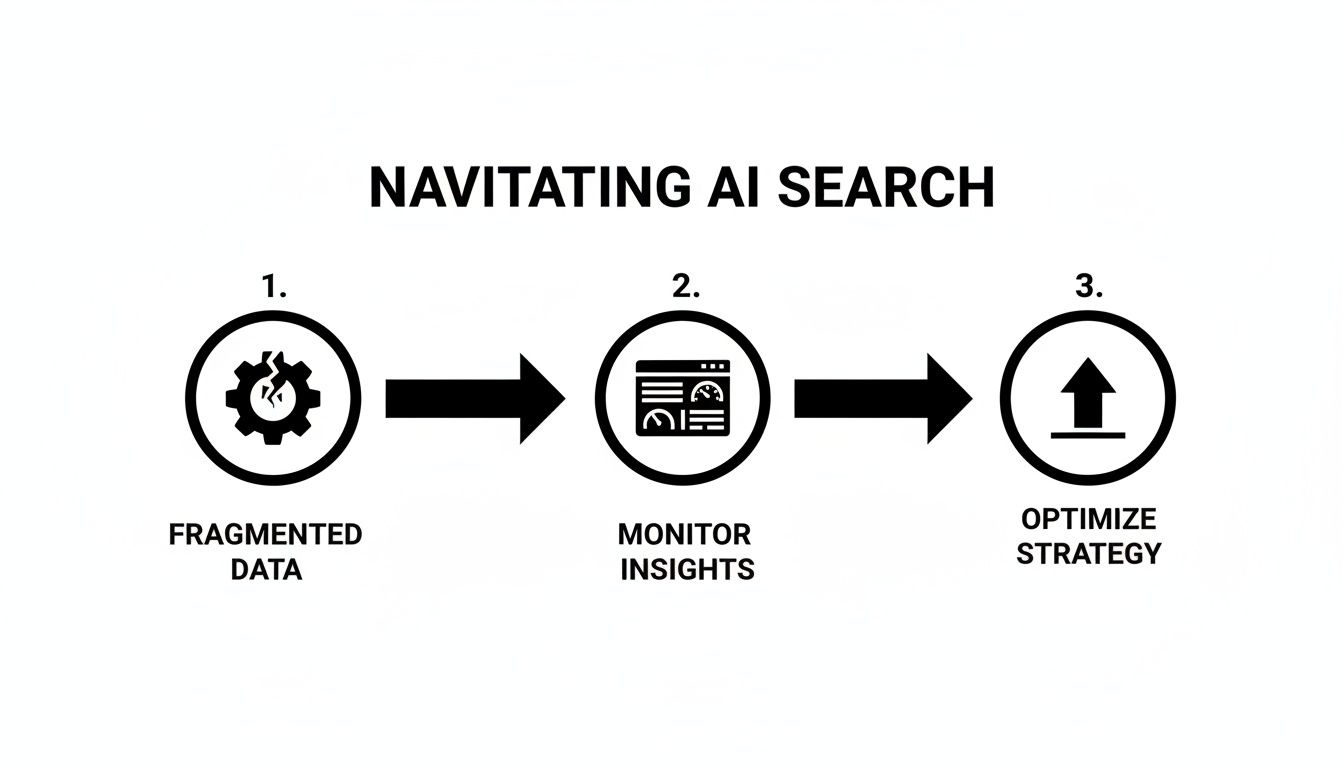
It really is that straightforward. You have to start by accepting that the data is fragmented, then monitor it all in one place, and finally, use those insights to build a smarter strategy.
Find and Fill Your Visibility Gaps
Before you can fix anything, you have to get an honest look at the problem. A strong ranking on Google can create a dangerous sense of security, leaving brands completely blind to the fact that they’re invisible where it increasingly matters.
To avoid this, your first job is to run a full AI content audit. Here’s how:
- Benchmark Against Competitors: Start by running your most important brand and product-related prompts across the big models like ChatGPT, Gemini, and Perplexity. See where competitors show up and you don't.
- Analyze Sentiment and Framing: Pay close attention to how you're being talked about. Is it positive, neutral, or negative? Is the information even correct?
- Trace Source Attribution: This is the critical part. Use a tool like PromptPosition to see the exact articles, forum posts, or reviews the AI is referencing. This gives you a direct hit list of sources you need to influence.
Create Content for the Platforms LLMs Favor
Once you’ve mapped out your blind spots, you can start creating content specifically designed to fill them. We're not just talking about another blog post. You need to create assets that are designed to be found and valued by the AI models themselves.
This often means showing up on platforms that LLMs use to get a pulse on real-world opinion and user sentiment. For example, getting proactively involved in discussions on sites like Reddit or Quora can have a massive, outsized impact on how an LLM search engine perceives your brand.
A few other key strategies include:
- Develop Authoritative Guides: Build in-depth, well-organized articles that answer your audience's most common questions. Use clear headings, bullet points, and Q&A formats that are easy for a machine to parse.
- Optimize for Entity Recognition: Use structured data (like Schema.org markup) to tell the AI exactly what your company is, what your products are, and how they all connect. This helps the model see you as a distinct, well-defined entity.
- Pursue Digital PR: Go after mentions and links in high-authority publications that LLMs frequently cite in their answers.
Master Prompting to Test Your Messaging
Finally, remember that optimization is a continuous loop of testing and tweaking. To do this well, you have to get good at prompting. Learning how to write effective prompts for AI lets you simulate different user queries and see exactly how your messaging is being interpreted.
By crafting a variety of prompts—from simple questions to complex scenarios—you can poke and prod at your brand's narrative from every conceivable angle. It's the only way to be sure your efforts are actually paying off.
Measuring What Matters in the Age of AI
You can't improve what you don't measure. For years, we relied on a simple playbook for online success: clicks, impressions, and keyword rankings told the whole story. But with LLM search engines, those old KPIs are not just outdated—they’re dangerously incomplete.
The new world of generative search requires a whole new set of metrics. The game is no longer just about getting found. It’s about being included favorably in the AI’s synthesized answer. This means we have to find a way to turn opaque AI responses into tangible data that proves your efforts are actually paying off.
The New KPIs for Generative Search
To get ahead, marketing teams have to start tracking metrics that actually reflect brand presence and perception inside the AI models. Think of these as the new vital signs for your brand's health.
Here are the key metrics you should start tracking now:
- Generative Share of Voice (gSOV): This is the new market share for attention. It measures how often your brand gets mentioned in AI answers for your most important prompts compared to your competitors.
- Sentiment Analysis: A mention is good, but a positive mention is what moves the needle. This tracks whether the AI is painting your brand in a positive, negative, or neutral light.
- Narrative Consistency: Does your brand story sound the same on ChatGPT, Gemini, and Claude? This metric checks for consistency, because a fragmented AI persona can seriously dilute your brand message.
Turning Opaque Answers into Measurable Data
The global LLM market—the engine powering these new search experiences—has exploded from $4.5 billion in 2023 and is on track to hit a staggering $82.1 billion by 2033. As this breakdown of key LLM statistics shows, we need better ways to measure brand stability, with new metrics like "LLM perception drift" expected to be as important as keyword rankings by 2026.
This is where specialized tools become absolutely essential. You need an analytics engine built specifically for this challenge. A platform like PromptPosition is critical for continuously monitoring sentiment, benchmarking against competitors, and seeing the sources LLMs are actually citing.
You wouldn’t manage your Google presence without an analytics platform. The same logic applies here. An AI search analytics tool turns the black box of LLM responses into a clear dashboard of KPIs you can act on.
By tracking these new metrics, you can finally shift from guesswork to data-driven strategy. Using a platform like PromptPosition gives you the clarity to see where you stand, report on your progress, and justify further investment in what is quickly becoming a critical channel for brand reputation and discovery.
Frequently Asked Questions
As marketing and brand leaders get their heads around the new world of the LLM search engine, a few key questions always come up. Let's tackle them head-on.
How Is an LLM Search Engine Different from Google's AI Overviews?
It's easy to lump all AI-powered search together, but they operate in completely different ways. Think of Google's AI Overviews as an upgraded featured snippet—it summarizes information at the top, but it's still just an introduction to the traditional list of blue links.
An LLM search engine like ChatGPT or Perplexity is the destination. The conversational, synthesized answer is the result. Users aren't looking for a list of sites to browse; they're looking for a complete story. If your brand isn't part of that story, you're invisible.
Can I Repurpose My SEO Content for LLM Optimization?
Yes, but you can't just copy and paste. While your existing SEO content is a great foundation, an LLM search engine is looking for different signals than a traditional one. The game has shifted from pure keywords to compelling, coherent narratives.
First, make sure your content clearly tells the story of who your brand is and what makes it special. Then comes the most important part: getting that story amplified in the places LLMs trust. This often means focusing on high-authority third-party articles and genuine discussions on platforms like Reddit, which might be entirely new targets for your team.
How Often Should I Track My Brand in LLM Search Engines?
Constantly. It's not a set-it-and-forget-it channel. The models powering these engines are always learning, and the data they pull from is refreshed daily.
A glowing mention of your brand one day could be gone the next, replaced by a competitor or, even worse, by old, negative information. Occasional spot-checks will only give you a dangerously incomplete picture. That’s why daily tracking is non-negotiable.
Continuous monitoring allows you to spot trends as they emerge, react swiftly to changes in your brand’s narrative, and seize opportunities to get ahead of your competitors before they even know what's happening.
See how your brand's story is being told across the AI search landscape. With PromptPosition, you can stop guessing and start optimizing. Get your free brand report today.