A Guide to LLM Brand Visibility: The New Frontier of AI Search
Welcome to a new front door for your brand. We're talking about LLM brand visibility—in simple terms, it's about whether and how AI models like ChatGPT mention your brand when users ask relevant questions. With millions of people now using AI for everything from product recommendations to complex problem-solving, showing up in these conversations is no longer optional. It’s essential.
What is LLM Brand Visibility and Why Does It Matter?
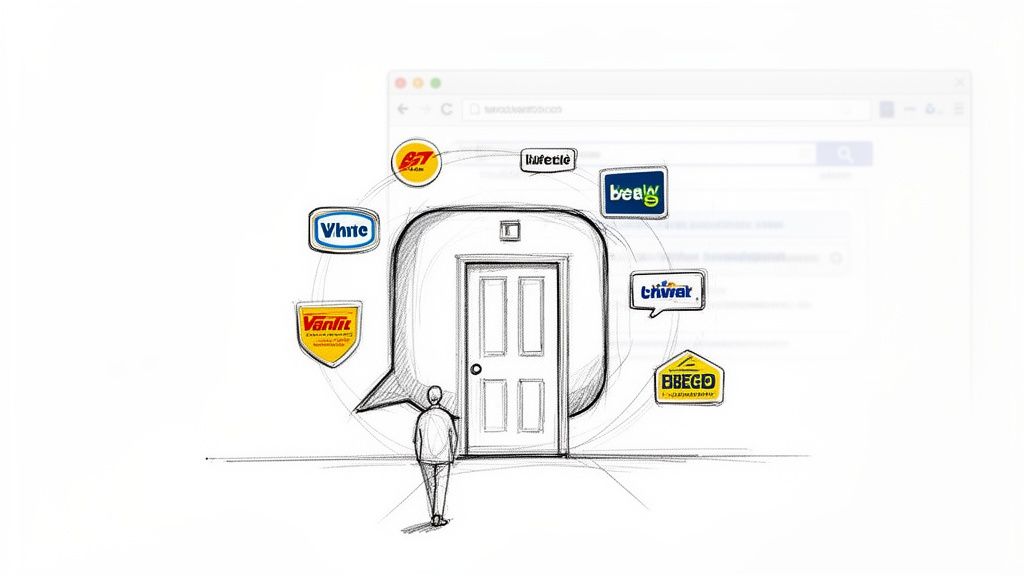
The customer journey we all knew is being redrawn. For decades, the path was clear: a person typed a query into Google, scanned the blue links, and clicked through to a website. That entire process is now being intercepted by conversational AI.
Instead of hunting through search results, your potential customers are getting neatly packaged answers directly from a large language model (LLM). This creates a powerful new entry point for brand discovery, and it's one most companies are completely blind to.
The Shift from Search to Synthesis
Think about it from a potential customer's point of view. A marketing manager asks Gemini, "What are the best CRMs for a small real estate agency?" The AI doesn't just spit out a list of links. It delivers a synthesized comparison of a few top contenders, complete with pros and cons. If your CRM isn't in that summary, you've lost the lead before you even knew they existed.
This isn't a niche behavior; it's happening at an incredible scale. Millions of users now get recommendations from AI. ChatGPT alone has over 800 million active users, a number that's still climbing. At the same time, traditional search is changing under our feet. With 69% of Google searches now resulting in zero-click answers and AI Overviews showing up for 25% of all queries, the firehose of traffic from SEO is slowing to a trickle. Users are getting their answers on the spot.
Your brand's story is now being told by an AI, long before a person ever lands on your homepage. Getting mentioned in these AI answers isn't just a nice-to-have; it's quickly becoming a core part of staying relevant.
Why Measuring LLM Visibility Is Crucial
Here’s the problem that keeps marketers up at night: a total black box. Most teams have zero idea how their brand is being portrayed by AI. That’s why getting a handle on your LLM brand visibility is a non-negotiable first step. It comes down to tracking a few core metrics across models:
- Visibility Rate: For the questions that matter to you, how often does your brand actually get mentioned?
- Sentiment: When you are mentioned, is it in a positive, negative, or neutral light?
- Position: Are you recommended as the top choice, or are you an afterthought listed after three of your competitors?
When teams first check their LLM visibility, they are almost always shocked by what they find—usually, surprising gaps. They might discover a key competitor is consistently recommended for their main keyword, a new startup is getting all the buzz, or worse—their brand is totally invisible. The landscape of search marketing intelligence is expanding to include these new AI-driven realities.
The way people find and consume information is also evolving, with resources like lists of AI tools for podcast listeners changing how brands even get on the radar in the first place.
This is precisely the problem we built PromptPosition to solve. It's the tool we created specifically to measure and improve how brands show up in AI. Once you measure your visibility and understand the sources, you can start to strategically influence the narrative and make sure your brand is part of the conversation.
What Drives LLM Brand Visibility?
To really get a handle on your LLM brand visibility, you have to first understand what these models are actually reading. It's a common mistake to think of them like traditional search engines, which crawl and rank specific pages. The reality is quite different.
Think of an LLM as a researcher who has devoured an entire library—not just the textbooks, but every newspaper, magazine, and even the notes scribbled in the margins. It then synthesizes all that information to form its own understanding. Your brand's visibility is a direct reflection of what’s written about you in that massive library.
The Digital Ecosystem Fueling AI Answers
The source material for today's AI models is incredibly broad. This isn't about tweaking a single webpage; it's about cultivating a strong, consistent signal across the entire digital landscape.
So, what are these models paying attention to? From what we've seen, it boils down to a few key areas:
- High-Authority Content: In-depth articles, industry reports, and long-form blog posts from trusted domains carry a ton of weight.
- Product Review Sites: For any "best of" or comparison-style question, dedicated review platforms and marketplaces are a go-to source.
- Community Forums: Conversations happening on Reddit, Quora, and other forums give the AI a sense of real-world sentiment and niche opinions.
- Structured Data: Information you format with schema markup (like product specs or FAQs) is like a cheat sheet for AI—it's easy to digest and often gets pulled directly into answers.
- Public Datasets: Foundational knowledge bases like Wikipedia and academic research papers serve as a baseline for factual information.
The tricky part is that your brand’s story is being shaped by content you don't always directly control. That’s why building a wide, authoritative digital footprint is the only way to achieve high LLM brand visibility. You can start to nudge models in the right direction with tools like an llms.txt file, a newer concept for giving AI crawlers clearer instructions about your content. More on how that works in our guide to the llms.txt file.
The Shock of the First Audit
This is why a brand's first AI visibility audit is often such a wake-up call. When teams use a tool like PromptPosition to systematically check how they appear across models for the first time, they almost always find uncomfortable surprises.
We’ve seen it happen over and over. A clear market leader discovers a smaller, newer competitor is the top recommendation for their most important use case. A B2B software company finds out an old, negative comment on a niche forum from five years ago is the primary source coloring the AI's sentiment about their flagship product today.
As shocking as these discoveries can be, they're also incredibly valuable. They give you a clear, actionable path forward. Once you know which sources are influencing the AI, you can stop guessing and start getting strategic. It’s all about creating better content, earning mentions in the right articles, and cleaning up your data across the web. This is the foundational work for building and maintaining strong LLM brand visibility.
How to Measure Your Brand's LLM Visibility
So, you want to know where your brand really stands in the age of AI? Auditing your LLM brand visibility isn’t about guesswork or running a few manual queries. It’s about adopting a measurement framework that looks beyond clicks and traffic.
To get an honest picture of your performance, you need to measure how, when, and in what context your brand appears in AI-generated answers. This starts with defining the right KPIs—the ones that will actually guide your strategy and expose the blind spots you didn't even know you had.
The Metrics That Matter for LLM Visibility
Manually asking ChatGPT a few questions is a start, but it's not a strategy. It's like checking the weather by looking out one window. AI models are notoriously inconsistent; you have to test prompts repeatedly to get data that’s statistically sound.
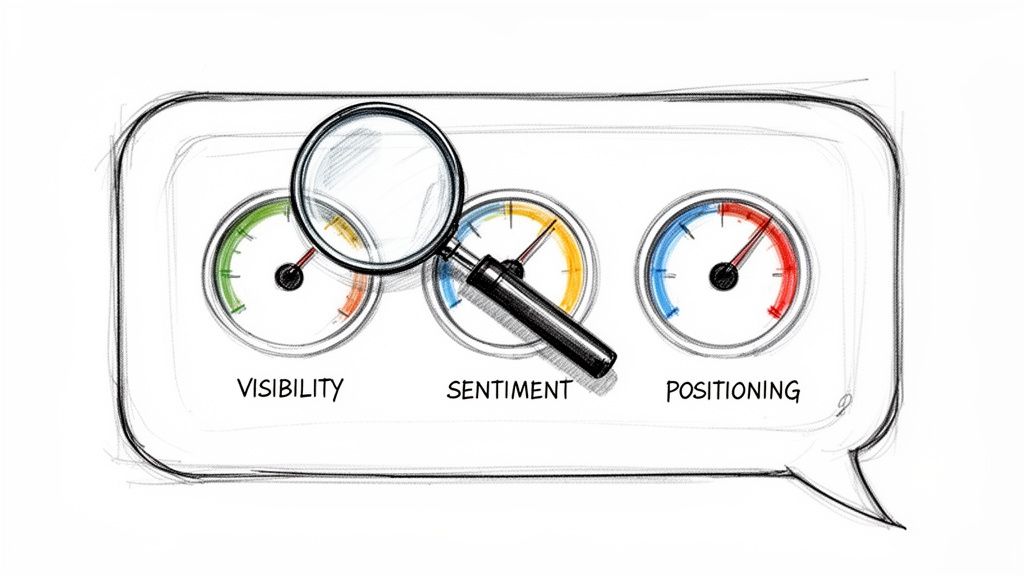
To do this at scale, you need to focus on three foundational metrics.
Visibility Rate: This is the most fundamental metric. For a core set of prompts your customers are asking, what percentage of the time does your brand get mentioned? A low visibility rate means you’re effectively invisible to a huge chunk of your audience.
Sentiment: When your brand is mentioned, is the tone positive, negative, or just neutral? An AI might mention your product but frame it as a "budget option" or highlight a known flaw. That’s a world away from being positioned as the "industry-leading choice."
Positioning: Where do you show up in the answer? Being the first brand mentioned in a list of recommendations carries far more weight than being buried at the bottom. Tracking your rank against competitors reveals who the AI thinks is a top-tier solution.
A Real-World Scenario: The Invisible SaaS Brand
Imagine you're running marketing for a project management software company. Your traditional SEO is humming along, and you rank on page one for "best project management software." You feel pretty good.
But when you start digging into your LLM brand visibility, you uncover a jarring reality. When users ask ChatGPT, Gemini, and Claude that same question, your main competitor is consistently named the #1 choice. Your brand? It only shows up in 10% of the responses—and usually as a footnote.
This is the exact situation playing out for countless brands right now. They’re winning on the old battlefield of Google search results while losing the new war for influence inside AI conversations. This visibility gap is where market share is quietly being won and lost.
This is where relying on a specialized tool becomes a necessity. The sheer volume of prompts, models, and competitors makes any kind of manual tracking completely unfeasible. We built PromptPosition to solve this exact problem by automating the entire audit process. It tracks these critical KPIs across all the major LLMs, turning the "black box" of AI answers into a clear, actionable dashboard.
For many teams we've worked with, their first report is a genuine wake-up call. They uncover surprising gaps, like a smaller competitor totally owning a niche topic, or an old, negative forum post from years ago influencing the AI's sentiment about their brand today. For a deeper look at this new kind of measurement, you can see how to calculate your brand’s share of voice for this new era.
As the old saying goes, "what gets measured gets managed." But in the context of LLMs, the metrics themselves have changed. The KPIs that mattered in 2024 are quickly becoming vanity metrics. By 2026, success will be defined by how well a brand shows up inside AI-generated answers.
Here’s a look at the essential KPIs marketing teams need to start tracking now.
Key LLM Brand Visibility Metrics to Track
| Metric | What It Measures | Why It Matters in 2026 |
|---|---|---|
| Visibility Rate | The percentage of AI-generated answers that mention your brand for a given set of prompts. | This is your new "impression." If you're not mentioned, you don't exist. |
| Share of Voice (SoV) | Your brand's visibility rate compared to your competitors for the same prompts. | Context is everything. A 30% visibility rate is poor if your top competitor has 85%. |
| Average Position | Your brand's average rank within a list of recommendations (e.g., 1st, 3rd, 7th). | Primacy bias is powerful. Being mentioned first is a massive advantage. |
| Sentiment Score | The qualitative context of the mention (positive, negative, neutral). | A mention isn't always a win. Negative sentiment can be more damaging than no mention at all. |
| Feature Mentions | The specific products, services, or features highlighted in the AI's response. | Shows which parts of your value proposition are successfully cutting through the noise. |
| Competitor Proximity | How often you are mentioned alongside specific competitors. | Reveals how AIs categorize your brand and who they see as your direct alternatives. |
Benchmarking Against the Competition
Simply measuring your own visibility is only half the story. You have to know how you stack up. A 30% visibility rate might sound okay in a vacuum, but it’s a major red flag if you find out your main competitor is hitting an 85% visibility rate for the exact same prompts.
An effective measurement process involves setting up a comprehensive tracking system:
- Identify Your Core Prompts: Start by curating a list of the high-intent questions your ideal customers are asking. Think "What is the best X for Y?" or "How do I solve Z?"
- Add Your Competitors: You need to track the visibility, sentiment, and positioning for your key rivals on the same set of prompts.
- Analyze Across Models: Your performance will vary. Compare how you do on ChatGPT versus Gemini, Perplexity, and Claude, since each model uses different data sources and has its own quirks.
By continuously tracking these KPIs, you can finally move from reactive panic to a proactive strategy. You'll be able to spot competitive threats, identify critical content gaps, and start the real work of shaping your brand’s story where it matters most.
A Practical Playbook to Improve Your Brand Presence in AI
Okay, so your audit shows a problem with your LLM brand visibility. Knowing that is half the battle, but now comes the real work: fixing it. Let's move past the metrics and get into the nitty-gritty of boosting your brand's presence where it counts—in the answers generated by AI.
This isn't about gaming the system with some fly-by-night trick. The only sustainable way to influence what an AI says about you is to improve the source material it’s reading. Think of it as building a rock-solid digital footprint that gives AI models a clear, positive signal they can't ignore.
Develop High-Quality, Long-Form Content
The most direct path to influencing AI is to become the definitive resource on topics you want to own. LLMs favor comprehensive, well-structured content that gets straight to answering a user's question. This means shifting your focus from short, keyword-sprinkled blog posts to creating true pillar pages and exhaustive guides.
Your objective is to be the primary source for a specific query. For example, if you sell high-end coffee grinders, a post on "why our grinder is great" won't cut it. Instead, create a 3,000-word guide on "The Ultimate Guide to Burr Grinders for Espresso." Dig into everything from grind consistency and motor types to cleaning and maintenance. When you do this, your content becomes an irresistible source for an AI tasked with answering that exact question.
As you build out this content, remember that your digital footprint is holistic. It's also worth exploring the role of AI for social media marketing, as the signals and content from these platforms can add another layer of authority.
Launch Targeted Digital PR Campaigns
A huge chunk of what an AI "knows" about your brand doesn't come from you. It comes from third-party sources like articles, reviews, and product roundups on other trusted websites. You can't just go in and edit those pages, but you can absolutely influence their creation. This is where digital PR becomes a secret weapon for improving your LLM brand visibility.
A smart digital PR campaign here involves a few key moves:
- Pinpoint influential publications: Your first job is to identify the top-tier blogs, news sites, and industry publications that LLMs already trust and frequently cite.
- Secure positive mentions: Start pitching journalists and editors. Offer them unique data from your own research, expert commentary they can't get elsewhere, or compelling stories that earn your brand a mention.
- Target "best of" lists: Be relentless in getting your products or services included in roundup articles like "Best X for Y." These lists are prime real estate and a go-to source for AI models answering recommendation-style questions.
By methodically getting your name onto trusted external sites, you create a chorus of positive reinforcement. It’s this combined signal that AI models synthesize into their answers. For a much deeper dive into this emerging field, check out our complete guide on the fundamentals of AI search engine optimization.
This whole process—from sources to the final answer—is something I often visualize like this:
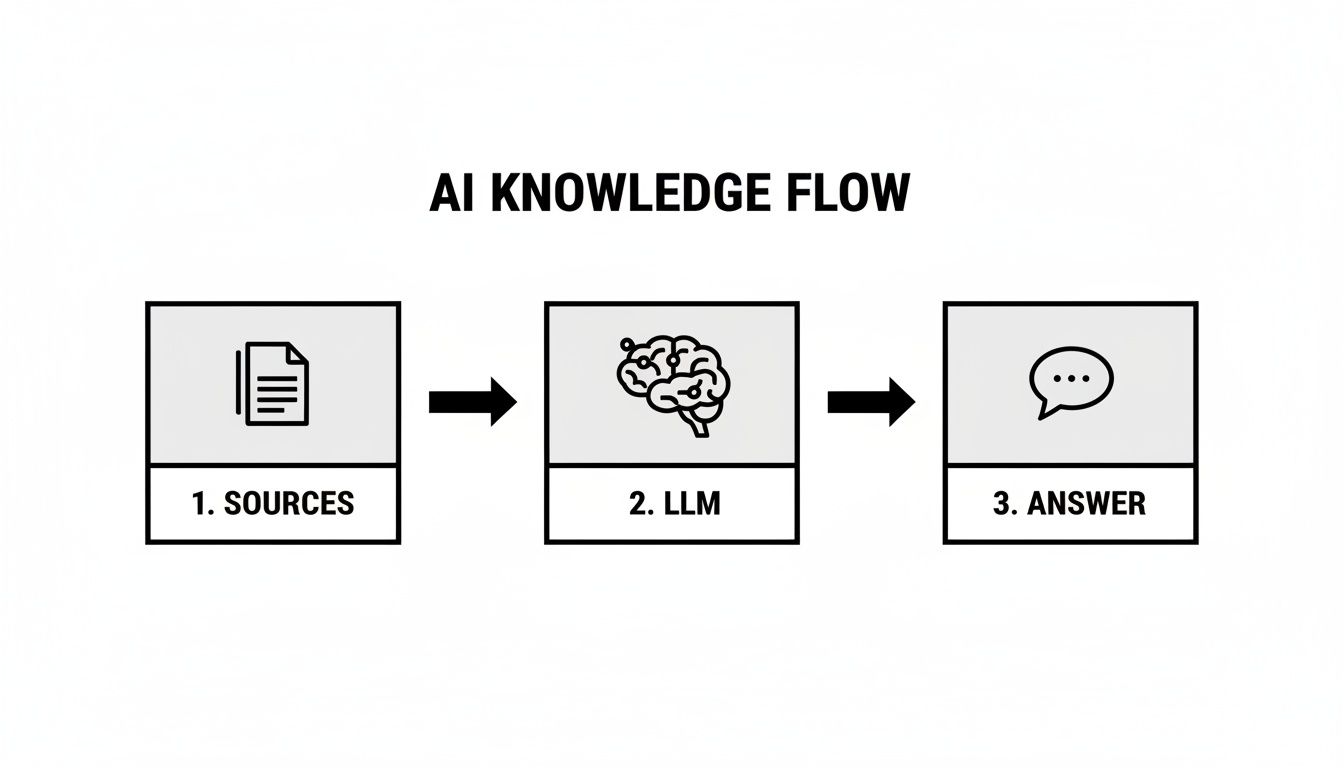
What this shows is that the AI's answer is a mashup of many different sources. That's precisely why a strategy that hits both your own content and third-party PR is so incredibly effective.
Implement and Optimize Structured Data
If you want to make things really easy for AI, use structured data. Also known as schema markup, it's essentially a hidden layer of code on your site that acts like a cheat sheet for language models. It removes any guesswork and tells them exactly what your content is about in a language they perfectly understand.
To really move the needle on LLM brand visibility, I recommend focusing on these specific schema types:
- FAQPage Schema: Marking up your FAQ pages gives AI models a bank of clear, direct answers to pull from. This is low-hanging fruit.
- Product Schema: For e-commerce brands, this is non-negotiable. Make sure your product pages have detailed markup with specs, pricing, and availability.
- Organization Schema: This helps you control the narrative. Clearly define your official company name, logo, social media profiles, and contact info to prevent factual errors and brand mix-ups.
When you make your information machine-readable, you dramatically increase the odds that it will be used accurately in AI-generated answers.
A Hands-On Example: Turning Negative Sentiment Around
Let's walk through a real-world scenario. Imagine a direct-to-consumer mattress brand. They run an audit with a tool like PromptPosition and uncover something alarming: when people ask Gemini for the "best mattress for side sleepers," their brand is mentioned, but the sentiment is negative. The AI is citing outdated customer reviews from three years ago that complained about the mattress being too firm.
Their visibility is there, but the context is actively hurting them. Here’s the playbook they used to fix it.
First, they diagnosed the root cause. PromptPosition helped them pinpoint that the negative comments were being pulled from a few old but highly-ranked review articles and forum threads.
With the problem identified, they launched a two-pronged attack. They kicked off a review campaign, reaching out to recent, happy customers and encouraging them to leave fresh feedback on the most authoritative review sites.
At the same time, their content team developed a new, definitive guide titled "How to Choose the Perfect Mattress Firmness for Side Sleepers." This brilliant piece of content positioned them as the expert and was pitched to mattress review blogs for inclusion in their articles.
By proactively seeding the web with new, positive, and authoritative information, you are effectively giving the AI a better set of facts to learn from. Over time, the new data will outweigh the old, and the model's sentiment will shift.
Finally, they kept monitoring. The brand continued to use PromptPosition to track sentiment for that critical prompt. Over the next few months, they watched the sentiment score tick up—from negative to neutral, and eventually, to positive. They successfully turned a brand weakness into a strength, proving the ROI of their efforts one new source at a time.
Common Questions About LLM Brand Visibility
As you start digging into LLM brand visibility, a lot of questions pop up. It’s a new frontier for many marketers, but the fundamentals are easier to grasp than you might think. Here are some of the most common questions I hear, along with straightforward answers based on what we're seeing in the field.
How Is LLM Brand Visibility Different From Traditional SEO?
This is probably the most frequent question, and the distinction is critical. Traditional SEO is a race to the top of the search results page to win clicks. LLM brand visibility is about making sure your brand is actually part of the answer the AI generates.
Think about it: many people now get their answer directly from the AI chat box and never click a single link. Your #1 Google ranking might not even be seen. This means your strategy has to be much broader. You're not just optimizing a single webpage; you're building brand authority across the entire web so the AI learns to trust and recommend you.
A #1 ranking is no longer the finish line. Success in the age of AI is about being woven into the answer itself, becoming part of the narrative the AI presents to the user.
Can I Improve My LLM Visibility Without a Specialized Tool?
You can absolutely get started without one. The DIY approach usually involves manually typing prompts into models like ChatGPT or Gemini and tracking what they say about your brand in a spreadsheet. This is a great way to get an initial feel for things.
However, you'll hit a wall with that manual approach pretty quickly. It's incredibly time-consuming and almost impossible to do at scale. Worse, the results are inconsistent. Recent studies have shown there’s a less than 1 in 100 chance of an AI giving the exact same list of recommendations twice. You’re only getting a single, unreliable snapshot.
This is where specialized platforms like PromptPosition come in. They’re built to automate this work, tracking thousands of prompts daily, analyzing sentiment, and benchmarking you against the competition. They can even help you trace an AI's answer back to the source documents it learned from. That’s the kind of data you need to move from a casual experiment to a real, long-term strategy.
How Long Does It Take to See Improvements?
The timeline really depends on what you’re trying to achieve.
Correcting Factual Errors: If an AI is misstating a simple fact about your company, you can sometimes see a fix happen surprisingly fast. For example, if the error is coming from your Wikipedia page, correcting that source can influence the model relatively quickly.
Improving Overall Visibility: This is a longer game. If you're trying to get mentioned more often for competitive queries like "best project management software," think of it like traditional brand-building. It takes a consistent, sustained effort over months, not days.
The key is to be relentless. You have to keep publishing great content and earning mentions from other authoritative sources. When you monitor your visibility over time, you’ll start to see the impact compound as the AI’s knowledge base is updated with all that new, positive information.
What Should I Do If an AI Says Something Negative About My Brand?
Seeing an AI say something negative about your brand can be jarring, but it's a problem you can fix. The absolute first thing you have to do is find out why it's saying it.
Specialized tools like PromptPosition are designed to help you trace the AI’s response back to the source—the specific article, forum thread, or bad review that's poisoning the well. Once you’ve identified the source, your path forward is clear.
If the negative content is on a site you own, like an old blog post or an outdated support article, just go in and update it. Problem solved.
If it's on a third-party site, you can try reaching out to the publisher with corrected info. A more powerful approach, though, is to launch a digital PR and content campaign to create a wave of new, positive material. Over time, this fresh content will effectively bury the old negative information, changing the story the AI tells about you.
Ready to stop guessing and start measuring your brand's true performance in AI search? PromptPosition gives you the data-driven insights you need to understand your visibility, benchmark against competitors, and build a winning strategy.