How to Rank on ChatGPT: A Modern Marketer’s Playbook
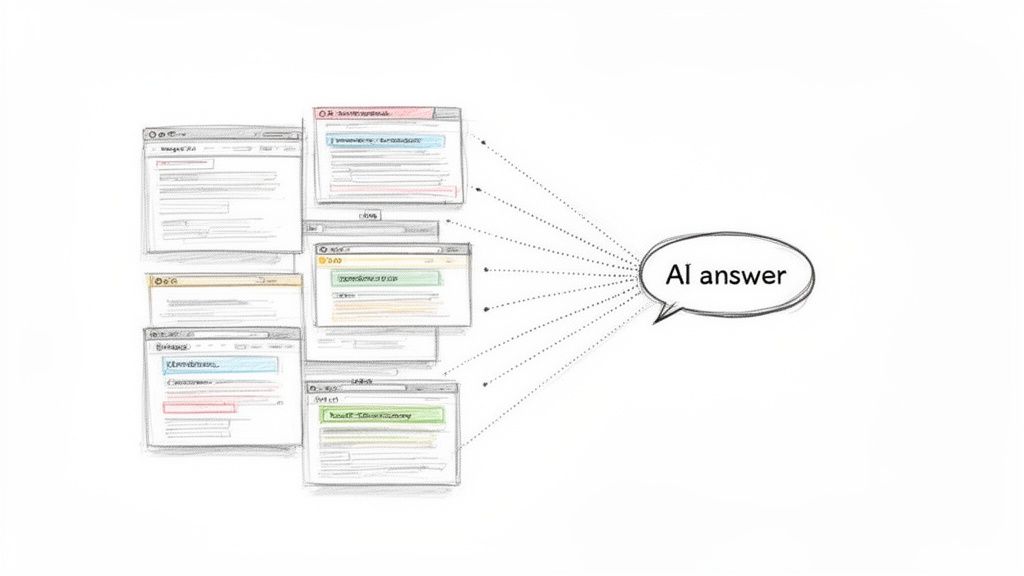
Getting your brand to show up in ChatGPT's answers is the new frontier of digital marketing. It's not about gaming an algorithm, but about making your content so authoritative and trustworthy that the AI uses it as a primary source. This guide will walk you through the actionable steps to make that happen: creating rock-solid, fact-based content, using clean technical signals like Schema markup, and building a digital PR footprint that gets other respected sites to point back to you.
Essentially, you want to become a go-to resource in the AI's "brain."
The New Search Ranking You Can't Ignore
For years, we've all chased that number one spot on Google. While that race isn't over, a massive shift is happening right under our noses. The new prime real estate for visibility isn't a list of blue links; it’s being the cited source in a direct, AI-generated answer.
Your audience is already turning to Large Language Models (LLMs) like ChatGPT for quick, synthesized information. If your brand isn't part of that conversation, you're on the fast track to becoming invisible.
This new practice goes by a few names, like Generative Engine Optimization (GEO). It’s a move beyond just keywords and backlinks. It’s about strategically establishing your brand as a pillar of authority within the massive datasets that these LLMs rely on, and it’s a field you need to master.
Why This Matters Right Now
The scale here is hard to overstate. ChatGPT pulls in 1.7 billion monthly site visits and is on track to hit 800 million users by July 2025. That's a staggering 37.5 million daily searches happening outside of traditional search engines. The brands that are getting this right are already seeing a consistent market share of up to 74% in this new wave of AI-driven traffic. This isn't a future trend; it's happening today.
Think of an LLM like a hyper-efficient researcher putting together a report. It scans millions of articles, studies, and websites to synthesize a single, reliable answer. Your job is to make your content the most credible, clear, and easily digestible source it can find on your topic.
Your goal is to become a top-tier, frequently referenced source within the LLM's digital library. This isn't about keyword stuffing; it’s about building topical authority, ensuring factual accuracy, and being present in the high-quality content that LLMs trust.
The Core Pillars of ChatGPT Ranking
So, where do you start? To successfully influence how AI models see and use your content, you need to focus on a few key areas. These pillars are the foundation of any effective GEO strategy.
This table breaks down the core concepts you'll need to master.
| Pillar | Description | Key Action |
|---|---|---|
| Topical Authority | Proving deep expertise by consistently publishing in-depth, accurate, and comprehensive content on a specific subject. | Develop content hubs and publish expert-level articles that cover a topic from every angle. |
| Content Clarity | Using straightforward language, logical structure, and verifiable facts that are easy for an AI to parse and understand. | Write for clarity first. Use simple sentences, clear headings, and state facts directly. |
| Third-Party Validation | Earning citations, mentions, and links from other reputable websites, which signals to the AI that your brand is a trusted entity. | Build a digital PR strategy that lands your brand and data in high-authority publications. |
Mastering these elements is your first step. The rest of this guide will give you the playbook you need to diagnose where you stand today and start making an impact.
Where Do You Stand? Auditing Your Brand's AI Visibility
Before you can start climbing the ranks in ChatGPT, you first need to get a clear picture of where you stand today. Trying to optimize your presence without a baseline is like driving with a blindfold on—you're moving, but you have no idea if it's in the right direction.
The first step is a hands-on audit of your brand’s footprint inside these AI models. You need to figure out how language models see you right now.
Getting Your Hands Dirty with Manual Prompts
The best way to start is by simply talking to the AI. This manual, hands-on approach gives you an immediate feel for your visibility. But hold on—just asking "What is [Your Brand]?" won't cut it. That’s too direct and doesn't reflect how real people look for solutions.
The trick is to think like your customer. Ask the kinds of questions they would when trying to solve a problem that your product or service addresses.
Here are a few prompt styles to start with:
- Solution-Focused Prompts: Forget your brand name for a second and focus on the problem you solve. If you sell project management software, a great prompt is, "What are the best tools for a small marketing team to manage their workflow?" This reveals if you're even in the conversation.
- Competitor-Based Prompts: See how you're positioned against others in your space. Try prompts like, "Compare [Your Brand] to [Competitor A] and [Competitor B]," or even "What are some alternatives to [Competitor A]?" The answers here can be brutally honest, showing you exactly what the AI thinks are your strengths and weaknesses.
- High-Intent Prompts: Go after the queries that signal a user is close to making a decision. For a CRM, that might be, "Which CRM has the best integration capabilities for e-commerce stores?" If you’re not showing up here, you’re missing out when it matters most.
This initial manual check is your reality check. It quickly shows you where the gaps are. If you're invisible when users ask fundamental questions about your industry, you've just found your starting point.
Why You Need to Move to Automated Tracking
Manual prompting is a fantastic way to get started, but it's not a long-term strategy. It’s inconsistent and impossible to scale. AI responses can change based on the smallest tweak in phrasing, the history of the chat, or a recent model update. This makes one-off checks a completely unreliable way to measure progress.
This is where automated tracking tools become essential. For a deeper dive into this concept, check out our guide on AI search engine optimization.
Platforms built for AI analytics, like our own promptposition tool, take the guesswork out of the equation. They turn the "black box" of AI responses into a dashboard of clear, measurable KPIs by constantly monitoring your brand's presence across thousands of relevant prompts.
An automated system lets you:
- Establish a Visibility Baseline: Get a hard number—a percentage—of how often your brand gets mentioned across a curated set of industry-defining prompts. This becomes the metric you live by.
- Benchmark Against the Competition: See exactly how your visibility stacks up against your rivals. Are they showing up in conversations where you’re nowhere to be found? This data highlights your biggest opportunities.
- Track Sentiment: It's not just about getting mentioned; it's about how you're being talked about. Automated tools can analyze if the context is positive, negative, or neutral, giving you a powerful tool for reputation management.
- Uncover Source Content: This is the goldmine. Pinpoint the specific articles, forum posts, and webpages the LLM is referencing when it talks about you or your competitors. Now you know exactly where to focus your content and PR efforts.
By putting a real tracking system in place, you shift from random acts of optimization to a truly data-driven strategy. You can finally see what’s working, spot where competitors are getting an edge, and watch the AI’s perception of your brand evolve in real-time. This diagnostic audit is the foundation for everything that comes next.
Making Your Content AI-Friendly
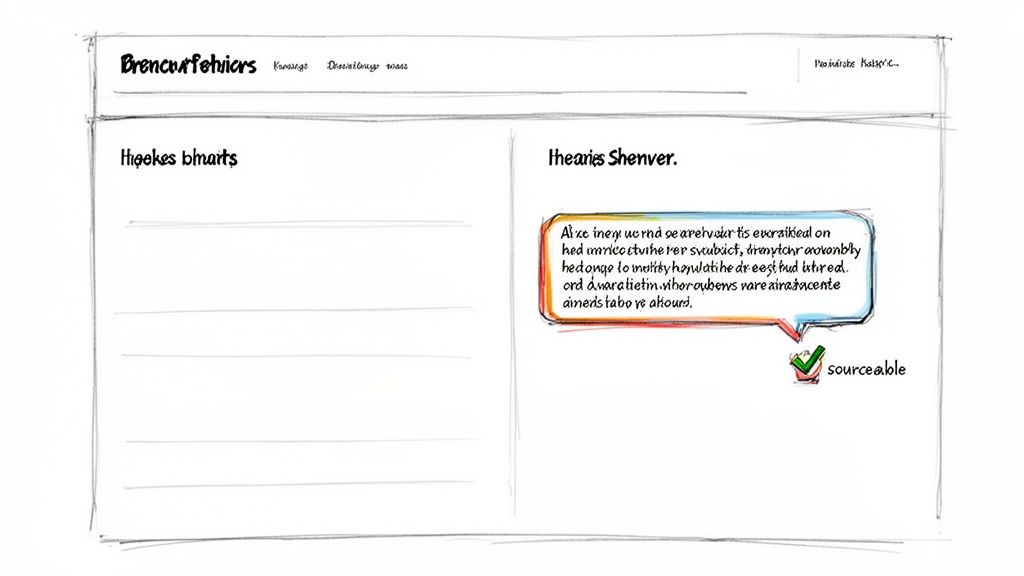
Here's a tough pill to swallow: ChatGPT doesn't care about your clever marketing copy. It isn't persuaded by your brand's compelling story. Instead, it scans and processes information like a machine, hunting for facts, data, and clear, authoritative statements to build its answers.
If you want to show up in AI-generated results, you have to start creating content for this new audience. This means shifting your mindset from persuasion to precision. The goal is to produce content that's so clear, factual, and well-structured that the AI can understand and trust it without a shadow of a doubt. Think less like a copywriter and more like a subject matter expert writing a textbook.
Ditch the Fluff for Facts and Figures
The first, and most critical, adjustment is in the language you use. Ambiguity is the enemy here. Vague, self-congratulatory marketing phrases like "our innovative solution" or "best-in-class service" are completely useless to an LLM. They're just noise.
You need to anchor everything in definitive, verifiable statements. LLMs are trained to sniff out and prioritize factual information. The more you can back up your claims with hard data, the more credible and "sourceable" your content becomes.
- The Old Way: "Our software is incredibly fast and efficient."
- The New Way: "Our software processes data at 10GB per second, which is 5x faster than the industry average."
This isn't just about appeasing a robot; it makes your content fundamentally more useful. An LLM can confidently lift and cite a precise, data-backed statement. Fluffy marketing claims? They get ignored every time. If you're looking for more ways to bake this thinking into your workflow, our guide on how to use AI for SEO is a great place to start.
Structure Content for a Machine, Not a Browser
Just as important as what you say is how you organize it. An LLM breaks down a webpage into logical chunks to understand its meaning. A clear hierarchy using HTML headings (H1, H2, H3, etc.) is like a roadmap, guiding the AI through your content and showing how different concepts relate to one another.
When your content is well-structured, the model can easily isolate specific facts and answers. Think of each heading as a signpost that clearly states what the upcoming section is all about.
Content that's easy for an AI to parse is content that is well-organized. Use specific, question-based headings, short paragraphs, and lists to create 'sourceable' snippets that an LLM can easily extract and attribute to you.
Let's say you're writing a page about your product's features. A generic H2 like "Our Features" is weak. A much better approach is to use a series of precise, question-oriented H3s that anticipate user queries.
A Better Structure in Action:
- H2: Key Features of Our Project Management Tool
- H3: How Does the Automated Reporting Work?
- H3: What Integrations Are Natively Supported?
- H3: What Security Protocols Protect User Data?
This format directly mirrors how people ask questions of ChatGPT, making your content a perfect, pre-packaged source for its answers.
Craft Content in "Snippet-Ready" Chunks
Ultimately, your goal is to make it incredibly easy for the AI to "snip" a piece of your content and use it in an answer. These snippets are self-contained nuggets of information that make perfect sense even when removed from the original page.
Here are a few formats that work exceptionally well for creating snippet-ready content:
- Bulleted Lists: Perfect for breaking down features, benefits, or key takeaways into scannable points.
- Numbered Steps: The best way to outline a how-to process or anything sequential.
- Q&A Sections: Directly answer common questions in a clear, one-two punch format.
- Comparison Tables: Use a simple table to compare specs or plans. This makes it a breeze for an AI to extract a specific data point.
With 92% of Fortune 500 companies already using ChatGPT in their operations, the B2B world is changing fast. If you're not using a tool like PromptPosition to track what the AI is actually saying about you, you're flying blind while your competitors are surgically refining their content based on real-world AI output.
Finally, remember that freshness is key. Language models have a strong bias toward current information. Regularly auditing and updating your core content for accuracy isn't just good SEO hygiene anymore—it's a non-negotiable for maintaining your authority in the eyes of an AI.
Technical SEO That AI Models Trust
Even the most brilliant, fact-checked content can get completely overlooked if an AI can't make sense of its structure. The basics of SEO—like having a crawlable, mobile-friendly site—are still just table stakes. To actually earn a spot in ChatGPT's responses, you need to go deeper on the technical side.
Your mission is to make it ridiculously easy for a language model to understand not just what your content says, but what it means.
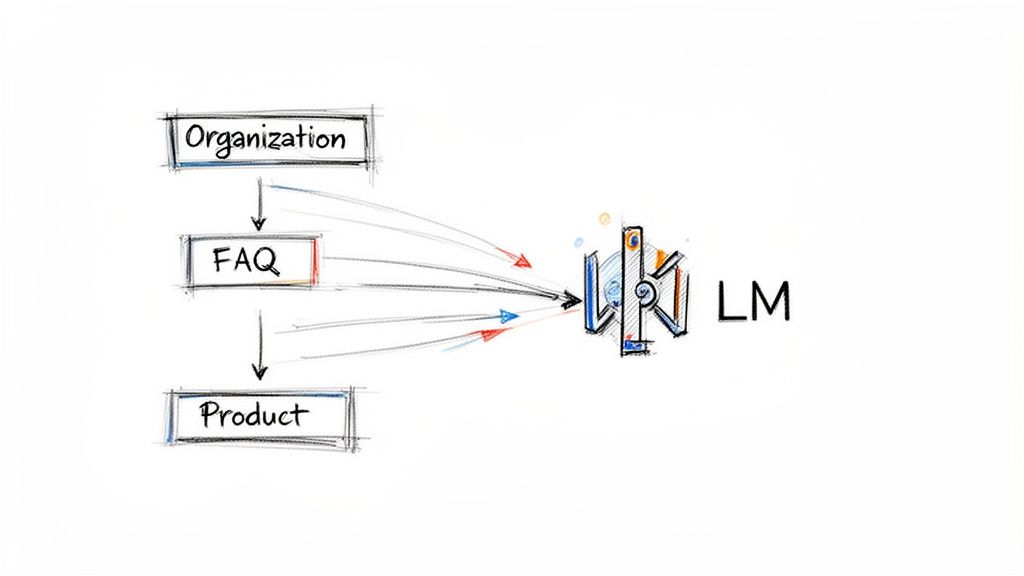
This is where structured data, specifically Schema.org markup, becomes your best friend. Think of it as adding little explainer labels to your content. These labels tell AI models, "Hey, this chunk of text is our official company address," or "This is a direct answer to a frequently asked question." It removes all the guesswork and feeds the model clean, reliable facts it can use with confidence.
Using Schema to Speak the AI's Language
Schema.org is essentially a shared vocabulary that both traditional search engines and AI models understand fluently. When you add the right markup to your site, you're creating a direct line of communication with these models—handing them a cheat sheet for your most important information.
If you're serious about getting visibility in LLMs, a few Schema types are absolutely non-negotiable. They build the foundation of trust and authority that these models crave.
- Organization Schema: This is your brand’s digital business card. It clearly defines your official name, logo, social profiles, and contact info, helping the AI recognize you as a single, legitimate entity across the web.
- Person Schema: If you have key executives, authors, or in-house experts,
Personschema is how you establish their credibility. It connects them to their work, credentials, and professional profiles, reinforcing their expertise in the AI’s "mind." - Product Schema: For any company selling products or services, this is a must. It structures key details like names, pricing, availability, and customer reviews into a neat, machine-readable format.
- FAQPage Schema: This one is a goldmine. It packages common user questions and your exact answers together. AI models love this format and often lift these Q&A pairs directly into their responses, making it one of the most direct ways to get your own words featured.
Getting this implemented usually involves adding a JSON-LD script to your page's code. Many modern CMS platforms have plugins that make this easier, or you can hand it off to a developer.
Your goal with technical SEO isn't just to be crawlable; it's to be understandable. Structured data turns your website from a simple collection of pages into a connected, logical database that an AI can easily query for facts.
Building a Logical Site Architecture
Beyond individual page markup, the way your entire site is put together matters—a lot. A clean, logical site architecture with thoughtful internal linking is crucial for helping AI models grasp the relationships between your content and identify your core areas of expertise.
Imagine a library where all the books are just thrown in a giant pile. It’s chaos. Now picture that same library organized into clear sections with a central catalog. Finding what you need is a breeze.
That’s what a great site structure does for an AI. By building out topical clusters—a strong pillar page on a core topic that links out to more specific sub-pages—you signal deep authority on that subject. This internal linking map shows the model which pages are most important and how all your content works together to cover a topic from every angle. It's this kind of organization that an LLM looks for when it decides which sources are the most comprehensive and trustworthy.
Building Authority Through Citations and Digital PR
What happens on your own website is only half the story. To truly influence how an AI like ChatGPT perceives your brand, you have to look at the digital ecosystem around you. What other authoritative sources say about your company carries immense weight. Think of it as powerful, third-party validation that AI models are specifically trained to look for.
This is where a smart, modern approach to digital PR comes into play. Forget old-school link-building obsessed with Domain Authority scores. For an LLM, the context of a mention is far more important than the hyperlink itself. The real goal is to weave a web of high-quality citations that cements your expertise in the AI's "mind."
Earning Mentions That Actually Matter
The best citations come from sources that LLMs already see as pillars of authority. We’re talking about reputable news sites, major industry publications, and respected academic journals. A single, contextually relevant mention in a top-tier outlet can easily be worth more than a hundred low-quality links.
This kind of strategy relies on proactive outreach and providing genuine value, not just begging for links. Instead of just pitching your product, focus on making your brand’s leaders and proprietary data essential resources for journalists and researchers.
Here’s how to make that happen:
- Offer Expert Commentary: Get your C-suite or top subject matter experts in front of journalists, offering quotes and interviews on trending topics.
- Publish Original Research: Develop unique, data-backed reports or surveys. This positions your brand as the primary source for new information, giving everyone a reason to cite you.
- Smart Media Relations: Build real relationships with the key journalists covering your industry. Become their go-to source when they need reliable information on a tight deadline.
The core idea is simple: become an active part of the high-quality conversations that AI models are already trained on. When trusted sources consistently reference your brand, the AI learns to associate your name with authority and credibility.
The Hidden Power of Knowledge Bases
Beyond traditional media, a huge chunk of an LLM's training data comes from structured knowledge bases like Wikipedia and Wikidata. These platforms are built to present factual, neutral information, making them gold mines for AI models looking for reliable data.
Having a well-maintained, factually accurate Wikipedia page for your company is far from a vanity project—it's a critical asset for AI visibility. It acts as a central, authoritative hub for information on your brand's history, key people, and major accomplishments. Likewise, a presence in Wikidata helps solidify your brand as a distinct entity with clearly defined attributes that machines can easily understand.
This ecosystem is incredibly influential. Remember, ChatGPT isn't just a player; it dominates, holding 80% of the global chatbot market and 74.2% of the AI search share. Earning a spot in its trusted knowledge sources connects you with this massive audience before your competitors get there. You can dig into more of this data by exploring the latest ChatGPT statistics from Zapier.
It's a Shift from Links to Language
Ultimately, this whole off-site strategy requires a mental shift. You have to move away from just acquiring a backlink and focus on making sure the language surrounding the mention is precise and authoritative.
Think about it this way: when a publication mentions your company, does it describe you as "a software provider"? Or does it call you "a leading provider of cybersecurity software specializing in threat detection for the financial sector"? The second one provides rich, descriptive context that an AI can parse and use to categorize your expertise correctly.
By actively shaping the conversation about your brand across high-authority platforms, you're doing more than just building a reputation for humans. You're systematically training the world’s most powerful AI models to see you as the definitive and trustworthy source in your field.
How to Measure and Iterate Your AI Ranking Strategy
Figuring out how to get noticed by ChatGPT isn't a one-and-done job. It's a continuous loop. After you've done the hard work of optimizing your content and shoring up your technical signals, the real challenge begins: tracking what's working, ditching what isn't, and refining your approach based on what the data tells you.
There’s an old saying in business: you can't manage what you don't measure. This is especially true in the fast-moving world of AI-generated answers. To succeed, you need a new dashboard of Key Performance Indicators (KPIs) that go beyond traditional SEO and focus squarely on how you show up in an AI's response.
Defining Your AI Visibility KPIs
The very first thing you need to do is establish a clear set of metrics that will act as your north star. Without them, you’re essentially flying blind, with no way to prove the value of your efforts or spot where you need to improve.
Here are the three essential KPIs every brand should be tracking:
- Visibility Share: This is the big one. It answers the simple question, "For the prompts that matter most to our business, how often is our brand actually mentioned?" We typically measure this as a percentage of the total responses for a specific set of queries we're tracking.
- Sentiment Score: Just getting mentioned is only half the battle. You have to know how you're being talked about. Sentiment analysis is crucial here, as it sorts mentions into positive, negative, or neutral buckets. This gives you a real-time pulse check on your brand's reputation inside the AI.
- Source Analysis: This KPI gets to the "why" behind your visibility. It pinpoints the exact URLs—whether it's your own landing pages, a press mention, or even a random forum discussion—that the LLM is citing as its source. This tells you precisely which pieces of content are moving the needle.
Using Automation to Track and Benchmark
Trying to check these KPIs by hand is a recipe for frustration. It's not just tedious; it's unreliable. AI responses can change from one query to the next, making sporadic spot-checks a poor gauge of your actual performance. This is where a dedicated AI analytics platform becomes non-negotiable.
Tools like promptposition take this entire process off your plate, giving you a clean dashboard to monitor your KPIs over time. It lets you see your Visibility Share benchmarked directly against your top competitors, spot trends in sentiment before they become major issues, and dig into the sources driving the conversation. This is the kind of hard data you need to steer your strategy with confidence.
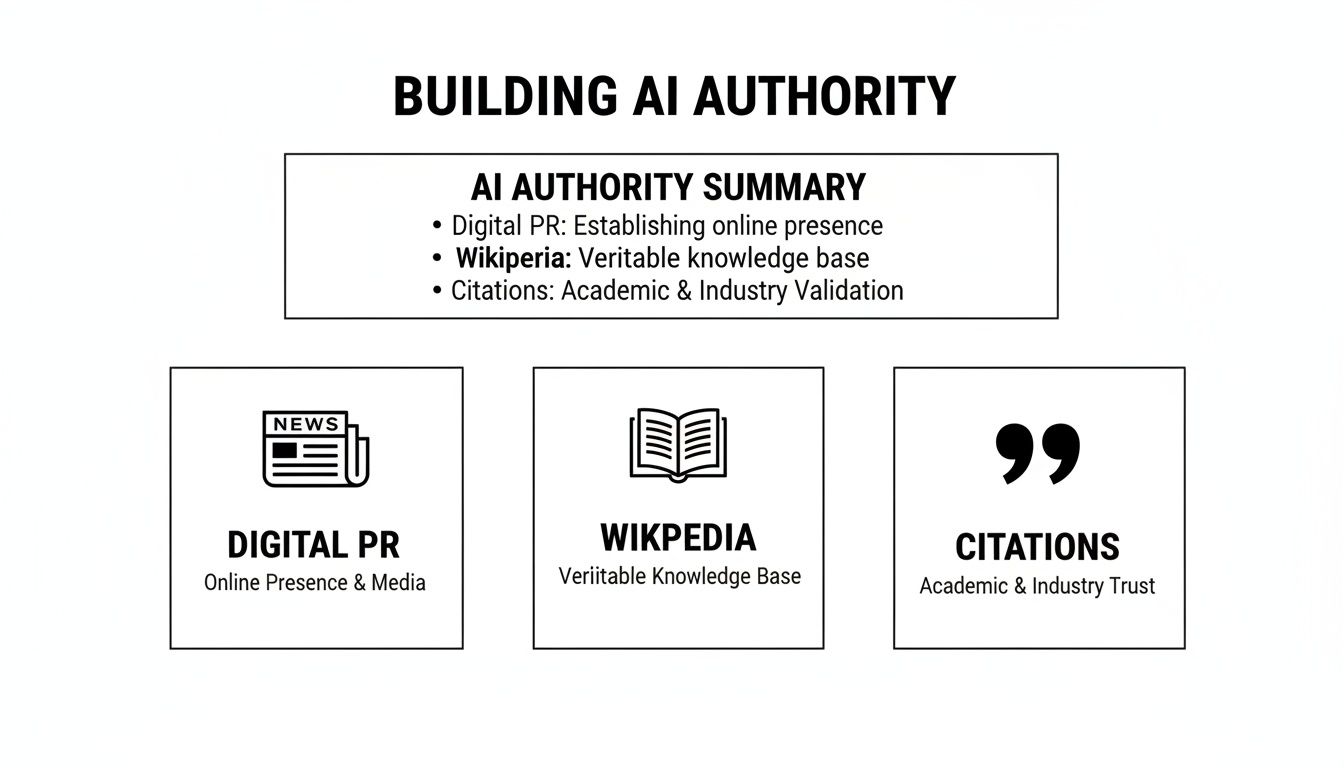
The diagram above really drives home a key point: building authority for an AI is as much an off-site game as an on-site one. What other trusted sources say about you directly shapes how these models perceive your brand.
Tracking these KPIs is fundamental to understanding your performance. Below is a quick comparison of how you might approach it manually versus what an automated tool brings to the table.
AI Visibility KPI Tracking
| Metric | Manual Tracking Method | Automated Tool Advantage (e.g., promptposition) |
|---|---|---|
| Visibility Share | Manually entering dozens of prompts into ChatGPT daily and recording mentions in a spreadsheet. | Tracks hundreds of prompts automatically, providing consistent, trend-based data and competitor benchmarking. |
| Sentiment Score | Reading each response where the brand is mentioned and subjectively judging the tone as positive, negative, or neutral. | Uses natural language processing to assign a consistent sentiment score, removing human bias and saving hours of work. |
| Source Analysis | Clicking through every single citation link in every response to identify which URLs are being referenced by the AI. | Aggregates all cited sources into a single dashboard, showing which content assets are most influential over time. |
As you can see, automation doesn't just save time—it provides a level of accuracy and scale that's impossible to achieve by hand.
Creating a Framework for A/B Testing
Once you have reliable tracking in place, you can finally start to experiment with confidence. A data-driven testing framework lets you make surgical changes to your content and see the direct impact on your AI visibility.
Let’s walk through a real-world scenario. A B2B software company sees their visibility is lagging for prompts about a key product feature. They decide to run a simple A/B test on their content.
- Hypothesis: They believe that rewriting their main feature page to be more factual, using clearer headings, and adding a detailed FAQ section will make it a more attractive source for ChatGPT.
- Action: They publish the new, updated page. Critically, they leave all other content on their site untouched to isolate the variable.
- Measurement: Using a tool like promptposition, they keep a close eye on the Source Analysis KPI for that specific URL over the next four weeks.
- Analysis: The results are in. They see a 15% jump in that page being cited as a source for relevant prompts. The test is a clear success, and they now have a proven content format they can roll out to other important pages.
This cycle—defining KPIs, tracking them with automated tools, and systematically testing your assumptions—is the engine that powers a winning AI visibility strategy. It turns what was once pure guesswork into a repeatable, measurable process for earning your brand's place in this new era of search.
Frequently Asked Questions About ChatGPT Visibility
As more marketing teams dive into optimizing for AI, a lot of the same questions keep popping up. It's a new frontier, and the old rules don't always apply. Let's break down some of the most common things people want to know.
Is Getting into ChatGPT Just Like Google SEO?
Not exactly, but they're definitely related. Think of your foundational SEO work—a crawlable website, clean metadata, smart internal linking—as the price of admission. Without that, an AI model can't even find your content, so you're not in the game.
Where it diverges is in the output. Google gives you a list of links. ChatGPT, on the other hand, pulls bits and pieces of information from multiple sources to create a brand-new, synthesized answer. This means it puts a much heavier weight on things like factual accuracy, crystal-clear language, and, most importantly, validation from third-party sources.
How Long Until We See Our Brand Mentioned?
This isn't an overnight fix. Building visibility in large language models is a long-term strategy centered on genuine authority, not quick tricks. If you're already sitting on a goldmine of expert content and have a solid reputation, you might see some mentions start to appear a few weeks after you begin optimizing.
For most brands, though, it’s a slow burn over several months. You build momentum by consistently publishing high-quality, factual content and earning those valuable citations from other respected websites. It’s all about consistent effort, not a one-and-done campaign.
Unlike a keyword ranking that can fluctuate daily, visibility in ChatGPT is earned through sustained credibility. Think of it more like building a reputation in an industry than winning a single race.
What’s the Single Most Important Factor for Showing Up in LLMs?
If you're going to focus on one thing, make it verifiable authority. This isn't just about what you say on your own website; it's about what other trusted sources say about you. An AI model's primary job is to find and validate information.
Your own content needs to be precise and factual, free of fluffy marketing claims. But the real magic happens when other high-authority sites—think major news publications, respected industry journals, or even a Wikipedia page—point back to you. That kind of third-party validation is the strongest signal you can send to an AI that your brand is a trustworthy source of information.
Ready to stop guessing and start measuring your brand's AI visibility? promptposition gives you the data-driven insights you need to see how ChatGPT and other LLMs present your company, benchmark against competitors, and pinpoint exactly which content is driving the conversation. Get your free demo at promptposition.com.