How to Optimize for AI Search and Drive Real Business Growth
Optimizing for AI search isn't just another item on your SEO checklist. It's a fundamental shift in how brands become visible. Your goal is no longer just ranking on a page of links; it’s about becoming a citable, authoritative source that AI models trust and feature directly in their answers.
This guide will walk you through the practical steps to make this happen. We’ll focus on creating highly structured, fact-based content and implementing the technical SEO signals that make it incredibly easy for AI to parse and verify your information. It's not about chasing clicks anymore. It’s about becoming the answer.
The New Search Reality: Why AI Optimization Matters Now
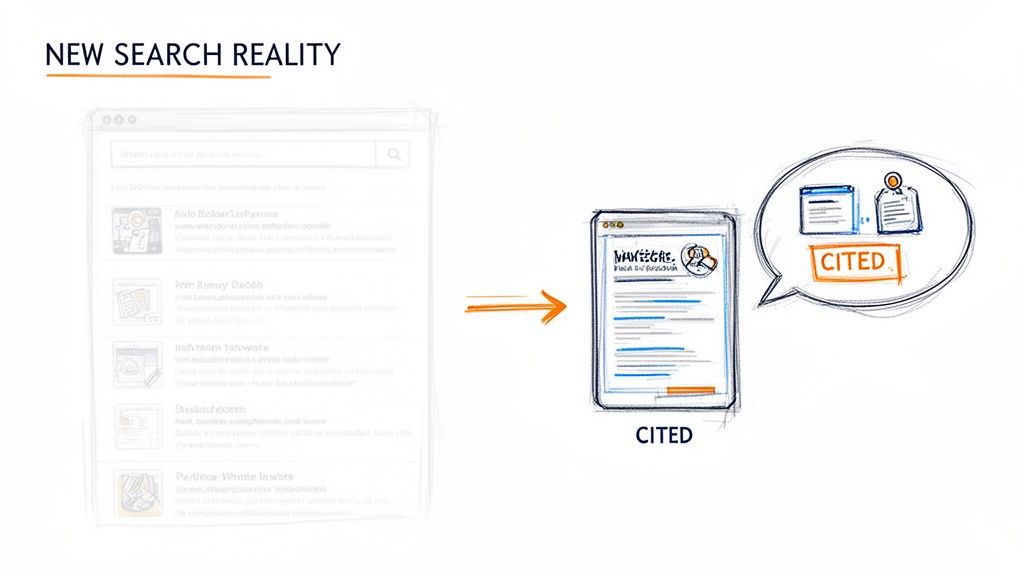
Imagine your perfectly crafted content suddenly becoming invisible to your target audience. This isn't a distant threat. It's the new reality for countless brands as users shift from traditional search bars to AI assistants like ChatGPT, Perplexity, and Google's AI Overviews.
The change is seismic. For years, the game was straightforward: get to the top of the search engine results page (SERP) and win the click. That game is over. AI models now act as gatekeepers, synthesizing information from multiple sources and presenting a single, direct answer. That familiar list of blue links? It's quickly becoming a relic of a past era.
This creates a critical business problem. If your brand isn't cited directly within that AI-generated summary, you simply don't exist for that search. We're not talking about a small dip in traffic; we're talking about a potential collapse of visibility for any business that fails to adapt.
The Invisibility Crisis
The data paints a sobering picture. Imagine pouring your budget and team's energy into a killer SEO strategy, only to watch 92% of brands vanish when users turn to AI for answers. That's the stark reality from recent industry analysis—the vast majority of brands are completely invisible in AI-generated responses.
This invisibility is a direct result of a massive traffic collapse. Organic click-through rates (CTR) for informational queries have plummeted by 61% since AI Overviews started rolling out. These aren't just statistics; they represent a critical, urgent challenge for every marketer today.
The Pivot from Ranking to Citation
Success in this new era demands a complete mental reset. Your goal is no longer to rank. It's to become a citable, trusted source that AI models rely on. The new playbook is all about establishing your brand as the primary source of truth for your niche.
The core question has shifted from "How do I get my page to the top of Google?" to "How do I get my key messages into the AI's answer?" This means your content must be structured for machine readability and backed by undeniable authority.
To help you grasp this change, here's a look at how the old and new worlds compare.
Traditional SEO vs AI Search Optimization Key Differences
This table provides a clear, scannable comparison of the old and new optimization paradigms, helping you quickly grasp the fundamental shifts in strategy.
| Focus Area | Traditional SEO (The Past) | AI Search Optimization (The Future) |
|---|---|---|
| Primary Goal | Rank #1 on the SERP, win the click. | Become a cited source in the AI answer. |
| Key Metric | Organic Traffic, Click-Through Rate (CTR). | Share of Prompt, brand mentions, citations. |
| Content Focus | Long-form, keyword-driven articles. | Factual, structured data; direct answers. |
| Technical Focus | On-page SEO, backlinks, site speed. | Schema markup, structured data, entity recognition. |
| User Interaction | User clicks a link to visit your website. | User gets an answer directly, may not visit any site. |
As you can see, simply continuing with old SEO tactics is like bringing a knife to a gunfight. The entire arena has changed.
This pivot involves several key adjustments to your day-to-day work:
- From Keywords to Concepts: Keywords still have a place, but the real focus is now on comprehensively covering topics and answering questions directly and clearly. AI understands context and intent, not just a string of words.
- From Clicks to Mentions: The new KPI to obsess over is "Share of Prompt"—how often your brand is mentioned for key queries compared to competitors. Tools like Prompt Position are emerging to track exactly this.
- From Content to Data: Your articles, blog posts, and landing pages must be treated as structured data. Clear headings, lists, and schema markup are no longer just "best practices"; they are essential for being understood by AI crawlers.
Learning how to optimize for AI search is about future-proofing your brand's digital relevance. It's about ensuring that when users ask questions, your expertise provides the answer. For a deeper dive into the fundamentals, check out our complete guide to AI search engine optimization.
Auditing Your Current Visibility in AI Search
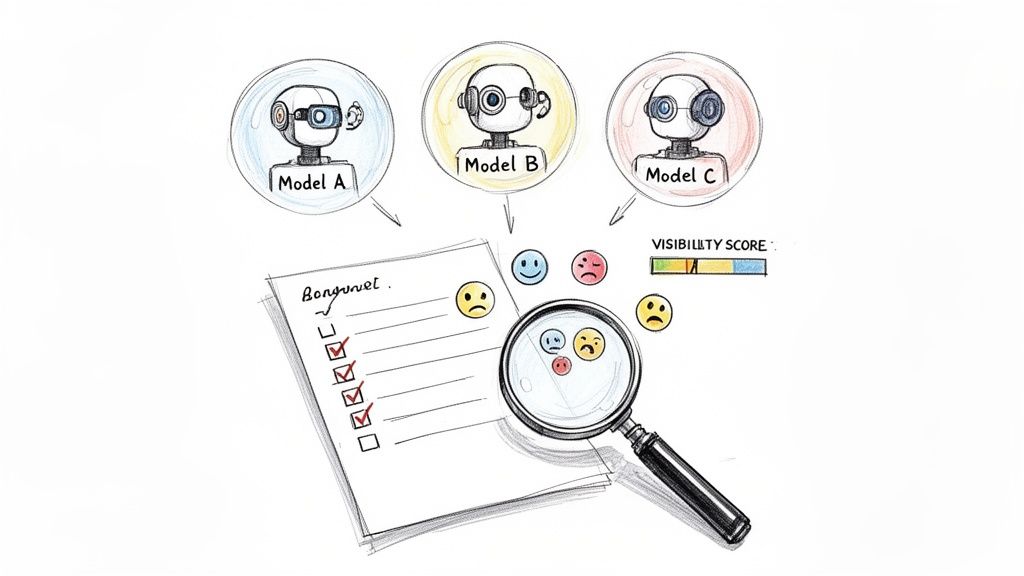
Before you can optimize, you have to establish a baseline. The first actionable step is to get a clear picture of your brand’s current footprint in AI-generated answers. Without this audit, you're essentially flying blind, with no way to measure progress or prove the value of your efforts.
The goal here is to discover how—and if—your brand appears when people ask questions about your industry, your products, or your competition. This isn't your typical keyword ranking check; it’s about understanding how you fit into the narrative AI is building for your audience.
Getting Your Hands Dirty: Manually Testing Your AI Footprint
The most direct way to begin is to dive in and ask the models yourself. This hands-on approach gives you an immediate, real-world feel for how different AI systems perceive your brand. I always recommend this as the first action because it reveals the raw output you need to influence.
Start by opening up a few different platforms. Don’t just stick to one. I like to have tabs open for ChatGPT, Gemini, and Perplexity because their answers can vary significantly based on their training data and which live sources they access.
Now, think like a customer and start crafting prompts to test your brand from different angles.
- Brand-vs-Brand: Pit yourself directly against a competitor. For example, "Compare HubSpot's CRM with Salesforce's for a small business."
- Recommendation Seekers: Act like a buyer looking for help. Try something like, "What are the best project management tools for a remote marketing team?"
- Top-of-Funnel Questions: Ask broad, informational questions where your brand should be an authority. Think along the lines of, "What are the most important trends in sustainable packaging for 2025?"
- Simple Brand Queries: Just ask about yourself. "What is [Your Brand Name] known for?" or "Summarize recent reviews for [Your Product]."
As you go, document everything. A simple spreadsheet is perfect for this. You're not just logging answers; you're hunting for patterns.
A manual audit isn't just about spotting a mention. It’s about analyzing the context, sentiment, and positioning of that mention. An inaccurate or negative citation can be far more damaging than being invisible.
Making Sense of the AI-Generated Answers
Once you have a collection of responses, you need to know what to look for. I break down my analysis into three core areas:
- Visibility: Are you even in the conversation? If you are, how prominent is the mention? Are you cited as a key source, or are you just another name in a long list?
- Sentiment: When the AI does talk about you, is the tone positive, negative, or just neutral? Does it highlight your strengths or surface old complaints?
- Positioning: How are you framed next to your competitors? Does the AI cast you as the premium choice, the budget-friendly option, or the innovative disruptor?
This manual work quickly uncovers your blind spots and opportunities. You might discover you're a thought leader on one topic but completely absent from another. Or worse, you might find that a single negative review from two years ago is being constantly surfaced by multiple AI models, poisoning your reputation. These are the actionable insights that will shape your entire content strategy.
Scaling Up Your Audit with Specialized Tools
Let's be realistic. While manual testing is a fantastic starting point, it’s not a viable long-term strategy. AI answers are constantly changing, and no team has the bandwidth to check hundreds of prompts across multiple models every single day. That’s where specialized tools come into play.
Platforms like Prompt Position can put this entire process on autopilot. They can monitor a vast array of prompts continuously, track your brand's "Share of Prompt" against competitors, and alert you to shifts in sentiment in real time.
For example, a competitor dashboard can visualize who is winning the visibility battle for key queries and how sentiment is trending over time.
This move from occasional spot-checks to a continuous monitoring framework is a game-changer. It allows you to pinpoint the exact sources influencing the AI, find content gaps where your competition is winning, and actually measure the ROI of your optimization efforts.
Becoming a Primary Source for AI Models
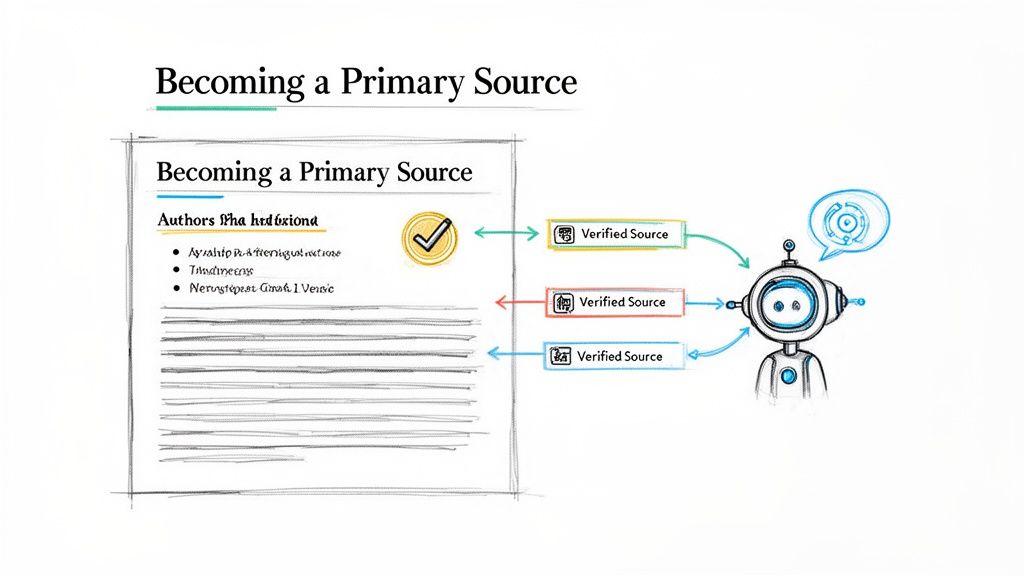
This is where the real work begins. To win in AI search, you must shift your mindset. It's time to stop seeing your content as a collection of blog posts and start treating it as an indispensable library that language models can trust and cite.
The old game of keyword stuffing and algorithm-chasing is over. The new goal is to become the most reliable, easily digestible authority on your topic. Every piece you publish needs to be engineered for two audiences: your human readers and the AI crawlers that dissect it. These crawlers don't "read" your articles; they strip them down, looking for clear facts, logical structures, and verifiable data to build new answers.
The stakes are unbelievably high. Google's AI Overviews are already in front of a staggering 2 billion monthly users, completely changing how people find information. With these summaries driving down clicks to websites by an average of 34.5%, earning a direct citation in an AI answer isn't just a nice-to-have—it's a critical survival tactic.
Reimagining E-E-A-T for an AI Audience
Google’s E-E-A-T framework (Experience, Expertise, Authoritativeness, and Trustworthiness) is more important than ever, but we have to look at it through a new, machine-readable lens. An AI model can't pick up on your brand's clever voice or infer expertise from subtle storytelling. It needs explicit, verifiable proof.
Think of it like this: a human might be swayed by a compelling narrative, but an AI needs to see the cold, hard data points within that narrative. Your content has to broadcast trust in a language algorithms understand.
Here’s how to translate E-E-A-T for AI crawlers:
- Experience: Don't just claim you have experience—prove it. Instead of saying "We're experts," show it: "We helped Company X achieve a 45% increase in lead quality by implementing this exact framework." Concrete examples and case studies are your best friends.
- Expertise: Attribute your content to real, qualified authors. This means detailed author bios with credentials, links to their LinkedIn profiles, and mentions of other respected publications they’ve contributed to. You're building a verifiable web of authority.
- Authoritativeness: When you make a claim, back it up. Link out to reputable primary sources like academic studies, government data, and well-known industry reports. This shows the AI that your information is grounded in research, not just opinion.
- Trustworthiness: Make your "About Us" page, contact details, and privacy policy incredibly easy to find. These practical elements, combined with positive third-party reviews, are powerful trust signals for both people and AI.
Engineering Content for Machine Readability
AI models thrive on structure. They get lost in long, dense paragraphs of prose, making it hard to pull out individual facts. Your job is to break down complex ideas into simple, logical building blocks that an AI can easily grab and repurpose.
This isn’t about dumbing your content down; it’s about making it smarter and more accessible.
The most effective content for AI search is modular. An AI should be able to lift a single sentence or bullet point from your article, and it should still make perfect sense out of context.
Think about how you can deconstruct your expertise into its cleanest format. Explaining a process? Use a numbered list. Comparing a few options? A table is perfect. Answering a frequently asked question? Use a clear Q&A format with a bolded question as the heading.
| Content Type | Poor for AI Parsing | Excellent for AI Parsing |
|---|---|---|
| Product Features | A long paragraph describing all the benefits of your software. | A bulleted list with each feature and its primary benefit clearly stated. |
| Process Guide | A narrative story about how a team completed a project. | A numbered list detailing the exact steps to follow, with action-oriented headings. |
| Concept Definition | An introductory paragraph that vaguely hints at a definition. | A direct, one-sentence definition immediately following a heading like "What Is X?" |
This structured approach makes your content a goldmine for citations. You’re no longer just providing an article; you're providing a database of answers. To see how this fits into a broader strategy, check out this great overview on what is generative engine optimization.
Creating Prompt-Aware Content
The final piece of the puzzle is learning to think like your audience—specifically, how they talk to AI assistants. People don't just type keywords into ChatGPT; they ask full-sentence questions. Your content needs to answer these "prompts" directly.
Start by digging into the core questions your audience is asking. Use tools like AnswerThePublic or simply look at the "People Also Ask" box in Google search results. Then, build entire sections of your content around answering those questions, using the questions themselves as your subheadings.
For example, instead of a generic post titled "The Benefits of Our Software," try "How Does [Your Software] Solve [Specific Customer Pain Point]?" This simple reframing aligns your content directly with the user's intent, making your article the most logical and authoritative source for an AI to pull from when that question gets asked. When you become the best answer, you become the primary source.
Mastering Technical SEO for AI Crawlers
You can create the most insightful, authoritative content on the planet, but it's completely useless if AI models can't find and understand it. Once you've honed your content to be a primary source, your next job is to get your technical house in order. This isn't just about user experience anymore; it's about making your site a welcoming place for the new generation of AI crawlers, like GPTBot.
Think of it this way: these crawlers are on a tight "crawl budget." They only have so much time and so many resources to spend indexing your site. A slow, clunky website is a dealbreaker. It often causes them to give up and leave before they’ve even had a chance to see your brilliant work. Your technical setup is the first handshake, and it determines whether an AI model wants to stick around or move on to a faster, more efficient competitor.
The Need for Speed in the Age of AI
Site speed has always mattered for SEO, but for AI optimization, it’s non-negotiable. Large language models are incredibly resource-intensive, and their crawlers are built for ruthless efficiency. They have a massive preference for ultra-fast websites because a quick server response means they can gather more data in less time.
This isn't just a theory; it directly impacts who gets seen and who doesn't.
In the high-stakes game of AI search, technical performance is everything. We're seeing pages with server response times under 200ms get 3x more Googlebot requests. What's more, ChatGPT citations favor pages with a First Contentful Paint (FCP) under 0.4s by 3x over those with an FCP above 1.13s. Every millisecond counts. A sluggish site is an invisible site. You can dive deeper into these performance benchmarks at almcorp.com.
Structured Data: The Universal Language for AI
Beyond pure speed, your single most powerful technical tool is structured data, usually implemented with Schema markup. Think of Schema as a universal translator for your content. It turns your human-readable text into a format that AI models can instantly process, removing all ambiguity about what your content is.
Without it, an AI is left guessing. Is that number a price, a model number, or a star rating? Is this an article, a product page, or a recipe? Schema gives crawlers the explicit context they need to stop guessing and start understanding.
Implementing structured data is like handing an AI a detailed table of contents and a glossary for your website. It helps models classify your information with confidence, making your content a far more attractive source for citations.
Putting Schema Into Action
Getting started with Schema can feel intimidating, but you can make a huge impact by focusing on a few key types that directly influence how your brand shows up in AI summaries.
- Organization Schema: This defines your business from top to bottom—official name, logo, social profiles, and contact info. It’s the foundational block for establishing your brand as a clear, defined entity.
- Article Schema: For any blog or news content, this markup identifies the author, publication date, headline, and featured image. It's a powerful signal of freshness and authority.
- FAQPage Schema: Do you have pages with questions and answers? This schema structures them into a perfect Q&A format that models can lift directly into their responses.
- Product Schema: This is essential for e-commerce. It details product names, pricing, availability, and reviews, feeding AI shopping assistants the exact data they crave.
Here’s the thing: most companies are dropping the ball on this. An analysis found that a shocking 12.4% of Fortune 1000 companies have valid structured data that's crucial for Retrieval-Augmented Generation (RAG). This leaves a massive competitive advantage on the table for anyone willing to act now.
By using the right Schema, you're not just optimizing a page; you're feeding a knowledge graph. If you're looking to weave these technical fixes into your overall strategy, our guide on how to use AI for SEO is a great place to start.
Building Your AI Search Monitoring Framework
In the world of AI search, there is no “set it and forget it.” You can’t just publish a piece of content and assume it will perform well forever. These models are in a constant state of flux, learning and updating daily, which means your brand's visibility can change literally overnight.
To stay ahead, you must shift from occasional spot-checks to a continuous, data-backed monitoring process. Without a system to track your performance, you're flying blind. You’ll have no idea if your content updates are working, whether a competitor just stole your visibility, or if a negative story is starting to gain traction in AI responses.
A solid monitoring framework is what separates the teams that adapt and win from those that get left behind.
Introducing New KPIs for a New Reality
Your trusty old SEO metrics like keyword rankings and organic traffic just don't cut it here. They don’t reveal what’s happening inside the AI-generated answers. You need a new dashboard of KPIs built for this specific challenge.
The real goal is to measure how much influence you have on the conversation the AI is having with your customers.
- Share of Prompt: Think of this as your North Star. It’s a measure of your brand’s visibility for a specific set of prompts compared to your competitors. A higher share means you’re showing up more often as a recommendation or source.
- Sentiment Analysis: Is the AI speaking about your brand in a positive, negative, or neutral light? This is your early warning system for reputational fires and a great barometer for overall brand health.
- Citation Frequency: This one is simple but powerful. It just counts how often your domain is cited as a source. More citations directly signal to the AI that you're an authoritative and trustworthy source of information.
Tracking these metrics over time isn't just for your own benefit—it’s how you prove the ROI of your entire AI optimization strategy. It gives you hard data to show that your work is making a real impact.
Establishing Your Monitoring System
Let’s be realistic: manually checking dozens of prompts across multiple AI models every single day is a recipe for burnout. It's just not scalable. To track these new KPIs effectively, you need a system to automate the grunt work and pull all the data into one place.
This is where an AI search analytics platform becomes an essential part of your toolkit. A dedicated dashboard from a tool like promptposition lets you see the big picture at a glance. It can track your Share of Prompt for your most important queries, helping you spot content gaps where your competitors are visible but you’re nowhere to be found. It also helps you react fast to negative mentions by pointing you to the source material that poisoned the well.
Your monitoring framework shouldn't just be a report card. It should be your strategic command center—the place you go to spot trends, identify threats, and uncover opportunities before anyone else does.
This process flow really breaks down the technical pillars that your monitoring system helps you validate and improve upon.
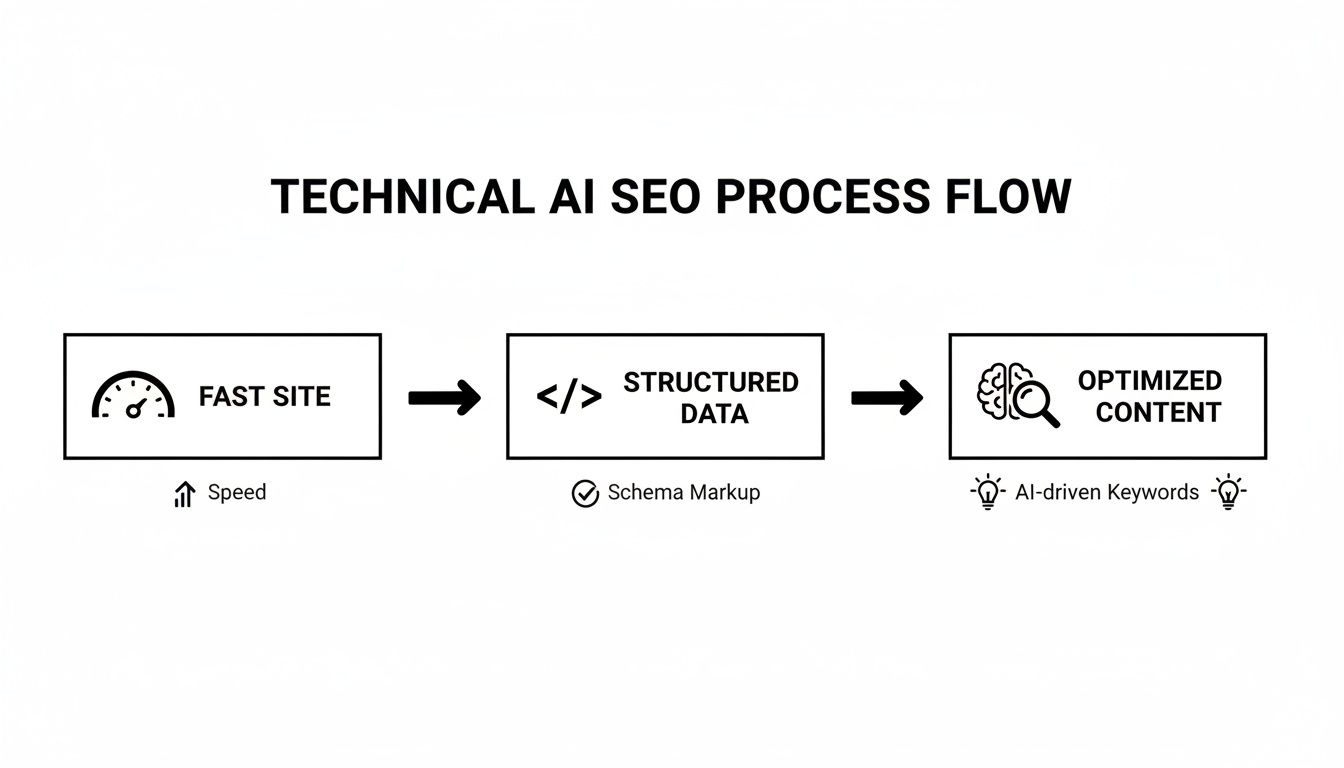
As the graphic shows, a speedy website and clean structured data are the technical handshake you need to make with AI. Your monitoring system then tells you how well your optimized content is being received.
Turning Insights into Action
Data is useless if it just sits in a dashboard. The magic happens when your monitoring framework feeds directly back into your content and technical SEO work, creating a powerful feedback loop.
Here’s what that looks like in the real world:
- Spot a Visibility Gap: Your dashboard shows a competitor consistently gets cited for the prompt "best tools for remote teams."
- Analyze the Sources: You dig in and see the AI is pulling from your competitor's detailed comparison guide, which happens to have a really well-structured data table.
- Create Better Content: Armed with that insight, you build a more comprehensive, up-to-date guide with even clearer structured data and more verifiable facts.
- Monitor for Impact: After publishing, you keep a close eye on your dashboard to see if your Share of Prompt for that query starts to climb over the next few weeks.
This systematic approach takes your AI search strategy from a random set of tasks to an agile, measurable program that delivers results you can proudly show to leadership.
Your AI Search Optimization Questions, Answered
As you start digging into AI search, you're going to have questions. This entire field is new and moving incredibly fast, so what works today might need a tweak tomorrow. To give you a bit more clarity, I've pulled together answers to the most common questions I hear from marketing teams trying to get a handle on this stuff.
Think of this as your go-to guide for those practical, "how does this actually work?" moments when you’re shifting focus from traditional SEO to this new world of AI citations.
How Is This Really Different From Old-School SEO?
It’s a fundamental shift in goals. Traditional SEO is all about climbing a list of blue links to get a click. AI Search Optimization, on the other hand, is about becoming the source cited directly in an AI's answer.
You're not just trying to be found; you're aiming to be the trusted authority an AI model quotes. This means we have to prioritize things like rock-solid factual accuracy, super clear content structure, and all those E-E-A-T signals that tell an AI, "Hey, this is a source you can rely on." It's less about stuffing keywords and more about being the most direct, authoritative answer to a question.
Okay, Where Do I Even Begin? What’s the First Step?
Before you do anything else, you need to run an audit of where you stand right now. It's the classic "you can't improve what you don't measure" scenario. You need a baseline to understand how—or even if—your brand shows up when people ask AI about your industry.
You have to know your starting point to chart a course to where you want to be. That initial audit is what will expose your biggest blind spots and your most promising opportunities, giving you a real, data-backed foundation for your entire strategy.
A great way to start is just by manually plugging prompts into models like ChatGPT and Gemini. Ask about your brand, your products, and your competitors. This will give you a quick, unfiltered look at your current AI footprint.
Can I Repurpose My Existing Content?
Absolutely. In fact, you should. Your existing content library is the perfect place to start. Go find your high-performers—the blog posts, guides, and whitepapers that already pull in traffic and are seen as go-to resources. These are your low-hanging fruit for AI optimization.
Once you’ve got a piece of content picked out, give it an AI-focused tune-up:
- Structure: Make sure it’s laid out logically. Use clear H2s and H3s to break down the information into easy-to-scan chunks.
- Clarity: Write in plain English. Get straight to the point and answer specific questions directly. Cut the jargon and marketing fluff that a machine might misinterpret.
- Data: Add structured data (Schema markup) to explicitly label your content for AI crawlers. Tell them if it's an article, a product page, or an FAQ.
How Long Until I See Any Results From This?
Because we're all figuring this out together, the timelines can be a bit unpredictable. That said, I've seen technical fixes deliver results much faster than with traditional SEO. When you implement changes to your structured data or improve your site speed, AI crawlers can pick up on those signals pretty quickly.
Getting your content cited as a primary source for a major topic will naturally take longer, especially in a competitive space. The real key is consistency. The brands that win will be the ones that are constantly monitoring their AI visibility, updating their content, and refining their approach over the long haul.
Ready to stop guessing and start measuring your brand's performance in AI search? promptposition gives you the data-driven insights you need to see how you're positioned against competitors, track sentiment, and pinpoint the sources influencing AI models. Take control of your AI visibility today.