A Practical Guide: How to Increase Organic Traffic on Your Website
If you're trying to figure out how to increase organic traffic on your website, you've probably felt like you're running in place. It's not just you—it really is getting harder.
The honest answer is that winning today means doing two things at once: you have to nail the timeless SEO fundamentals, but you also have to start optimizing for the new world of AI-driven search. This guide is your practical playbook for doing both, helping you understand this new field and take decisive action.
The Shifting Landscape of Organic Traffic
The old rules for getting found on the internet still matter, but they aren't the whole story anymore. Foundational work like technical SEO, great content, and solid backlinks are the table stakes. But now, a new, almost invisible layer of discovery is taking shape through AI, and it’s completely changing how people find brands online.
If you ignore this shift, you’re leaving a huge—and growing—amount of high-intent traffic on the table for your competitors to grab.
The Widening Gap Between The Top And The Rest
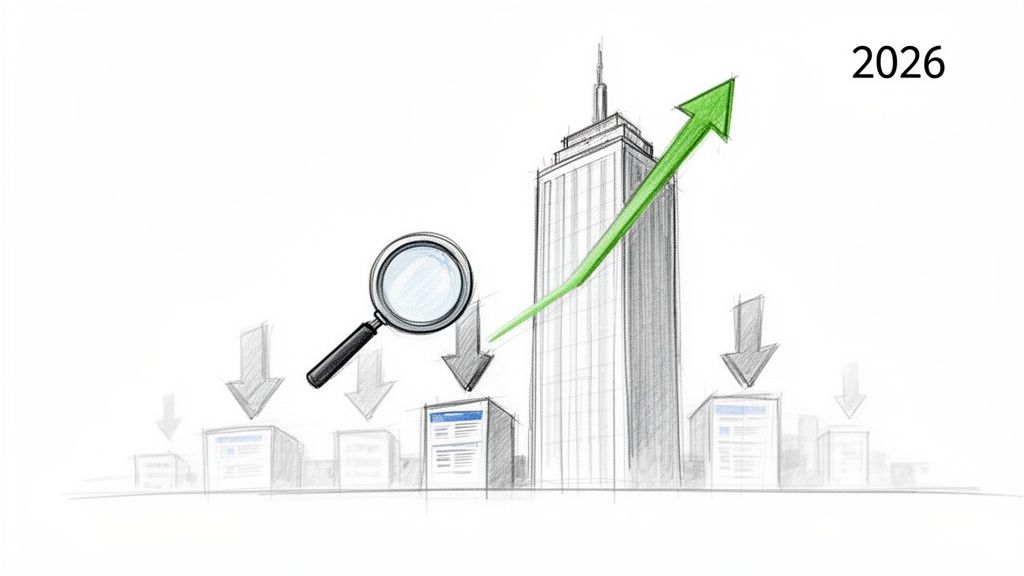
Recent data paints a stark picture: the internet isn't getting smaller for everyone. While a Graphite analysis of Similarweb data showed organic traffic dropping 2.5% year-over-year (2024 to 2025) across 40,000 major U.S. sites, the biggest players saw the opposite happen.
In that same timeframe, the top 10 most authoritative domains actually saw their organic search traffic increase by 1.6%.
This divergence tells us one thing loud and clear: authority is everything now. Mid-sized sites are getting squeezed while the giants consolidate traffic. The table below breaks down this trend.
Organic Traffic Trends Snapshot
| Website Segment | YoY Organic Traffic Change | Key Takeaway |
|---|---|---|
| Top 10 Most Authoritative Sites | +1.6% | The strongest brands are not just surviving; they're pulling ahead. |
| 40,000 Major U.S. Websites | -2.5% | The average website is losing ground in organic search. |
What this data shows is a clear consolidation of traffic at the very top. This is why building real, defensible brand authority has become the most critical mission for any marketing team.
As you plan for this new reality, getting a firm grasp on the complete definition and framework for Answer Engine Optimization (AEO) in 2026 is no longer optional—it's essential for navigating your organic growth strategy.
The Rise of AI Referrals
Now for the overlooked angle that most analytics tools completely miss. An increasingly significant slice of what you see as "direct" or "branded organic" traffic is actually coming from AI.
When a large language model like ChatGPT or Perplexity recommends your brand, the user’s next move is almost always a direct Google search for your company name. This is recorded as organic traffic, but its true origin—the AI referral—is completely hidden from view.
This creates a "dark funnel" of discovery that looks something like this:
- The AI Prompt: A user asks an AI chatbot for recommendations, solutions, or comparisons.
- The AI Answer: The model mentions your brand, product, or content in its generated response.
- The Branded Search: The user, now aware of your brand, opens a new tab and searches for you by name.
This AI-driven activity delivers incredibly high-intent visitors, but standard analytics can't connect the dots. You can't see the "why" behind these valuable branded searches unless you're specifically tracking your visibility in AI models. Tools like PromptPosition are designed to help you understand this connection. If your AI visibility goes up and you see a corresponding increase in branded searches in Google Analytics, that's the AI referral effect in action.
Master the Fundamentals: Proven Tactics for Organic Growth
If you really want to increase your organic traffic for the long haul, you have to look past the latest shiny object or algorithm chase. Sustainable growth is built on a solid foundation—the stuff that search engines have always rewarded at their core. This practical how-to covers the proven tactics you need to master.
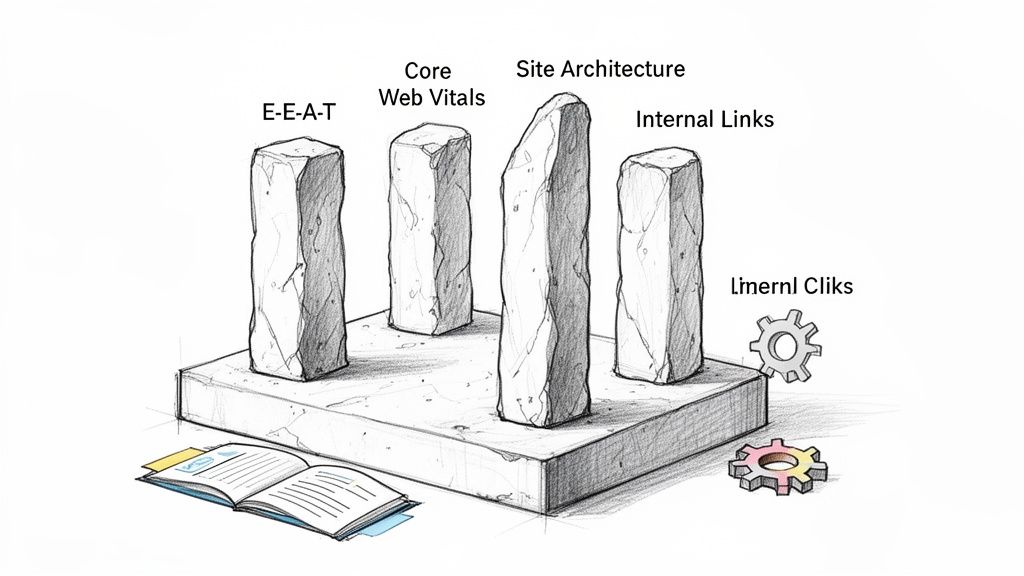
It's all about building a website on pillars of trust, quality, and technical excellence. When you get these fundamentals right, you’re not just appeasing Google; you're creating a genuinely better experience for your visitors, and that’s what really moves the needle.
1. Create Content That Demonstrates Quality and E-E-A-T
Google’s focus on E-E-A-T—Experience, Expertise, Authoritativeness, and Trustworthiness—is their way of telling us to stop publishing generic, surface-level articles. To make your mark, you have to prove you know your stuff, and more importantly, that you've lived it.
Here’s how to put these ideas into action on your own site:
- Show Your Work (Experience): Don’t just write another generic how-to guide. Include your own photos, screenshots, or even short video clips of the process. If you run a marketing agency, sprinkle in a mini-case study about a real client problem you solved (with their blessing, of course).
- Publish Your Own Data (Expertise): Have you ever looked at your company’s internal data and realized there's a story there? Turn it into a unique industry report. A SaaS company, for example, could analyze usage trends to uncover surprising user behaviors, creating a report that no one else can replicate.
- Bring in Outside Voices (Authoritativeness): Interview a recognized expert in your space and feature their direct quotes. Weaving customer stories and testimonials directly into your blog posts also adds a powerful layer of real-world proof.
- Be Radically Transparent (Trustworthiness): Put author bios with real credentials on your articles. If you’re reviewing products and using affiliate links, disclose it clearly. This kind of honesty builds the trust that both your audience and search engines crave.
A fundamental aspect of increasing organic traffic involves continuous efforts to improve SEO rankings through these kinds of technical and content optimizations. It's a non-negotiable part of the process.
This approach helps you create content that's not just informative but also defensible. It's a whole lot harder for a competitor to copy a post built on your unique data and firsthand experience than it is to churn out another bland listicle.
2. Nail Your Technical SEO
All the brilliant content in the world won't matter if your site is a technical mess. A slow, confusing website kills user experience and tells search engines your site isn't a quality result. Technical SEO is the work you do under the hood to make sure search engines can easily crawl, index, and understand what you’re all about.
Your two biggest priorities here are page speed and site architecture.
Get a Handle on Page Speed and Core Web Vitals
Google's Core Web Vitals are specific, user-centric metrics that directly influence your rankings. Think of them as a technical grade for your site's user-friendliness.
- Largest Contentful Paint (LCP): This is how fast the main content on your page loads. You're aiming for under 2.5 seconds. Big wins here come from optimizing your images, using a good CDN, and ensuring your web host isn't letting you down.
- Interaction to Next Paint (INP): This new metric measures how quickly your page responds when someone clicks a button or interacts with an element. A good score is anything under 200 milliseconds. If you're slow here, bloated or poorly-written JavaScript is often the culprit.
- Cumulative Layout Shift (CLS): This tracks visual stability—how much your page content unexpectedly jumps around while loading. We've all been there, trying to click a button that suddenly moves. Your goal is a CLS score below 0.1. The easiest fix is to always specify the height and width for your images and ad slots.
These aren't just arbitrary numbers; they are a direct reflection of how a real person experiences your website. A fast, stable site keeps people around, which is a massive quality signal to Google.
3. Weave a Web of Authority with Internal Linking
Internal linking is easily one of the most powerful and overlooked SEO strategies. This isn't just about shoehorning links into your text. It's about strategically building a site structure that makes perfect sense to both users and search engine crawlers.
When done right, a smart internal linking strategy does three things:
- It clarifies the relationship between your pages for Google.
- It passes authority (or "link equity") from your strong pages to other pages on your site.
- It guides visitors to other relevant content, keeping them engaged and on your site longer.
The best way to visualize this is the pillar-and-cluster model. You start by creating a comprehensive "pillar page" that covers a broad topic. Then, you write several "cluster posts" that each dive deep into a specific subtopic, with every cluster post linking back up to the main pillar.
For example, your pillar page might be "A Complete Guide to Social Media Marketing." Your cluster content could then be individual articles like "Crafting a Winning Instagram Ad Strategy," "How to Use LinkedIn for B2B Lead Gen," and "Viral TikTok Content Ideas." This structure shouts to Google that you are a true authority on the entire subject. You’re no longer just a collection of random blog posts; you’re a well-organized library of expertise.
4. Build Real Authority with Backlinks and Digital PR
You can have the most brilliant, insightful content on the internet, but if it's sitting in a corner by itself, it won't move the needle on your organic traffic. Authority isn't just about what you say; it's about who backs you up. In the SEO world, those endorsements are backlinks—links from other credible sites pointing to yours.
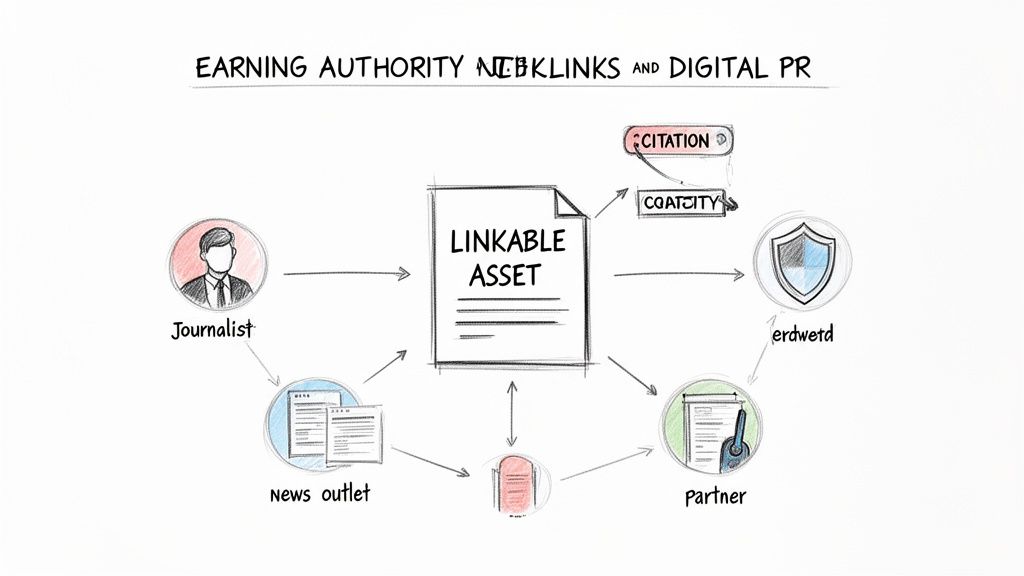
A modern backlink strategy is really a digital PR strategy. It’s about creating content so valuable that journalists, industry experts, and popular bloggers want to cite you. This is how you build a powerful backlink profile and establish the kind of credibility that both Google and the new AI models use to decide who's an authority.
Focus on Creating "Linkable Assets"
A linkable asset is a piece of content engineered from the ground up to attract backlinks. It’s unique, genuinely useful, and not easily copied.
I've seen these types of assets work time and time again:
- Original Research & Data: This is the absolute gold standard. Dig into your own internal data or run a survey to publish a report nobody else has. It's packed with fresh stats that journalists will love to reference.
- Free, Useful Tools: Build a simple tool or calculator that solves a real problem for your audience. Resources that make people's lives easier get linked to.
- The Definitive Guide: Create the single best resource on a core industry topic. Go deeper and cover more ground than anyone else, becoming the go-to reference.
- Killer Data Visualizations: People are visual. Turn your complex data into a beautiful infographic or an interactive chart. A striking visual is incredibly shareable.
The whole point is to shift the dynamic. You're no longer asking for a favor; you're offering a valuable resource that makes someone else's content better.
Master Relationship-Based Outreach
Once you’ve built your amazing asset, you have to get it in front of the right people. Effective outreach is about building actual relationships.
The most successful outreach emails don't feel like outreach at all. They feel like a helpful colleague sharing a resource. Personalize every message, explain why your asset is relevant to their specific audience, and make it clear what’s in it for them.
Here’s a simple, more human way to approach it:
- Find Your People: Use tools like Ahrefs or Semrush to find journalists and bloggers who have recently written about your topic or linked to similar articles.
- Look for a Real Connection: Before you hit send, find a genuine reason to connect. Did you love a recent article they wrote? Mentioning this shows you've done your homework.
- Write a Simple, Personal Pitch: Keep it short. Introduce yourself, mention that connection, and then present your asset as a resource that could add more depth to their work.
- Make Their Job Easy: Give them the direct link and maybe even suggest a sentence or two where it might fit naturally. The less work they have to do, the higher your chances of getting that link.
This patient, thoughtful approach is how you earn the high-quality, relevant backlinks that signal true authority to both Google and AI models.
Uncovering the Hidden Engine of Organic Traffic: AI Referrals
Even with a finely tuned content and technical SEO machine, there’s a new source of organic traffic that most marketing teams are completely missing. A significant portion of what your analytics calls "direct" or "branded organic" traffic isn't starting with a Google search anymore. It’s starting with a conversation.
Think about it. When a potential customer asks ChatGPT for a product recommendation or gets a list of top providers from Perplexity, and your brand is mentioned, what do they do next? They almost always open a new tab and search for your brand name directly. This super-valuable, high-intent visitor lands on your site, but their true origin—the AI referral—is completely invisible.
This creates a "dark funnel" problem. You're seeing the fantastic end result (a direct branded search), but you have no idea that an AI's answer was the first touchpoint that sparked their interest. Traditional tools like Google Analytics simply can't trace it.
The New AI-Powered Customer Journey
This path to discovery is quickly becoming the new normal. The modern customer journey is less about a chain of search queries and more about a simple dialogue with an AI, followed by a quick search to validate the recommendation.
Here are a couple of real-world examples we see all the time:
- For a B2B SaaS company: A project manager asks an AI like Gemini, "What's the best software for tracking team sprints for a small remote company?" The AI suggests your tool. The manager's immediate next step is to search for "YourBrand pricing."
- For an e-commerce brand: A shopper asks Perplexity, "Recommend a sustainable and ethically made running shoe." The AI highlights your brand’s eco-friendly materials. The user then Googles "YourBrand reviews."
In both of these situations, the AI acts as a powerful, trusted referral, sending a highly motivated visitor straight to your digital front door.
Why This Hidden Traffic Is a Big Deal
You can't afford to ignore this shift. The data points to a dramatic change happening right now, with AI answers and zero-click results eating into traditional search traffic. Projections show that a staggering 73% of B2B websites could see major organic traffic losses between 2024-2025. Some sectors might even see declines as high as 70-80% on top-of-funnel, discovery-related keywords.
This isn't a minor dip; it’s a fundamental change in how people find information. The flow diagram below shows just how much AI has inserted itself into the process.
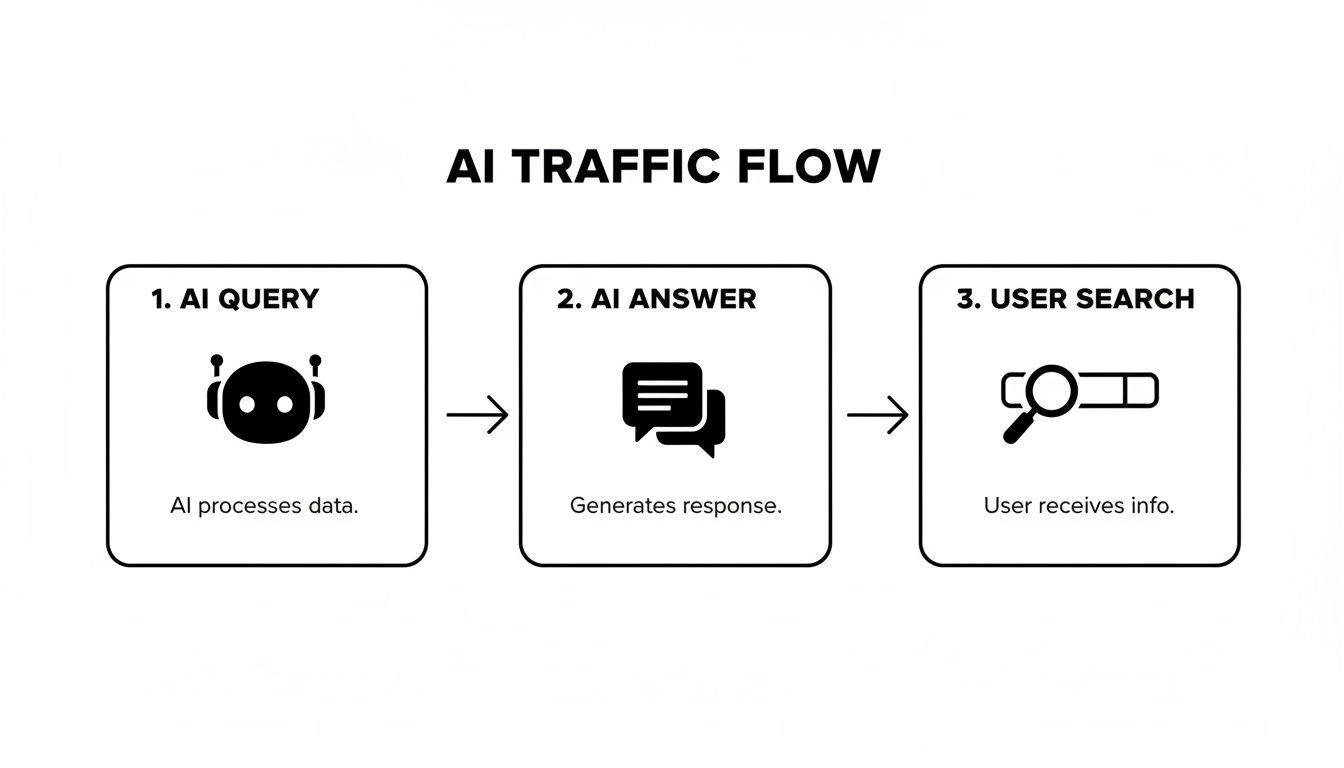
As you can see, the AI query and answer now come before the user's search, completely altering the traditional traffic flow we're used to measuring.
How to Bridge the Analytics Gap
The biggest challenge here is that this valuable AI-referred traffic looks just like any other branded search in your analytics. Was that spike in branded traffic from your latest podcast ad, a social media campaign, or an AI recommendation? Without the right data, it’s just a guessing game.
This is the core problem: you can't optimize what you can't measure. If you have no idea that AI models are recommending you, you can't lean into what's working or fix what isn't.
This is where a new generation of analytics tools comes in. Platforms like PromptPosition are built specifically to shine a light on this invisible traffic. By tracking when and how your brand gets mentioned across the major large language models, you can finally start to connect the dots.
For example, if your PromptPosition dashboard shows a wave of positive mentions for your brand on a Monday, you can cross-reference that with Google Analytics. If you see a corresponding lift in branded search traffic on Tuesday and Wednesday, you're starting to prove the direct impact of AI referrals. This is closely related to the idea of "query fan-out," where one question from a user gets spread across multiple platforms. Making these connections is the first step toward actively influencing this powerful new stream of organic traffic.
How to Measure and Influence Your AI Visibility
So, you know AI is quietly driving organic traffic, but what's next? You have to be able to look under the hood. You can't improve what you can't measure, and frankly, most marketing teams are flying blind when it comes to how large language models see their brand. This is where a new kind of analytics comes into the picture.
Traditional SEO metrics just don't cut it anymore. We're in the middle of a massive shift where AI-generated answers are intercepting people before they even get to a search results page. Data from Similarweb, for instance, projects that by January 2026, paid search clicks will likely double while organic click share falls off a cliff.
Just look at the jeans retail category: organic's share of clicks plummeted from 73% to 56%—a staggering 17-point drop—while paid search’s slice of the pie grew. This shows just how critical it is to find new traffic streams, like AI referrals.
Bridging the AI Analytics Gap
The real headache here is attribution. When an AI like ChatGPT or Perplexity recommends your product and the user then Googles your brand name, your web analytics just chalk it up to "organic" or "direct" traffic. You completely lose the context of where that customer really came from.
This makes it impossible to know if your content and PR efforts are actually making a dent in the AI space.
This is exactly the gap that tools like PromptPosition were built to fill. By systematically tracking how your brand shows up across the major LLMs, you can finally turn the black box of AI answers into a measurable marketing channel.
The goal is to move from guessing to knowing. Instead of wondering if AI is helping you, you can see exactly when, where, and how your brand is being mentioned, alongside what your competitors are doing.
This creates a clear feedback loop. Suddenly, you can see your AI Visibility Score, track sentiment over time, and even pinpoint the exact sources the models are citing when they talk about you.
An Actionable Workflow for AI Visibility
Once you have the right data, connecting the dots between AI mentions and organic traffic isn't as complicated as it sounds. It’s all about spotting the correlation between your presence in AI and your website's performance.
Here’s a practical workflow you can put into practice today.
First, you'll want to set up monitoring for your brand name, key products, and important industry keywords using a platform like PromptPosition. This gives you a baseline for how often you’re appearing in AI-generated responses.
Next, keep an eye on your AI analytics dashboard. Did you suddenly get a wave of positive mentions in ChatGPT for a specific product? Note the date.
Now, pop over to Google Analytics or whatever web analytics tool you use. Look at your branded organic search traffic for the few days immediately following that spike in AI visibility. Do you see a clear lift? If you didn't launch any other big campaigns at that exact moment, you can confidently attribute that boost to AI referrals.
This simple process proves the "AI referral effect" in action. For example, if your report shows a 15% increase in positive AI mentions on Monday, and your branded search traffic climbs 10% on Tuesday and Wednesday, you’ve just quantified the real-world impact of your brand's AI presence.
Using Competitive Benchmarking to Drive Strategy
Of course, tracking your own brand is only half the picture. To really get an edge, you need to know how you stack up against the competition. A solid AI analytics tool won't just show you your own data; it will highlight where your competitors are getting mentioned and you aren't.
- Spot Content Gaps: Are your competitors consistently showing up for high-intent prompts where your brand is a ghost? That's a massive content opportunity right there. It tells you exactly which topics to build authority around.
- Analyze Sentiment: Is a rival getting more positive shout-outs? Dig into the actual quotes from the AI to understand why. Are they praised for customer service? A specific feature? This is pure gold for shaping your own messaging.
- Identify Influential Sources: An advanced tool can also show you the underlying sources that LLMs use to form their answers. If an AI consistently cites a particular industry blog or review site when recommending your competitor, you know exactly where to focus your digital PR and link-building efforts.
By systematically tracking these metrics, you learn what kind of content resonates with AI models. You can then fine-tune your strategy to create assets designed to be cited and recommended. To dig deeper into this, check out our guide on the AI Overview Tracker.
This creates a powerful, data-driven cycle: create content, measure its impact on AI visibility, and use those insights to create even better content. This is how you stop reacting to the changing search landscape and start actively shaping your brand's narrative within it.
A Few Common Questions on Organic Growth
Let's tackle some of the big questions we hear all the time from marketing teams trying to navigate this new world of search.
How Long Does It Take to See Real SEO Results?
This is the million-dollar question, and the only honest answer is: it depends. While you might see a quick bump from some technical fixes in a few weeks, building genuine authority through solid content and backlinks is a long game.
As a general rule, you can expect to really see the needle move in about 6-12 months. The key is relentless consistency. One-off efforts just won't cut it. The new wrinkle, however, is AI search. By tracking when your brand gets mentioned in AI responses with a tool like PromptPosition, you can often spot a corresponding jump in branded search traffic within days, giving you much faster feedback on what's working.
Should I Focus on Traditional SEO or AI Optimization?
This isn't an either/or decision. Thinking you can choose one over the other is a fast track to falling behind. Your foundational SEO work is precisely what fuels your visibility in AI.
Think about it: AI models are built to find and surface credible, well-organized, and authoritative information. If your site is a technical mess or your content is thin, you simply don't have the raw materials for an AI to find and recommend. Neglecting one will always hamstring the other.
Your goal isn't just to rank on Google; it's to become the primary, most reliable source of information in your niche. A strong SEO foundation makes you a trusted source for both humans and AI.
Is Creating Blog Content Still Worth the Effort?
Absolutely. In fact, it might be more important than ever, but the game has changed. The new goal is to become the primary source cited in AI Overviews and chatbot answers.
AI models don’t invent facts; they synthesize them from the web. When you publish the most thorough, expert-backed content—filled with unique data, specific examples, and firsthand insights—you make your site an essential reference that AI models have to cite. This pays off twice: you still capture direct clicks from traditional search, and you also generate valuable brand searches from people who saw you mentioned by an AI.
How Can I Know for Sure If a Traffic Spike Came From AI?
This is where you have to play detective. Since you won't see a "Referred by ChatGPT" line in your analytics, you need to connect the dots yourself.
Using a platform that tracks your brand's visibility in AI chat, you can line up the dates of your mentions with the traffic data in your Google Analytics account.
Here’s what that looks like in the real world:
- Your AI tracking tool (like PromptPosition) shows your brand was mentioned frequently in AI answers on a Monday.
- Looking at Google Analytics, you notice a 15% lift in branded organic searches on Tuesday and Wednesday.
- You double-check and confirm there were no other major marketing campaigns (like a big sale or podcast ad) running at the same time.
When those three things line up, you can confidently attribute that traffic boost to the AI mentions. It's this simple act of cross-referencing that turns what feels like invisible traffic into a measurable, optimizable channel.
Ready to uncover the hidden AI referrals driving your organic traffic? PromptPosition gives you the tools to track your brand's visibility across major AI models, benchmark against competitors, and connect the dots between AI mentions and website traffic. Start measuring your AI visibility today.