The Difference Between Perplexity and ChatGPT Explained
At their core, the difference between Perplexity and ChatGPT comes down to their fundamental purpose. Think of Perplexity AI as a conversational answer engine built for discovery and verification. It’s a research powerhouse. On the other hand, ChatGPT is a creative conversational partner, designed to generate, ideate, and engage in complex dialogue.
ChatGPT vs Perplexity: The Core Difference
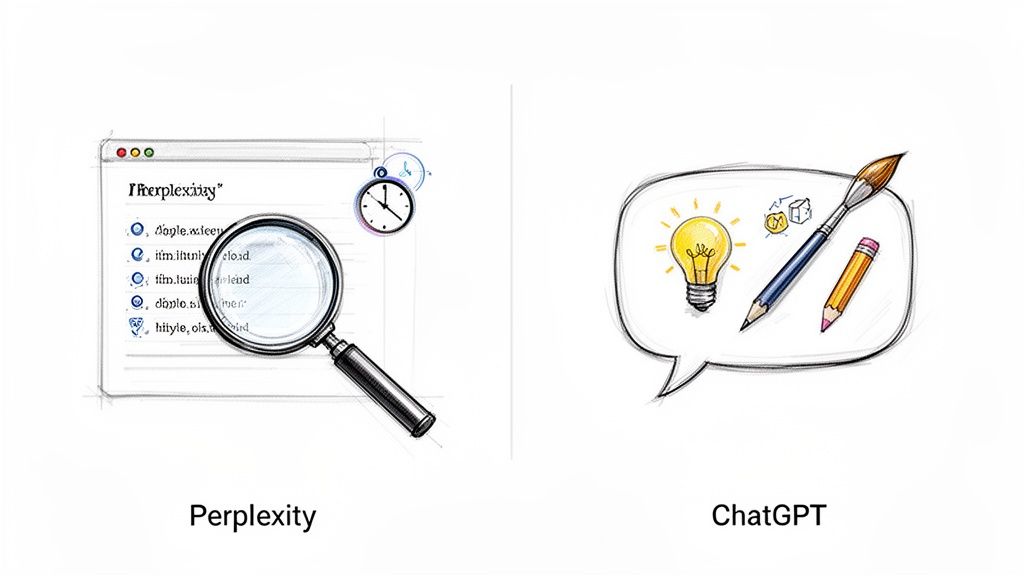
So, which one should you use? The answer really depends on what you’re trying to accomplish. It’s like choosing between a meticulous research assistant and a brilliant brainstorming partner. One delivers verifiable, up-to-the-minute facts with direct links to its sources. The other helps you create new things, flesh out ideas, and explore topics from different angles without needing to prove where every piece of information came from.
This core philosophical difference influences everything from how the tools look and feel to what they’re best at. Perplexity is designed for inquiry and validation; you go there to ask "what happened" or "who said that" and get a sourced answer. ChatGPT is built for generation and exploration; it's your go-to for prompts like "draft a marketing email" or "explain quantum computing like I'm five."
Perplexity vs ChatGPT At a Glance
To put it simply, Perplexity’s mission is to deliver accurate, transparent answers by connecting you directly to the live web. It’s all about trust and verification. ChatGPT’s strength lies in synthesizing the massive amount of information it was trained on to give you detailed, context-aware responses that can spark new ideas. This at-a-glance table breaks down the key distinctions.
| Attribute | Perplexity AI | ChatGPT |
|---|---|---|
| Primary Function | Conversational Answer Engine | Generative Conversational AI |
| Core Strength | Real-time, cited information retrieval | Creative content generation & reasoning |
| Best For | Research, fact-checking, current events | Brainstorming, drafting, problem-solving |
| Key Feature | Provides direct links to sources | In-depth, iterative conversations |
| Ideal User | Researchers, journalists, students | Writers, developers, marketers |
This quick comparison highlights the distinct roles each tool plays. For marketers and brand managers, this is a critical distinction. Getting visibility on Perplexity is like earning a top spot in a search engine that rewards authoritative, well-cited content. In contrast, influencing how your brand is portrayed on ChatGPT requires a much broader strategy focused on shaping the overall online narrative that feeds its knowledge base.
At its heart, the choice is simple: Use Perplexity for answers you need to trust and verify. Use ChatGPT for ideas you need to create and expand upon.
Understanding this fundamental split is the first step. Now, we can dig deeper into their underlying technology, how they source information, and what it all means for your brand.
Understanding Their Core Technology and Market Roles
Before you can really see the difference between Perplexity and ChatGPT, you have to pop the hood and look at their engines. They are not built the same, and that simple fact explains everything—their strengths, their weaknesses, and even how you should approach getting your brand seen on each platform. It’s why one is a creative workhorse and the other is a precision research tool.
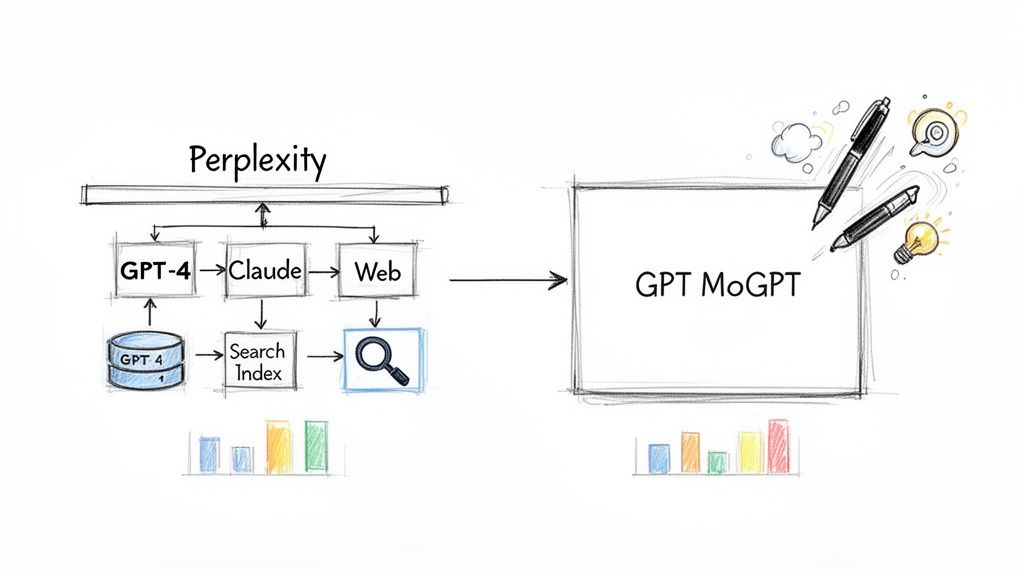
ChatGPT runs on OpenAI's own Generative Pre-trained Transformer (GPT) models, like the powerful GPT-4. These models are trained on a colossal, but fixed, snapshot of the internet. This massive dataset is what gives ChatGPT its incredible knack for understanding nuance, writing like a human, and piecing together complex ideas.
The catch? Its knowledge is frozen in time. While newer versions can browse the web, ChatGPT’s core strength is still synthesizing information from its internal training data. It’s fantastic for generating ideas, but it can fall short when you need the absolute latest, up-to-the-minute information.
Perplexity’s Unique Hybrid Model
Perplexity takes a completely different path. Think of it as an intelligent layer sitting on top of other powerful Large Language Models (LLMs), including OpenAI’s GPT-4 and Anthropic’s Claude. This lets it pick the right tool for the job, but the real magic is in its process.
At its heart, Perplexity is built around real-time web indexing. When you ask a question, its first move is to actively crawl the live web for current, relevant sources. Only after it has this fresh data does it pass it to an LLM to craft a tidy, synthesized answer. This is what makes it an "answer engine," a subtle but critical distinction from a traditional chatbot.
Perplexity's architecture is all about accuracy and being current. By mashing up live web search with top-tier LLMs, it neatly sidesteps the "knowledge cutoff" problem that plagues other chatbots. The result? Fresh, verifiable answers with every source cited.
This architectural split is the whole story. ChatGPT pulls from its memory; Perplexity builds answers from what it finds on the web right now. This has huge implications for marketers trying to influence how their brand is represented. You can learn more about how to approach AI search visibility in this new environment.
Contrasting Market Dominance and Niche Roles
These technical differences have led to wildly different positions in the market. ChatGPT, with its first-mover advantage and do-it-all creative abilities, has a massive lead as a general-purpose AI assistant.
The numbers don't lie. ChatGPT absolutely dominates the AI chatbot market, holding a staggering 82.65% market share. Meanwhile, Perplexity sits between 6.4% and 8.03%, making it a distant third behind giants like Microsoft Copilot at 7.22%. This isn't just about popularity; it reveals how people use them.
Millions of users flock to ChatGPT for everything—writing code, drafting emails, planning vacations, you name it. Its user base is broad and its applications are nearly endless.
Perplexity, on the other hand, has carved out a dedicated niche. Its users are researchers, journalists, and professionals who need accurate, sourced answers. While its user base is smaller, their intent is often more focused and high-value, much like someone using a traditional search engine with a specific goal in mind. For brands aiming to be the go-to authority, this makes Perplexity a critical battleground.
How Each AI Sources and Cites Information
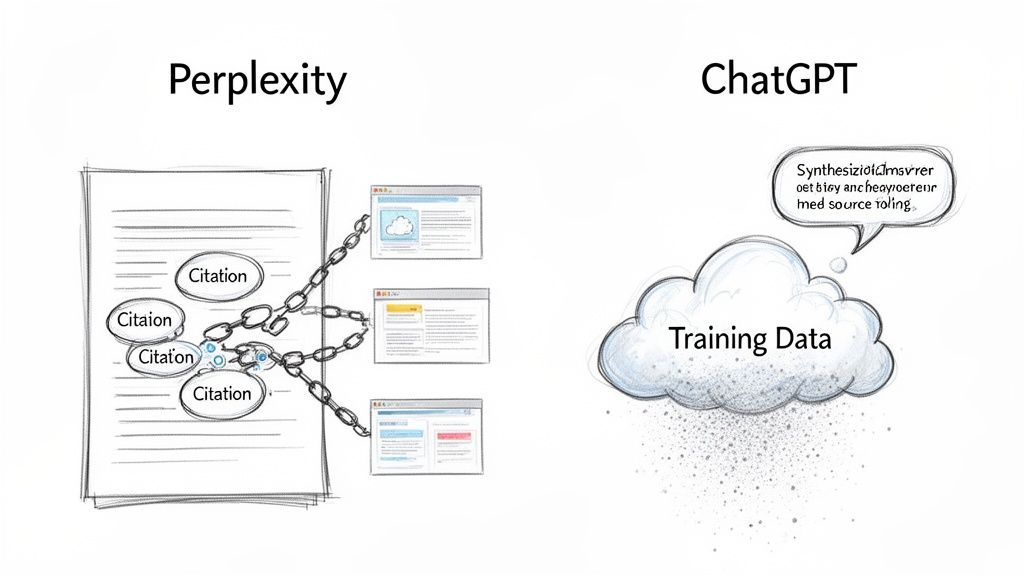
The single biggest difference between Perplexity and ChatGPT is how they handle their sources. This isn’t just a minor technical detail—it completely changes how you should trust, verify, and ultimately use what they tell you. For anyone in marketing or brand management, this is the most important distinction to grasp.
Perplexity was built from day one to be an "answer engine," which means sourcing and citation are baked into its DNA. When you ask it a question, it doesn't just dip into a static knowledge base; it actively scours the live web for current, relevant information to build its answer.
This commitment to showing its work is Perplexity's defining feature.
Perplexity: The Champion of Transparent Sourcing
With Perplexity, nearly every key point in its response comes with a small, numbered citation. These aren't just for show. They are clickable links that take you directly to the articles, reports, and data sources it used to assemble that specific piece of information.
This model gives you a few immediate advantages:
- Instant Verification: You can click any citation on the spot to check the original context and confirm the facts for yourself.
- Deeper Research: The sources essentially become a curated reading list, giving you a launchpad to explore the topic further.
- Brand Monitoring: This is a huge win for marketers. If Perplexity mentions your brand, you know precisely which article or press release it's pulling from.
This makes Perplexity a fantastic tool for any work that demands accuracy and a clear paper trail, like market research, competitor analysis, or simple fact-checking. It marries the traceability of a search engine with the conversational flow of an AI.
ChatGPT: The Synthesizer of Vast Knowledge
ChatGPT, on the other hand, works very differently. Its main job is to synthesize information from the massive dataset it was trained on—a vast, static snapshot of text and code from the internet. By default, it isn't performing a live web search for every question.
Instead, it relies on the patterns, facts, and language it learned during its training. The output is remarkably fluent and sounds like it’s coming from a well-read expert.
But there’s a big trade-off: a near-total lack of direct, inline citations. ChatGPT generates text without pointing back to the specific documents it learned from. While newer versions can browse the web and sometimes offer links, it’s not their core function, and the sourcing is nowhere near as granular as Perplexity's.
This creates a real headache for brand managers. When ChatGPT says something about your company, you can't easily trace it to a single source. The information is an amalgamation of countless articles, forum discussions, and reviews it has processed, making it tough to pinpoint where a specific claim or sentiment originated.
This "black box" sourcing means that to understand—and influence—how your brand is portrayed, you need a completely different strategy. You can't just target a few top-ranking articles. You have to think about shaping the entire online conversation that feeds the model's knowledge base.
This is where specialized tools like promptposition become critical. By constantly tracking how models like ChatGPT talk about your brand, you can start to uncover the hidden narratives and key sources that are shaping your reputation in AI-generated answers. Without that insight, you're flying blind, completely unaware of the data that truly dictates your AI search positioning. The difference in sourcing isn't just a feature; it directly impacts your entire brand management strategy.
Query Style and User Experience: A Tale of Two Interfaces
Putting aside the tech for a moment, the biggest practical difference between Perplexity and ChatGPT is how they feel to use. Their interfaces aren't just cosmetic; they’re intentionally built to steer you toward very different kinds of tasks, shaping the questions you ask from the very beginning.
Perplexity’s interface is clean, direct, and will feel instantly familiar to anyone who’s used a search engine. It’s built to take a question and give you a straight answer. The whole design nudges you toward factual, research-heavy questions that have a verifiable outcome. You ask, it finds, it answers, and it shows its work. The experience is transactional, focused purely on getting you information.
This direct approach is exactly what you want when accuracy and sources are non-negotiable. Think of a query like, "What were the key findings of the latest Gartner Magic Quadrant for cloud infrastructure?" This is Perplexity's home turf.
Perplexity: The Answer Engine
Using Perplexity feels like a focused research session. Once it gives you an initial answer, it smartly suggests related follow-up questions, such as "What are the market share trends for AWS vs. Azure?" or "Who are the leaders in the AI/ML quadrant?" This feature is fantastic because it helps you go deeper, mimicking the natural discovery process of research but without all the extra clicks.
This guided discovery makes Perplexity the perfect tool for:
- Fact-Checking: Quickly verifying a statistic or a claim with linked sources.
- Market Research: Gathering real-time data on industry trends, competitor news, or market sentiment.
- Current Events: Getting a summarized, sourced brief on a breaking story without having to piece it together from five different news sites.
ChatGPT: The Creative Conversationalist
ChatGPT, on the other hand, presents you with a blank canvas. It’s designed for an open-ended, back-and-forth dialogue. The goal isn't just to find one right answer; it's often to collaborate and create something entirely new. It truly comes alive when your query isn't a simple question but the starting point for a multi-step project.
Its real power is in handling complex, layered prompts that demand creative generation, synthesis, or even role-playing. Instead of just asking for a fact, you might instruct it: "Act as a marketing strategist. Draft three unique campaign angles for a new eco-friendly sneaker, targeting Gen Z. Include a potential slogan for each."
This conversational flow is where ChatGPT pulls away from the pack. It remembers what you’ve talked about, letting you refine your ideas step-by-step. A natural follow-up might be, "For the second angle, expand on the slogan and write a short Instagram caption." This creative partnership makes it invaluable for strategic and generative work. Exploring the concept of query fan-out can give you a much better sense of how to structure these complex prompts for better results.
The core distinction is simple: You go to Perplexity to find something out. You go to ChatGPT to figure something out or create something new.
The table below breaks down which tool to grab for which job.
Optimal Query Types for Perplexity vs ChatGPT
| Task Type | Best Fit for Perplexity | Best Fit for ChatGPT |
|---|---|---|
| Factual Research | Asking for specific data, statistics, or historical facts with cited sources. | Summarizing well-known concepts, but less reliable for real-time, sourced data. |
| Content Creation | Generating sourced summaries or outlines for articles and reports. | Writing original drafts, brainstorming ideas, and creating diverse content formats. |
| Brainstorming | Suggesting research topics or related questions based on an initial query. | Generating a wide array of creative ideas, marketing angles, or project plans. |
| Problem-Solving | Finding existing solutions or documented answers to technical questions. | Working through multi-step problems, debugging code, or developing strategic plans. |
| Current Events | Getting a real-time, multi-source summary of breaking news. | Discussing the implications of news or generating content about it. |
| Quick Answers | "What is the capital of Mongolia?" | "Explain the concept of quantum computing like I'm five." |
Ultimately, choosing the right tool comes down to your goal. If you need a verified fact with a paper trail, Perplexity is your best bet. If you need a brainstorming partner to help you build a campaign from the ground up, ChatGPT is the obvious choice. Understanding this fundamental difference is the key to getting the most out of both.
How Perplexity and ChatGPT Impact Your SEO and Brand Visibility
The way you build brand visibility is fundamentally different for Perplexity versus ChatGPT. Think of it this way: one platform is a new spin on the classic SEO game, rewarding well-sourced, authoritative content. The other requires a much softer touch, where you're trying to shape the massive online narrative that feeds its knowledge base.
Getting a handle on this split is non-negotiable for any modern marketing strategy. Your brand doesn’t just live on Google anymore. It exists in the answers these AI models generate, and each one is its own unique ecosystem you have to learn to navigate.
The user numbers alone tell a story of two very different tools. ChatGPT's staggering 5.6 billion monthly visits completely overshadow Perplexity's 239.97 million. This reflects their core identities: ChatGPT is the creative, conversational powerhouse, while Perplexity is the focused search specialist, quietly carving out its niche with a 1% quarterly growth in the U.S. market.
Perplexity Visibility: The New Face of SEO
Getting your brand featured in Perplexity's answers feels a lot like ranking on a traditional search engine. Because Perplexity actively crawls the web and meticulously cites its sources, the path to visibility is surprisingly clear and measurable. If your content is accurate, authoritative, and trusted by other credible sites, you have a solid shot at being cited.
This means your classic SEO best practices are more relevant than ever, just with a slightly different focus:
- Create Authoritative Content: Go deep. Produce high-quality articles, reports, and original research that position your brand as the go-to expert.
- Build a Strong Sourcing Game: Make sure your content is well-researched and links out to other reputable sources. It's a signal of credibility that Perplexity looks for.
- Earn Media Mentions: Getting mentions and backlinks from trusted news outlets and top-tier industry publications is gold. These are the exact kinds of sources Perplexity loves to pull from.
When Perplexity cites your website, it's a direct, public endorsement of your content's authority. Monitoring your brand's presence on Perplexity should absolutely be a KPI for your content marketing and digital PR efforts.
ChatGPT Visibility: It’s All About Narrative Shaping
Trying to influence how your brand shows up on ChatGPT is a whole different ballgame. It's a much murkier, more complex challenge. Since it pulls information from a massive, mostly static training dataset, you can't just optimize a single page and expect to "rank" in its answers.
Instead, your job is to shape the entire online conversation about your brand over the long haul. It’s about building a strong, consistent digital footprint so that the collective information out there—from press releases and news coverage to forum discussions and customer reviews—paints the right picture.
This is where you absolutely need a specialized tool. You can't fly blind. Platforms like promptposition are built specifically to track brand presence in large language models, turning the black box of ChatGPT's answers into data you can actually use. By monitoring how often you're mentioned, the sentiment of those mentions, and the exact language used, you can start to piece together which sources are shaping your AI reputation. For a deeper dive, check out our guide on how to rank on ChatGPT.
How to Measure and Influence Your Brand in AI
To get a foothold in this new landscape, you need a new toolkit and new metrics. Just tracking website traffic from search engines isn't enough anymore. You have to actively measure how your brand is being portrayed inside these AI platforms.
Here’s a simple framework to get you started:
- Set Your Baseline: Use a tool to see where you stand right now. Measure your brand's current visibility and sentiment on both Perplexity and ChatGPT for your most important industry keywords.
- Find the Key Sources: On Perplexity, look at which websites and articles it repeatedly cites for topics in your industry. Those are your new high-value targets for SEO and PR.
- Track Sentiment Over Time: In ChatGPT, keep an eye on whether your brand is being talked about positively or negatively. This gives you a read on the broader narrative you need to influence.
- Spot Your Competitors' Wins: Run queries where your competitors are mentioned but you aren't. This instantly highlights the conversations you need to become a part of.
Ultimately, the rise of answer engines calls for a two-pronged strategy. For Perplexity, your focus should be on creating best-in-class, citable content. For ChatGPT, it's about building a powerful, pervasive online presence that shapes the data it learns from. If you can master both, you'll be well-positioned to win in the age of AI-driven search.
Strategic Guidance: When to Use Perplexity vs. ChatGPT
Figuring out whether to use Perplexity or ChatGPT isn't about crowning one as "better." It's about matching the right tool to the right job. The real difference between them comes down to their core purpose: Perplexity is built for verifiable research, while ChatGPT is designed for creative generation. Getting this distinction right is the key to building a workflow that actually works.
I like to think of it like this: Perplexity is your research analyst, and ChatGPT is your creative director. You wouldn't ask your analyst to dream up a new ad campaign, and you wouldn't send your creative director to the library to pull academic studies. Each has its own domain of excellence. Using them strategically means you get the best result for every project, every time.
This decision tree helps visualize where each tool fits, depending on whether your goal is research-driven or content-focused.
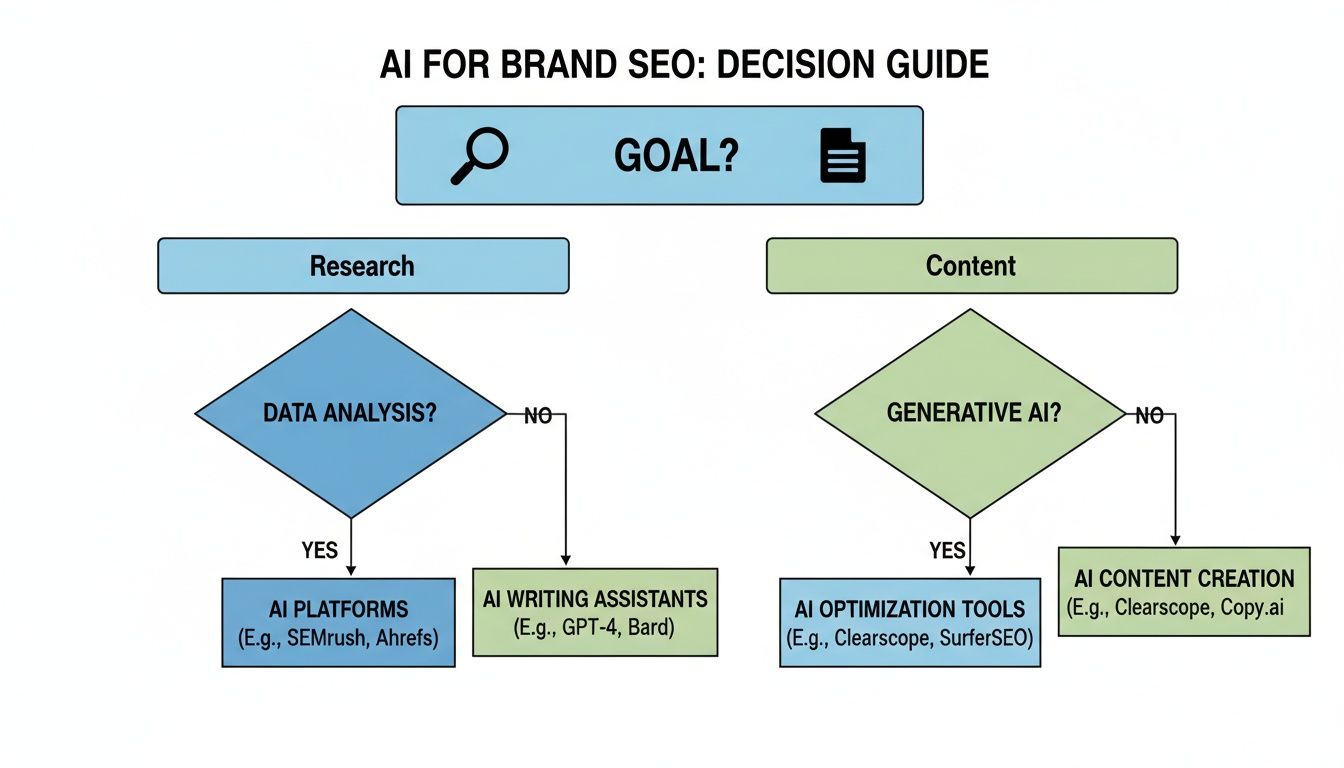
As you can see, the workflow splits into two clear paths. When you need to discover and verify information, Perplexity is the obvious choice. When you need to brainstorm and create, you’ll turn to ChatGPT.
Use Perplexity for Research and Verification
Perplexity is your best bet whenever your work hinges on accuracy, current information, and a clear trail of sources. Because it actively searches the web in real-time and provides direct links, it's the clear winner for any task that needs a factual foundation.
Turn to Perplexity when you need to:
- Conduct Market Research: Get up-to-the-minute data on industry trends, competitor moves, or consumer chatter pulled from the latest articles and reports.
- Fact-Check Competitor Claims: Instantly see if a statistic or bold marketing claim holds up by tracing it back to the original source.
- Identify Primary Sources: Quickly find the authoritative studies, press releases, or articles needed to build your own credible content.
- Monitor Brand Mentions: See who is talking about your brand and what they're saying, complete with direct links to the coverage.
Basically, if your query starts with "What is," "Who said," or "Find data on," Perplexity is where you should start. It gives you answers you can actually trust and build on.
Use ChatGPT for Creation and Ideation
ChatGPT truly comes alive in situations where ambiguity and creativity are required. It's an incredible brainstorming partner, perfect for drafting content from the ground up and exploring ideas without being tied down by the need to cite every point.
Lean on ChatGPT for tasks like:
- Drafting Ad and Social Media Copy: Generate a dozen creative takes on headlines, slogans, or social posts designed for a specific audience.
- Developing Content Outlines: Brainstorm a comprehensive structure for a blog post, whitepaper, or video script in minutes.
- Brainstorming Campaign Ideas: Explore unique marketing angles, promotional concepts, and different narrative themes.
- Simplifying Complex Topics: Turn dense, technical jargon into clear, simple language that a broader audience can actually understand.
Getting the hang of both platforms is essential in this new environment. You can learn more about building a full strategy by reading our guide to AI search engine optimization. By treating Perplexity as your research analyst and ChatGPT as your creative strategist, you’ll build a powerful, data-driven workflow that gets the most out of what each tool offers.
Frequently Asked Questions
When you're trying to figure out how these powerful AI tools fit into your workflow, a few key questions usually pop up. Let's tackle some of the most common ones to clear things up.
Is Perplexity AI Better Than ChatGPT?
This is a classic "it depends" situation. Neither one is universally "better" because they were built for different jobs. Perplexity is your go-to when you need accurate, verifiable, and current information with sources you can actually check. Think of it as a research powerhouse.
On the other hand, ChatGPT is the undisputed champ for creative tasks, brainstorming sessions, and working through complex problems that require a conversational back-and-forth. It’s more of a creative partner.
The best way to think about it is this: Perplexity is a research assistant obsessed with facts, while ChatGPT is a creative partner built to explore ideas. The right tool is the one that matches your specific goal.
Can Perplexity Replace Google Search?
Not entirely, but it definitely changes how you find answers. Perplexity is more of a powerful "answer engine" that works alongside traditional search. It's fantastic for getting direct, synthesized answers with sources, which is a game-changer for any research-heavy task.
That said, you'll probably still find yourself using Google for broader discovery, looking up a local restaurant, or when you just need to get to a specific website.
Are Perplexity and ChatGPT Free to Use?
Yes, both platforms have incredibly useful free versions. Perplexity gives you a solid, source-backed search experience with a cap on how many advanced "Pro" searches you can do. ChatGPT also offers free access to its base model, which is more than capable for a ton of different tasks.
If you find yourself needing more muscle, both offer paid plans that give you access to their best models and extra features:
- Perplexity Pro
- ChatGPT Plus
Which Tool Is Better for Marketing Professionals?
For marketers, the answer isn't choosing one over the other—it's about using both strategically.
Use Perplexity for the analytical side of your job: digging into market research, running real-time competitor analysis, and quickly fact-checking industry stats. Then, switch over to ChatGPT to draft ad copy, spin up a dozen different content outlines, and brainstorm fresh campaign angles. The smartest marketing strategies will lean on each tool for its unique strengths.
Ready to see how your brand is showing up in AI-generated answers? promptposition provides the data you need to monitor and influence your visibility on Perplexity, ChatGPT, and other key platforms. Start tracking your AI search presence today at https://www.promptposition.com.