Unify Your Branding and Visibility for Lasting Growth
When you get down to it, strong branding and high visibility are the two sides of the same coin for growth. Branding is your story—who you are, what you stand for, and the promise you make to your customers. Visibility is how many people actually hear that story and come to believe it.
A powerful brand makes your marketing efforts more effective, and getting in front of more people reinforces your brand's message. It's a virtuous cycle: strong branding increases visibility, and greater visibility reinforces your brand. This synergy builds real, lasting value.
The Unbreakable Link Between Branding and Visibility
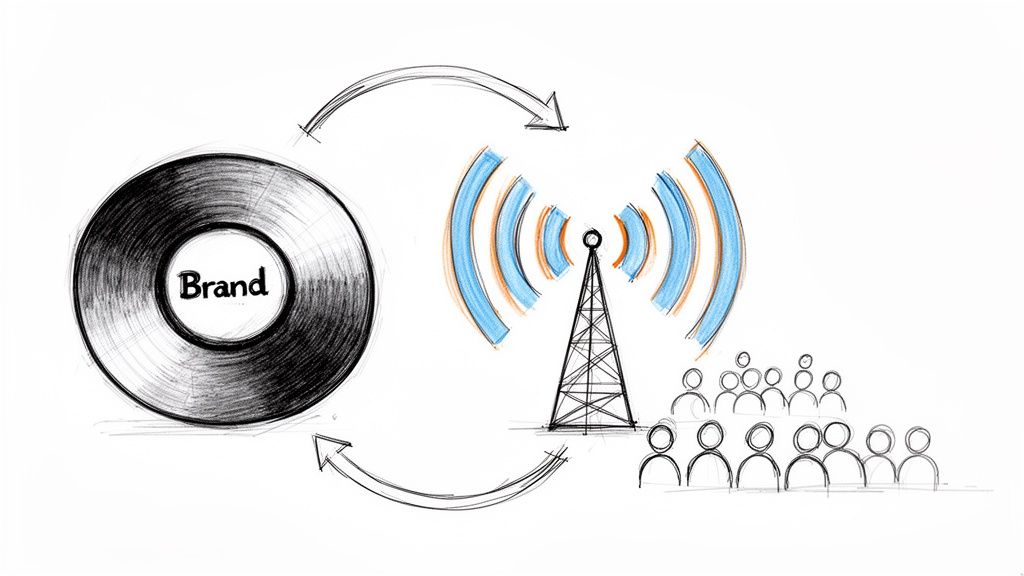
Think of your brand as a brilliant song. You’ve poured everything into crafting the perfect melody and unforgettable lyrics—that's your branding. But if it never gets any radio play, it’s destined to remain an undiscovered gem. Visibility channels are your radio stations, getting that song to the masses.
Every time someone new hears it, their connection to it grows. This is the core of modern marketing: one can't work without the other. Visibility without a strong brand is just noise. And a great brand without visibility is just a well-kept secret.
The powerful relationship between branding content marketing and business value is all about turning reputation into a tangible asset. To do that, your brand story has to be consistent everywhere your audience might find you.
The Pillars of Brand Visibility: Traditional and AI
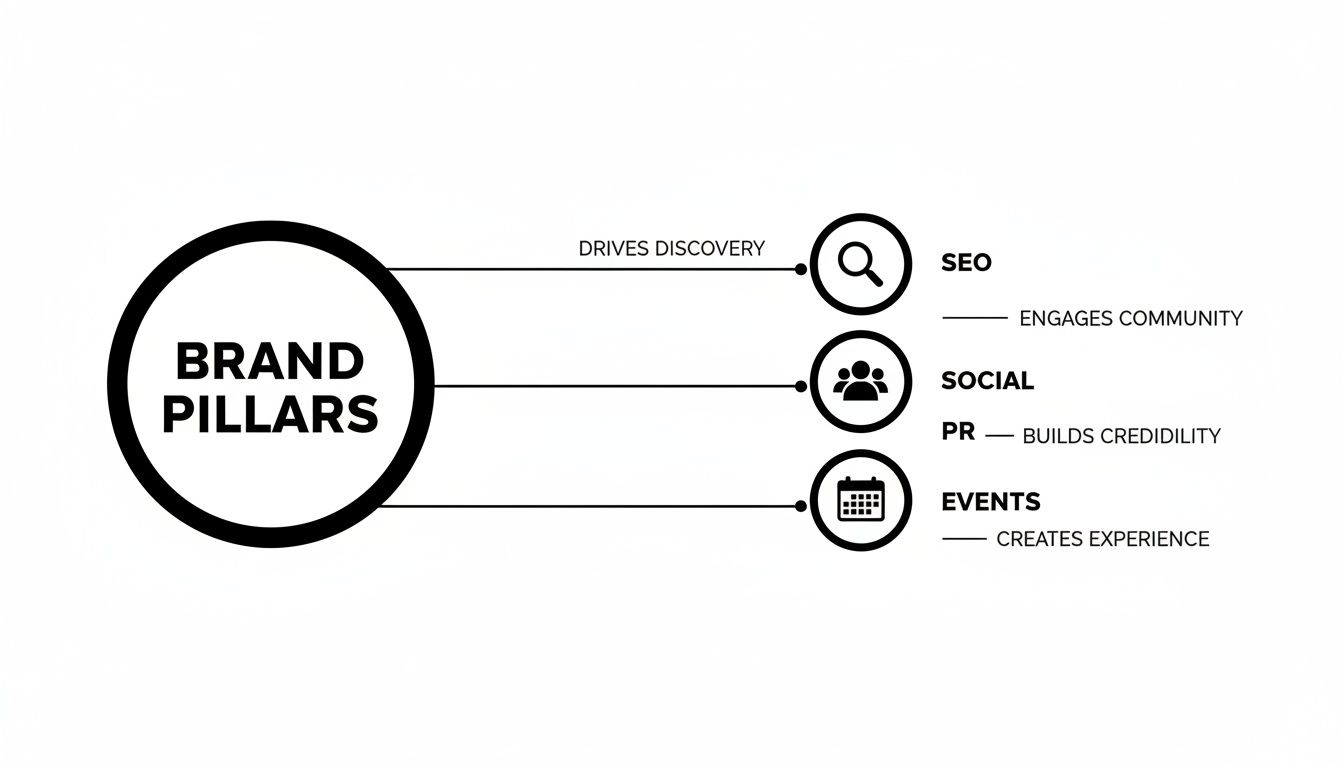
For years, marketers have relied on a proven playbook to build brand visibility. We've mastered the art of search, social media, PR, and live events—the traditional pillars that put our brands on the map. These channels are the bedrock of brand building, each serving a unique purpose.
Traditional Visibility Channels
Great branding is the result of a coordinated effort across a few key fronts. Each channel has its own job to do, but the real magic happens when they're all telling the same, consistent story. To ensure this, the first step is to create brand guidelines so your team presents a unified message everywhere.
- Search (SEO): This is how customers discover you when they have a problem. Good SEO positions your brand as a trusted authority at the precise moment of need.
- Social Media: This is where your brand develops a personality. By engaging with your audience, you build a community and turn passive followers into loyal fans.
- Public Relations (PR): Earned media, like features in articles or positive reviews, provides third-party validation that builds a level of credibility you can't buy with ads.
- Events: Real-world or virtual interactions create tangible, lasting memories of your brand, forging a deeper connection with your audience.
These channels work in concert to establish a strong market presence. But while we were perfecting this formula, a new and disruptive channel emerged—one that doesn't play by the old rules.
The New Frontier: AI Visibility
Millions of people have stopped just searching. They’re now asking AI models like ChatGPT, Gemini, and Claude for advice, summaries, and direct answers. In doing so, they've turned these platforms into the world’s newest storytellers. And right now, these AIs are retelling your brand’s story—with or without your input.
This is a monumental shift in the relationship between branding and visibility. For the first time, you've lost direct control of the narrative. The story an AI tells is a synthesis of everything it can find about you: your website content, news articles, third-party reviews, and even stray comments on forums. Your brand story is now being retold by AI models to millions of users, and you should know whether they're telling it correctly.
The most critical question for marketers today has changed. It's no longer just "Are we on the first page of Google?" It's now "How do AI models describe our brand when a potential customer asks?"
This isn't some far-off trend. It’s happening today, and it demands the immediate attention of every marketing leader.
Why Your AI-Told Story Is a Big Deal
Picture a potential customer asking an AI, "What's the best software for project management?" The AI doesn't just serve up a list of links for them to research. It delivers a single, confident answer, often highlighting just two or three brands it considers the most relevant.
If your brand isn’t in that definitive AI summary, you’ve just become invisible at the most critical moment of the buying journey. This is the new 'page two' of Google, only there's no page one to click.
To understand this shift, it helps to compare the new AI channel directly with the traditional ones we know so well.
Comparing Traditional vs. AI Visibility Channels
The table below breaks down the key differences, showing why a new approach is necessary.
| Attribute | Traditional Channels (Search, Social, PR) | AI Channel (LLM Answers) |
|---|---|---|
| User Interaction | User navigates, clicks, and evaluates multiple sources. | User asks a question and receives a single, synthesized answer. |
| Control Over Message | High. Brands control website content, ads, and press releases. | Low. The AI synthesizes information from third-party sources. |
| Primary Influencers | Owned content (your website) and paid media (ads). | Earned media (reviews, articles, forum discussions). |
| Visibility Metric | Rankings, impressions, clicks, share of voice. | Mentions, rank within the answer, sentiment, source attribution. |
| Call to Action | Clicks to a landing page or website. | Often none. The answer is the final destination. |
As the table illustrates, the AI channel operates on a completely different logic. Your brand story is now a living narrative, constantly being reinterpreted by algorithms. The only way to manage it is to understand what's being said and actively shape the source material that feeds those algorithms. This requires auditing how AI models frame your brand. Tools like PromptPosition offer a way to analyze the sentiment, positioning, and sources AI models rely on, so you can ensure your branding efforts translate into accurate AI representation. For a deeper dive, check out our guide on brand awareness measurement tools.
How to Measure Your Brand's Footprint in AI
Trying to pin down your brand's presence in AI can feel like nailing Jell-O to a wall. You get one answer from a chatbot, and a colleague gets a completely different one a minute later. So, how can you possibly measure it?
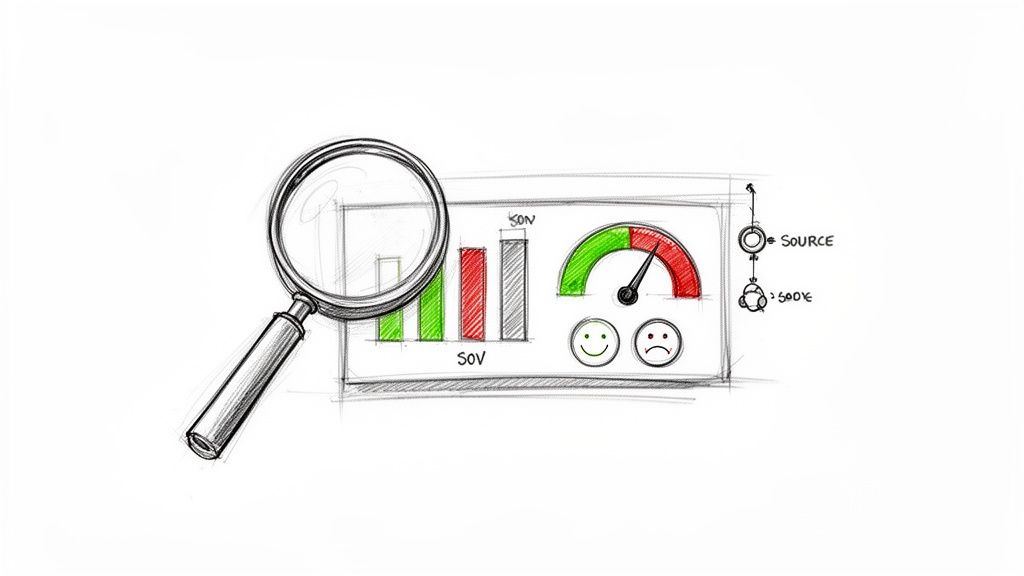
The trick is to stop obsessing over single, random responses and start looking for consistent patterns. This is the core idea behind a new discipline we call AI Search Analytics. It's all about making your brand's AI footprint something you can actually see, track, and improve. When you systematically test hundreds of prompts over time, clear trends emerge, giving you a reliable signal to move from guesswork to an evidence-backed strategy.
Core Metrics for Your AI Brand Audit
A proper audit requires a new set of metrics built for this new world. These KPIs give you a full 360-degree view of your brand’s position, making your branding and visibility efforts in AI concrete and manageable.
- Share of Voice: This measures how often your brand shows up in AI answers for a given set of prompts compared to your competitors. A high Share of Voice means AI models consistently recognize you as a key player.
- Sentiment Analysis: It’s not just about being mentioned; it’s about how you’re mentioned. This metric tracks whether the AI describes your brand in a positive, negative, or neutral way. It’s the difference between being called an "industry leader" and a "cheap alternative."
- Competitive Positioning: This reveals how the AI frames you in relation to your rivals. Does it see you as the premium choice? The innovator? Understanding this context is everything.
- Source Attribution: This uncovers the digital breadcrumbs—the specific articles, reviews, and forum posts—that AI models use to form their opinions. If you know the sources, you can start to influence the narrative.
Running a Comprehensive Audit with PromptPosition
Tracking all this manually is nearly impossible. AI responses are constantly in flux, making a one-off spreadsheet obsolete the moment you finish it. This is why specialized platforms are becoming non-negotiable for marketing teams.
A tool like PromptPosition is designed to do the heavy lifting for you. It automates the entire process, acting as a command center for your AI Search Analytics. You can continuously monitor what AI models are saying about you and your competitors for the prompts that matter most. This dashboard gives you an immediate, actionable overview of where you stand—how your visibility stacks up, where harmful inaccuracies exist, and where your brand is missing from the conversation.
An AI audit is no longer a "nice-to-have." It is the starting point for any modern brand strategy. You cannot manage, protect, or improve a narrative that you cannot see.
With a thorough audit in hand, you can finally connect the dots and turn a fuzzy problem into a clear to-do list for your content and PR teams. As you get more comfortable quantifying your AI presence, you may also want to explore how to measure brand perception more broadly.
A Strategic Framework for Influencing AI Narratives
So, you've audited your brand's presence in AI search and seen how these models perceive you. Now for the important part: doing something about it. The real goal is to proactively shape that narrative, turning your observations into a concrete action plan that elevates your branding and visibility.
Influencing an AI isn't about finding a secret backdoor. It's about getting back to the fundamentals of great marketing, but with a new audience in mind: the machine. A solid strategy comes down to three core pillars that work in tandem to teach AIs what's true, important, and authoritative about your brand.
Pillar 1: Authoritative Content and SEO
The most direct line of communication you have with any AI is your own website and blog. AI models prioritize clear, factual, and well-organized content. Your job is to build a library of material that makes it incredibly easy for them to get your story right. This means creating comprehensive guides, detailed product pages, and crystal-clear "About Us" sections that spell out your mission, values, and what makes you different. For a deeper dive, read our guide on how to align branding and SEO for better overall performance.
Pillar 2: Strategic Digital PR
While your own website is the foundation, AI models look for third-party validation to figure out who's truly credible. A smart digital PR strategy is critical. The aim is to earn mentions, reviews, and links from high-authority websites that AI models already see as trustworthy sources.
Every positive review, industry award mention, or expert quote published on a reputable site acts as a powerful vote of confidence. It’s a signal to the AI that your brand is not just talking about itself but is recognized by others as a significant player.
Focus your energy on getting featured in top-tier industry publications, respected news outlets, and influential blogs. Each piece of earned media strengthens the web of trust around your brand, making it far more likely that an AI will feature you in a positive and accurate way. A report on branding statistics shows that consistent brand presentation can increase brand recognition significantly.
Pillar 3: Structured Data Implementation
The final pillar is the most technical, but its impact can be huge. Structured data, also known as schema markup, is code you add to your website that acts like a set of labels, explicitly telling AI models what your content is about. It removes room for misinterpretation by clearly defining your company, products, articles, and more. This technical layer of SEO takes the guesswork out of the equation for an AI, feeding it unambiguous facts directly from the source of truth: you.
Platforms like PromptPosition are becoming essential for tracking visibility in ChatGPT and Gemini to find high-impact prompts and critical gaps in your narrative. To learn more, check out our guide on how to master AI brand visibility.
Common Questions About Branding and AI Visibility
As marketers, we’re all trying to get our heads around this new AI-powered search world. It’s natural to have questions. Here are the answers to the most common questions about branding and visibility in the age of AI.
Is AI Visibility Just a New Name for SEO?
No, though they are closely related. Traditional SEO is about earning a top spot on a list of options a user can choose from. AI visibility is about influencing the single, synthesized answer the AI creates for the user. There is no menu of choices, just one story. Your goal is to make sure your brand’s core message is woven directly into that story. It’s a shift from chasing rank to controlling the narrative.
How Can We Influence AI Models if They Are Black Boxes?
While they can seem like a "black box," AI models learn from their training data—which is largely the public internet. You influence the AI by becoming an undeniable, authoritative voice on that internet. When you combine great content, get press on trusted websites, and support it all with solid technical SEO, you are actively feeding the AI the right information.
You are, in essence, teaching the machine what’s true about your brand. Every piece of high-quality content and every authoritative backlink is another lesson that shapes how the AI understands and talks about you.
What Is the First Step My Team Should Take?
Start with a baseline audit. You can't fix a problem you can't see. Use a platform like PromptPosition to ask the major AI models the exact questions your customers are asking—about your brand, your products, and your competitors. Document the sentiment, your positioning against rivals, and the sources the AI is using. This simple audit will immediately highlight your biggest risks and opportunities, helping you focus your efforts where they’ll have the most impact.
How Often Does Our Brand's AI Representation Change?
Frequently. AI models are constantly being updated, and the online conversation around your brand is always in flux. This is why monitoring your AI visibility can’t be a one-time project; it must be an ongoing process. You need to check in regularly to spot changes, fix new inaccuracies, and jump on opportunities as they appear. It's all about staying aligned in a constantly shifting, AI-driven world.
Ready to see how AI models are portraying your brand? With PromptPosition, you can audit your AI visibility, track sentiment, and benchmark your performance against competitors in minutes. Stop guessing and start managing your brand's narrative in the new age of search. Get started with PromptPosition today.