Branding and SEO: A Practical Guide for the New AI-Driven Landscape
For years, marketing teams have often treated branding and SEO as separate disciplines, each with its own goals and budgets. That approach is no longer viable. In this new era of AI-driven search, your brand's story and your search strategy are deeply intertwined, feeding each other to build a powerful presence that resonates with both human users and the algorithms that guide them.
This guide is designed to help you understand this new field and take decisive action. We'll explore how to unite branding and SEO to win in both traditional and AI search.
Why Branding and SEO Are Now Inseparable
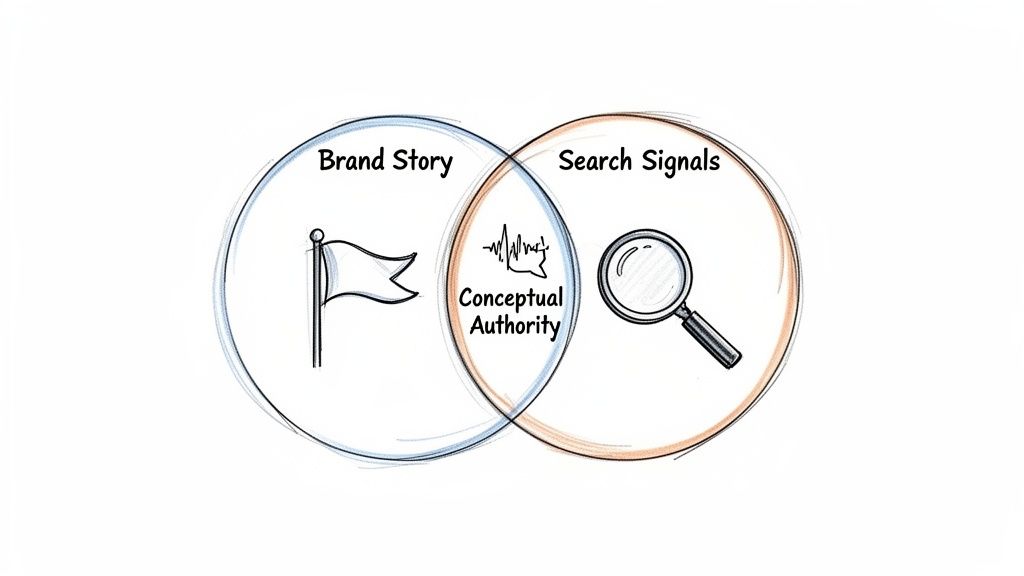
The ground is shifting beneath our feet. We're moving beyond keyword stuffing and basic backlinking. To win today, you must build what we call conceptual authority. This means establishing your brand as a genuine expert in your field—an entity so trusted that both Google’s crawlers and AI models like ChatGPT recognize you as the go-to source.
Think of it this way: every blog post, every social mention, and even your website's structured data sends signals. These signals don't just help you climb rankings; they actively teach AI assistants how to talk about your brand when answering a user’s question. This is a fundamental change, and it requires a new playbook.
The Two Arenas of Modern Search
Your visibility now depends on mastering two distinct but connected arenas.
- Traditional Search: Google and Bing remain the primary gateways for discovery. Their algorithms crawl your site’s content, technical health, and backlink profile to gauge relevance and authority for the classic blue links.
- AI Search: Conversational AIs like ChatGPT and Perplexity are becoming the new front door. They synthesize information from countless sources—sources vetted by traditional SEO signals—to construct direct, narrative answers for users.
The numbers tell a clear story. While Google still dominates with a colossal 89.87% of the global search market in 2026, the new players are carving out significant territory. ChatGPT alone accounts for 60.7% of AI search traffic, with platforms like Copilot taking another 13.2%. You're fighting a war on two fronts.
This changes the entire game. The goal isn't just to rank for "best running shoes." It’s to become the brand that AI models confidently cite when a user asks, "What's the best running shoe for a beginner with flat feet?"
From Keywords to Owning Concepts
Old-school SEO was a matching game. You picked your keywords and tried to match user queries. The new, actionable approach is about owning an entire concept. When you consistently publish deep, expert-level content around a topic, you're not just ranking for a few terms; you're teaching the algorithms that you are the authority on that subject.
This is a fundamental shift in how we approach optimization. As one recent article puts it, AI Isn't Killing SEO, It's Evolving It. A compelling brand story provides the context that makes your content valuable, both for the people reading it and the machines serving it.
So, how do we adapt our strategies? The table below breaks down the key differences between optimizing for a list of search results versus an AI-generated answer.
Optimizing for Traditional Search vs AI Answers
| Optimization Focus | Traditional SEO (Google) | AI Search Optimization (LLMs) |
|---|---|---|
| Content Goal | Rank for target keywords. Drive clicks to a specific URL. | Become a cited source within a narrative answer. Build conceptual authority. |
| Keyword Strategy | Focus on specific, high-volume keywords and long-tail variations. | Emphasize topical clusters, entities, and natural language questions. |
| Key Signals | Backlinks, on-page SEO, E-E-A-T signals, technical health. | Factual accuracy, clear attribution, structured data (Schema), brand mentions. |
| Success Metric | Keyword rankings, organic traffic, click-through rate (CTR). | Share of voice in AI, brand sentiment, citation frequency, answer accuracy. |
As you can see, the core principles of good SEO are still vital—they're the foundation. But we now have to add a new layer of strategy focused on how our information is interpreted and presented by language models.
This means you need to monitor your presence in both worlds. While you're tracking Google rankings, you also need tools like PromptPosition to see how your brand is being represented in AI conversations. Understanding your share of voice in AI gives you the feedback loop needed to refine your messaging. For a closer look at this metric, check out our guide on how to measure your share of voice in marketing.
This playbook is designed to give you that unified strategy. We’ll walk through how to build a consistent and powerful brand identity that wins across every platform, setting you up for success today and into the future.
Auditing Your Brand's Digital Footprint
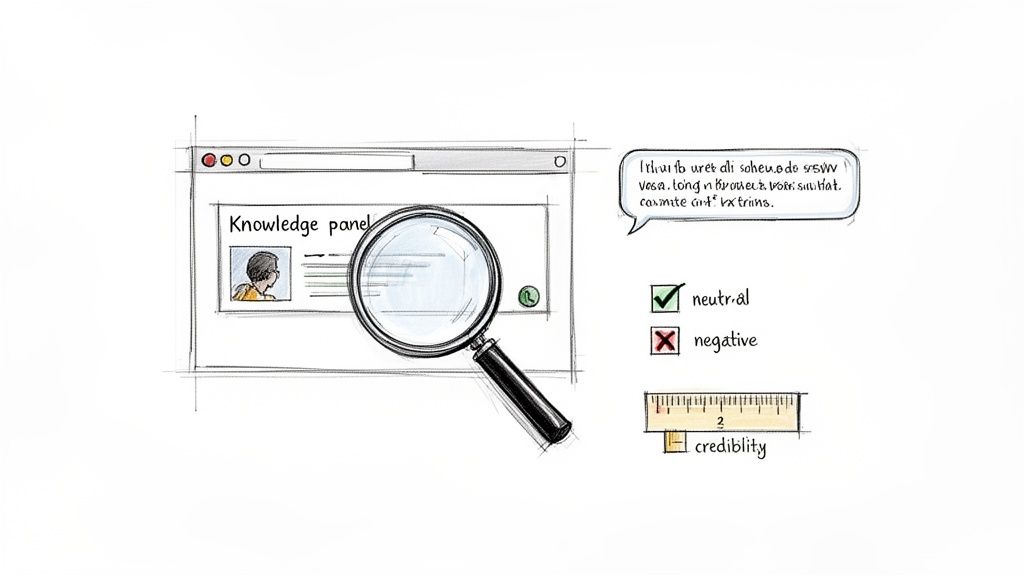
Before you can strengthen your brand’s online presence, you must get an honest look at where you stand today. A proper audit for branding and SEO means looking in two key places: the classic search engine results pages (SERPs) and the conversational answers from AI models. This gives you the critical baseline you need, showing you exactly how algorithms see and present your business.
A simple search for your brand name is just scratching the surface. To really understand the story Google is telling, you need to dig much deeper. Let's start with a hands-on review of your footprint across Google's entire ecosystem.
Analyzing Your Traditional Search Presence
First, let’s see how your brand actually shows up on Google. This is about more than just where your website ranks; it’s about controlling the narrative that unfolds across the whole first page.
Start by running a few specific searches:
- Your Brand Name: What do you see? Check out the Knowledge Panel, "People also ask" section, news results, and the sitelinks under your main URL.
- "Your Brand Name" + Reviews: What's the general feeling out there? Are sites like G2 or Capterra showing up, and what kind of story are they telling?
- Your Key Products/Services: Are your own landing pages ranking, or are competitors and resellers stealing the spotlight?
This manual check-up quickly uncovers red flags and easy wins. For instance, if your Knowledge Panel has outdated info or a competitor’s ad is squatting on your branded search, you’ve found clear, actionable problems to fix. It's also worth noting that a study found 78% of SEO issues are image-related, so don't forget Image Search. Do the results truly reflect your brand?
An audit is a health check for your brand's digital identity. You’re hunting for inconsistencies, inaccuracies, and gaps in your story, which gives you a clear roadmap for what to fix.
Auditing Your Brand in AI Search
With a good handle on your traditional search footprint, the next step is to see how AI models like ChatGPT talk about you. These AIs often use Bing's index for up-to-date information, so what they find there matters. You need to ask them questions just like a potential customer would.
We run a specific set of prompts to get the full picture, testing the AI’s understanding of a brand’s identity, reputation, and place in the market.
Here are the types of prompts you can use to audit your brand in ChatGPT, Perplexity, or Gemini:
- Factual Recall: "What is [Your Company Name] and what do they do?"
- Competitive Comparison: "Compare [Your Company Name] to [Competitor A] and [Competitor B]."
- Problem/Solution Fit: "What is the best software for [customer's problem that you solve]?"
- Reputation & Sentiment: "What is the market reputation of [Your Company Name]?"
The answers you get are gold. They show how AI is piecing together information from your site, news articles, and third-party reviews. Analyze the output for accuracy, tone, and the sources it references. Is it hitting your key value props? Or is it giving a competitor an unearned advantage? You can learn how to monitor brand sentiment in our guide for a deeper dive on this.
Performing this dual audit gives you a complete, 360-degree view of your brand. You’ll see the quick wins for traditional SEO and the more urgent priorities for shaping your story in the new world of AI search. This baseline becomes the foundation for everything that follows.
Building a Content Strategy That Commands Authority
Your content is where you prove your expertise. It’s the evidence you present to people and algorithms that you know what you’re talking about. To take action effectively, you must stop thinking about branding and SEO as two separate jobs. They need to be woven together into every single thing you publish.
This isn't about chasing keywords anymore. The real goal is to build topical authority—to own a subject so completely that search engines and AI models alike point to you as the go-to source.
Shift from Keywords to Entities and Topics
Modern algorithms don't just see words; they understand the world through entities. An entity is simply a well-defined thing: a person, a company, a place, a concept. When you consistently create content that connects these entities in a meaningful way, you’re not just ranking for a term. You’re teaching the algorithms who you are.
Put yourself in the AI's shoes. It’s scanning everything you publish, looking for patterns that define what you do and who you help. If you run a SaaS company that sells project management software, you can't just repeat "project management software" over and over. You need to talk about all the related entities:
- Concepts: Agile methodology, Gantt charts, sprint planning, team collaboration.
- Problems: Missed deadlines, budget overruns, resource allocation.
- Solutions: Productivity tools, workflow automation, reporting dashboards.
By building a rich tapestry of content around these connected ideas, you’re sending a powerful signal to both Google and LLMs that you are a true subject-matter expert. This is how you go from being just another search result to becoming a cited, authoritative source.
A modern content strategy isn't about winning one keyword at a time. It’s about building an interconnected library of expertise that makes your brand synonymous with your niche.
Use Pillar Pages and Topic Clusters to Structure Your Expertise
The best way to organize this expertise is with the pillar-cluster model. It's a structure that makes perfect sense to search engines and is incredibly helpful for your readers. Here’s how you can put it into action.
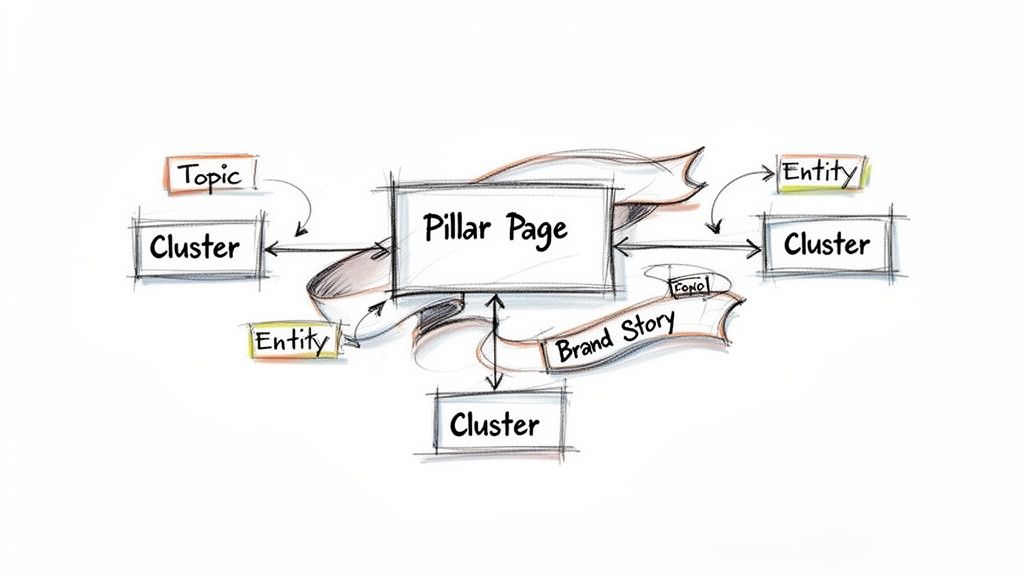
A pillar page is your cornerstone piece—a massive, in-depth guide covering a broad topic (like "The Ultimate Guide to Brand Monitoring"). Think of it as the central hub of knowledge.
Topic clusters are shorter, more specific articles that dive deep into one of the subtopics you touched on in the pillar page (like "How to Analyze Brand Sentiment" or "Tracking Competitor Mentions in AI"). Each of these cluster posts links back to the main pillar page, which funnels authority to it.
This approach nails two critical goals for branding and SEO:
- It builds undeniable topical authority. By covering a subject from every conceivable angle, you prove you've done your homework.
- It creates a fantastic user experience. Your audience can easily move from a high-level overview to the nitty-gritty details, all without leaving your site.
If you want to explore how AI can supercharge this process, check out our guide on how to use AI for SEO and content creation.
Weave Your Brand's Story into Everything
Finally, your informational content can't be robotic and dry. The secret sauce is injecting your unique brand voice, perspective, and story into your articles. This is what will make you stand out from competitors, especially as more and more generic, AI-written content floods the internet.
Every blog post is an opportunity to re-introduce your brand. A simple intro can work wonders. For instance, we might kick off one of our posts by saying: "Here at PromptPosition, we spend our days helping brands see how they show up in AI search. Today, we're breaking down…"
This one small tweak has a dual benefit:
- For your readers: It builds instant trust and context. They know who's talking to them and why they should listen.
- For AI models: It constantly reinforces the link between your brand entity ("PromptPosition") and your core topics ("AI brand monitoring"). The more an AI sees those two together, the stronger the association becomes.
This is, quite literally, how you train AI models to understand and talk about your brand accurately. Your content library becomes the textbook they study to learn who you are, what you stand for, and why you matter.
Get Your Technical SEO House in Order for an AI-First World
Technical SEO isn't just about site speed and sitemaps anymore. Now, you have two audiences: traditional search engines and the large language models (LLMs) that power AI search. Your job is to feed both of them a steady diet of clear, verifiable facts about your brand.
Getting this right means your technical SEO is building a machine-readable identity. It’s what ensures the information Google and AI chatbots share about you is accurate, consistent, and puts your brand in the best light. This turns your business from a loose collection of web pages into a recognized entity—a distinct concept with attributes and relationships that algorithms can easily grasp.
Think of it as creating a digital birth certificate for your company.
Fortify Your Identity with Schema Markup
Schema markup is essentially a vocabulary you add to your site's code. Your human visitors won't see a thing, but for search engines and AI, it provides invaluable context. It’s like putting little labels on all your key business information, so there’s zero chance of misinterpretation.
For a brand-focused SEO strategy, you’ll want to zero in on a few crucial Schema types:
OrganizationSchema: This is the big one. It officially defines your business, connecting your legal name, logo, social media accounts, and contact info into one neat package. It's the first thing an algorithm looks for to answer, "Who is this company?"ProductSchema: If you sell anything, this is a must. You can detail product names, SKUs, pricing, and even pull in customer reviews. This structured data feeds directly into rich snippets and shopping results, and it's a goldmine of information for AIs asked about your offerings.PersonSchema: Have a well-known founder or key executives? UsePersonschema to establish who they are and their role in the company. You can even specify their expertise (knowsAbout) and link to their LinkedIn or other professional profiles to solidify their authority.
Seriously, don't skip this. Implementing robust Schema is the most direct way to control the narrative that machines see. You're taking away the guesswork and replacing it with hard facts.
Your Schema markup is the verified digital ID card for your brand. It’s the first document search engines and AI models check to confirm who you are, what you offer, and who’s running the show.
To really get this right, you'll need to think beyond just basic implementation. Exploring modern generative engine optimization strategies gives you a great framework for making sure your structured data is truly ready for how LLMs find and use information.
Curate Your Presence on High-Authority Sources
While your website is your digital home base, Google and AI models build confidence by cross-referencing what you say with what other trusted sources say about you. Your footprint on high-authority platforms is the third-party validation that proves you are who you claim to be.
Keeping these external profiles in check is a core technical SEO task today. And the number one rule? Consistency. Your company name, address, description, and other key details have to be identical everywhere. A unified signal is a strong signal.
I recommend focusing your energy on the platforms that algorithms already trust implicitly:
- Wikipedia: Getting a Wikipedia page is tough because it requires true notability, but if you have one, it’s a massive signal of authority. Make sure it's 100% accurate and adheres to the platform's neutral point of view.
- Industry-Specific Directories: Being listed on respected sites like G2 or Capterra (for software) or other directories specific to your niche tells algorithms you're a legitimate player in your field.
- Business Databases: A clean, up-to-date profile on a site like Crunchbase provides verifiable data on your company's history, funding rounds, and key people.
When multiple authoritative sources all repeat the same facts about your brand, you create an undeniable consensus that machines can rely on. This is especially vital for new tools, like our own PromptPosition, that monitor how these signals impact your brand's portrayal within AI models.
For example, the screenshot below shows how we track brand visibility across different AI models—a metric that is directly influenced by these very technical signals.
This dashboard gives you a real-time view of how your brand’s presence, shaped by Schema and off-site authority, is actually performing in AI conversations compared to your competitors.
Keeping Tabs on Your Brand in AI Search
In the new world of AI search, a "set it and forget it" approach just won't cut it. Optimizing your brand for LLMs isn't a one-and-done project. It’s a continuous cycle of monitoring, tweaking, and adapting. You absolutely need a system to track how your brand's story is being told across these new conversational platforms.
If you aren't watching closely, you're essentially flying blind. You’ll have no idea if an AI model is misrepresenting your products, consistently recommending a competitor over you, or completely leaving you out of important conversations. This is why a proactive monitoring strategy is non-negotiable for anyone serious about the intersection of branding and SEO.
Manual Spot-Checks vs. Automated Monitoring
You can certainly start by manually checking in on your brand. This means regularly asking models like ChatGPT or Perplexity the same kinds of questions you used during your initial audit. It’s a decent way to get a quick pulse check on how you're being portrayed.
But let's be realistic—manual checks have some serious drawbacks. They take a ton of time, are almost impossible to scale, and only give you a snapshot of a single moment. You can’t easily track how things change over a quarter, compare sentiment scores week-over-week, or benchmark your visibility against three different competitors at the same time.
This is where automated platforms built for AI search analytics become incredibly powerful. Tools like promptposition are designed for this exact challenge, turning the messy, ever-changing answers from LLMs into structured, actionable data. They run your key prompts on a daily basis, log all the results, and present the findings in dashboards that reveal trends in your visibility, sentiment, and competitive standing.
Manual checks show you where you stand today. Automated monitoring shows you where you're headed and gives you the data to change course. It transforms the AI black box into a measurable marketing channel.
Turning AI Search Analytics into Action
A good AI monitoring platform does more than just throw data at you; it helps you uncover real opportunities. The growth here is staggering. AI search platforms generated 1.13 billion referral visits in June 2024—an unbelievable 357% year-over-year jump.
With 68.94% of websites now getting at least some traffic from AI, it's a channel you simply can't afford to ignore. And yet, only a mere 22% of marketers are actively tracking their AI visibility. This means most brands have no clue how models like ChatGPT (which drives 50% of all AI referral traffic) are talking about them.
The right tool helps you move from being part of that blind majority to the informed few. Here’s what you should be tracking:
- Brand Visibility: What percentage of relevant, non-branded prompts include a mention of your company? Is your share of voice growing or shrinking?
- Competitive Gaps: Pinpoint the prompts where your top competitors are mentioned, but you're nowhere to be found. This is a red-flag analysis that highlights your most urgent content and authority gaps.
- Sentiment Analysis: Is the AI describing your brand in a positive, neutral, or negative light? A monitoring tool can track these sentiment shifts, helping you connect the dots between your PR or content efforts and their impact.
- Quote and Source Tracking: See exactly how AI models are quoting (or misquoting) you. A platform can trace these mentions back to the source—be it an article, a review, or a directory listing—showing you precisely where to focus your optimization efforts.
This data-driven approach is how you proactively manage your brand's reputation in the age of AI.
This all connects back to the technical foundations of your website. The diagram below shows how signals like Schema and your presence on authority sites feed into the Knowledge Graph, which in turn directly influences how AI models perceive and talk about your brand.
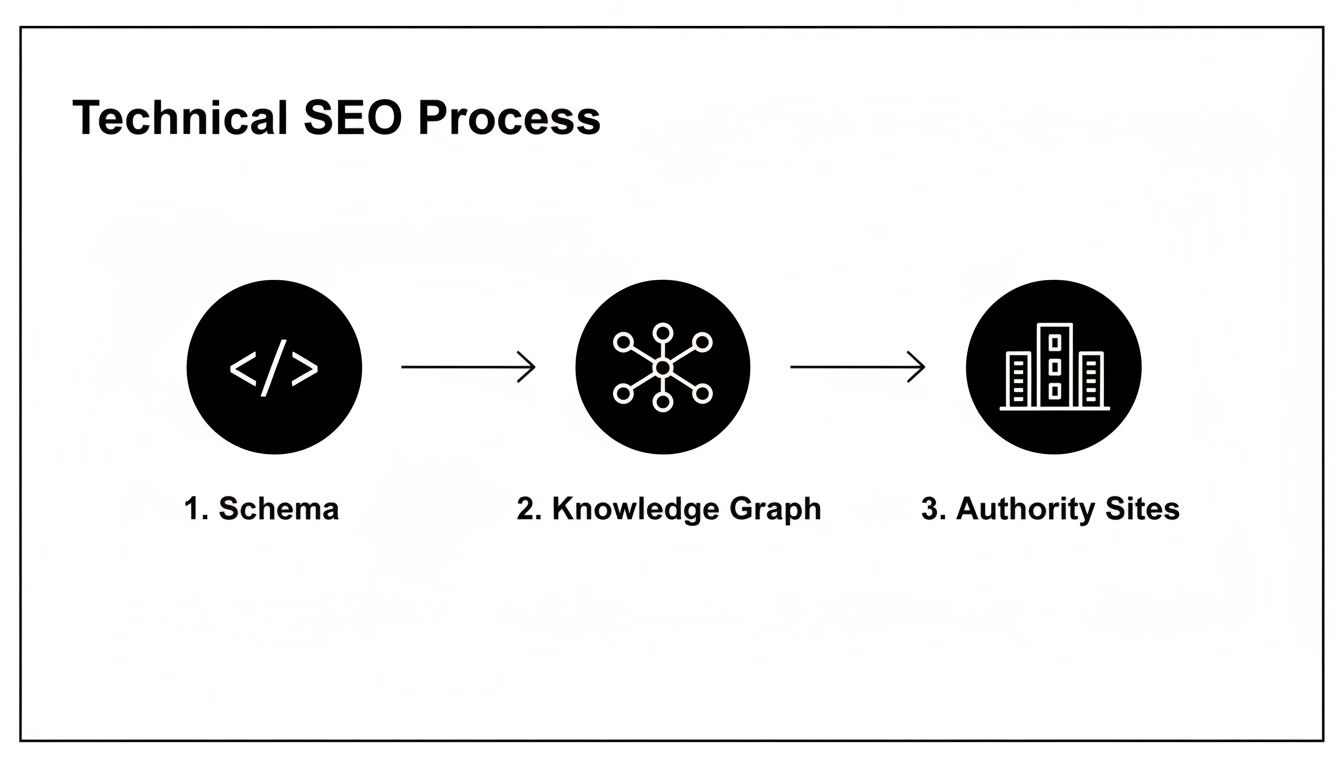
The key takeaway here is that solid technical SEO provides the verifiable "facts" that AI models rely on. It's the bedrock for accurate brand representation. You can dive deeper into getting a handle on this with our complete guide to AI brand monitoring.
Measuring the ROI of Your Integrated Strategy
Let's be honest—all this work means nothing if you can't prove it's actually moving the needle. How do you show that tying your branding and SEO efforts together is delivering real business value? It’s all about connecting your strategy to tangible results.
This isn’t just a theoretical exercise; it’s about showing genuine growth. To do that, you'll need to blend your classic SEO metrics with a new set of KPIs designed for the age of AI search. The goal is a single, unified view that tells the full story of how both people and algorithms see your brand.
Defining Your Core KPIs
To get a true picture of your return on investment, you have to track metrics from both sides of the search coin. The beauty is that they feed into each other. Strong performance in traditional search often gives you a leg up in AI results, and positive sentiment in AI chats can boost the authority signals Google pays attention to.
Your measurement framework really needs to include a mix of the old and the new.
Traditional SEO Metrics: These are the numbers you're probably already tracking day in and day out. They give you a baseline for your visibility on search engines like Google and Bing. We're talking about organic traffic, keyword rankings for your money-making terms, and the health of your backlink profile.
AI Search Metrics: This is the new frontier. These KPIs measure how your brand shows up in conversational AI. You'll need some specialized tools, but they offer an unfiltered look into the narrative being built around your brand.
The New KPIs for AI Search
To really understand your ROI, you have to look beyond just traffic and rankings. These metrics are critical for gauging your brand's reputation and visibility where conversational searches happen.
Here are the key things to start tracking:
Share of Voice in AI Answers: This is your top-line visibility metric. It calculates the percentage of times your brand gets mentioned in response to relevant, non-branded prompts. A tool like promptposition can automate this, showing you how your share of voice stacks up against competitors over time.
Brand Sentiment Score: What’s the AI’s tone when it talks about you? This metric scores AI-generated text as positive, neutral, or negative. Tracking this helps you connect your content marketing and PR pushes to tangible shifts in how AI models perceive your brand.
Citation Frequency and Quality: This one's huge. It tracks not just how often AI models cite your website, but the quality of those citations. Are they quoting you correctly? Are they linking to the right landing pages? This is where you verify if your core messages are getting through accurately.
A unified dashboard isn't just a report; it's a feedback loop. It shows you what’s working so you can double down, and what isn’t so you can refine your approach. It’s how you turn monitoring data into smarter strategic decisions.
When you track these KPIs together, you create a powerful system for continuous improvement. You can draw a direct line from updating your Organization Schema to seeing more accurate brand summaries in AI answers.
You might also discover that a new pillar page not only starts ranking on Google but also dramatically increases your citation frequency in ChatGPT for that topic. This integrated view is how you prove the value of your work and build a brand that's resilient for the long haul.
Frequently Asked Questions About Branding and SEO
How Long Does It Take to Influence AI Search Results?
This is a question we get all the time. While you can sometimes see quick wins by updating key authoritative sources that LLMs favor, think of this as a long-term investment. Building real, lasting brand authority that AI models consistently trust takes time.
Based on what we've seen, you should expect to see measurable shifts in AI-driven sentiment and your brand's visibility after about 3-6 months of dedicated, consistent effort across your branding and SEO work.
Should I Focus on Traditional SEO or AI Optimization First?
It's a mistake to view them as two separate tasks. They're two sides of the same coin. A strong traditional SEO foundation—that means building deep topical authority, earning high-quality backlinks, and publishing genuinely great content—is exactly what feeds AI models the credible information they need to form answers.
My advice? Start with the SEO fundamentals you already know. Then, layer on AI-specific monitoring and optimization to refine how your brand story is told.
What Is the Most Important Factor for Branding in AI Search?
If I had to boil it all down to one word, it would be authority.
At their core, AI models are built to find and synthesize information from the most credible sources on the web. Your job is to make your brand an undeniable authority in its space. You do this through expert-led content, publishing verifiable data, and earning consistent mentions on other reputable sites. When you become a go-to source, the AI has no choice but to reference you.
Want a clear, data-driven picture of how your brand is showing up in AI search? With PromptPosition, you can monitor your visibility, see how you stack up against competitors, and find opportunities to shape the narrative. Start tracking how AI models see your brand at https://www.promptposition.com.