Master SEO with an Automated Rank Tracker for Google & AI Search
At its core, an automated rank tracker is a piece of software that takes on the heavy lifting of checking your website's search engine rankings for you. It's a foundational tool for the new field of SEO, designed to help people understand their performance and drive action. Instead of you manually slogging through search results, it does the work automatically, giving you accurate, daily feedback on how your site is performing for the keywords that matter most.
Why Manual Rank Checking Is Obsolete
Let's be honest. Manually typing keywords into Google, scrolling to find your site, and then plugging that number into a spreadsheet might feel productive. But this old-school approach is a huge time-sink, notoriously inaccurate, and simply doesn't scale for any modern business. It’s a relic from a much simpler era of SEO.
Think of it like trying to take inventory in a massive warehouse by hand with a clipboard and pen. You’d inevitably miss items, make counting errors, and fall hopelessly behind. That’s a perfect parallel for manual rank checking in today's crowded digital marketplace. Manual tracking simply does not scale.
The Problem with Manual Tracking
Manual rank checking falls apart for a few critical reasons, making it more of a liability than a useful strategy.
- It Doesn't Scale: Checking 10 keywords might take 20 minutes. But what about 100? Or 1,000? Tracking a serious keyword list, especially across different cities or countries, quickly becomes an impossible task.
- It's Inaccurate: The search results you see are tailored specifically to you—based on your location, past searches, and the device you're using. A manual check will never truly reflect what an average customer sees, leading to flawed and misleading data.
- It Lacks Historical Context: Without consistent, daily data, you can't spot trends, figure out why your rankings suddenly dropped, or measure the real impact of your SEO work over time. A single manual check is just a meaningless snapshot with no story to tell.
Before we dive deeper, let's quickly compare the two approaches side-by-side. The differences in efficiency and data quality are stark.
Manual vs Automated Rank Tracking At a Glance
| Feature | Manual Tracking | Automated Rank Tracker |
|---|---|---|
| Efficiency | Extremely time-consuming; hours of manual work. | Fully automated; runs in the background. |
| Scalability | Not scalable beyond a handful of keywords. | Easily handles thousands of keywords. |
| Accuracy | Highly inaccurate due to personalization and location bias. | Delivers objective, unbiased data from any location. |
| Data History | Limited to sporadic, manually entered snapshots. | Provides a complete, daily historical record for trend analysis. |
| Competitor Insights | Requires a separate, tedious manual process. | Tracks competitor movements automatically. |
As you can see, automation isn't just a convenience—it's essential for getting reliable data.
An automated rank tracker is the foundational tool for any serious SEO strategy. It acts as your tireless digital assistant, methodically checking rankings for thousands of keywords across different locations every single day, without bias.
This automated approach immediately solves the problems of scale and volatility. It delivers accurate data that saves you countless hours and, just as importantly, uncovers competitor movements you would have otherwise completely missed. By automating this task, you get the clear, consistent visibility needed to create truly effective and data-driven search ranking reports.
But the evolution of search has introduced a new blind spot. While a traditional automated rank tracker gives you perfect visibility on Google, it's completely dark on what's happening in AI search. Millions of people are now turning to models like ChatGPT, Gemini, and Claude for answers, and your standard tools can't tell you if your brand is being mentioned, ignored, or even misrepresented.
This is where the concept of automated tracking takes its next logical step. Platforms like PromptPosition apply the same principle of daily, automated monitoring to large language models. Instead of tracking keywords in SERPs, it runs prompts and tracks your brand's visibility, sentiment, and position within AI-generated responses. For any team already relying on SERP tracking, this is the natural next step to maintain full visibility across the entire modern search ecosystem.
How a Modern Automated Rank Tracker Works
So, what is automated rank tracking and how does it function? At its core, the tool is a purpose-built engine that checks search engines like Google for your specific keywords, from the locations that matter to your business. The standard use case is simple: automatically monitoring Google keyword positions daily. It does this every single day, giving you a steady, objective view of where you stand—without the bias and inconsistencies that come from manual spot-checks.
Think about it this way: trying to track your rankings by hand is like sending a single scout out to survey a massive, shifting landscape. They can only report back on what they see from one spot, at one moment in time. An automated tracker is like having a fleet of drones flying constant surveillance, reporting back from thousands of different locations at once. You're not just getting a snapshot; you're getting a continuous, high-definition map of the entire terrain.
This comparison really highlights the difference between guesswork and a data-driven strategy.
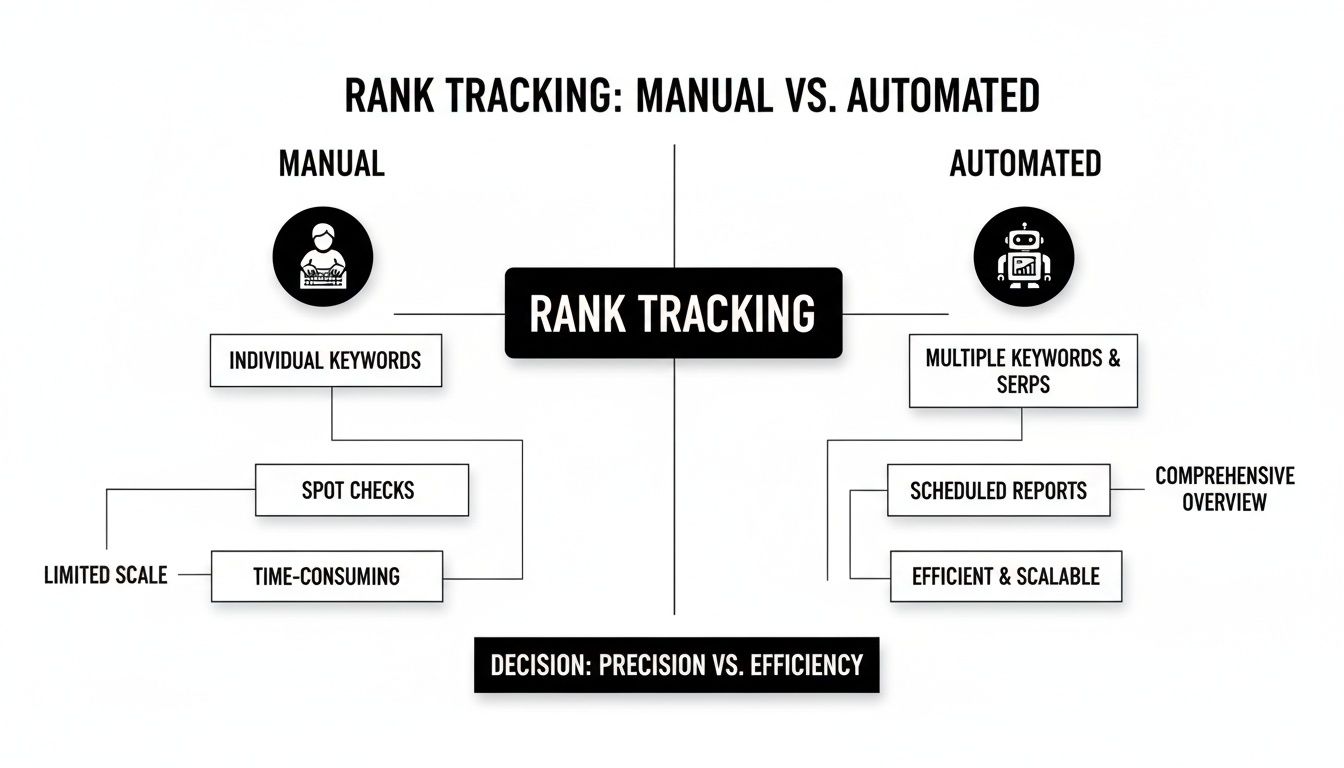
As you can see, automation isn't just about saving time. It’s about replacing a manual, error-prone task with a system built for accuracy, scale, and genuine strategic insight.
Beyond the Blue Links: The Evolution of Tracking
Of course, the most basic job of any rank tracker is to see where your website lands for a given keyword. But we all know that a Google search result is so much more than a simple list of ten blue links these days. A truly modern tool needs to see everywhere your brand can appear.
That means keeping an eye on your visibility across valuable SERP features, such as:
- Featured Snippets: That coveted "position zero" answer box that sits right at the top.
- 'People Also Ask' Boxes: A huge opportunity to answer related questions your audience has.
- Google Map Packs: Absolutely critical for any local business trying to drive foot traffic.
- Image and Video Carousels: Visual real estate that can grab a user's attention immediately.
Winning a spot in one of these features can be even more impactful than a #1 ranking, driving a ton of traffic and cementing your authority. A good automated tracker gives you the data you need to target these placements and measure your success.
The Next Frontier: Tracking AI Search
The evolution of automated rank tracking means looking beyond Google. It now needs to include AI search. While tracking your web search performance is now standard practice, the very definition of "search" is getting bigger. Millions of people are now asking their questions directly to AI models like ChatGPT, Gemini, and Claude. This has created an entirely new channel for discovery—one that traditional SEO tools are completely blind to.
This is simply the next step in the evolution of rank tracking. If your team already relies on automated SERP monitoring, applying that same discipline to AI is the logical next move.
Traditional tools track your position in Google results; PromptPosition automates the same concept for AI models, running your target prompts against ChatGPT, Claude, Gemini, Perplexity, and others daily and tracking your visibility, sentiment, and position over time.
This is precisely why tools like PromptPosition exist. They were built to monitor this new reality, checking whether your brand is cited in AI responses, analyzing the context of those mentions, and turning the "black box" of AI answers into clear, measurable KPIs. This is the natural next step for teams that already rely on automated SERP tracking.
The marketing automation software market was valued at $7.23 billion in 2025 and is expected to explode to $20.12 billion by 2034. That’s a nearly 180% jump, proving that automation is essential for staying competitive. If you want to dive deeper into the fundamentals, our guide on what is rank tracking is a great place to start. As this market grows, investing in a platform that covers both traditional web search and the new world of AI search will be what separates the leaders from the laggards.
The New Blind Spot Your Rank Tracker Cannot See
You’ve done everything right. You ditched the soul-crushing manual SERP checks and got a modern, automated rank tracker. Your team now has a fantastic handle on your Google performance—daily keyword updates, SERP feature wins, and a clear view of your competitors. It's a solid, data-driven system for the world's biggest search engine.
But what happens when your customers stop starting their journey on Google?
That question isn't a hypothetical anymore. It points to a massive new blind spot that has quietly opened up, and your traditional rank tracker is completely oblivious to it.
The Rise of Conversational Search
The new frontier is AI search. Millions of people are now firing up tools like ChatGPT, Gemini, and Claude to get answers, bypassing traditional search altogether. Instead of picking through a list of blue links, they're asking complex questions and getting a single, synthesized answer.
The problem is, your rank tracker was built for a different world. It can tell you with pinpoint accuracy if you're on page one of Google, but it has absolutely nothing to say about what's happening inside these AI conversations.
This creates a dangerous visibility gap. Your current tools can't tell you if ChatGPT is recommending your biggest competitor, if Claude is misrepresenting your services, or if Gemini is failing to mention your brand at all during crucial buying decisions.
This isn't a "prepare for the future" problem. It's a "right now" problem that leaves your brand exposed. Any team only looking at Google is flying blind in a channel that is becoming more important by the day.
The New Competitive Landscape
This shift toward AI-generated answers is happening incredibly fast. In fact, AI search has seen an explosive 527% growth in just one year, fueled by the adoption of AI chatbots and features like Google's own AI Overviews. Some projections even suggest that traffic from AI search could eclipse traditional search traffic by 2028—a turning point that demands an immediate change in strategy.
A whole new competitive landscape has emerged, one that requires a new kind of monitoring. The classic use case for an automated rank tracker—watching Google keyword positions—is still essential, but it's no longer enough.
The Natural Next Step for Marketing Teams
For teams that already see the value in automated SERP tracking, closing this visibility gap is the logical next step. The core principle hasn't changed: you need consistent, automated data to understand and shape your visibility where it matters most. The "where" has just expanded.
This is where the evolution of the automated rank tracker comes in. Just as traditional tools were built to monitor Google, new platforms have been designed to automate visibility tracking inside AI models.
Tools like PromptPosition apply the same proven logic to this new ecosystem. The system runs your key prompts against leading models like ChatGPT, Gemini, and Claude every single day. It goes beyond just looking for a link; it tracks your share of voice, analyzes the sentiment of each mention, and charts how your visibility changes over time within the AI's answers.
If you’re curious how this applies to Google’s own generative results, you can see exactly how an AI Overview tracker works. For any brand already invested in automated SERP monitoring, this is the essential next step to ensure complete and truly modern visibility.
Introducing the Automated Rank Tracker for AI
So, you’ve got your SEO monitoring dialed in. You have a great automated system that gives you a crystal-clear view of your Google performance day in and day out. But that’s only half the story now. The moment a potential customer skips Google and just asks ChatGPT for a recommendation, your traditional rank tracker goes completely dark.
You’re left with a massive—and growing—visibility gap.
This is where the idea of an automated rank tracker for AI comes in. It’s not about inventing something from scratch. It’s about taking a proven, reliable strategy that works for search engines and pointing it at the new world of conversational AI.
From Keywords to Prompts
The underlying logic is exactly the same as what you’re used to. Just as your current rank tracker checks your target keywords on Google every morning, an AI rank tracker runs your target prompts against the major AI models. It’s that same systematic, daily check-in, just for a different environment.
Here’s a simple way to think about it:
If a traditional rank tracker gives you ‘eyes’ on Google’s search results, an AI rank tracker gives you ‘ears’ inside the most important AI conversations about your brand and industry.
For any team that already sees the value in automated SERP tracking, this is the logical next step. Instead of wondering what models like ChatGPT, Claude, or Google Gemini are saying, you can get a consistent, data-driven report card. Platforms like PromptPosition were built specifically for this, automating the daily process of asking the right questions and recording the answers.
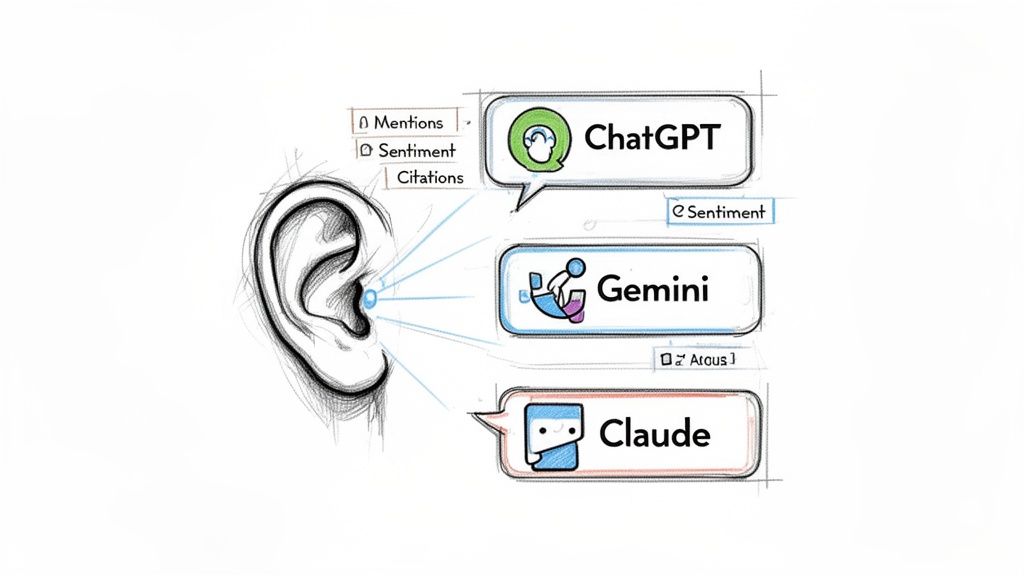
This lets you finally stop guessing and start measuring. You can spot trends as they emerge, see if your marketing efforts are making an impact, and catch negative brand mentions before they gain traction.
The New Metrics for AI Visibility
Unlike a tidy list of 10 blue links, an AI’s answer is conversational, unstructured, and can vary wildly. A simple numerical rank doesn't cut it anymore. A true AI rank tracker needs to measure a few new things to give you the full picture.
Here are the key metrics you need to be watching:
- Brand Mentions & Share of Voice: This is your baseline. How often does your brand actually show up in relevant answers compared to your competitors?
- Sentiment Analysis: When your brand is mentioned, is the tone positive, negative, or just neutral? An automated system can analyze the language to score sentiment, telling you if the AI is acting as an advocate or a critic.
- Position Within the Response: Just like in search results, position matters. Were you mentioned first in a list of recommendations, or were you an afterthought buried at the end of a long paragraph?
- Citation Tracking: Where is the AI getting its information? By tracking the sources it links to, you can pinpoint the exact articles and websites that influence its answers. This gives your content and PR teams a clear list of high-value targets.
These new KPIs turn the "black box" of AI into a marketing channel you can actually measure and influence. By monitoring them, you can build a real strategy to improve how your brand is perceived and represented. For a deeper look at what to look for in a platform, check out this breakdown of essential rank tracker features.
If your team is already committed to automated monitoring, this isn’t some radical new discipline you need to learn. Think of it as the necessary evolution of a strategy you already trust—one that ensures your brand stays visible across the entire customer journey, wherever it happens.
Choosing Your Automated Rank Tracker in 2026
Picking the right automated rank tracker used to be straightforward. Not anymore. The real question you have to ask yourself today is, where are my customers actually looking for information? Are they still typing queries into a Google search bar, or are they having conversations with AI models like ChatGPT and Gemini?
To make the right call, you need to evaluate tools based on the specific world they operate in. For most brands, this isn't an either/or situation. It's about building a complete visibility stack that covers your bases on traditional web search and the new frontier of AI search.
Evaluating a Traditional SERP Tracker
When your focus is on Google performance, your criteria should be razor-sharp. These tools have been around for a while, and the best of them are masters at delivering precise, actionable data.
Here are the non-negotiables for any top-tier automated rank tracker for web search:
- Data Accuracy and Freshness: The tool’s whole purpose is to give you daily, unbiased ranking data from any location you’re targeting. If the data is late or just plain wrong, it’s worse than having no data at all.
- SERP Feature Tracking: It's not just about the classic "ten blue links." A modern tracker has to show you where you stand in Featured Snippets, 'People Also Ask' boxes, local map packs, and image carousels.
- Competitor Analysis: Simply tracking your own ranks is like playing chess and only watching your own pieces. You absolutely need to see what your competitors are doing to spot the gaps and opportunities you'd otherwise miss.
You'll find that pricing models vary quite a bit, from pay-per-keyword plans to all-inclusive subscriptions. Your choice really boils down to the size of your keyword list and how deep your team needs to go with its analysis.
Evaluating an AI Search Tracker
As more customers turn to AI for answers, a completely new set of evaluation criteria has popped up. Picking an AI search tracker like PromptPosition means asking entirely different questions, because the way you measure success here is fundamentally different from old-school SEO.
An AI search tracker's value isn't just in spotting mentions; it's in analyzing the quality, sentiment, and context of those mentions over time. It turns the conversational output of an AI into measurable marketing KPIs.
Here are the key questions you should be asking when looking at an AI search tracker:
- Which LLMs Does It Support? The platform has to cover the major models your audience is actually using, whether that’s ChatGPT, Claude, Gemini, or Perplexity.
- How Deep is the Analysis? Does it just count how many times your brand was mentioned? Or does it give you deeper insights like sentiment analysis (is the AI talking about you in a positive light?), positioning (were you mentioned first?), and citation tracking (what sources is the AI learning from?).
- Does It Provide Historical Data? A one-off report is interesting, but it's not actionable. You need a tool that tracks trends daily, so you can see how your visibility and sentiment change as a direct result of your marketing efforts.
Legacy vs. Next-Gen Automated Rank Trackers
The rank tracking industry itself has had to evolve significantly by 2026. Specialized tools are now available to monitor AI-generated results, and what we expect from a "rank tracker" has completely changed. These tools now need to track AI-search presence and historical volatility, things that weren't even on the radar a few years ago. Thankfully, pricing has also become more accessible, with options for everyone from small teams to large enterprises. This shift shows that AI search tracking isn't a novelty anymore—it's a standard business practice. You can explore a detailed guide to understand more about these evolving capabilities.
This table breaks down exactly what separates the old guard from the new.
| Capability | Legacy SEO Rank Tracker | AI Search Tracker (e.g., PromptPosition) |
|---|---|---|
| Core Function | Tracks keyword rankings on Google SERPs. | Tracks brand visibility in AI model responses. |
| Key Metric | Numerical position (e.g., #3). | Brand mentions, sentiment, share of voice. |
| Data Source | Scrapes structured Google search results. | Analyzes unstructured, conversational AI output. |
| Competitor View | Shows competitor keyword rankings. | Benchmarks mentions & sentiment vs. competitors. |
| Actionable Insight | "We moved up for 'best CRM'." | "ChatGPT is now citing our competitor's case study." |
Ultimately, choosing your automated rank tracker in 2026 is about identifying your blind spots. If you're only using a traditional SERP tracker, you're flying blind in the entire AI conversation. A truly comprehensive strategy demands tools that give you a clear, data-driven picture of your brand's presence in both worlds.
Building a Unified Visibility Strategy for Web and AI
The way people find information has splintered. A customer’s journey no longer starts and ends on Google. It now weaves between traditional search, AI Overviews, and direct conversations with AI chatbots.
Given this new reality, asking whether to focus on Google or AI is the wrong question entirely. To truly protect and grow your brand, you need a unified strategy that sees and measures both.
For marketing and brand teams, this doesn't mean you have to scrap everything and start over. It's about expanding your field of view. The core principles of an automated rank tracker—daily data, consistent monitoring, and objective insights—are more important than ever. The playing field has just gotten bigger.
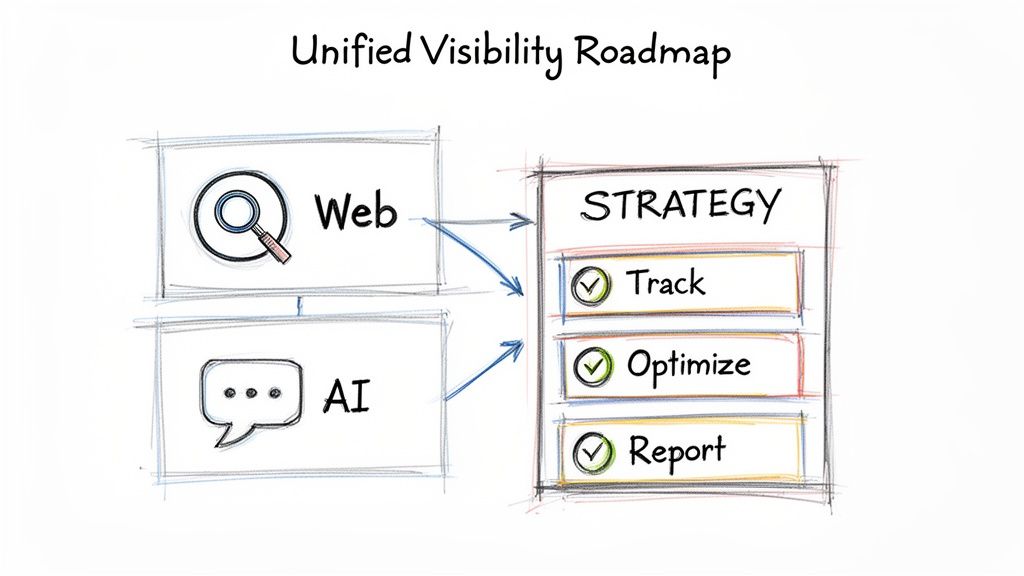
The Modern Visibility Roadmap
Building a strategy that covers all your bases is more straightforward than it sounds. It’s an expansion, not a revolution. By following a clear, three-step process, you can hold onto your hard-won search engine real estate while building influence where it counts in the new world of AI.
Maintain Your Bedrock. Your automated SERP tracker is still the foundation of any solid SEO program. It’s your defense and offense on Google, giving you the daily keyword data and competitive intelligence needed to protect and grow organic traffic. Don't touch this.
Layer on AI Coverage. Next, you need to add an AI search tracker to your toolset. Think of a platform like PromptPosition as your eyes and ears inside models like ChatGPT, Gemini, and Claude. It fills the visibility gap that your SERP tracker simply can't see, giving you hard data on brand mentions and positioning within conversational AI.
Build a Unified Content Strategy. With both of these systems feeding you data, you can finally build a single, cohesive content strategy. Use your SERP data to optimize for classic keyword intent. Then, use your AI tracking data to see which sources and topics are actually shaping the language models' understanding. This two-front approach makes your content effective in both arenas.
The real goal here is to stop thinking in silos. Your brand's ranking on Google and its reputation inside an AI chatbot are two sides of the same visibility coin. A winning strategy tracks and influences both at the same time.
The teams that will win in the coming years are the ones that can see the whole picture. By combining the proven strengths of a traditional automated rank tracker with the new intelligence from AI analytics, you get a complete view of your brand’s digital presence. This unified approach is what allows you to make smart decisions that build authority and shape customer perception across every channel where people are looking for answers.
Your Rank Tracking Questions, Answered
As rank tracking evolves, a lot of questions naturally come up. Let's tackle some of the most common ones we hear from teams trying to navigate visibility on both traditional search and AI platforms.
Can I Use One Tool for Both Google and AI Rank Tracking?
The short answer is no, not effectively. The underlying technology is just too different right now. Think of it like this: traditional rank trackers are built to scan and interpret Google's neatly organized results pages. They know what to look for and where.
AI trackers, on the other hand, like PromptPosition, have a completely different job. They need to understand the free-flowing, conversational responses that LLMs generate. For a truly accurate picture, you really need a specialized tool for each job.
How Do I Optimize My Content for AI Search?
This is a big shift in thinking. Optimizing for AI isn't about keywords; it's about influencing the source material that the AI models rely on. An AI rank tracker will show you exactly which websites, articles, and studies the model cites when it talks about your industry.
Your goal is to get your brand mentioned favorably in those authoritative sources. Focus your content and PR efforts on high-quality, factually accurate content published on trusted sites—this is the key to shaping AI conversations.
When you show up in the sources the AI trusts, you start to shape the answers it gives to users.
Is Google Rank Tracking Still Relevant with AI Search?
Absolutely, and here's why. While AI search is making waves, Google still handles a mind-boggling amount of traffic and is the go-to for millions of people looking to discover products and find information. It's not going anywhere anytime soon.
An automated SERP tracker remains a cornerstone of any solid digital strategy. The best way to think about it is as one half of a whole. Google tracking is essential, and AI tracking is now the other crucial piece of the puzzle for any brand that's serious about future growth.
Ready to stop guessing what AI models are saying about your brand? See how PromptPosition can give you a clear, data-driven view of your AI search visibility. Start tracking your brand's AI presence today.