A Guide to the Best AI SEO Software for Modern Marketers
AI SEO software isn't just another buzzword; it's a critical category of tools designed to tackle modern search engine optimization using artificial intelligence. This goes far beyond simple rank tracking. These platforms help you analyze search intent, create optimized content, and track your visibility where it matters most now—in new AI-driven answer engines like ChatGPT. The goal is to help you understand this new field and take decisive action.
The New Era of Search and AI SEO Software
Generative AI has completely changed how people find information. Search is no longer just a static list of blue links; it has become a dynamic, interactive conversation. People now get complex, direct answers from AI models, which means your brand needs a new strategy to stay visible and ensure it's represented accurately on these powerful platforms.
This shift has given rise to AI SEO software, a necessary evolution from the traditional SEO tools we’ve relied on for years. Instead of only crunching keyword data from Google, these platforms leverage large language models (LLMs) to understand context, semantics, and user intent on a much deeper level. For any marketer who wants to stay competitive, adopting these tools isn't just an option—it's essential for driving action and results.

Understanding the Two Core Categories
The AI SEO software market is exploding. Projections show it rocketing from USD 3.98 billion in 2025 to a mind-boggling USD 32.6 billion by 2035, a clear signal that businesses are scrambling for smarter, more efficient ways to optimize their online presence.
To navigate this crowded space, it’s best to think of the tools in two main categories based on their primary function. Understanding this distinction is the first step toward building an SEO strategy that truly works in today's AI-driven landscape.
| Tool Category | Primary Goal | Core Function |
|---|---|---|
| AI Content Optimizers | Improve rankings on traditional search engines like Google. | Analyze top-ranking content, suggest keywords, and score drafts based on on-page SEO factors. |
| AI Search Analytics | Track brand visibility and sentiment in AI answer engines. | Monitor how LLMs like ChatGPT and Gemini portray a brand, its products, and its competitors. |
AI Content Optimizers are all about refining the content you publish on your own website. They are designed to help you write articles and landing pages that perfectly align with what Google's algorithm wants to see.
On the other hand, AI Search Analytics platforms tackle the new frontier of Generative Engine Optimization (GEO). These tools are crucial for managing your brand’s story in an environment you don't directly control—the conversational answers generated by AI models. Our tool, PromptPosition, is a leader in this emerging space.
The core difference is simple: Content optimizers help you win on Google's turf by improving your owned assets. AI analytics platforms help you understand and influence how you appear on the AI's turf, where your brand reputation is being shaped by external sources.
A truly effective strategy needs both. You need fantastic, optimized content to rank in traditional search, which in turn feeds the data that LLMs are trained on. At the same time, you need analytics to monitor whether your efforts are actually shaping your brand’s narrative inside AI chats.
Comparing the Two Types of AI SEO Platforms
The world of AI SEO software has split into two distinct camps. Getting a handle on what each one does is crucial for building a strategy that truly covers all your bases and helps you drive meaningful action. One type of tool helps you perfect the content on your own website, while the other gives you a window into the AI-driven conversations you don't control.
This isn't just a minor distinction; it's fundamental to modern SEO. The numbers don't lie: with 75% of marketers already using AI tools in their workflows and nearly 70% of businesses seeing better ROI from their SEO efforts because of it, the pressure is on. It's no surprise that 82% of enterprise SEOs plan to bump up their AI tool budgets by 2026. If you want more on this, you can find more insights on the rapid adoption of AI in SEO.

Category 1: AI Content Generation and Optimization
First up are the tools most people think of when they hear "AI SEO": AI Content Generation and Optimization platforms. These are all about helping you create and polish content on your website to perform better in traditional search engines like Google.
Think of tools like SurferSEO or MarketMuse as your content team's data-obsessed co-pilot. They crawl the top-ranking pages for your target keywords, break down what makes them work, and hand you a blueprint for creating something even better. Their main job is to help you rank higher by making your content more comprehensive and authoritative than the competition.
What they typically do:
- Automate Content Briefs: They generate detailed outlines based on what's already ranking, complete with suggested headings, topics to cover, and questions to answer.
- Score Content in Real-Time: As you write, a live score grades your work against hundreds of on-page SEO factors, telling you exactly where you stand.
- Suggest Semantic Keywords: They go beyond basic keywords to find related concepts and terms that help build your topical authority.
- Assist with AI Writing: Many include features to draft paragraphs, rewrite sentences, or expand on ideas, which can seriously speed up content creation.
The Bottom Line: These tools are focused inward, on the assets you directly control. Their value is in making your on-site content as bulletproof as possible for traditional Google search results.
Category 2: AI Search Analytics
The second, and much newer, category is AI Search Analytics software. These platforms tackle a completely different problem: the rise of generative answer engines like ChatGPT, Gemini, and Claude. Their goal isn't to help you write content, but to show you how your brand is being talked about inside these new AI-powered search experiences.
Platforms in this space, like our own PromptPosition, work from a different angle entirely. They're built to track your brand’s visibility, positioning, and overall sentiment within Large Language Models (LLMs). Since you can't just log in and edit what an AI says about you, these tools give you the intelligence needed to influence it over time. They are your eyes and ears in a search environment that has, until now, been a complete black box.
This kind of analysis transforms abstract AI conversations into hard data, showing you how different models perceive your brand's reputation compared to others.
What these platforms deliver:
- Multi-LLM Visibility Tracking: They monitor how often your brand gets mentioned across various AI models when people ask relevant questions.
- Sentiment Analysis: You can see how your brand is mentioned—is the context positive, negative, or just neutral?
- Competitive Benchmarking: They let you directly compare your AI visibility and sentiment against your top competitors.
- Source Attribution: This is huge. They can often trace the AI's answer back to the specific articles, websites, and data points it used, so you know where the information is coming from.
AI SEO Software Categories A Quick Comparison
To make the distinction crystal clear, here’s a quick breakdown of how these two types of platforms stack up, helping you understand where to take action.
| Category | Primary Function | Typical Use Case | Example Tools | Key Metrics Tracked |
|---|---|---|---|---|
| Content Optimization | Writing & improving on-page content for traditional search. | Creating a new blog post; optimizing an existing landing page. | SurferSEO, MarketMuse, Clearscope | Content Score, Keyword Density, SERP Position, Readability |
| AI Search Analytics | Monitoring brand reputation & visibility in AI answer engines. | Tracking brand sentiment; analyzing competitor mentions in ChatGPT. | PromptPosition, BrightEdge, Searchmetrics | Brand Mentions, Sentiment Score, Share of Voice, Source URLs |
Ultimately, these two kinds of AI SEO software are two sides of the same coin. One helps you nail your performance on Google, while the other gives you the tools to manage your reputation in the new world of AI-powered answers. A truly comprehensive SEO strategy in today's world needs to account for both.
What to Look for in Modern AI SEO Software
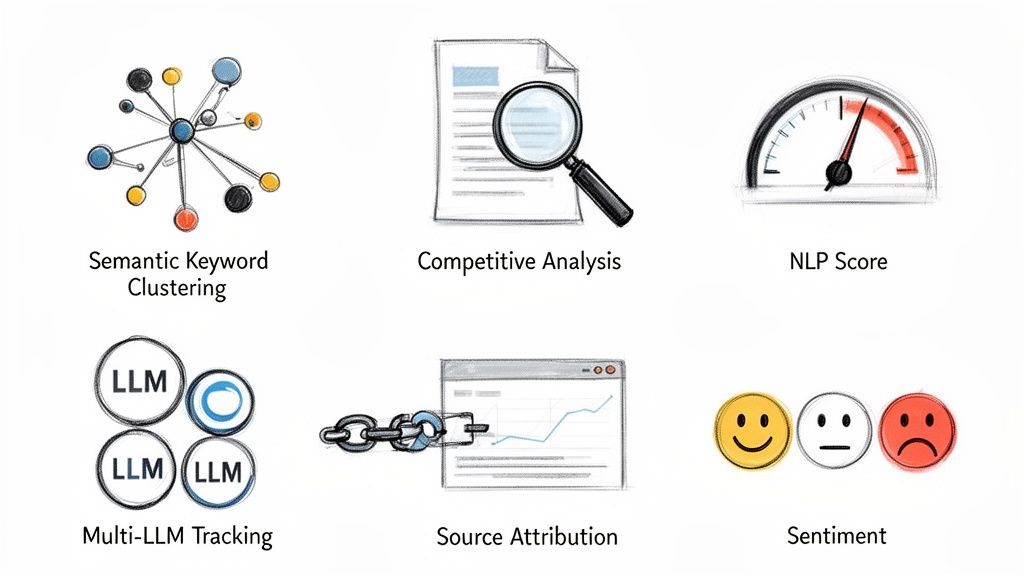
When you're evaluating AI SEO software, it's crucial to cut through the marketing fluff and focus on the capabilities that actually drive results. Whether your goal is to climb the Google rankings or shape how your brand appears in AI chats, some features are simply non-negotiable. Use this as a buyer's guide to build your own evaluation checklist and drive your team to action.
The features you'll need most depend entirely on which side of the SEO coin you’re focused on. A content marketing team needs tools to create articles that rank. A brand or PR manager needs to know how that content is influencing AI models. They're two different jobs requiring two different toolkits.
Core Features for Content Optimization Tools
For any platform built to help with on-page SEO for traditional search engines, the most valuable features replace guesswork with a clear, data-driven process. These tools dissect what's already working on page one and hand you a blueprint to create something even better.
Here’s what I’d consider essential:
Semantic Keyword Clustering: This is a game-changer. Instead of just targeting one keyword, this feature groups together hundreds of related queries and subtopics. It helps you build out comprehensive pillar pages and cluster content that signals true topical authority to Google. You're not just answering one question; you're covering an entire subject.
Competitive Content Analysis: The software should automatically pull in and analyze the top-ranking pages for your main keyword. It needs to show you common headings, questions people are asking, average word counts, and key concepts being covered. This is how you find the gaps in your competitors' content and create something more thorough.
NLP-Driven Optimization Scores: I wouldn't consider a tool without a real-time content editor that scores your draft using Natural Language Processing (NLP). As you write, it should provide actionable feedback, pointing out important terms and concepts you've missed. This ensures your content isn’t just long, but truly relevant.
These three features create a powerful workflow. You find the right topics with clustering, see what you’re up against with competitive analysis, and then write better content with a live editor guiding you.
Mission-Critical Functions for AI Search Analytics
Now, if your goal is to manage how your brand is portrayed in AI answer engines like ChatGPT or Gemini, you need a completely different set of features. These platforms shine a light on the black box of LLM outputs, where your reputation is being defined in real-time.
You can't just log in and edit what an AI says about you. You need intelligence to influence it.
For an AI search analytics platform like PromptPosition, these are the absolute must-haves:
Multi-LLM Tracking: Your customers and prospects aren't just using one AI. It's critical that the platform can track your brand's mentions and visibility across all the major models—ChatGPT, Gemini, Claude, and others. Anything less gives you an incomplete picture of your AI footprint.
Source Attribution: This might just be the most important feature of all. The tool must be able to show you the exact websites, articles, and data sources an LLM is referencing when it answers questions about your brand or products. If you don't know the source, you have no way to influence the output.
Sentiment and Positioning Analysis: It’s not enough to know if you were mentioned; you need to understand how. The best platforms analyze the full context of each mention to assign a sentiment (positive, negative, neutral) and map out how you're positioned against competitors for the same prompts. This turns vague AI chatter into concrete brand health metrics that can drive action.
Real-World Workflows for AI SEO Tools
It’s one thing to talk about the features of AI SEO software, but it’s another to see how these tools plug into a real marketing strategy. Theory is nice, but actionable blueprints are what get results. These tools aren't just a set of buttons to push; they’re designed to be part of a larger operational flow that can drive serious growth.
To make this tangible, let’s walk through two very different, real-world scenarios. The first is a classic content optimization workflow aimed at winning on Google. The second showcases a modern brand management workflow designed to shape how you appear in AI answer engines.
Workflow 1: Boosting Google Rankings with a Content Optimizer
Let's say you're the head of content for a B2B SaaS company. Your primary goal is to rank higher for the high-intent keyword "project management software for small teams." Right now, your article is languishing on page two, and you need to take action.
Here’s a step-by-step process using an AI content optimization tool:
Find the Content Gaps: First, you plug your target keyword into the tool. It instantly scans the top-ranking articles and shows you exactly what you’re missing. It might reveal that your competitors consistently cover subtopics like "integration capabilities," "budget-friendly pricing tiers," and "team collaboration features"—things your current article barely mentions.
Generate a Data-Driven Brief: With that analysis complete, the tool creates a comprehensive content brief. This isn't just a list of keywords; it’s a strategic outline. It might suggest an optimal word count of around 2,500 words, provide specific H2s and H3s to use, and give you a list of semantic terms like "Gantt charts," "Kanban boards," and "task dependencies" that are crucial for demonstrating topical authority.
Write and Optimize in Real-Time: Your writer gets to work in the tool’s live editor. As they draft the new version of the article, a content score updates on the fly, guiding them to include all the necessary topics and terms. The score literally climbs from a D- to an A+ as they methodically address the gaps from the brief.
Publish and Watch it Climb: Once the revamped article is published, you monitor its performance. Within a few weeks, you see it climb to the number three spot on Google for your main keyword, bringing in a steady flow of qualified leads. This process turns a once-subjective writing task into a predictable, data-driven project.
Workflow 2: Shaping Your Brand Narrative with AI Search Analytics
Now, let's switch gears. Imagine you're a brand manager for a popular consumer electronics company that just launched a new smartwatch. Your focus isn't on a single keyword but on your overall brand perception in emerging AI search channels like ChatGPT.
This calls for a proactive, reputation-focused workflow, which is where an AI analytics platform like PromptPosition comes in.
Detect Negative Mentions: The platform’s dashboard flags a new, negative sentiment trend. It shows that when users ask ChatGPT questions like, "Is the new [Your Brand] smartwatch durable?" the AI is generating answers that highlight screen scratching issues.
Trace the Narrative to its Source: This is the most critical step. The platform’s source attribution feature reveals that the AI is pulling this negative information from a couple of influential tech blogs and a viral Reddit thread. Without this insight, you'd be flying blind, just guessing what was shaping the AI’s opinion.
By identifying the exact sources influencing the LLM, you can move from reactive panic to a targeted, strategic response. You now know precisely where to focus your PR and content efforts.
Launch a Counter-Campaign: Armed with this data, your team can take strategic action. You could reach out to reputable tech influencers for new, unbiased durability test videos. Your content team could produce a detailed blog post showcasing the watch’s gorilla glass screen, complete with stress-test data. This is a perfect example of how to use AI for SEO in a modern context.
Reshape the AI’s Knowledge Base: As this new, positive content gets published and indexed, the AI analytics platform tracks the shift. Over the next month, you can literally watch the sentiment score for durability-related questions turn from negative to neutral, and eventually, positive. The AI’s answers start referencing the new, authoritative sources you created, effectively reshaping the public narrative.
These two workflows highlight the dual power of today's AI SEO software. One workflow helps you refine your own content to win in traditional search, while the other gives you the intelligence to actively manage your brand’s reputation on the new frontier of AI-driven search.
How to Choose the Right AI SEO Tool for Your Business
Picking the best AI SEO software isn't about finding the tool with the most features. The right tool is the one that solves your specific problems, fits your team's workflow, and aligns with your business goals. A solo marketer’s needs are a world away from a global enterprise's, so a one-size-fits-all approach just doesn't work.
The most critical question to ask upfront is this: what’s my main objective? Are you trying to climb the traditional Google search rankings, or is your top priority to protect and manage your brand’s reputation in the new world of AI-generated answers? Your answer will guide you to immediate action.
This simple decision tree breaks down the two main strategic paths you can take.
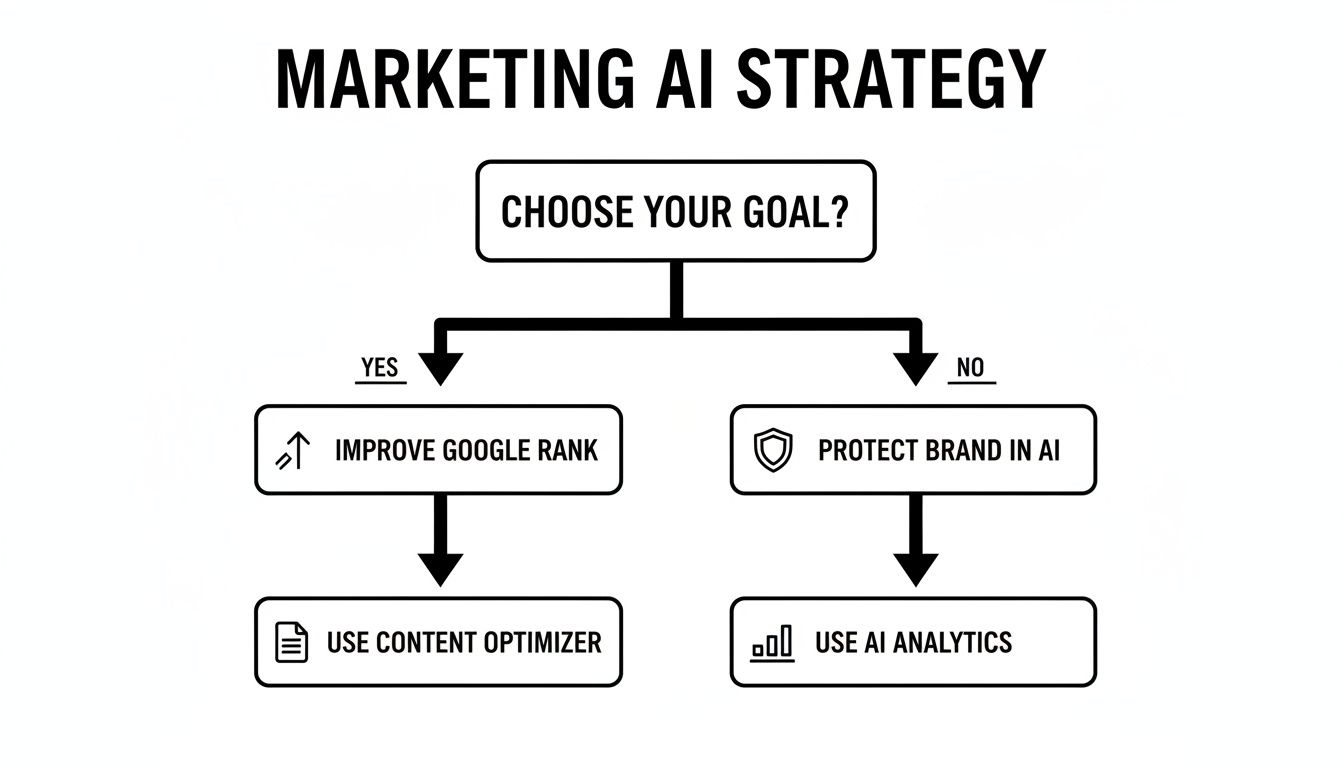
As you can see, your core goal—ranking improvement versus brand protection—is what should guide your decision. It's the fork in the road that leads you to either a content optimization tool or an AI analytics platform.
Recommendations for Solo Marketers and Small Businesses
If you're a solopreneur or running a small team, your resources—especially time and money—are tight. You need a solution that delivers a strong impact without a steep learning curve or a hefty price tag. For most small businesses, an all-in-one content optimization tool is the perfect place to start.
These platforms roll keyword research, content brief generation, and a real-time editor into one clean workflow. This setup lets you produce high-quality, SEO-focused content efficiently, even without a dedicated SEO specialist. My advice is to look for tools with a simple interface, clear content scoring, and flexible pricing.
Guidance for Mid-Sized Marketing Teams
For mid-sized businesses, the game gets more complex. Your team likely has multiple content creators, SEO specialists, and brand managers all trying to work in sync. That makes collaboration features non-negotiable. The right AI SEO software for a team this size has to support multiple users, shared projects, and clear reporting dashboards that everyone can understand.
At this stage, you’ll probably need a foot in both camps: a content optimizer and an AI search analytics platform. For your content tool, look for more advanced features like semantic keyword clustering and internal linking suggestions. For analytics, a platform like PromptPosition that offers unlimited seats is a game-changer. It allows your entire team to monitor brand mentions and competitor moves in AI answers without your costs spiraling out of control.
For mid-sized teams, it’s all about integration and collaboration. Your tools need to create a unified strategy where the content you create is directly informed by insights from both traditional search and AI answer engines.
Strategic Choices for Large Enterprises
Enterprises operate on a completely different scale, one that demands robust, scalable, and data-heavy solutions. Security, compliance, and the ability to plug into an existing martech stack are table stakes. For large organizations, API access is often a must-have, as it lets them pipe AI search data directly into their own business intelligence tools and custom dashboards.
An enterprise-grade AI search analytics platform is essential for managing brand reputation across global markets. These tools provide the deep competitive intelligence and source attribution needed to steer large-scale PR and content strategies. The ability to track a huge range of products, services, and brand messages across multiple LLMs is paramount. A platform like PromptPosition can provide this level of insight.
Here’s a quick breakdown of the key decision factors by business size:
| Business Size | Primary Goal | Key Factors to Consider | Recommended Tool Type |
|---|---|---|---|
| Solo/Small | Drive traffic efficiently | Affordability, ease of use, all-in-one features | Content Optimization Tool |
| Mid-Sized | Scale content & protect brand | Collaboration, user seats, deeper analytics | Combination of both types |
| Large Enterprise | Manage global reputation | Scalability, API access, advanced reporting | AI Search Analytics Platform |
Ultimately, choosing the right AI SEO software comes down to an honest assessment of your budget, your team's capabilities, and your most urgent strategic priorities. Whether you’re a scrappy startup trying to hit page one or a Fortune 500 company protecting its brand story, there’s a tool out there built to help you win.
Preparing Your Strategy for the Future of Search
Search has fundamentally changed. We’ve moved from a simple list of ten blue links to direct, conversational answers from AI models, and that shift changes everything. A modern SEO strategy can't just fixate on traditional search engines anymore; ignoring the rise of AI answer engines is no longer an option.
Visibility is now a two-front war. You still need great on-page optimization, but proactive brand management inside large language models is just as critical. The future of search demands a real presence in these new conversational platforms, where people form opinions about your brand before they even think about visiting your website.
Auditing Your Current Approach
To get ready for what's next, you need to take a hard, honest look at your current tool stack. Are your tools built for the search of yesterday or the search of tomorrow? A standard rank tracker can’t see the conversations happening in ChatGPT, and your go-to content editor has no idea what your brand sentiment looks like in Gemini.
This is exactly where a dedicated ai seo software for analytics, like PromptPosition, comes into play. It delivers the insights you absolutely need to understand and shape how your brand is represented in this powerful new channel.
It really boils down to this: you can't manage what you don't measure. Without any visibility into AI conversations, your brand’s story is being written for you, guided by whatever information the algorithm happens to pull.
Taking Action for Future Visibility
The time to start is now. The first step is to identify the strategic gaps in your current SEO plan. Are you actively monitoring how AI models talk about your brand, your products, and your competitors? If the answer is no, you're leaving a huge piece of your online reputation completely to chance.
For a deeper look into this emerging field, check out our guide on AI Search Engine Optimization.
Start auditing your toolset and look into platforms that can give you a clear window into this previously hidden world. Securing your brand’s future means adopting the tools that cover both sides of the modern search coin.
Frequently Asked Questions About AI SEO Software
It's completely normal to have questions about AI SEO software, especially with how quickly this new field is moving. Let's tackle some of the most common ones to help you better understand the landscape and take action.
What Is the Main Difference Between Traditional and AI SEO Software?
Think of it this way: traditional SEO software is like looking in the rearview mirror. It's excellent for analyzing historical data—what your keyword rankings were, how your backlink profile grew. It gives you a clear picture of what's already happened.
AI SEO software, on the other hand, is like your forward-facing navigation. It’s predictive. It uses machine learning to understand searcher intent, anticipate trends, and reveal how your brand shows up in AI chat responses on platforms like ChatGPT. You're shifting from simply tracking what happened to actively shaping what comes next.
Can AI SEO Software Replace Human SEO Professionals?
Not at all. A better way to see it is as a powerful co-pilot, not a replacement for the human expert in the driver's seat. The true purpose of these tools is to handle the heavy lifting—the tedious, data-intensive tasks that consume hours of a marketer's day.
This automation frees up SEO professionals to do what humans do best: think strategically, solve complex problems creatively, and connect the dots in ways a machine can't. The real magic happens when you pair the raw analytical power of AI with the strategic vision of a skilled human team. That's how you drive real results.
How Do I Measure the ROI of an AI Search Analytics Platform?
Measuring the ROI of an AI search analytics platform goes beyond just traffic and conversions; it's about protecting and managing your brand in a completely new arena. You're trying to shape your reputation where customers are now forming their first impressions.
Here’s what you should be tracking to measure impact:
- Improved Brand Sentiment: Are you seeing a tangible shift from negative or neutral AI mentions to positive ones?
- Increased Share of Voice: When people ask about your industry, is your brand mentioned more often than your competitors?
- Mitigation of Negative Narratives: How quickly and effectively are you spotting and correcting false or damaging information generated by AI?
Ultimately, the ROI isn’t just a number on a spreadsheet. It’s the value of safeguarding your brand’s reputation and getting ahead of the conversation before your competitors even know it's happening.
Ready to see how your brand is being represented in AI search? Get a clear, data-driven view with PromptPosition. Start monitoring your visibility and sentiment across all major LLMs today at https://www.promptposition.com.