A Guide to Mastering AI Search Visibility

AI search visibility is all about making sure your brand shows up accurately and in a good light within the answers generated by AI search engines like ChatGPT, Gemini, and Google's AI Overviews. It’s a move beyond just climbing the rankings. Now, the goal is to directly influence the conversational answers people get, making this a brand-new, critical piece of any digital strategy.
From Blue Links to Direct Answers
For the longest time, the SEO playbook was pretty simple: fight your way to the top of a search engine results page (SERP). Think of it like a library. Traditional SEO was the art of getting your book onto the most prominent, eye-level shelf. When someone needed information, they'd scan that shelf (the search results), grab a book that looked promising (click a link), and find their answer inside.
But AI search visibility completely flips the script.
Imagine walking into that same library, but instead of pointing you to a shelf, the librarian instantly reads from a dozen books, pulls together the key points, and gives you a single, direct answer. That librarian is the new AI-powered search engine. Suddenly, your brand isn't just a book on the shelf anymore. It’s a source the librarian either trusts and quotes, completely misinterprets, or ignores altogether.

This shift from a list of links to a synthesized answer is fundamentally changing what it means to be "visible" online.
Why This New Visibility Matters
The sheer scale of this change is hard to overstate. Google AI Overviews, for instance, now reach an incredible 2 billion monthly users in over 200 countries, completely rewiring how brands get discovered.
These AI-generated summaries sit right above the classic organic listings, often providing such complete answers that users never need to scroll down. In fact, some estimates suggest that roughly 60% of searches now end without a click because the AI handles the query right there on the page. You can dive deeper into these AI search visibility statistics to see how user behavior is evolving.
This presents a huge risk but also a massive opportunity. Your brand's story is no longer entirely in your hands; it’s being interpreted and retold by Large Language Models (LLMs). The real challenge for marketers now is to figure out how to understand and influence this new information layer.
The Core Pillars of AI Search Visibility
To win in this new world, you need to zero in on three key areas:
- Presence: Does your brand even get mentioned when people ask relevant questions?
- Sentiment: When your brand is mentioned, is it in a positive, negative, or neutral light?
- Accuracy: Is the information the AI gives about your products or services actually correct?
AI Search Visibility isn't just about being found; it's about being understood correctly. It's the art and science of ensuring AI models represent your brand with the accuracy and positive sentiment you've worked hard to build.
Keeping an eye on these pillars isn't optional anymore. Tools like Promptposition are emerging specifically to track how your brand is portrayed across different AI models, giving you the data you need to build a smart strategy.
Without that kind of insight, you’re flying blind, completely in the dark about how the world's most powerful information gatekeepers are talking about your company. This isn't some trend on the horizon—it's the new reality of how brands are discovered.
How Generative AI Really Sees Your Brand
To get a handle on how AI talks about your brand, you first have to grasp how it "thinks." Picture a Large Language Model (LLM) like Gemini or Claude as a research assistant—one that’s incredibly fast but takes everything very literally. It doesn't have opinions or experiences. Instead, it forms its entire understanding by piecing together information from a massive digital library.
That library contains just about everything: news articles, Wikipedia entries, customer reviews, forum chatter, and of course, your own website. The AI reads it all, spots the patterns, and builds a narrative based on the digital trail you and everyone else have left behind. This process is the heart of managing your ai search visibility.
What the AI spits out about you is a direct echo of the quality, consistency, and sentiment it finds in those source materials.
The Digital Echo Chamber
Think of every piece of content as a signal. A string of glowing press releases teaches the AI that your brand is a respected leader. But on the flip side, a few highly visible negative reviews on a popular forum can quickly become the AI's core truth, blowing a small problem way out of proportion.
This is where things get tricky. An AI can't tell the difference between a one-off issue and a core brand flaw. It just reports back on the most dominant story it finds in its data.
The narrative your brand has online is no longer just for human consumption. It is now the direct source code that programs how AI models perceive and present you to the world.
Understanding this is the first real step toward shaping that narrative. When you actively manage your digital source material, you're essentially curating the AI's education about your company. This is a fundamental part of what we now call Generative Engine Optimization. You can learn more by checking out our guide on what is Generative Engine Optimization.
From Sources to Synthesis
This whole process isn't random. AI models weigh sources based on signals of authority and trust, not unlike how traditional search engines work. A mention in a major publication like The New York Times will almost always carry more weight than an anonymous comment on a small blog.
This dashboard gives you a glimpse into how you can track exactly which sources an AI pulls from when answering questions about your brand.
By seeing which sources are most influential, you can aim your content and PR efforts where they’ll make the biggest dent in the AI's perception. Tools like PromptPosition are built to uncover this exact information, turning the AI's "black box" into a clear, measurable marketing channel.
The Local Visibility Gap
This synthesis process creates huge new challenges, especially for local businesses. The way an AI decides what to recommend can be wildly different from traditional search, creating a major visibility gap.
For example, a recent study uncovered a shocking lag in local AI recommendations. Assistants like ChatGPT, Gemini, and Perplexity recommend only 1% to 11% of the businesses that would normally show up in Google's local 3-pack. This makes it up to 30 times harder for a local spot to get mentioned in an AI answer, a problem laid bare in an extensive local visibility report. You can dig into more insights about this AI local visibility chasm and see its market impact.
This data hammers home a crucial point: you can't just assume your great SEO performance will translate into strong ai search visibility. The sources AI trusts and the way it pieces them together have created a whole new ballgame, and it demands its own strategy. Your brand's AI story is being written right now, with or without you.
The New Metrics for AI Search Performance
The SEO metrics we’ve relied on for years, like keyword rankings and click-through rates, are starting to show their age. In a world where AI-driven search engines give users direct answers, being number one on a list of blue links just isn't the whole story anymore. What really counts is whether your brand is mentioned, trusted, and recommended within the AI's generated response.
This shift demands a completely new set of KPIs to measure your ai search visibility. After all, you can't manage what you don't measure. Using old metrics to navigate this new environment is like trying to find your way through a city with a 20-year-old map—the streets have changed, and you're going to get lost. The real goal now is to put a number on your brand's presence and narrative inside AI-generated conversations.
Moving Beyond Rank Tracking
First things first: we need a mental shift. While organic rankings still matter, they don't tell you if an LLM is actually using your content as a source. More importantly, they don't reveal how the AI is portraying your brand in its summaries. You could hold the top spot for a crucial keyword, but an AI might still cobble together a negative summary by pulling from old news articles or a few grumpy forum posts.
This means we have to stop obsessing over the inputs (our rankings) and start tracking the outcomes of AI queries. We need to measure the story being told, not just our position on the page.
Defining Your Core AI Search KPIs
To get a clear picture of how you're performing, you need to zero in on the metrics that reflect this new reality. These KPIs are the bedrock of any modern AI search strategy, turning fuzzy concepts about brand perception into cold, hard data.
Here are the three essential metrics you should start tracking right away:
AI Share of Voice (SoV): This measures how often your brand gets mentioned in AI answers for your target prompts compared to your competitors. It answers one simple question: Are we even in the conversation? A low SoV is a massive red flag, signaling a serious visibility gap, no matter how good your traditional SEO looks.
Sentiment Score: This KPI analyzes the tone of the AI’s responses whenever it talks about your brand. It classifies each mention as positive, negative, or neutral, giving you a real-time pulse check on your brand’s reputation. A sudden dive in sentiment can be your first warning of a brewing PR crisis.
Citation Frequency: This metric counts how many times your domain is cited as a source in AI-generated answers. A high citation frequency is a huge vote of confidence. It tells you that AI models see your content as authoritative and trustworthy—it’s the new backlink, proving your material is a go-to source of truth.
This diagram shows exactly how AI models pull from all kinds of sources to piece together a story about a brand. It’s this final narrative that these new KPIs are designed to capture and quantify.
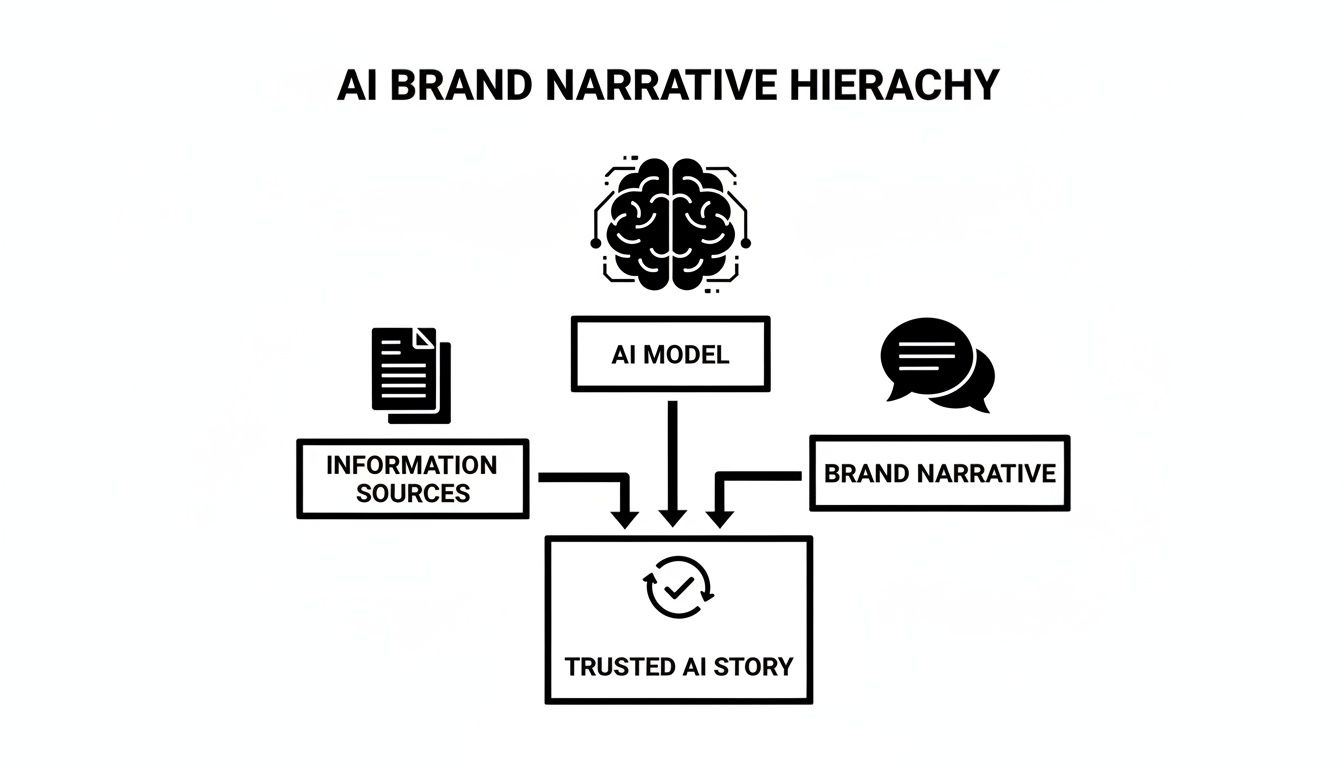
As you can see, the story the AI tells is a direct result of the information it’s fed. That makes tracking these new metrics absolutely critical.
To put this all into perspective, let's look at how the old world of SEO metrics stacks up against the new AI-focused KPIs.
Comparing Traditional SEO KPIs with AI Search Visibility Metrics
The table below contrasts familiar SEO metrics with the new KPIs needed to manage your brand's presence in AI-generated search. It highlights the shift from measuring positions to measuring perception.
| Focus Area | Traditional SEO Metric | AI Search Visibility Metric |
|---|---|---|
| Visibility | Keyword Ranking | AI Share of Voice (SoV) |
| Authority | Backlink Count / Domain Authority | Citation Frequency |
| Reputation | Online Reviews / Social Mentions | Sentiment Score |
| Engagement | Click-Through Rate (CTR) | Inclusion in Summaries |
| Content Goal | Attract Clicks to a Webpage | Become a Trusted Source for the AI |
This comparison makes it clear: while traditional metrics aren't obsolete, they no longer provide the full picture. The new metrics give you insight into the quality and narrative of your brand’s presence, which is what truly matters in an AI-first world.
Building Your AI Visibility Dashboard
Once you've got these metrics locked in, you can build a performance dashboard. The PromptPosition tool is built to automate this, constantly pinging models like ChatGPT and Gemini to collect this data for you. This lets you spot trends, see how you stack up against the competition, and pinpoint exactly where your brand’s story is strong or needs work.
The new question for every marketer isn't "Where do we rank?" It's "What is the AI saying about us?" This shift from position to perception is the heart of AI search visibility.
By adopting these KPIs, you give your team a data-backed way to navigate this new landscape. You stop guessing and start knowing, which is the foundation of any proactive strategy. For more hands-on ideas, you can also check out our guide on how to use AI for SEO.
Ultimately, tracking these new metrics isn’t just a reporting exercise. It’s a strategic imperative for any brand that wants to stay relevant in the age of AI.
A Strategic Playbook to Improve Your AI Visibility
Knowing the numbers is one thing, but putting that data to work is where you’ll see real results. Improving your AI search visibility demands a deliberate strategy that goes way beyond old-school SEO tactics. The game has changed. Instead of just chasing clicks, the new goal is to become an undeniable source of truth—the kind of authority that large language models (LLMs) trust and cite without hesitation.
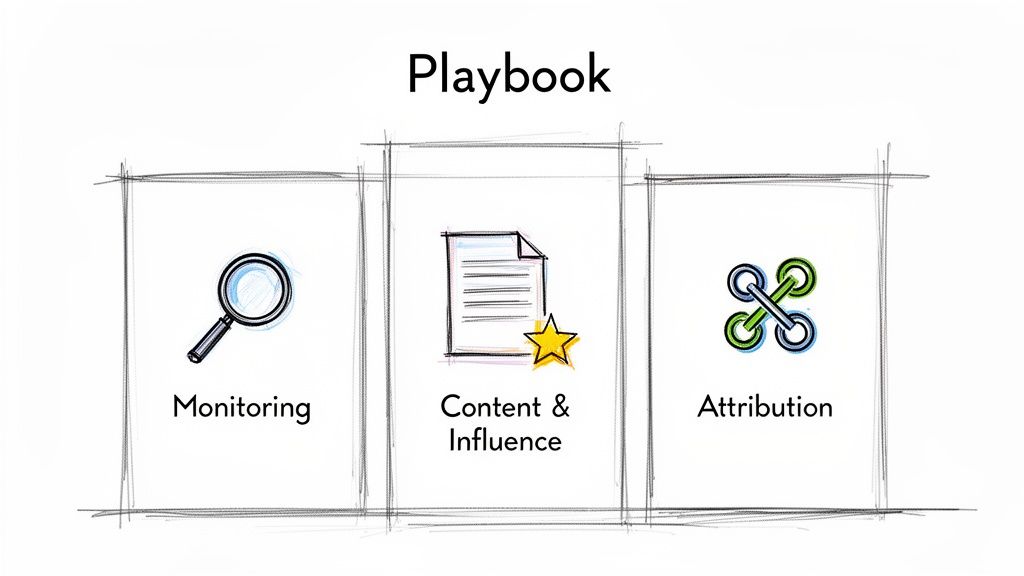
I've structured this playbook around three core pillars: Monitoring, Content and Influence, and Attribution. Think of them as a continuous cycle. Each pillar builds on the last, giving you a repeatable process for managing and improving how AI models see your brand. This isn't about finding quick hacks; it's about laying a durable foundation of authority that will pay off for years.
Pillar 1: Monitoring Your AI Presence
You can't fix what you can't see. The first step is all about getting a crystal-clear baseline of where you stand right now in the world of AI search. This means moving past random, one-off checks and into a system of consistent, reliable tracking.
Start by identifying the prompts that are absolutely critical to your business. These should cover everything from simple brand questions and product comparisons to the complex problem-solving scenarios where you need to be the top recommendation. Once you have that list, you have to track your performance over time.
This is where a platform like PromptPosition comes in, automating the heavy lifting. It constantly monitors how models like ChatGPT and Gemini answer your key prompts. You get hard data on your Share of Voice, Sentiment Score, and Citation Frequency—turning a fuzzy concept like "brand presence" into concrete KPIs you can actually use.
Your AI visibility baseline is your single source of truth. It's the starting line from which all progress is measured and the diagnostic tool that reveals your most urgent priorities.
Don't forget to benchmark against your top two or three competitors. This adds crucial context, showing you not just where you’re winning, but more importantly, where your rivals have an edge. This analysis will point you directly to the priorities you need to tackle in the next pillar.
Pillar 2: Content and Influence
With a clear picture of your performance in hand, you can start actively shaping the AI's narrative. This pillar is all about creating and amplifying the kind of definitive content that LLMs are engineered to find and use as primary source material.
Your mission is to become the "encyclopedia entry" for your niche. This takes a two-pronged approach: first, creating unimpeachable source material on your own digital properties, and second, making sure that information is backed up and validated across trusted third-party platforms.
Here are a few key tactics to get started:
- Create Definitive Source Content: Build out comprehensive guides, detailed glossaries, and data-rich reports on your website that answer common industry questions with absolute clarity. Structure this content with clean headings, Q&A formats, and easy-to-read tables so an AI can parse and pull the information effortlessly.
- Optimize Structured Data: Make sure your brand's entries on platforms like Wikipedia and Wikidata are accurate, complete, and meticulously sourced. LLMs lean heavily on these structured databases for their initial "fact-checking," which gives them an outsized influence on what the AI believes to be true.
- Earn High-Quality Press: Go after media placements in reputable publications that LLMs already trust. A single feature in an authoritative outlet can be worth more than a hundred blog posts, directly influencing an AI's sentiment and its memory of your brand.
This focused approach to content and PR is a central piece of modern AI search engine optimization, where the main goal is to educate the machine itself.
Pillar 3: Attribution and Measurement
The final pillar is all about tying your efforts back to real business outcomes. Metrics like Sentiment Score are great for tracking progress, but your leadership team will want to know how this work is actually impacting the bottom line. Attributing value in an AI-first world is tricky since direct clicks are less common, but it's far from impossible.
First, look for correlations between a rising AI Share of Voice and any shifts you see in direct and branded search traffic. As AI models start recommending your brand more often, you should see a natural lift in people searching for you by name.
Next, watch for changes in the sentiment of your branded search queries. A positive turn in how AI talks about you will often come just before a positive shift in how people search for you. You can also use brand-lift studies and customer surveys to measure changes in perception and recall over time.
Finally, dig into the sources the AI is citing. If your content is being used to answer questions from users with high purchase intent, you can draw a pretty clear line from your content strategy to influencing potential customers at a critical moment. This closes the loop, proving that strong AI search visibility isn't just another marketing metric—it's a powerful engine for business growth.
How to Analyze Competitors in the AI Landscape
Knowing your own AI search visibility is a great first step, but it’s only half the story. To actually gain an edge, you have to look over your shoulder and see what the competition is doing. Without that context, you're essentially flying blind, completely unaware of the threats and opportunities lurking right around the corner.
Competitive analysis in this new era isn't just about old-school keyword tracking. It's about understanding the narratives AI models are building. You need to dig into how often your rivals get mentioned, what the tone of those mentions is, and—most crucially—which sources are feeding the AI those impressions, good or bad. Think of this as your strategic radar, helping you point your resources where they’ll make the biggest splash.
Building Your Competitive Intelligence Framework
The goal here is to create a repeatable system for measuring yourself against everyone else. This framework is all about turning vague, conversational AI answers into hard data you can actually compare. A systematic approach means you're making decisions based on consistent insights, not just reacting to a few oddball AI responses.
First, lock down a core set of high-value prompts. These are the exact questions your ideal customer would ask when they’re weighing their options or looking for recommendations. For instance, a company that makes project management software would want to track prompts like:
- "What are the best tools for agile development teams?"
- "Compare [Our Brand] vs [Competitor A]"
- "Which project management software is best for small businesses?"
With this list in hand, you can use a platform like PromptPosition to keep tabs on these prompts across different LLMs, like ChatGPT and Gemini. This gives you the raw data you need to start comparing vital metrics like Share of Voice and Sentiment Score.
Finding and Fixing Visibility Gaps
One of the most valuable things you'll uncover from this analysis is what we call visibility gaps. These are high-intent prompts where your competitors are getting all the love, and your brand is nowhere to be seen. Every single gap is a flashing sign pointing to an opportunity to boost your AI search visibility.
Once you spot a gap, the real work begins: you have to figure out why it exists. Dive into the sources the AI is citing when it recommends your competitor. Are they popping up in every "best of" list from major industry blogs? Do they have a mountain of positive reviews on certain sites? Is their Wikipedia page just that much better than yours?
A visibility gap isn't a failure; it's a roadmap. It tells you exactly where your competitors are winning the narrative and provides a clear target for your own content and PR efforts.
This kind of intelligence lets you shift from a defensive, reactive posture to an offensive, proactive strategy. Instead of just guessing what to write next, you can create content and build relationships that directly challenge your competitors' strongholds and fill the information voids causing the AI to ignore you.
Turning Analysis into Action with Benchmarking
To make this data useful, you need to organize it. A simple competitive benchmark table can give you a powerful, at-a-glance view of the AI landscape, immediately highlighting where you’re strong, where you’re weak, and what you need to focus on next. This is the perfect kind of visual to share with your team or stakeholders to get everyone on the same page.
For example, a marketing team at a software company might put together a table that looks something like this:
Sample Competitor Visibility Benchmark
| High-Value Prompt | Our Brand Visibility | Competitor A Visibility | Competitor B Visibility | Opportunity Gap |
|---|---|---|---|---|
| "Best CRM for startups" | Mentioned 10% of the time (Neutral) | Mentioned 70% of the time (Positive) | Not Mentioned | High |
| "Compare our brand vs Competitor A" | Mentioned 95% of the time (Positive) | Mentioned 95% of the time (Neutral) | Not Mentioned | Low |
| "Top sales automation tools" | Not Mentioned | Not Mentioned | Mentioned 45% of the time (Positive) | Medium |
| "Is [Our Brand] good for enterprise?" | Mentioned 80% of the time (Mixed) | Not Mentioned | Not Mentioned | Low |
This kind of straightforward analysis turns abstract data into a concrete action plan. You can clearly see that the "Best CRM for startups" prompt is a huge vulnerability, while the head-to-head comparison is a strength. By tracking your position this way, you can focus your energy on closing the most critical gaps and start positioning your brand to be the AI's go-to recommendation.
Frequently Asked Questions About AI Search
As teams start wrapping their heads around this new reality, the same handful of questions always pop up. Let's tackle them head-on, clearing up the practical concerns and strategic hurdles so you can confidently guide your team.
Is AI Search Visibility Just a New Name for SEO?
Not quite, but they're definitely related. Think of it this way: traditional SEO is about getting your website to the top of a list of blue links, hoping for a click. AI search visibility, on the other hand, is about becoming the source for the direct answer the AI gives.
The game has changed. It's no longer just about being found; it's about being trusted and cited directly within the AI's response. All the foundational SEO work—like making your site easy to crawl and structuring your content clearly—is still the price of entry. But it's just the starting line, not the finish.
How Quickly Does AI Learn from New Content?
It depends. A large language model's core knowledge gets updated in big batches during training sessions, which don't happen every day. This means a change you make on your website today might not show up in an AI's answers for weeks or even months.
However, many AI search tools now pull in real-time information to give fresher answers, so new, authoritative content can sometimes make a difference much faster. The real key here is consistency. You're building a digital footprint over time, not just hoping one article will get you noticed overnight.
In AI search, your brand's reputation is built on the cumulative weight of your digital presence. It’s a marathon of establishing trust with the machine, not a sprint for rankings.
This is exactly why continuous monitoring with a tool like PromptPosition is so important. It helps you see the moment your efforts finally start paying off and appear in AI-generated answers.
Can We Pay to Get Recommended by AI Models?
As of now, no. There's no "pay-to-play" option to get your brand mentioned favorably in the organic, conversational answers from models like ChatGPT or Gemini. The recommendations you see are based on the AI’s synthesis of information it has learned from across the public web.
This is why earning genuine authority is everything. High-quality content, good press, and clean, accurate data are the currency here. Your AI search visibility has to be earned through a strong, trustworthy digital presence, not bought.
What Is the Biggest Mistake Companies Make?
The single biggest mistake is assuming that a strong SEO game will automatically translate to great AI visibility. I've seen brands with top Google rankings get a rude awakening when they discover they’re either invisible or, worse, being misrepresented in AI answers.
This happens because AI models don't just look at the top-ranking pages. They pull information from everywhere—forums, customer reviews, news articles, and deep archives. Ignoring your brand's story across all these other sources is a critical blind spot. Another classic blunder is syndicating content without a clear canonical source, which often results in other websites getting cited for your own work.
How Can a Small Business Compete with Big Brands?
You compete by owning your niche with undeniable authority. Don't try to be everything to everyone. Instead, focus on creating the absolute best, most detailed, and most helpful content on a very specific topic for a very specific audience. LLMs are built to find and surface true expertise.
Your goal is to become the definitive source for a particular problem. Create in-depth guides, answer every possible question, and back it up with data. By doing this, you can become the most credible source in the AI's "mind" for that one area, letting you punch way above your weight and build powerful AI search visibility against much bigger competitors.
Ready to stop guessing and start measuring your brand's presence in AI search? PromptPosition gives you the data-driven insights you need to monitor your visibility, benchmark against competitors, and build a winning strategy. See exactly how AI sees your brand at https://www.promptposition.com.