What Is an AI Overview Tracker and Why Is It Essential for SEO?
In the evolving landscape of SEO, a new, critical tool has emerged: the AI overview tracker. Think of it as your brand’s personal monitor for the AI-powered world. It’s a specialized tool that keeps a close eye on how your brand, products, and services are portrayed in the AI-generated answers from search engines and chatbots. As search shifts from lists of links to direct answers, using an AI overview tracker is quickly becoming a non-negotiable part of modern SEO, giving you a direct look into what AI models like Google's AI Overviews, ChatGPT, and Gemini are saying about you.
The New Reality of Search and Brand Reputation
For the last two decades, the name of the game in search was simple: get your website to the top of that list of blue links. But the way people find information has been completely upended. Today, users often bypass that list entirely, getting a direct, summarized answer from an AI right at the top of the page.
This shift moves the goalposts for every brand, marketing, and PR team out there. You're no longer just fighting for a top ranking; you're now competing for a positive mention inside the AI’s own summary. It's a whole new battleground for controlling your brand's narrative, and the AI is the new gatekeeper standing between you and your customers.
From Clicks to Conversations
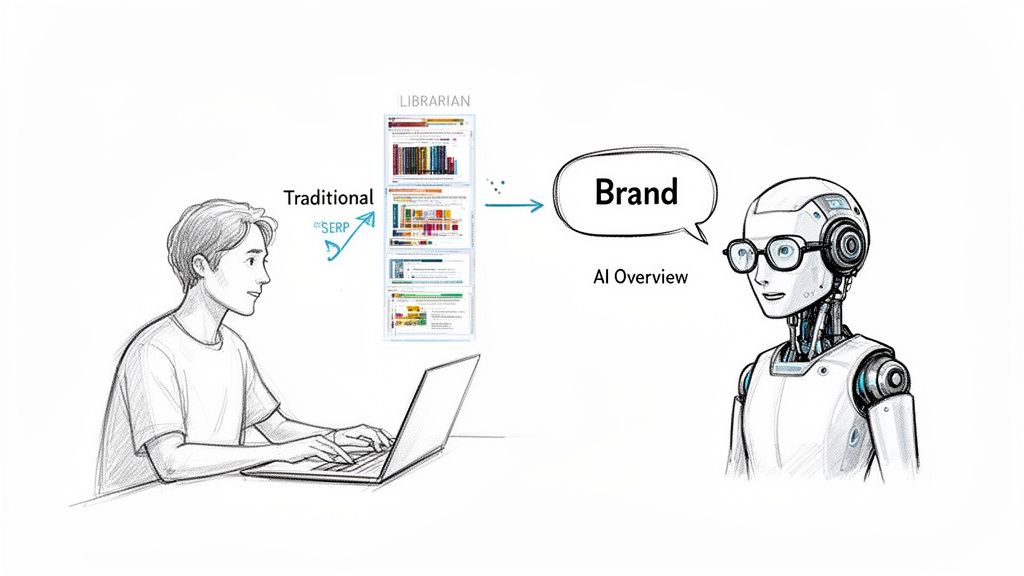
Here’s a practical way to understand this change. Traditional search was like a library catalog. It gave you a list of potential books (websites), and you had to do the work of pulling them off the shelf to find what you needed.
AI Overviews, on the other hand, are like a well-read librarian who has already gone through all the relevant books and simply gives you a concise summary.
In this new model, if your brand isn’t part of the librarian’s summary, you effectively don’t exist for that search. Worse, if the summary is negative, your reputation takes a hit before anyone ever clicks through to your site.
This is exactly why an AI overview tracker is so crucial. It acts as your eyes and ears, showing you precisely how these AI models are talking about your brand. Without that insight, you're flying blind in a new and vital channel.
Why This Matters for Every Team
Keeping tabs on your AI presence isn't just a task for the SEO team anymore—it's a core business function that touches multiple departments. To get a better handle on this emerging field, you might want to read our guide on what is generative engine optimization.
Here’s how an AI overview tracker delivers critical intelligence across your organization:
- Marketing Teams can finally measure how their campaigns influence brand perception in AI and see how they stack up against the competition in near real-time.
- Brand Managers can track sentiment and positioning to ensure the story the AI is telling aligns with the message they want to be telling.
- PR and Communications can catch negative narratives or misinformation as they emerge, quickly identifying the source content that’s causing the problem.
- SEO Professionals get a direct roadmap for optimization by seeing the exact articles, data points, and sources the AI is referencing in its answers.
Tools like promptposition were built specifically to tackle this new reality. They provide the analytics you need to measure, manage, and shape your brand’s story in an era where an AI is often the first interaction a person has with your business. In this new landscape, monitoring is the first step to winning.
What an AI Overview Tracker Actually Measures
At its heart, an AI overview tracker is a specialized tool built to answer one simple, but crucial, question: what are the big AI models saying about my brand? It systematically queries models like Google’s AI Overviews, ChatGPT, and Gemini, then translates their fluid, often unpredictable, answers into hard data you can actually use.
This is a whole new ballgame compared to traditional SEO tools, which are focused on keyword rankings and backlink profiles. This new breed of software is designed for the age of AI search. It goes beyond just seeing if you show up and starts to analyze the quality, sentiment, and context of your brand’s presence in AI-generated answers.
And this shift couldn't be more important. The global AI search engine market—the very engine powering these overviews—is expected to hit USD 18.5 billion in 2025. From there, it’s projected to explode to USD 66.2 billion by 2035. With that kind of growth, understanding how AI portrays your brand isn't just a good idea; it's a strategic necessity. You can get a sense of this massive shift by reading more about the growth of the AI search engine market.
From Vague Answers to Tangible Metrics
An effective AI overview tracker pulls back the curtain on the AI's "black box" by measuring concrete KPIs. So, instead of just guessing whether an AI has a positive impression of your brand, you can see the data that proves it. This gives marketing, brand, and PR teams a unified language to discuss performance and plan their next moves.
The core job of these trackers is to monitor three key areas:
- Visibility: This is the new "ranking." It measures how often your brand, products, or key messages appear in AI answers for the queries that matter to your business.
- Sentiment: The system analyzes the language used to describe your brand, flagging it as positive, negative, or neutral. This gives you a clear pulse on your AI-driven reputation.
- Source Tracing: This is a game-changer. The tracker pinpoints the exact websites and articles the LLM is using to form its "opinion," showing you precisely which content is shaping the narrative.
Tools like promptposition give you a dashboard where you can see all of this unfold over time. It turns these abstract AI conversations into clean, easy-to-read performance reports.
This screenshot from our own tool, PromptPosition, is a perfect example. It visualizes how a brand's visibility and sentiment are trending, letting teams see exactly how they stack up against their competitors in real-time. The real power is connecting the dots between specific prompts and concrete results, like a spike in positive sentiment or a mention next to a rival.
Comparing Old and New Search Analytics
It's a night-and-day difference when you compare this new approach to old-school SEO tracking. Traditional tools were made for a world of links and clicks. An AI overview tracker is built for a world of answers and influence. If you're curious about how these two worlds are starting to merge, our guide on how to use AI for SEO is a great place to start.
To really see the difference, it helps to put them side-by-side.
Traditional SEO vs AI Overview Tracking
This table breaks down the core philosophies behind these two ways of monitoring your digital presence.
| Focus Area | Traditional SEO Tracking | AI Overview Tracking |
|---|---|---|
| Primary Goal | Achieve high rankings on a Search Engine Results Page (SERP) | Secure favorable mentions within AI-generated summaries |
| Key Metrics | Keyword rank, domain authority, backlink count, click-through rate | Visibility percentage, sentiment score, source attribution, competitive positioning |
| Strategic Focus | Technical optimization, link building, on-page content relevance | Influencing source material, narrative control, sentiment management |
At the end of the day, an AI overview tracker gives you a completely new lens for viewing your digital footprint. It’s not about ditching traditional SEO, but about adding a critical layer of insight needed to manage your brand when AI is the new front door to information.
The Five Core Metrics You Need to Master
To effectively manage your brand's presence in AI-generated answers, you have to look beyond traditional SEO metrics. We need a new vocabulary to make sense of this channel. This is where an AI overview tracker comes in—it translates the often abstract, hard-to-pin-down outputs from large language models into real, measurable data your team can use to take action.
And this isn't some far-off future trend. The scale is already staggering. Google's AI Overviews are in front of 2 billion monthly users in over 200 countries. For marketers, this is a wake-up call. Old-school metrics are starting to lose their punch when roughly 60% of searches don't result in a click anymore. The AI summary is the new destination. Just look at the traffic from AI search engines, which exploded by 527% year-over-year from early 2024 to 2025. You can dig deeper into AI's impact on SEO statistics on semrush.com to see just how much user behavior is changing.
So, let's break down the five core metrics that every marketing, brand, and PR pro needs to get a handle on, right now.
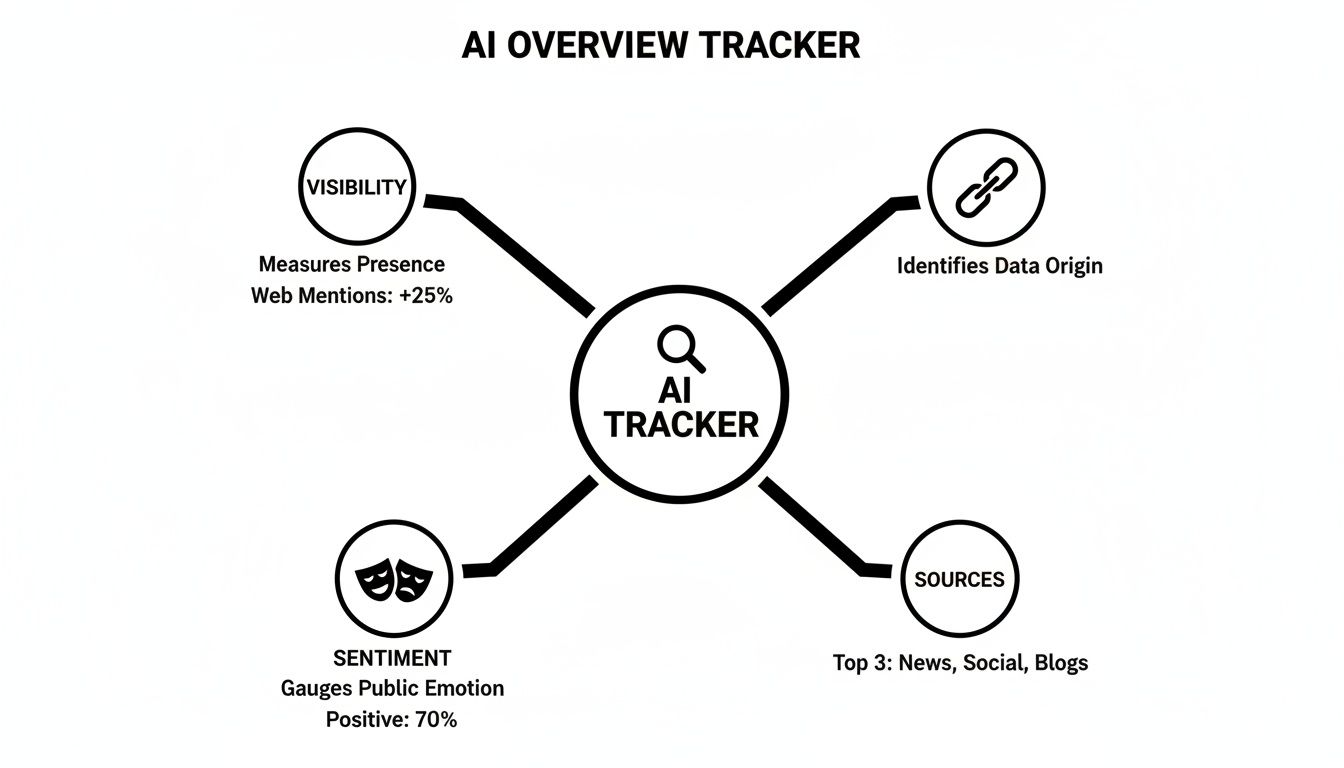
As you can see, this isn't about chasing a single number. It’s about understanding the whole picture: how often you show up (Visibility), how you’re talked about (Sentiment), and where the AI is getting its information (Sources).
1. Visibility Percentage
Forget ranking #1. Visibility is the new top spot. This metric simply measures the percentage of times your brand, product, or key message shows up in an AI-generated answer for a specific set of keywords you're tracking. Your goal is no longer to own the top blue link, but to be a constant, reliable presence in the AI's summary.
Think of it as your high-level relevance score. If your visibility is next to zero for a crucial prompt like "best project management software for small teams," you're completely invisible to a huge and growing piece of your market. An AI overview tracker automates this, giving you a clear score to watch and improve over time.
2. Sentiment Score
It's not just about if you appear, but how you appear. The Sentiment Score is a game-changer here. It analyzes the language used to describe your brand in AI answers and classifies it as positive, negative, or neutral. This gives you an instant read on your reputation as seen by the AI.
Imagine someone asks, "Is Brand X a reliable company?" The AI's answer will shape their opinion in seconds. A tracker like promptposition can flag a sudden dip in sentiment, letting your PR team jump in and figure out why before a negative story takes hold. It turns a vague "vibe" about your brand's reputation into a hard number.
Key Takeaway: Sentiment analysis is your early warning system. It helps you catch reputational threats in AI Overviews before they snowball into bigger problems.
For instance, a sudden negative swing might be traced back to a single bad review that an LLM has latched onto. Without tracking this, you'd be left guessing why customer perception is shifting.
3. Competitive Positioning
AI models love to make comparisons, especially for searches like "Brand X vs Brand Y" or "alternatives to Brand X." The Positioning metric tracks how your brand is framed against your competitors. Are you the premium choice? The budget-friendly one? The undisputed market leader?
Understanding this framing gives you a massive strategic advantage. If an AI consistently calls your competitor the "best for beginners," you can tweak your content to either challenge that narrative by highlighting your own product's ease of use or lean into a different strength, like being the "best for power users."
This data gives you clear, actionable insights:
- Find the Gaps: See which competitors are getting mentioned for valuable queries where you're nowhere to be found.
- Analyze the Framing: Understand the specific features or qualities the AI associates with you versus your rivals.
- Shape the Narrative: Create new content that directly addresses these comparisons and reinforces your desired market position.
4. Source Analysis
This might be the single most powerful metric for taking action. Source Analysis tells you exactly which websites, articles, and data points an LLM is citing to build its answers about you. It's like getting a peek inside the AI's "brain," giving you a direct roadmap for what to optimize.
If an AI keeps pulling information from an outdated industry report or a single biased product review, that content is actively shaping your brand's story. By identifying these sources, your SEO and content teams know exactly where to focus their efforts—whether it's updating that source, correcting it, or creating better content to outrank it.
5. Verbatim Quotes
Finally, the Verbatim Quotes metric captures the exact phrases and sentences the AI is using to talk about your company, products, and services. This raw intelligence is pure gold for understanding the specific language defining your brand in the age of AI.
Is the AI using your current brand messaging and taglines? Or is it pulling from an old press release from five years ago? Reviewing these direct quotes helps marketing teams spot message misalignment and find opportunities to feed LLMs better, more accurate content. This is ground-level intelligence that, until now, was practically impossible to get.
Putting Tracker Insights Into Practice
Understanding the metrics is just the first step. The real value comes from using that data to make smarter, faster decisions. An AI overview tracker isn't just another dashboard to glance at; it’s a strategic tool that bridges the gap between knowing what’s happening and doing something about it.
Let's walk through three common situations where teams can use these AI insights to tackle real-world problems and drive concrete results. These examples show how the data becomes the spark for meaningful action.
Scenario 1: The Product Launch
Imagine a marketing team rolling out a new software product called "SyncUp" in a competitive space. The launch goes smoothly, but they need to know how their product is being framed by AI—a crucial source of information for potential customers doing their research.
They set up their AI overview tracker to monitor prompts like "best alternatives to Asana" and "SyncUp software reviews." The first wave of data reveals two critical insights:
- Poor Visibility: SyncUp is barely on the radar, showing up with only a 5% visibility score for high-value search queries. It's practically invisible in AI-generated answers.
- Weak Positioning: In the rare moments it is mentioned, it's labeled a "basic tool for freelancers." Meanwhile, a major competitor is consistently crowned the "top choice for enterprise teams."
This data gives the team a clear mission. They immediately create a series of in-depth blog posts and case studies highlighting SyncUp's enterprise-level features. They also launch a PR push, aiming to get SyncUp featured in the authoritative tech publications they discovered through the tracker's source analysis.
Just a few weeks later, the results start rolling in. SyncUp's visibility score jumps to 25%, and the AI's description starts to change, now incorporating phrases like "scalable for growing businesses."
Scenario 2: The Reputation Crisis
A PR team for a large e-commerce brand is suddenly in damage control mode. A news article with incorrect information about their return policy has gone viral, and they need to stop the bleeding.
They use their AI overview tracker, setting it to monitor sentiment and sources tied to their brand name plus "return policy." The dashboard immediately flashes red. Their sentiment score has plummeted from a healthy 85% positive down to just 40%—overnight.
The tracker’s source analysis is the key here. It pinpoints the exact article the LLMs are pulling from and confirms that multiple AI Overviews are directly quoting the misinformation.
Now the PR team knows exactly where to focus their efforts. They don't waste time with vague press releases. Instead, they work directly to get the original article corrected and publish a crystal-clear explanation of their return policy on their own blog. Then, they put a significant promotional push behind this new, correct content.
By checking the tracker daily, they watch as the AI models slowly stop referencing the negative article and begin citing their official blog post instead. Within a week, the sentiment score starts to rebound, and the crisis is brought under control.
Scenario 3: The SEO Content Strategy
An SEO team is hitting a wall. They’re trying to rank for the hyper-competitive term "low-code app development platform," but despite creating tons of content, they can't crack the top results or land a spot in the AI Overviews.
They decide to use an AI overview tracker to see which sources the LLMs are actually citing for that query. The findings are a huge eye-opener. The AI isn't just pulling from the highest-ranking blogs. It consistently references three specific types of sources:
- A G2 Crowd comparison page.
- A dense, technical whitepaper from a university.
- A specific Stack Overflow forum thread where developers were debating platform limitations.
This gives the SEO team a direct roadmap. They realize their current content strategy was completely off base. They immediately shift gears to build a much stronger presence on G2, develop their own authoritative whitepaper, and start engaging in those technical forums.
They stopped guessing what might work and started creating the kind of content the AI already proved it trusts. This targeted strategy gave them a much clearer, more effective path to influencing the AI's answers.
How to Build Your AI Overview Tracking Strategy
Theory is great, but a real-world plan is what gets you results. Building a solid AI overview tracker strategy isn't about getting bogged down in complex software; it's about creating a clear, repeatable process that turns raw data into smart decisions. This five-step framework walks you through everything from setup to execution, making it easy for any team to start taking control of their presence in AI.
Tools like PromptPosition are designed to handle the heavy lifting here, automating data collection so your team can stay focused on strategy and action.
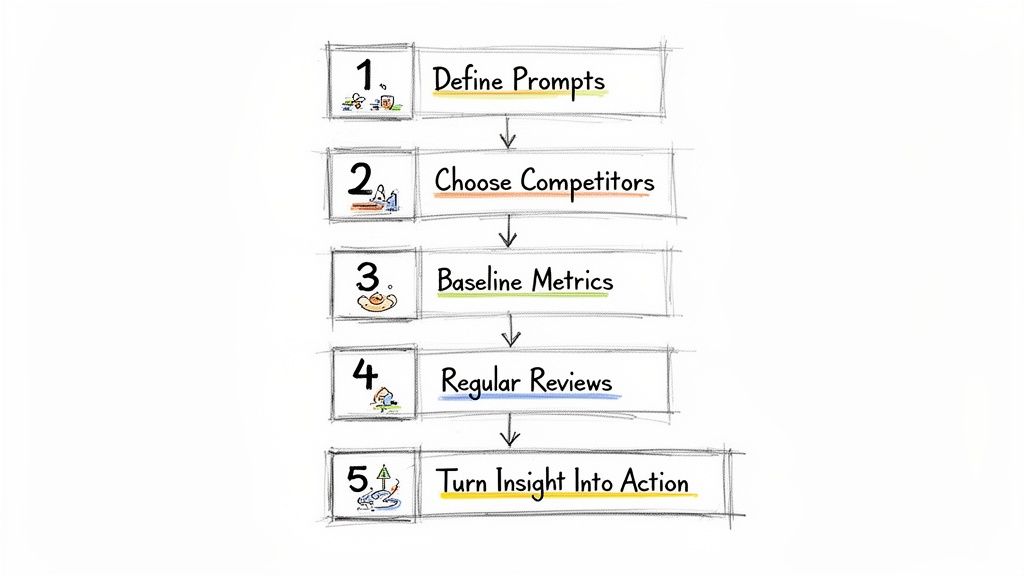
Step 1: Define Your Core Prompts and Queries
First things first: you need to figure out which questions and comparisons actually matter to your business. The best way to do this is to think like your customers. What would they ask an AI to learn about your industry, your products, or your competition?
Start by brainstorming a list of high-intent prompts. Good starting points usually fall into a few key categories:
- Brand Queries: "Is [Your Brand] a good company?"
- Product Comparisons: "[Your Product] vs [Competitor Product]"
- Best-in-Class Searches: "Best software for [your industry]"
- Problem-Solving Questions: "How to solve [customer pain point]"
Don't just guess. Dig into your keyword research, sift through customer support tickets, and talk to your sales team to build a list of queries that reflect what real people are actually asking.
Step 2: Select Your Brand and Key Competitors
You can't measure your progress in a vacuum. Next, you need to formally define who you’re competing against in the AI’s mind. Pinpoint your primary brand and then list your top three to five direct competitors.
This simple step allows your AI overview tracker to start benchmarking automatically. Suddenly, you can see not just how you're doing, but how you stack up against the competition on crucial metrics like visibility and sentiment. That context is what elevates simple monitoring into true competitive analysis. Our guide to AI search engine optimization offers more depth on how to approach this.
Step 3: Establish Your Baseline Metrics
You can't show improvement if you don't know where you started. Once your prompts and competitors are loaded into the system, run an initial analysis to establish your baseline. Think of this as your "Day One" snapshot.
Your baseline report should capture your initial visibility percentage, sentiment score, and positioning for every core prompt you're tracking. This starting point becomes the benchmark against which all future efforts are measured.
This step is absolutely critical. It helps you turn a vague goal like "improve our AI presence" into a concrete objective, such as "increase our visibility for 'best X software' from 10% to 30% by next quarter."
Step 4: Integrate Regular Reviews into Your Workflow
Data doesn't do much good if nobody looks at it. The key to making this strategy work is consistency. You need to schedule regular, recurring meetings to review the insights from your tracker. A weekly check-in works well for most teams, though you might need daily monitoring during a big product launch or a PR crisis.
Make this review a standard part of your team's rhythm—whether it’s part of your Monday marketing huddle or a dedicated monthly strategy session. The goal is to make your AI presence a core KPI for the business, right alongside website traffic or lead generation.
Step 5: Turn Insights into Actionable Tasks
This is the final and most important step: connecting insights to action. Your review meetings should always end with a clear set of tasks assigned to the right people.
This is where the strategy becomes real. For example:
- Insight: A competitor is consistently mentioned as the "easiest to use."
- Action: The content team gets a new task: create a series of tutorials and a blog post titled "Why [Your Product] is the Most Intuitive Choice."
As AI Overviews continue to reshape search, this kind of proactive approach is non-negotiable. Predictions point toward a future dominated by zero-click results and fragmented discovery across platforms like Google, ChatGPT, and Perplexity. With AI search engines projected to grow from USD 18.5B in 2025 to USD 66.2B by 2035, a systematic tracking strategy isn't just an advantage—it's essential for survival. You can learn more about the future of AI search from Botify's analysis.
Frequently Asked Questions About AI Overview Trackers
As this new world of AI search analytics comes into focus, it's natural to have questions. Let's tackle some of the most common ones to give you a clearer picture of how this all works.
How Is This Different from Social Media Listening?
It’s a great question, and the answer gets to the heart of why this is so new. While both are about monitoring your brand, they’re listening in completely different universes.
Social media listening tools tune into the public square—places like X, Instagram, and Facebook. They tell you what people are saying. An AI overview tracker, however, listens to what the AI itself is saying in its own self-contained systems like Google's AI Overviews, ChatGPT, or Gemini.
Think of it this way: social listening tracks public opinion, while AI tracking monitors the AI's "researched" conclusion, which is built from the authoritative sources it trusts online. The insights are fundamentally different.
Can You Actually Influence What an AI Says?
Yes, absolutely. This is the most important takeaway. It’s easy to think of these AI models as creative minds, but they aren't. They are incredibly sophisticated synthesizers of information that already exists online. They're programmed to find patterns and pull data from websites they see as credible.
And that’s your opening.
Key Insight: You can't just log in and "edit" an AI's answer. But you can influence the raw material it uses to build that answer. This is the next phase of SEO—optimizing your content not just for people, but for machine understanding.
When you use a tracker to see exactly which sources the AI is citing about your brand, you’ve found your roadmap. You can then work on optimizing those specific pages, creating new content to fill gaps the AI has identified, and earning links from other trusted sites to bolster your authority.
How Often Should I Check My Tracking Data?
There's no single magic number here; it really depends on what’s happening with your business. The right rhythm for your team will be based on your current goals and marketing tempo.
Here’s a good way to think about it:
- For general brand health and keeping an eye on competitors, a weekly review is a solid baseline. It's often enough to catch new trends or shifts in how you're being portrayed without causing data fatigue.
- During a critical moment—like a product launch, a big campaign, or a reputation crisis—you’ll want to switch to daily monitoring. This lets you see how the AI is interpreting events in near real-time, giving you the chance to react quickly and intelligently.
This is where automated tools like promptposition really shine. Getting daily updates during these high-stakes periods ensures you never miss a crucial change.
Is AI Overview Tracking Only for Large Companies?
Not in the slightest. While big corporations definitely need to manage their reputation at scale, this technology can be a massive game-changer for smaller businesses. If search is how customers find you, then understanding your AI story is non-negotiable for future growth.
For startups and smaller companies, an AI overview tracker can reveal strategic openings that bigger, slower competitors might overlook. You could find niche topics or specific customer questions where the major players aren't even mentioned. This gives you a golden opportunity to step in and become the AI's go-to, trusted source, letting you build authority and punch way above your weight.
Ready to see how AI is portraying your brand? promptposition provides the clarity you need to measure, manage, and influence your narrative in AI search. Start tracking your brand's AI presence today.