AI Driven Marketing Insights: Your Guide to the Newest Marketing Channel
When we talk about AI-driven marketing insights, we’re no longer just talking about using AI to create more content. We’re talking about something much bigger: understanding that AI is now a powerful marketing channel that needs to be monitored. It’s a fundamental shift from creating with AI to decoding how large language models (LLMs) like ChatGPT perceive and present your brand to millions of potential customers.
The New Marketing Channel Hiding In Plain Sight

For decades, we’ve poured our energy into mastering channels like search, social, and email. But now, there’s a new consultant in the room, advising millions of your potential customers every single day. This consultant isn’t a person—it’s the AI brain inside platforms like ChatGPT, Claude, and Gemini.
This changes everything. The old playbook of tracking clicks and impressions doesn't apply here. Modern marketing teams now need to understand how these AI models talk about them.
Beyond Traditional Analytics
Traditional analytics tell you what users do on your website. AI-driven insights, however, reveal what AI models are telling users about your brand before they even have a chance to click. This means asking a completely new set of strategic questions:
- When a potential customer asks an AI a relevant question, how often is our brand mentioned?
- Is the sentiment of the mention positive, negative, or neutral?
- Are we being recommended over our competitors, or are we being left out of the conversation entirely?
- What specific websites and articles are the AIs learning from to form their opinions about us?
Answering these questions is the new frontier of marketing intelligence. It feels a lot like the early days of SEO, where the rules were still being written and the biggest wins went to those who were willing to explore and adapt first.
Think about it: a single, well-written comparison article on a mid-tier tech blog could be the reason an AI consistently recommends your competitor. That one source might be doing more for their AI visibility than their entire traditional SEO program.
This is exactly the kind of insight that modern tools are designed to uncover. A platform like PromptPosition, for instance, goes beyond simple mentions to pinpoint the exact sources an AI relies on when it recommends a competitor over you. Suddenly, an abstract problem ("we're not getting mentioned by AI") turns into a concrete to-do list ("we need to get featured on these three blogs").
This new reality demands a new discipline. We're moving beyond just creating content for users to find; we now have to create and place content specifically for AI models to learn from. By monitoring how models perceive your brand, you stop being a passive observer and start actively shaping your company's AI narrative. The process often involves a query fan-out strategy, which you can read about in our detailed guide on the topic. This is where the real work of influencing this powerful new channel truly begins.
What AI-Driven Marketing Insights Actually Mean
For years, we've relied on clicks, impressions, and conversion rates to measure marketing success. While those metrics still have their place, they only show a piece of the puzzle. Today, true AI-driven marketing insights go way beyond website performance to uncover something entirely new: how AI models see and talk about your brand.
This isn't just a new spin on keyword tracking. It's about analyzing the narrative that AI assistants build around your company in their direct answers. To really get it, you have to look past the surface-level definitions of AI-driven marketing insights. This new field is all about dissecting AI-generated responses to give you a clear, actionable picture of your brand's standing in this new channel.
The Three Pillars of AI Brand Analytics
You can’t measure your brand's presence in AI with a single number. It requires a more nuanced approach. It’s helpful to break it down into three core components that, when viewed together, give you the complete picture of your AI visibility.
These are the core metrics you need to watch:
- Visibility Rate: This is the most fundamental metric. It asks, "How often is our brand mentioned when someone asks a relevant prompt?" If your visibility is low, you’re essentially invisible in the new AI-powered answer channel.
- Sentiment Analysis: This one measures the tone of the mention. Is the AI framing your brand positively, negatively, or just stating a fact? This reveals the qualitative story behind your mentions.
- Positional Ranking: When multiple brands are mentioned, where do you appear in the list? Being the first brand recommended with glowing praise is worlds apart from being mentioned last as a footnote.
The real insight comes when you look at these three metrics together. A common misinterpretation teams make is celebrating a high sentiment score in isolation.
But sentiment without visibility is meaningless. If the AI says nice things about you in just 2% of responses, that positive framing doesn't help much. The insight only becomes useful when you look at sentiment alongside visibility rate and position.
That’s why platforms like PromptPosition encourage looking at the three metrics together rather than celebrating one number in isolation. Thinking this way transforms abstract data into a powerful diagnostic tool. You can learn more about putting this into practice in our guide on improving your search marketing intelligence.
By understanding how visibility, sentiment, and position influence one another, you can get an honest assessment of your brand's health in this critical new channel and start building a strategy to win it.
Turning AI Data Into A Winning Marketing Workflow
Knowing how your brand shows up in AI chats is one thing. Actually using that information to build a winning marketing plan is a whole different ballgame. Raw data on your visibility and sentiment gives you a score, but a repeatable workflow is what delivers real results.
The goal is to create a process that takes those abstract AI-driven marketing insights and turns them into clear, actionable steps for your content and outreach teams.
This isn't about guesswork or needing a data science degree. It's a simple, powerful loop: figure out what your audience is asking, see where you stand in the answers, understand why you're getting those results, and then execute a focused plan. This is how you go from passively watching AI conversations to actively shaping them.
From Data Points To A Content Roadmap
So, how do you turn AI search data into actionable marketing insights? It starts with identifying what matters most.
The first step is to identify 10–20 high-intent prompts your target audience would ask AI assistants. Then you run those through a tool like PromptPosition to see where you stand across ChatGPT, Claude, Gemini, and others. The real insight comes from the source analysis. Once you see which websites the LLMs are citing for competitor recommendations, you have a clear content roadmap. From there it's about creating or placing content on those specific sources and tracking the impact week over week. You can learn more about this approach in these marketing intelligence platform strategies.
The process below shows how these key metrics build on each other, giving you a complete picture of your performance in AI-generated answers.
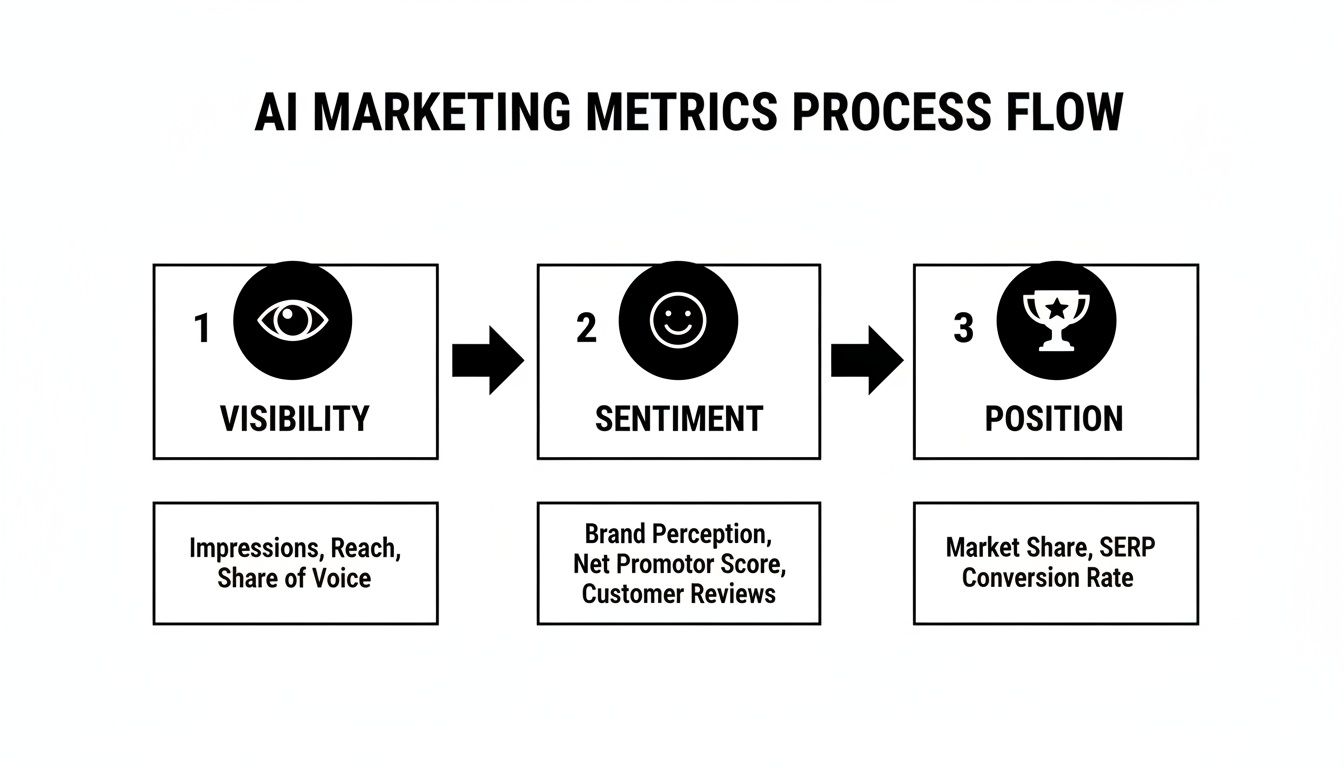
As you can see, metrics like visibility, sentiment, and your position in the conversation all work together to define your brand's overall presence in AI.
A Practical Workflow For Taking Action
With this data in hand, you can build a systematic approach to consistently improve how your brand appears in AI search. This workflow turns analytics into a reliable engine for growth.
The table below breaks down a simple process for turning AI search data into a real-world content plan.
| From AI Insight to Marketing Action |
| — | — | — | — |
| Phase | Action | Goal | Tool/Metric |
| Discovery | Identify 10-20 high-intent customer prompts. | Find the most valuable questions being asked about your industry. | Brainstorming sessions, customer interviews. |
| Analysis | Run prompts through a monitoring tool. | Measure brand visibility, sentiment, and position across LLMs. | PromptPosition, Share of Voice metric. |
| Strategy | Pinpoint the sources cited by the AI. | Identify the exact websites and articles influencing the AI's answers. | Source Attribution in PromptPosition. |
| Execution | Create or place content on target sources. | Get your brand's messaging onto the platforms the AI already trusts. | Content creation, digital PR, guest posting. |
| Measurement | Track prompt performance over time. | Measure the change in visibility and sentiment resulting from your efforts. | Trended reports, weekly monitoring. |
This repeatable loop demystifies AI optimization. It's not some dark art; it's a measurable and manageable part of modern marketing operations, much like using data for AI powered lead scoring to refine sales funnels. Following a clear workflow like this is what separates the brands that are winning in AI from those who are just watching from the sidelines.
Why Source Attribution Is Your Most Valuable Metric
Metrics like visibility rate and sentiment are helpful; they give you a quick snapshot of what’s happening with your brand in AI-generated answers. But they leave you with the most important question unanswered: why?
That's where source attribution comes in. It’s the metric that turns abstract AI visibility data into something your content team can actually act on tomorrow morning. It's the most essential metric for deriving reliable AI-driven insights.
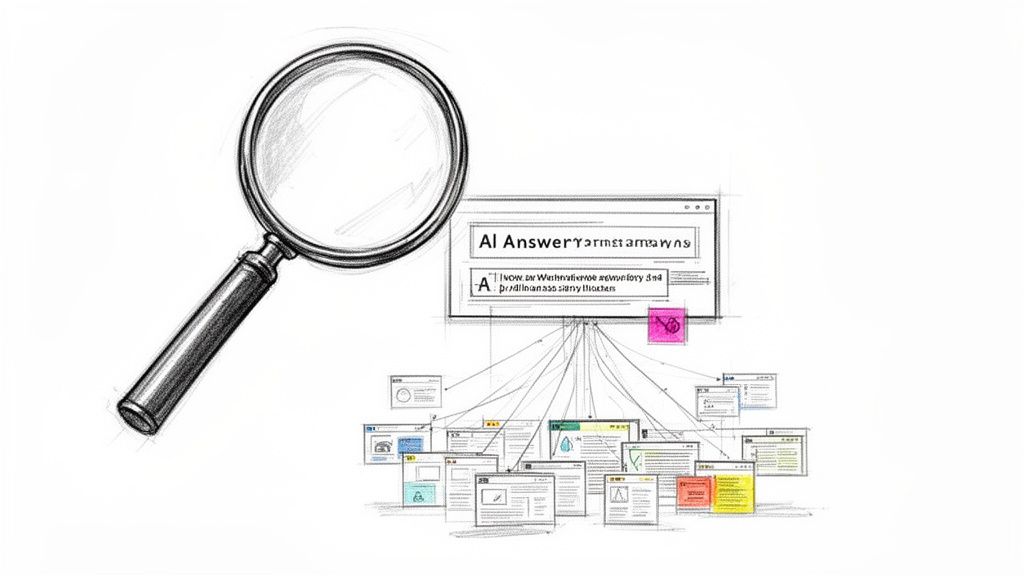
Think of it like uncovering the DNA of an AI's answer. Large Language Models don’t just invent opinions. They synthesize them from the massive digital libraries they were trained on. Source attribution lets you pinpoint the exact articles, reviews, forum threads, and data sheets that act as the building blocks for what an AI "knows" about your market.
From Mystery to Roadmap
Trying to influence AI without source attribution is like shouting into a hurricane. You know you’re not getting through, but you have no idea which direction to even face. Source attribution completely changes the game by giving your team a clear, prioritized list of targets.
Knowing that Reddit, G2, and a handful of industry blogs are driving 80% of your competitors' AI mentions gives you a concrete hit list. Everything else—visibility rate, sentiment, position—tells you what's happening. Source attribution tells you why and where to focus your effort.
By identifying the sources an AI model already trusts, you can stop guessing and start building a real strategy. You finally have a clear path to influence future AI responses by getting your brand’s story onto the exact digital properties that matter.
A New Kind of Backlink Strategy
This brings a whole new dimension to your digital PR and content strategy. For years, the undisputed goal was chasing high-authority backlinks to climb Google's rankings. While that's still important, source attribution creates a parallel priority: earning placements on the specific sites that LLMs rely on, even if those sites aren't DA90 behemoths.
A platform with an AI overview tracker automates the discovery of these critical sources. This is how you can put it to work:
- Discover hidden influencers: You might find that a niche industry forum or a handful of tech blogs have an outsized impact on how AI models perceive your space.
- Prioritize outreach: Focus your PR and link-building efforts on the domains that will directly improve your visibility in AI answers.
- Build a data-backed content plan: See the topics, formats, and language that resonate on these influential sources, then create content that mirrors that success.
Ultimately, source attribution closes the gap between simply watching AI conversations and strategically shaping them. It’s what empowers your team to become an active participant, not just a spectator.
How One Insight Can Reshape Your Entire Strategy
It's one thing to talk about theory and workflows. It’s another thing entirely to see how one single AI-driven marketing insight can completely upend a company's marketing playbook. These are the moments that drive home the new reality: success in the age of AI depends on a new kind of intelligence.
Let’s get practical. An AI-driven insight recently helped a team discover that one of their competitors was consistently recommended by Claude and Gemini. The maddening part was that by all traditional metrics, this team’s own SEO program was superior. Every time a user asked for a recommendation on ChatGPT or Google's Gemini, the competition got the nod.
The breakthrough didn't come from a complex data report. It came from one, deceptively simple insight.
The Power of a Single Source
Using PromptPosition, the team dug into the source attribution behind the AI's answers. What they found was shocking. Their rival’s dominance was being fueled by a single, well-written comparison article on a mid-tier tech blog. That one source was doing more for their AI visibility than their entire SEO program.
Think about that. One piece of content on one website was the reason they were losing in this new channel. For the team that uncovered this, it was a game-changing moment. Here was tangible proof that LLMs assign trust and authority in a fundamentally different way than traditional search crawlers. You can learn more about how teams are finding these game-changing moments on PromptPosition.
That one piece of data changed everything. The team immediately pivoted. They shifted focus from chasing high-DA backlinks and reoriented their outreach strategy to getting similar placements on the exact types of sites that LLMs favor.
This isn't just a hypothetical story; it’s a perfect example of how an AI-driven insight can directly shift campaign strategy. When you can identify and understand the specific sources that AI models trust, you stop competing on budget and start competing on strategy. A single, targeted content placement, backed by the right data, can deliver what hundreds of traditional backlinks can't.
The Future Of Marketing Is Monitoring The AI
The conversation around AI in marketing is evolving, and it's about time. For years, we thought of AI primarily as a creation engine—a handy tool for churning out ad copy or automating tasks. That view is dangerously incomplete.
The real future isn't just about using AI. It’s about actively monitoring it as a fundamental channel that shapes how the public perceives your brand. Success in 2026 and beyond will hinge on your team's ability to listen to, understand, and ultimately influence what AI models are telling people about you. This isn't just another item for your marketing stack; it's a whole new discipline.
Adopting A New Discipline
The pace of AI adoption has been staggering. Recent data shows that nearly 70% of marketers use AI in their strategies, and with 93% of professionals reporting that new AI features are constantly appearing in their tech, it's clear this is not a passing trend. You can dig into more of the numbers on these rapidly growing AI marketing statistics.
This isn't just about using more tools. For content and PR leaders, the real advantage now comes from tracking your brand’s visibility, sentiment, and position inside the AI models themselves.
The most critical choice marketing teams face today is whether to become active participants in shaping their brand’s AI narrative or remain passive observers. Waiting on the sidelines is no longer a viable strategy.
AI-generated answers are quickly becoming the new starting point for countless customer journeys. The brands that are paying attention to this new reality will hold a massive edge. Platforms like PromptPosition are becoming indispensable, giving teams the visibility and control needed to get ahead before competitors own this space. The time to act is now—to shift your team from just creating content to actively shaping the narrative in this powerful new channel.
Your AI Search Insight Questions, Answered
As this new field of AI channel monitoring emerges, many practical questions arise. It’s a real mental shift away from classic search toward AI-powered conversations. Here are some of the most common questions marketers are asking as they start to explore AI-driven marketing insights.
How Is AI Search Different From Traditional Search?
Think of a traditional Google search as a library card catalog. It gives you a list of resources—links, in this case—and you have to do the legwork of clicking through, piecing things together, and forming your own opinion.
AI search, on the other hand, is like talking to a very well-read librarian. It listens to your question and gives you a direct, synthesized answer right away. It's an interpretive layer that sits between you and the web.
This is a huge deal. Your brand's mention within a single AI response can be more powerful than ranking #1 on Google. Why? Because the AI has already framed the narrative, and how it portrays your brand in that moment is incredibly influential.
Can We Directly Optimize For An AI Like ChatGPT?
Not in the old-school SEO sense. You can't just "game" an AI with tricks like keyword stuffing. The winning playbook here is about influence, not manipulation.
True optimization means understanding where an AI gets its information and then feeding it better raw materials for its next answer.
This is where a tool like PromptPosition comes in. It shows you the specific websites and articles an AI model trusts—its sources. Your job is to focus your content and PR efforts on getting high-quality, accurate information onto those exact domains. It’s all about strategic placement and the quality of your information.
How Often Should We Monitor Our Brand In AI?
AI models are constantly being updated, and the web content they reference changes by the second. Because of this, you have to monitor frequently.
For the most important prompts—think brand name searches, competitor comparisons, or "best of" categories—weekly tracking is a solid baseline. This rhythm is fast enough to let you catch new narratives or see a competitor making moves before those ideas become cemented in the AI's knowledge.
Using automated tracking makes this whole process manageable. More importantly, it ensures you never miss a critical shift in how the world's most popular AIs perceive your brand.
Ready to turn these ai driven marketing insights into a real competitive advantage? With PromptPosition, you can monitor your brand's visibility, sentiment, and sources across all major AI models. Start making data-driven decisions to shape your AI narrative today. Explore the platform at promptposition.com.