ChatGPT vs Grok: A Marketer’s Guide to AI Search Visibility
When you stack up ChatGPT vs Grok, the fundamental split comes down to their data sources and the personality they’re designed to project. Think of ChatGPT as the polished, reliable assistant built on a massive but mostly static dataset. It’s perfect for creating professional, well-structured content that you can act on. Grok, on the other hand, is the real-time, rebellious upstart, pulling its information and attitude straight from the live, chaotic feed of X (formerly Twitter), giving you insights you can use to shape your immediate strategy.
Understanding the AI Showdown for Marketers
The rise of AI-driven search has thrown a massive curveball into brand management. We're now dealing with a new reality where AI models like OpenAI's ChatGPT and xAI's Grok are the gatekeepers of information for millions. For anyone in marketing, getting a handle on their core differences isn’t just a good idea—it’s non-negotiable for staying visible and keeping control of your brand's story in this emerging field.
ChatGPT, running on powerful models like GPT-4o, has cemented its place as the go-to for reliability and a professional voice. It’s a workhorse for tasks that need a polished finish, whether you're drafting SEO-friendly blog posts or mapping out a complex marketing strategy. Its training on vast, curated data gives it a level of safety and consistency you can count on for customer-facing materials. The trade-off? Its knowledge base isn't always up-to-the-minute, so it can sometimes miss the very latest breaking news.
Grok is built for a different game entirely: immediacy and attitude. Its direct pipeline into X gives it a unique edge, letting it tap into live conversations, trending topics, and raw public sentiment as they happen. This makes it an incredibly sharp tool for real-time market research and spotting what's about to blow up. Its deliberately witty, sometimes edgy personality is a world away from ChatGPT’s careful neutrality, creating both huge opportunities and potential headaches for brands.
The real question isn't which AI is "better." It's about understanding which one fits the job so you can take action. For brand safety and polished content, ChatGPT is your best bet. For unfiltered, real-time insights that show you what people really think, Grok is the tool to watch and use.
This infographic gives you a quick visual breakdown of how ChatGPT's structured knowledge model squares up against Grok's dynamic, live-data approach.

The bottom line is that each model’s design will fundamentally change how it talks about your brand. That's why you can't just pick one; you need a strategy to monitor both to understand your visibility and drive the right actions.
At-a-Glance Comparison for Marketers
To really get a grip on how to manage your brand's AI-driven presence, it helps to see their key attributes side-by-side. This table breaks down what marketers need to know to take action.
| Key Factor | ChatGPT (GPT-4o) | Grok (Grok-4) | Recommendation for Marketers |
|---|---|---|---|
| Primary Data Source | Vast, curated datasets with Bing search for recent events. | Real-time data feed directly from the X platform. | Use ChatGPT for foundational, evergreen content. Tap into Grok for live trend analysis and social listening. |
| Output Tone | Professional, helpful, and generally cautious. Optimized for brand safety. | Witty, sarcastic, and intentionally unfiltered. Can be rebellious. | ChatGPT is your go-to for official communications. Monitor Grok to understand raw, candid public sentiment. |
| Best Use Case | In-depth content creation, strategic planning, and summarizing complex topics. | Real-time event monitoring, creative brainstorming, and discovering emerging narratives. | A dual-model approach is best. Use ChatGPT to build and Grok to listen and react. |
Ultimately, a balanced strategy is the only way forward. Relying on just one of these models means you're only getting half the picture of your brand's digital footprint and missing key opportunities for action.
Core Architecture and Data Sources Explained
To really get what makes ChatGPT and Grok tick, you have to look under the hood. Their core architecture—and especially their data sources—is what drives everything. It's the reason they can give you wildly different answers to the same question about your brand, and it's what shapes their tone, accuracy, and how they ultimately represent you in AI-generated search. This understanding is the first step toward building a successful strategy.
ChatGPT, running on OpenAI's GPT models, is like a scholar who has read a massive, impeccably organized library. Its knowledge is built on a vast collection of books, articles, and web content, giving it a deep but mostly static worldview up to its last training date. It can peek outside for current events using Bing, but its core "personality" is shaped by that historical, curated data. The result? Responses that are usually polished, reliable, and actionable.
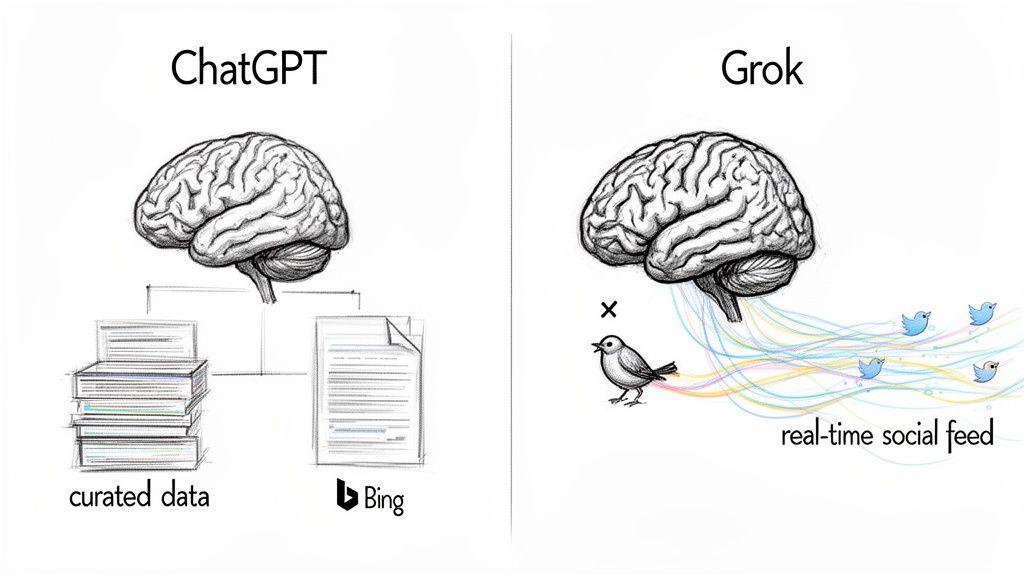
Grok, from xAI, plays a completely different game. Its standout feature is its live, direct pipeline into the chaotic, fast-moving stream of X (formerly Twitter). This real-time feed gives Grok a unique ability to tap into breaking news, viral trends, and raw public opinion as it happens.
Data Freshness: The Library vs. The Live Feed
This is probably the single biggest difference between them, and it dictates the actions you can take. Think of ChatGPT as that brilliant scholar in the library who can ask someone to check what's happening outside (via Bing). It’s an effective process, but there's a slight delay and a layer of interpretation involved.
Grok, on the other hand, is standing right in the middle of a global town square, listening to millions of conversations at once. Its connection to X isn't just a feature; it's fundamental to its identity. This lets it craft answers that capture the immediate pulse of what people are talking about—a massive advantage for marketers trying to track brand mentions during a product launch or a PR crisis and decide what to do next.
For marketers, this is everything. ChatGPT gives you a stable, well-researched view of your brand’s history that you can build on. Grok gives you a volatile but completely up-to-the-minute snapshot you can react to. You really need to monitor both to get the full picture and drive informed actions.
Model Size and Capability
It's not just about the data source; the sheer size of these models matters. Grok is built on a colossal architecture, reportedly with 2.7 trillion parameters and a 128k context window. That immense scale lets it process and connect huge amounts of information, which is a game-changer for complex analytical tasks. This is a critical piece of the puzzle for anyone working on Generative Engine Optimization, a new field focused on improving visibility within AI models.
That raw power shows up in the numbers. When you look at high-stakes AI benchmarks, Grok has managed to pull ahead of ChatGPT in key STEM areas. For instance, in the AIME 2025 math competition, Grok-4 hit an incredible 95.2% score, leaving ChatGPT's 86% behind. This advantage in logical reasoning is a big deal for brands that need to analyze complex market data or fine-tune their prompts in tools like PromptPosition to drive specific outcomes.
Here’s a quick look at the core technical differences:
| Architectural Aspect | ChatGPT (GPT-4o) | Grok (Grok-4) |
|---|---|---|
| Primary Data Source | Curated static datasets, web crawl | Real-time X (Twitter) feed, web crawl |
| Live Information | Supplemented via Bing Search | Native, direct integration with X |
| Parameters | Not officially disclosed (estimated) | ~2.7 Trillion (reported) |
| Context Window | 128,000 tokens | 128,000 tokens |
What this table really shows is that while both models have equally large context windows, it’s their information diet that truly sets them apart. The implications for your brand are huge. ChatGPT might describe your company based on a well-written Wikipedia page and some news articles from six months ago. Grok is far more likely to define your brand by what thousands of people are saying about it on X right now. This makes Grok a must-have for real-time sentiment analysis, while ChatGPT is still the go-to for established, historical context.
Comparing Speed and Real-Time Information Access
In marketing, speed is more than a nice-to-have—it’s a genuine competitive advantage. When a new trend blows up or a PR crisis hits, getting information right now is what matters. This is where the gap between ChatGPT and Grok really shows, moving past abstract features into the realities of time-sensitive work where quick action is essential.
Grok was built for the "now." Its direct, unfiltered pipeline to the X platform means it’s plugged straight into the global conversation as it happens. There’s no middleman; it just pulls from live social data, making it an incredibly sharp tool for real-time monitoring that enables immediate action.
ChatGPT, for all its power, works differently. It fetches recent information through Bing search, which adds a processing step and potential for a slight delay. It’s effective, for sure, but that indirect connection means a lag can exist between an event occurring and ChatGPT being able to analyze it with the full picture.
The Need for Speed in AI Search
How quickly an AI spits out an answer directly affects a team's workflow and ability to act. Think about a PR team running dozens of searches a day to track brand mentions, or a social media manager scrambling to jump on a viral meme. Every second matters, and this is another area where Grok’s architecture gives it an edge.
Benchmarks show Grok was designed for rapid-fire output. Its ability to process and generate tokens quickly makes the whole experience feel more fluid and responsive, especially when you're brainstorming and need to iterate on ideas fast. That kind of speed is a game-changer for marketers who need instant feedback on a developing situation to decide their next move.
Grok’s direct line to X gives it a unique pulse on the present moment. For tasks like immediate crisis monitoring or tracking the first whispers of a viral trend, this real-time capability is unmatched and empowers your team to act decisively. ChatGPT excels at deeper analysis of established topics, but Grok wins the race for immediacy.
Practical Implications for Marketers
Knowing the difference in speed and data freshness tells you exactly when to use each tool. The choice between ChatGPT and Grok often boils down to the specific job you need to get done and the action you need to drive.
- Real-Time Crisis Monitoring: Grok is the clear winner here. Its ability to pull live sentiment from X acts as an early warning system for negative feedback, letting your team get ahead of a story before it spirals.
- In-Depth Content Creation: ChatGPT often has the upper hand. Its access to the broader, more structured web via Bing lets it pull from various long-form sources to build out comprehensive, well-researched articles and reports.
- Tracking Viral Trends: Grok's connection to the social firehose makes it perfect for spotting emerging memes, challenges, or conversations that your brand could actually jump on authentically.
- Strategic Planning: ChatGPT’s more methodical approach is better suited for developing long-term marketing plans that rely on historical data and established market analysis.
This isn’t just a minor distinction. Grok’s speed and real-time data give it a lightning-fast edge for keeping an eye on your brand’s visibility. Benchmarks show Grok-4 hitting around 73 tokens per second, putting it ahead of competitors in raw output velocity. This is hugely valuable for teams using platforms like promptposition for daily gap monitoring, as it lets them see where competitors are popping up in Grok’s answers and adjust their own content. To learn more about this, read the full analysis of Grok's performance.
At the end of the day, you need to track how your brand is being portrayed across different AI models. Daily checks can show you how these real-time shifts in public conversation are being reflected, so you can adapt your strategy on the fly. To get a better handle on managing this multi-model landscape, check out our guide on query fan-out strategies.
Analyzing Tone, Voice, and Brand Safety
An AI's personality isn't just a gimmick—it's a massive differentiator in the chatgpt vs grok debate, especially for brand managers. The tone an AI uses has a direct line to how people perceive your brand, making it a critical piece of the puzzle for both creating content and keeping an eye on your reputation.
ChatGPT and Grok come from two completely different schools of thought on AI personality. OpenAI has poured countless hours into making ChatGPT cautious, professional, and helpful. Its responses are buttoned-up and generally align with corporate safety standards, which makes it a solid, reliable choice for customer-facing content where you can't afford any surprises.
Grok, on the other hand, is built to be the exact opposite. It's intentionally witty, a bit rebellious, and way less filtered. Its personality is a direct reflection of the chaotic, unfiltered conversations happening on X, which means it can spit out humorous, sarcastic, or even controversial takes that ChatGPT is specifically programmed to avoid.

The Brand Safety Implications
For marketers, this personality clash creates a clear divide on brand safety. ChatGPT’s predictable, restrained nature is the safer bet. When you ask it about your brand, the odds of it generating something offensive or wildly off-brand are incredibly low. It’s perfect for drafting official communications or website copy.
Grok’s unfiltered approach is a classic double-edged sword. It can pull up brutally honest, candid mentions of your brand, giving you a raw look at what people actually think. But that same quality brings a much higher risk. Grok might amplify negative chatter or frame your brand in an edgy way that completely torpedoes your official messaging.
ChatGPT is like a well-trained corporate spokesperson—reliable, on-message, but rarely surprising. Grok is like an unfiltered focus group—it will tell you what people are really saying, for better or worse, giving you raw insights you can't get elsewhere and empowering you to act on them.
This isn't just a theoretical problem. A snarky or controversial summary from Grok, fed by real-time social data, could instantly color how a user sees your products.
Adapting Your Monitoring Strategy
Because these models are so different, you can't just use a one-size-fits-all monitoring plan. You have to tailor your strategy to the unique risks and opportunities each one brings to the table. You absolutely have to track how each AI talks about your brand so you can take informed action.
Here’s how you can adjust your approach:
- For ChatGPT: Your focus should be on factual accuracy. Are your key messages getting through? What sources is it citing? The goal here is making sure the polished, professional story it tells aligns with your brand identity.
- For Grok: Monitoring here is all about sentiment analysis and tracking verbatim quotes. You need to pay close attention to the specific words and tone it’s using. Is it sarcastic? Critical? Is it making a joke at your expense? Understanding that context is everything.
Using a dedicated tool to track these outputs daily is non-negotiable. It gives you the power to see the exact language each model uses when describing your brand and your competition. This process is a fundamental part of any serious AI brand monitoring strategy, helping you spot trouble before it spirals. By analyzing the verbatim outputs, you get a crystal-clear picture of the narrative each AI is building and can start taking steps to shape it.
Practical Use Cases for Marketing Teams
Theory is one thing, but the real test in the ChatGPT vs. Grok debate is how each tool actually performs on the ground. For marketing teams, knowing when to pull out which tool can be the difference between a good campaign and a great one. It all comes down to matching the AI’s core strengths to the specific job you need done and the action you need to drive.
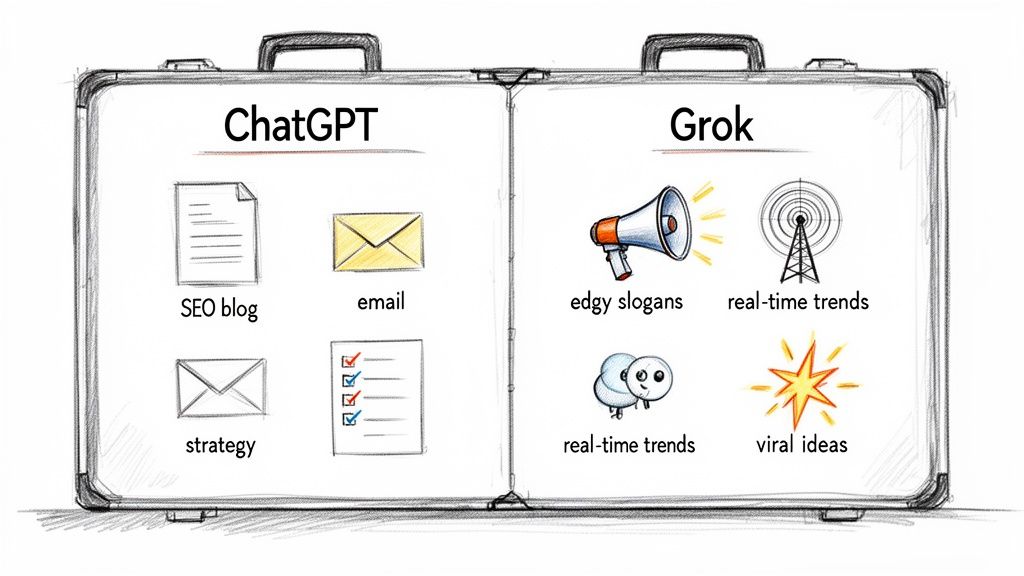
ChatGPT really comes into its own when you need structure, polish, and a professional sheen. Its deep training on a vast, curated dataset makes it a beast for creating well-researched, SEO-friendly content that stays firmly on-brand.
On the other hand, Grok is your go-to for unfiltered creativity and real-time social listening. Its direct line to the live X feed gives it a unique pulse on the cultural zeitgeist, making it perfect for tasks that need an edgy, timely, or even a slightly off-the-wall perspective.
Crafting Polished Content with ChatGPT
When your goal is to produce high-quality, authoritative content that you can publish with confidence, ChatGPT is easily the more reliable choice. The outputs are consistent and almost always adhere to professional standards, making it a safe bet for any public-facing materials.
Here are a few common marketing scenarios where ChatGPT really shines:
- SEO-Optimized Blog Drafts: Give ChatGPT a target keyword, a reader persona, and a basic outline, and you’ll get back a well-structured article that’s ready for a human to add the final polish.
- Detailed Marketing Plans: It’s great for building out comprehensive strategies, helping you outline campaign goals, audience segments, channel tactics, and KPIs based on established marketing frameworks.
- Professional Email Copy: From complex lead nurturing sequences to simple customer service templates, ChatGPT delivers clear, concise, and brand-safe copy that’s ready for your email service provider.
ChatGPT's main strength is its dependability. For marketers, that means consistently stable, polished outputs for everything from competitor analysis to reviewing verbatim quotes. It provides a solid foundation for action.
ChatGPT has cemented its place as the all-purpose powerhouse, dominating the enterprise market with tools that have become essential for content creators and SEOs. This widespread adoption, driven by OpenAI's enterprise focus, creates a huge opportunity to influence AI-driven search results. It also means that learning how to rank on ChatGPT is quickly becoming a non-negotiable marketing skill.
Brainstorming and Trend-Spotting with Grok
When the mission is to cut through the noise and grab attention, Grok’s unconventional, of-the-moment personality becomes a major advantage. Think of it as your creative partner for brainstorming sessions and getting a real-time read on social sentiment to inspire immediate action.
Here’s where Grok’s unique skills give it a clear edge:
- Edgy Campaign Slogans: Ask Grok for taglines with a bit of humor or a rebellious tone, and it will often spit out surprising ideas that ChatGPT would be far too cautious to even suggest.
- Real-Time Sentiment Analysis: You can query Grok about your brand or a recent product launch and get an immediate, unfiltered look at public opinion, sourced directly from live conversations on X.
- Unconventional Content Ideation: Feed it a broad topic, and Grok can suggest angles and hooks based on what’s currently trending or sparking debate, helping you create content that feels genuinely relevant right now.
Ultimately, the choice isn’t about which tool is better, but which tool is right for the task at hand. For building a solid foundation of reliable, professional content, ChatGPT is your workhorse. But for injecting a dose of creativity, humor, and real-time relevance, Grok is the agile, insightful upstart. The smartest marketing teams will learn how to play to the strengths of both to drive action.
Which AI Should Your Marketing Team Prioritize?
Choosing between ChatGPT and Grok isn't about picking a single winner. It's about crafting a smart, two-pronged strategy that recognizes what each model brings to the table for marketers. Your whole approach should boil down to one core question: Are you trying to influence the massive, established consensus, or are you trying to tap into raw, real-time conversations to drive immediate action?
Your main focus, without a doubt, should be on monitoring and influencing ChatGPT. With its enormous user base and deep roots in business workflows, it has become the default information engine for millions. When a potential customer has a question about your industry, your products, or your brand, they are almost certainly using a tool built on OpenAI's technology.
Where to Put Your Resources
Given its sheer scale and perceived authority, ChatGPT has effectively become a digital "source of truth." Making sure your brand shows up accurately and positively within its responses isn't just a good idea—it's a core part of modern brand management. This means the bulk of your team’s time should be spent understanding what sources ChatGPT trusts and then creating content that gets into those sources. That's exactly what tools like promptposition were built for; they let you track your visibility and see how you stack up against the competition on this critical platform, so you can take targeted action.
At the same time, you need to be watching Grok as a leading indicator. Think of Grok as the most powerful, unfiltered social listening tool you've ever had. Its direct access to X gives you an unmatched window into raw public opinion, breaking news, and viral trends—often before they bubble up anywhere else.
A savvy AI visibility strategy doesn’t treat this as an either/or decision. It focuses on influencing the established giant (ChatGPT) while listening carefully to the rebellious upstart (Grok) to see what's just over the horizon and decide how to act.
Putting a Dual-Model Strategy into Practice
This two-track approach turns the ChatGPT vs Grok debate from a confusing choice into a clear, data-driven advantage for your marketing team. It helps you understand where to focus your efforts for maximum impact.
Here’s a simple framework for structuring this strategy:
- Dedicate 80% of your optimization work to ChatGPT. This involves a mix of content creation, digital PR, and technical SEO aimed at influencing the knowledge base it relies on. You should be tracking your brand's share of voice and sentiment on this platform weekly to guide your actions.
- Use the remaining 20% of your time to monitor Grok. Use it to spot new narratives forming, see what kind of buzz competitors are getting during live events, and get a completely honest read on public sentiment. Treat it as your early warning system to inform your tactical moves.
For brands with a major social media presence or those operating in fast-paced industries like tech or fashion, the insights from Grok are priceless. By understanding the unique role each AI plays, you shift from a reactive stance to a proactive one, shaping the AI-driven story about your brand before your competitors even realize it's being written.
Frequently Asked Questions: ChatGPT vs. Grok
It's easy to get lost in the weeds when comparing AI models, especially when your brand's reputation is on the line. Let's tackle some of the most common questions marketers have about ChatGPT and Grok to help you understand what actions to take.
Which Is Better for Content Creation, ChatGPT or Grok?
For most polished marketing assets, ChatGPT is still your go-to. Its foundation is built on vast, curated data, making it incredibly reliable for producing professional, brand-safe content. Think blog posts, email campaigns, and website copy—it excels at that kind of structured, long-form work that you can use immediately.
But don't count Grok out. It’s a fantastic tool for raw brainstorming and ideation. If you need to come up with an edgy slogan, explore a completely different marketing angle, or just tap into the real, unfiltered language people use on social media, Grok is your creative spark. Its less constrained nature can uncover ideas a more buttoned-up model would never touch, helping you find new directions for your campaigns.
How Should My Optimization Strategy Differ for Each Model?
You can't use the same playbook for both. They operate in completely different informational ecosystems, so your strategy has to adapt to be effective.
- For ChatGPT: Your focus should be on classic digital PR and SEO. This model learns from authoritative sources across the web—respected industry sites, major news articles, and informational hubs like Wikipedia. Getting your brand featured and linked to from these places is how you shape its understanding.
- For Grok: Your entire strategy has to revolve around X. Grok’s knowledge is built on the live, real-time conversations happening on the platform. The key is to build a strong presence, jump into relevant discussions, and keep a close eye on how people are talking about you right now.
Here’s a simple way to think about it: Influencing ChatGPT is like building a deep library of authoritative books about your brand. Influencing Grok is like being the most interesting and talked-about person at a massive, ongoing party. Both require a clear plan of action.
Can Grok’s Humor and Sarcasm Hurt My Brand?
Yes, without a doubt. Grok’s snarky, rebellious personality is an intentional feature, not a glitch. This means if the general sentiment on X about your company is critical or sarcastic, Grok will reflect that right back in its answers. That's a huge brand safety risk.
This is exactly why proactive monitoring is non-negotiable. You need to see the exact quotes Grok is using to describe your brand. Tracking its verbatim output gives you an indispensable early-warning system for negative sentiment or a brewing PR crisis, letting you get ahead of the story before it gets away from you. This is a critical action for any modern marketing team.
A solid AI visibility strategy means knowing precisely how models like ChatGPT and Grok see your brand. Tools like promptposition give you the analytics to turn that black box into a clear, data-driven advantage. It helps you monitor your visibility, see how you stack up against the competition, and start influencing model outputs before your rivals even know what's happening.