Perplexity vs Google: A Marketer’s Guide to the New Search Era
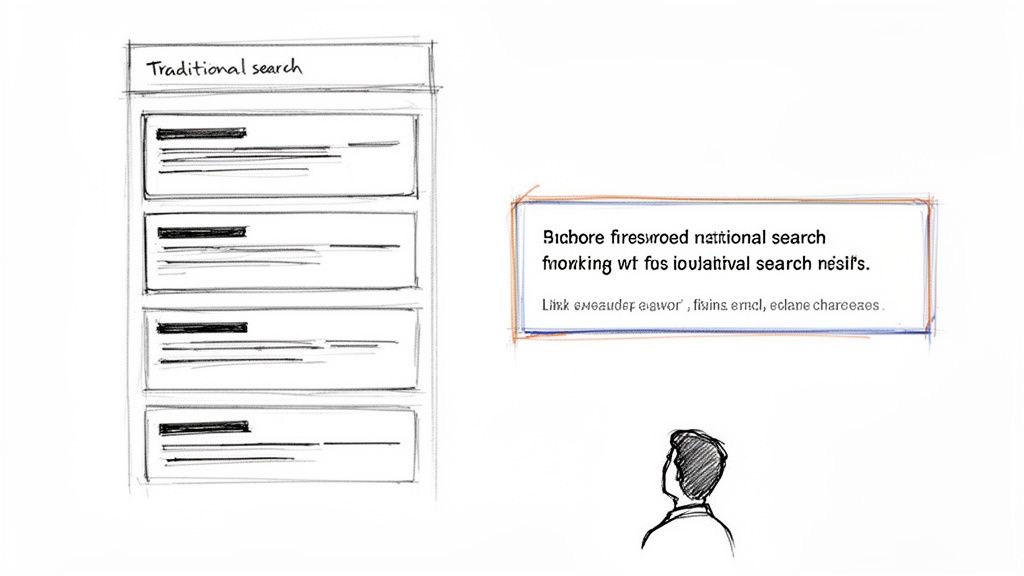
The whole Perplexity vs Google debate boils down to one fundamental shift: we're moving from search to answers. Google’s classic model hands you a ranked list of links, leaving you to do the legwork of clicking through and piecing things together. Perplexity, on the other hand, acts as an answer engine—it digests information from countless sources and gives you a direct, summarized answer with citations right there.
The Search Landscape Is Shifting From Links to Answers
For the first time in decades, the way we find information online is genuinely changing. For as long as most of us can remember, the routine was simple: type a query into Google, get a page of ten blue links, and start digging. That model, built on clicks and website visits, has been the bedrock of digital marketing and SEO for over 20 years.
Now, AI-powered tools like Perplexity are rewriting the rules. Instead of just giving you a map to the information, they want to be the destination. They pull content from all over the web, process it on the fly, and present a single, cohesive answer. It’s a huge evolution, moving us from a search-first to an answer-first reality.
Why This Shift Matters for Marketers
This isn't just about a new interface; it’s a complete shake-up of content strategy. The old goal was simple: rank high enough to get the click. The new goal? Become such a reliable source that the AI cites your work directly in its answer. This new dynamic brings a host of new challenges and opportunities for brands.
- Visibility Redefined: Success isn't just about your position on the results page anymore. Now, it's about being cited as a source in an AI-generated answer.
- Zero-Click Threat: When users get their answers instantly, the incentive to click through to a website drops, which could wreak havoc on traditional traffic metrics.
- Authority and Trust: Answer engines are designed to prioritize factual, well-organized, and authoritative content. This makes demonstrating genuine expertise more crucial than ever.
- Measurement Complexity: How do you track brand mentions when they're buried inside an AI's response? It's a "black box" problem that requires entirely new tools and ways of thinking.
Think of this guide as your field manual for navigating this new terrain. We’ll break down the Perplexity vs Google comparison across the areas that matter most, giving you the insights to build a more resilient strategy. The first step to winning in an AI-driven search world is understanding exactly how the game is played. To dig deeper into the mechanics, you can learn more about how AI models process queries in our article about query fan-out.
How Perplexity and Google Actually Work
To get ahead in this new game, you have to grasp the fundamental mechanics behind the "Perplexity vs. Google" dynamic. They might both give you answers, but how they get there reveals two completely different philosophies. Everything from the user experience to your marketing strategy is dictated by their inner workings and, more importantly, their business models.
For over two decades, Google's world has revolved around indexing and ranking. It has meticulously crawled and organized the internet into a massive library. When you type in a query, its sophisticated algorithms—factoring in hundreds of signals like PageRank, relevance, and user experience—scan that library to serve up a ranked list of what it believes are the most relevant and authoritative links.
At its core, Google was built to be a directory, not a destination. Its main job is to send you somewhere else. While AI Overviews are a major change, it's still an AI layer placed on top of the old link-based system. The DNA is the same: index, rank, and refer.
Perplexity: The Conversational Answer Engine
Perplexity takes a completely different path. Think of it as a real-time knowledge processor. Instead of digging through a pre-built, sometimes dated index, Perplexity scours the web in real time for every single query. This is a huge advantage for breaking news or any time-sensitive topic.
Next, it uses its large language models to read, understand, and synthesize information from a handful of the best sources it finds. The result isn't a list of places where you might find the answer. It is the answer—a single, clean summary with every source cited right there.
Perplexity’s goal is to end your search right inside its interface. It wants to give you a complete, trustworthy, and sourced response so you don't have to go anywhere else. This completely changes the user journey from exploring links to getting immediate understanding.
This direct-answer model is all about efficiency. It cuts out the middleman (the SERP) and the work of sifting through ten blue links to find what you need. It’s a conversational flow that invites follow-up questions, turning a search into a genuine dialogue. You can learn more about this new field of optimization in our guide on what is Generative Engine Optimization.
How The Business Model Shapes Everything
The deep-seated differences in how Perplexity and Google operate are directly tied to how they make money. As a marketer, this is the most important part to understand.
Google's Ad-Driven Ecosystem: Google makes its money from ads. Its success hinges on keeping you in its ecosystem, creating as many chances as possible for you to see and click on ads. The traditional search results page is the perfect machine for this, serving as a high-traffic intersection.
Perplexity's Subscription Model: Perplexity’s premium offering, Perplexity Pro, is a subscription. That means its entire focus is on delivering so much value in its direct answers that people are happy to pay for it. The key metric isn't ad impressions or clicks; it's user satisfaction and retention.
This split has massive implications for anyone trying to gain visibility. On Google, you're fighting for clicks against other organic results, a sea of ads, and now the AI Overviews. Success is about ranking high on a list.
On Perplexity, you're competing to become a trusted source—the kind of source its AI relies on for a citation. Your content has to be so clear, factual, and well-organized that the model picks it as a piece of evidence for its answer. This is a subtle but critical shift, moving the goalposts from chasing ranking signals to building source credibility. This is where a tool like promptposition is invaluable, as it lets you track when and how your brand is cited, turning this new kind of visibility into a real KPI you can measure.
Comparing the User Experience and Search Intent
The fundamental difference between Perplexity and Google hits you the second you ask a question. Each platform is engineered for a completely different user journey, which means they cater to very different types of search intent. If you're a marketer, grasping this difference is non-negotiable—it dictates where and how your content needs to show up.
Google's experience is the one we've all grown up with. It's a directory, a launchpad designed to send you somewhere else. The Search Engine Results Page (SERP) is a crowded hub of organic links, ads, "People Also Ask" boxes, and now, AI Overviews. Its main job is to give you a menu of options, leaving you to do the heavy lifting of clicking, reading, and piecing the information together yourself.
Perplexity, on the other hand, wants to be the destination. Its interface is clean and conversational, laser-focused on one thing: giving you a direct answer. It’s less about exploring and more about understanding. You’re encouraged to stay put, asking follow-up questions to drill down deeper, creating a fluid conversation instead of a series of disjointed searches.
This diagram breaks down how their core models differ at a glance.
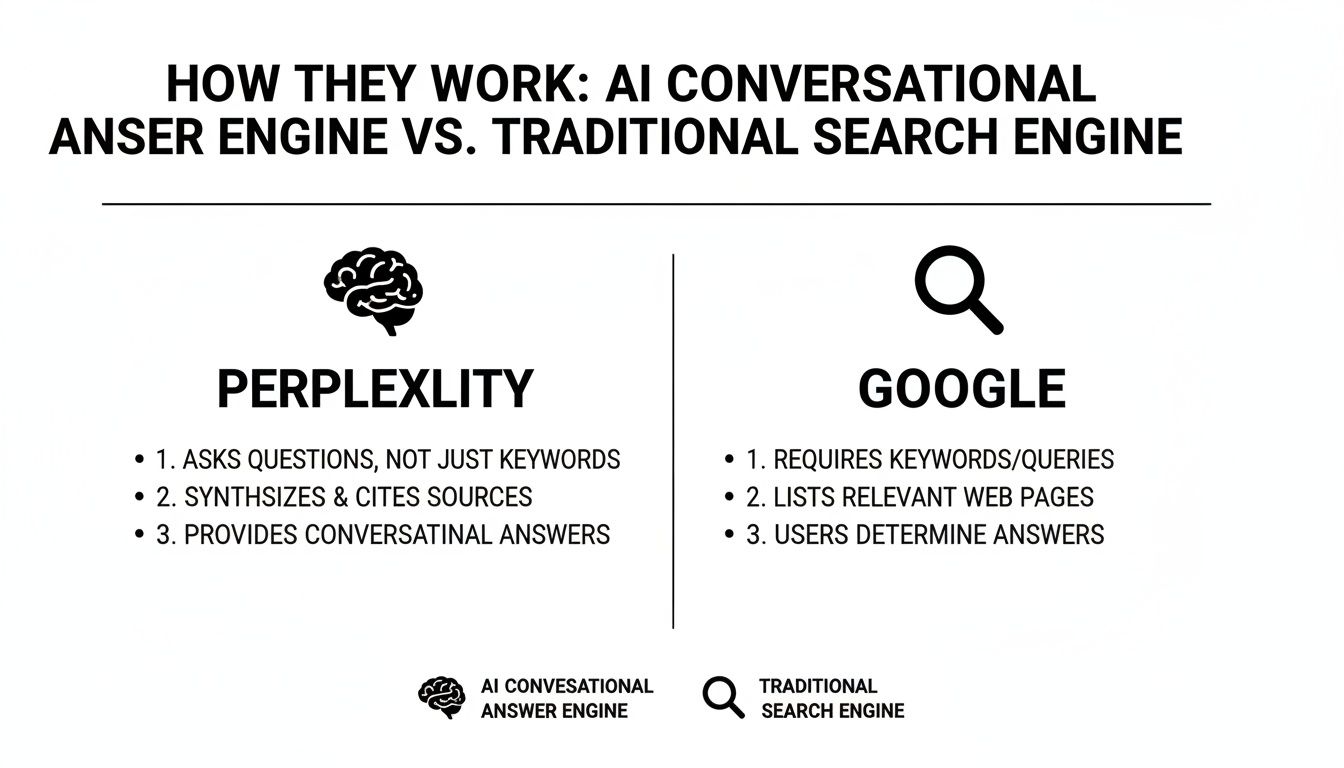
As you can see, Perplexity pulls real-time information into a single, cited summary. Google ranks its indexed links. It’s a classic answer model versus a referral model.
The User’s Mindset
Which platform someone chooses often comes down to what they're trying to accomplish.
If a user has a specific informational question, like "What were the key findings of the latest IPCC report?", they're a prime candidate for Perplexity. They want a concise summary with sources, not ten different links to dig through. This is where Perplexity’s model just works.
But if someone has transactional or navigational intent—think "best running shoes for flat feet" or "login to my bank account"—they're still heading to Google. Its massive index is built for connecting people to products, services, and specific websites. The goal is to go somewhere or do something, and Google's link-based world is perfect for that.
To put it in perspective, let's break down the user experience side-by-side.
User Experience Comparison Perplexity vs Google
The table below highlights the key differences in how users interact with each platform, moving from a link-based list to a direct, conversational answer format.
| Feature | Perplexity | |
|---|---|---|
| Primary Interface | Conversational, chat-based format. | List-based Search Engine Results Page (SERP). |
| Core Function | Synthesizes information into a direct, cited answer. | Ranks and presents a list of links to external websites. |
| Information Delivery | Provides a single, consolidated summary with numbered source citations. | Offers a variety of formats: organic links, ads, snippets, AI Overviews, etc. |
| Follow-up Questions | Encourages iterative questions within the same session to refine the answer. | Requires a new search, often losing the context of the previous query. |
| User Goal | Immediate understanding and direct knowledge acquisition. | Exploration, navigation, and transactions. |
| Source Transparency | Citations are embedded directly into the answer, linking to the source text. | Sources are the links themselves; user must click through to evaluate. |
Ultimately, Perplexity is built for learning and synthesis, while Google remains the master of discovery and navigation.
Engagement Metrics Tell the Real Story
Recent research uncovers some fascinating behavioral differences that really drive this point home. Perplexity users are far more active in each session, averaging 15 searches per user per month. They also stick around much longer—Perplexity sees average session times of 23 minutes and 10 seconds with 1.81 pages per visit. This makes sense; its conversational style lets you dig deeper without opening a dozen tabs.
This is a stark contrast to Google's click-and-go model. For SEOs and content creators, these numbers are a goldmine. Perplexity clearly favors structured content like lists and FAQs from niche sources, citing them prominently. This boosts what we can call 'citation potential' over traditional rankings. You can read the full research about these user engagement findings to see the data for yourself.
For marketers, this is the key takeaway: Are you creating content for a user who wants a map (Google) or for a user who wants the treasure delivered directly to them (Perplexity)? The answer determines your entire content strategy.
This deep engagement on Perplexity is a clear signal that users trust it for in-depth research. That's a huge opportunity for brands. Getting your content cited in a Perplexity answer means you're reaching a highly focused user at the exact moment they're building their understanding of a topic.
Of course, tracking this kind of visibility requires a new playbook. Tools like promptposition are becoming essential for monitoring when and how your brand is being used as a source inside AI answers. The focus is shifting from click-through rates to citation frequency—a vital new KPI for the age of answer engines.
How to Optimize for AI Answer Engines
The SEO playbook that we’ve relied on for the last decade is being torn up and rewritten. When you’re talking about Perplexity vs. Google, winning is no longer about climbing a ranked list of blue links. It’s about becoming a definitive, citable source for an AI. This new game is called Answer Engine Optimization (AEO), and it forces a fundamental shift from chasing ranking signals to building rock-solid source credibility.
With Google's AI Overviews, traditional authority signals—backlinks, domain rating, and years of established trust—still carry a lot of weight. Perplexity, however, plays by a different set of rules. It prioritizes clarity, structured data, and verifiable facts, which cracks the door open for niche experts and content rich with original data to get cited, even if they don't have a monster backlink profile.
Prioritize Original Research and Data
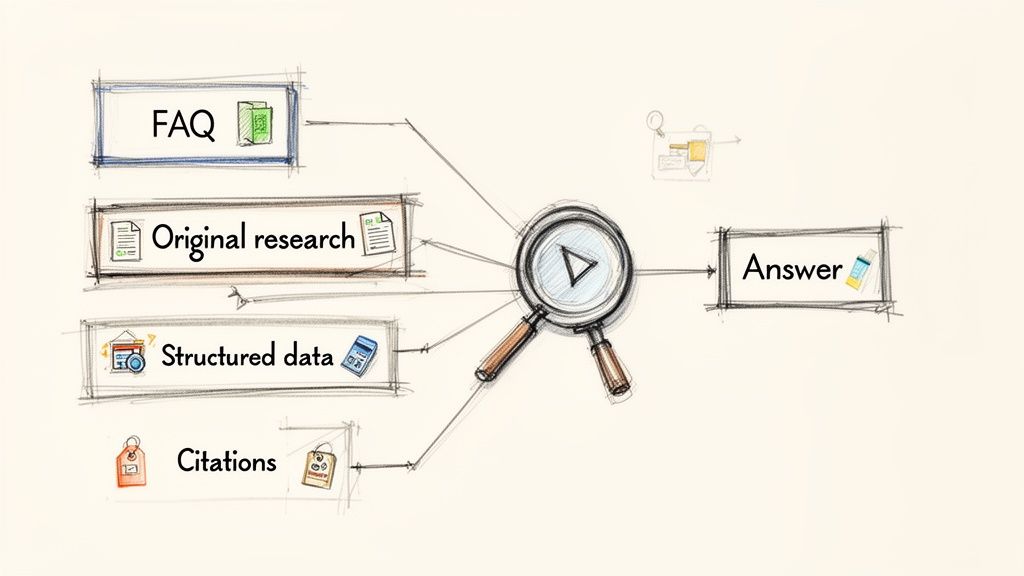
One of the most direct ways to get cited by an answer engine is to be the primary source. These AI models are built to find and synthesize information they can verify. When your content contains original data, unique statistics, or firsthand insights, it becomes a foundational piece for the AI to build its answer on.
So, instead of just curating what everyone else is saying, get in the habit of creating new knowledge. What does that look like in practice?
- Run your own industry surveys and publish the findings.
- Analyze your company’s proprietary data to uncover new trends.
- Develop incredibly detailed case studies with specific, quantifiable results.
Content that brings something genuinely new to the table is gold to an AI trying to deliver the most accurate answer possible.
Structure Content for Clarity and Synthesis
Answer engines don't just read your content; they parse it. They deconstruct it into logical components to understand how different pieces of information relate to one another and pull out the key facts. Content that’s cleanly structured is exponentially easier for an AI to process, understand, and ultimately, trust.
You almost have to think like a database engineer. Use crystal-clear headings, bullet points, and numbered lists to give your information a logical flow. A well-organized FAQ section, for example, is pure AEO gold because it creates a direct, machine-readable map between questions and answers.
The real goal here is to make your content as "citable" as possible. Break down complex topics into digestible chunks. Use descriptive subheadings (H2s, H3s) and make sure every single paragraph has one clear point. This isn't just good for your human readers; it's essential for AI.
This strategic formatting is a cornerstone of effective AEO. For a much deeper look, you can check out our detailed guide on how to optimize for AI search and really get ahead of the curve.
Build Authority in Niche Topics
While Google’s algorithm has always leaned heavily on broad domain authority, Perplexity often gives more credit to topical authority. It’s actively looking for sources that show deep, concentrated expertise on a very specific subject. This is a massive opportunity for brands to become the undisputed go-to source in their corner of the world.
Instead of trying to be a jack-of-all-trades, focus your content efforts on dominating a specific area of expertise. When you consistently publish high-quality, in-depth articles, whitepapers, and guides on one topic, you send a powerful signal to AI models that you are a definitive source worth citing.
Track and Measure Your Citation Visibility
You can’t optimize what you can’t see. Your traditional SEO tools, which are all about keyword rankings, are completely blind to your brand’s visibility inside AI answers. In this new world, you need specialized tools to see how, when, and why your content is being used as a source.
This is exactly what platforms like promptposition are built for. It lets you actually track your brand's "share of voice" within AI-generated answers, see how your citation frequency stacks up against competitors, and even pinpoint the exact quotes being pulled from your content.
This data transforms the AI "black box" into a measurable marketing channel. It provides the crucial feedback loop you need to continuously refine your AEO strategy, helping you identify which content formats are earning citations so you can double down on what’s actually working.
Measuring Success When Clicks Don't Matter Anymore
The very foundation of digital marketing analytics is starting to crack. For decades, measuring success was pretty straightforward: we tracked clicks, sessions, and conversions. But what happens when a user gets a perfect, direct answer from a tool like Perplexity and never even needs to visit your website? Those old metrics become dangerously misleading.
This new reality is a huge challenge for marketers. How do you possibly prove ROI when a user gets real value from your content—by seeing it cited in an answer—without ever generating a single click? The only way forward is to look beyond website traffic and start embracing KPIs built for the age of AI.
The New KPIs for Answer Engine Optimization
When you put Perplexity vs Google side-by-side, how you measure success is one of the biggest differences. Google Analytics is still all about your website's performance. But with Answer Engine Optimization (AEO), you need a totally different dashboard. The focus has to shift from how many people visit your site to how often your brand is the source.
Here are the new metrics that actually matter:
- Citation Frequency: This is simply the raw count of how many times your domain is cited as a source in AI answers for your target queries. It's the most direct measure of your visibility and influence within the model.
- Share of Voice in Answers: This metric calculates your brand's slice of the pie—your percentage of total citations compared to your competitors for a specific topic. Think of it as the new market share in an AI-driven world.
- Verbatim Quote Inclusion: This is pure gold. It tracks when an AI model directly lifts a sentence or phrase straight from your content. It’s a powerful sign that your messaging is clear, authoritative, and perfectly tuned to what users are asking.
These KPIs don't just measure visibility; they measure authority. Getting cited by an AI engine is a powerful third-party endorsement that tells users your brand is a definitive source of information.
From Black Box to a Measurable Channel
Without the right tools, AI answers can feel like an impenetrable black box. You have a hunch your content is being used, but you have no way to quantify it or tie it back to your marketing efforts. This is where specialized AEO platforms become absolutely essential, turning that ambiguity into a clear, optimizable marketing channel.
The core challenge of AI search isn't just about optimizing your content—it's about tracking your influence. You have to be able to see inside the model's output to know if your AEO strategy is actually working.
Tools like promptposition are built specifically to provide this kind of visibility. They constantly monitor AI models to track your citation frequency and measure your share of voice. This data gives you the critical feedback loop you need to refine your content, spot gaps where competitors are winning citations, and ultimately prove the value of your AEO work. We take a much deeper look into this in our guide on how to calculate share of voice for AI search.
The explosive growth of answer engines really drives home how urgent it is to adopt these new metrics. Perplexity AI, for example, saw incredible user adoption, jumping from 500 million total queries in all of 2023 to 780 million monthly queries by May 2024. While Google's total volume is still much larger, Perplexity's rapid ascent with its 15 million active monthly users points to a major shift in how people want to get information. You can read more about Perplexity's rapid query growth on Neowin. This trend is a clear signal for brands that can figure out how to measure and optimize for citations.
For now, a blended measurement approach is the smartest path. Keep tracking your traditional SEO metrics for Google, but start building out your AEO dashboard at the same time. By tracking both, you get a complete picture of your brand's visibility across the entire search landscape.
Building Your Dual SEO and AEO Strategy
The whole Perplexity vs Google debate misses the point. It's not about picking a winner. It's about recognizing that we're dealing with two powerful, parallel ways people get information. Thinking you have to choose one is a mistake—the brands that will win are the ones who master both traditional SEO and the new world of Answer Engine Optimization (AEO). A dual strategy is the only way to stay visible, no matter where your audience is searching.
A smart dual approach starts with a simple reality check: what gets you to the top of Google’s blue links won't necessarily earn you a citation from Perplexity. Your content now has to serve two masters. You need to keep up with proven SEO practices for Google's algorithms while also creating content specifically designed to be a primary source for AI.
Invest in Citable, Data-Rich Content
The core of a strong AEO strategy is content that AI models see as a trustworthy, definitive source. This means your focus has to shift from just hitting keywords to building a library of foundational knowledge.
- Publish Original Research: Run your own surveys, dig into your internal data, and publish the results. This makes you the source, and AI engines are built to find and credit the original source.
- Create Structured Knowledge: Think detailed guides, exhaustive FAQs, and data-packed whitepapers. Content with a logical flow, clear headings, and hard facts is much easier for an AI to digest and reference.
- Be Factually Dense: Load your content with stats, dates, and specifics that can be verified. Vague claims get glossed over, but concrete data is exactly what an AI looks for to build a synthesized answer.
Train Your Team for a New Search Reality
Your marketing team has to start thinking differently, right alongside the technology. Success isn't just about keywords and backlinks anymore; it's about prompts and answers.
Thinking in terms of 'prompts' forces you to consider the user's core intent with much greater precision. Instead of asking "What keywords are they using?" you start asking "What specific answer are they looking for, and how can we provide the most direct, citable version of that answer?"
This change in thinking requires training your team to write for both people and machines. It’s a game where clarity, structure, and factual accuracy are the most important rules. It also means getting used to new metrics that track citations and influence, not just clicks and sessions. New tools built for this space, like promptposition, are becoming essential for seeing how visible you are inside AI answers and making smart decisions based on that data.
Make no mistake, answer engines aren't just a fad. They are a permanent part of how we all find information now. By building a dual SEO and AEO strategy today, you’re doing more than just adapting to a new platform—you're securing your brand's authority and visibility for whatever comes next in search.
Common Questions About AI Search
As we all wrap our heads around these new AI-driven search tools, a lot of the same questions keep popping up. Let's tackle some of the most common ones I hear from marketers trying to figure out where Perplexity and Google fit into their plans.
Does Answer Engine Optimization Replace Traditional SEO?
Absolutely not. Think of it as a new, essential layer on top of your existing SEO work, not a replacement for it.
You still need solid SEO fundamentals because Google isn't going anywhere. It’s still the king for most searches, especially when people are ready to buy something or go to a specific website. But Answer Engine Optimization (AEO) is now critical for showing up in tools like Perplexity, which are quickly becoming the go-to for deep research and complex questions. A smart strategy means doing both: ranking your links on Google and getting your content cited directly in AI answers.
How Does Perplexity's Business Model Differ from Google's?
The difference is night and day, and it explains almost everything about how they behave. Google is an advertising machine. Its entire business is built on keeping you on its pages to see and click on ads. The classic blue links and ad placements are all designed to serve that purpose.
Perplexity, however, runs on a subscription model called Perplexity Pro. Their goal isn't to sell your eyeballs to advertisers; it's to give you an answer so good, so fast, that you'll happily pay for the premium version. This frees them up to design an experience purely focused on delivering the best possible answer, without the clutter of ads.
What Is the Best First Step to Optimize for AI Search?
Your best bet is to start with a content audit, but with a specific goal: find your most "citable" material. You're hunting for content that has original data, expert analysis, or incredibly well-organized information—think detailed how-to guides or comprehensive FAQs.
Once you've identified a few prime candidates, start tracking a handful of important informational keywords for your brand. Use a tool built for this, like promptposition, to see where you stand. This gives you a clear baseline of how visible (or invisible) you are in AI answers right now. From there, you can start tweaking that high-value content to make it the obvious, authoritative source for AI models to pull from.
Ready to see how your brand really shows up in AI search? promptposition provides the data-driven insights you need to measure and improve your visibility across Perplexity, ChatGPT, and Gemini. Stop guessing and start optimizing. Get started with promptposition today.