Mastering Share of Voice in Marketing for Competitive Growth

Think of your industry as a crowded room filled with conversations. In that room, how much of the chatter is about your brand compared to everyone else? That's your share of voice. It's a direct measure of your brand's visibility against your competitors, and it's one of the most reliable predictors of future market share and brand strength.
What Is Share of Voice and Why It Dictates Market Leadership
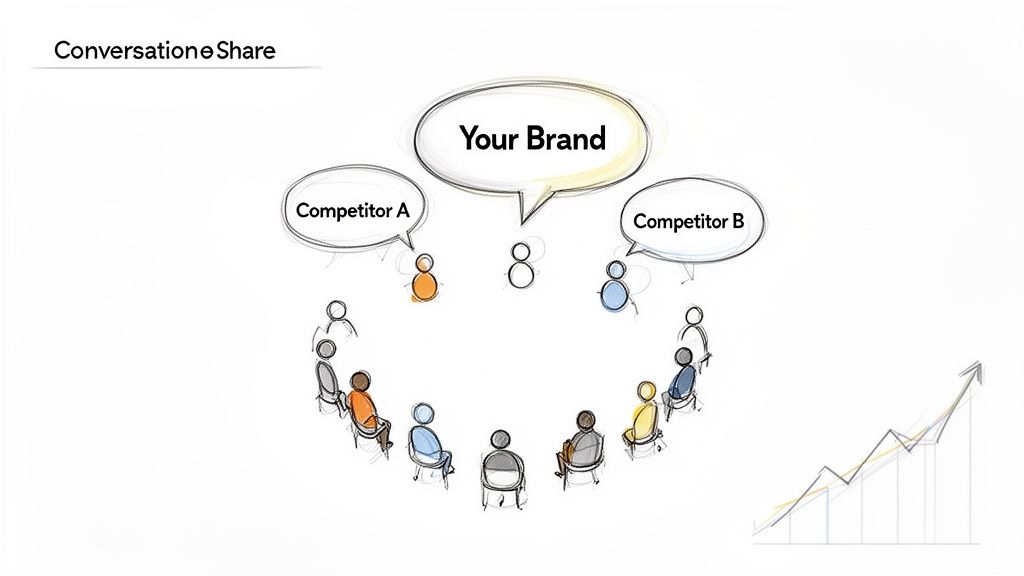
Let's stick with that crowded room analogy. Every brand in your market is trying to get the audience's attention. Your share of voice (SOV) is literally the percentage of that total conversation you own. It’s how often and how prominently your brand is seen and heard.
This isn't just about being loud for the sake of it. A higher SOV means your brand is top-of-mind. More people are seeing you, thinking about you, and talking about you. That constant presence almost always leads to stronger customer preference and, you guessed it, more sales.
The Proven Link Between Visibility and Growth
Smart marketers have known this for a long time: being seen is the first step to being bought. The link between share of voice and market leadership isn't just a hunch; it's backed by some of the most respected research in the industry.
In a landmark study analyzing 171 campaigns from 1980 to 2010, researchers Les Binet and Peter Field uncovered a powerful formula. They found that for every 10% of excess share of voice (ESOV)—that is, when your SOV is 10% higher than your current market share—your brand can expect to grow its market share by 0.5%. This principle has held true for decades, proving that consistently out-shouting the competition directly translates to winning their customers. You can discover more insights about these marketing principles and their impact.
Of course, the "room" where these conversations happen has changed dramatically. It's no longer just about TV commercials and newspaper ads. Today, the discussion is spread across social media feeds, search engine results, and a powerful new arena: AI chat.
Why SOV Is More Important Than Ever
Now, customers are asking AI assistants like ChatGPT and Gemini for product recommendations and solutions. This is the new frontier for brand visibility. If a customer asks an AI for the "best running shoes" and your brand's name doesn't appear in the answer, you've just lost your share of voice in a critical, high-intent moment.
This is precisely why tracking SOV is no longer a "nice-to-have." It’s essential. It gives you the raw competitive intelligence to understand where you stand, pinpoint where your rivals are getting all the attention, and uncover new opportunities to dominate the conversation. In today's market, you can't afford to be invisible.
How Share of Voice Evolved from TV Ads to AI Chatbots
The idea of share of voice in marketing has been around for decades, but what it means and how we measure it has changed dramatically. It got its start back in the golden age of advertising, when TV, radio, and print were the only games in town. Back then, calculating SOV was pretty straightforward, even if it cost a fortune.
Marketers used metrics like Gross Rating Points (GRPs) to see how their ad spend stacked up against the competition. The math was simple: your brand's GRPs divided by the total GRPs for everyone in your market. If your TV ads hit 30% of the potential audience while your rivals hit the rest, you owned a 30% share of voice. It was a direct reflection of who was shouting the loudest.
The Digital Shift to Clicks and Mentions
Then came the internet, which blew the media landscape wide open. The conversation moved online, and the old way of measuring SOV just didn't work anymore. The goal was still the same—gauge your visibility—but the "voice" itself was now coming through in clicks, comments, and keywords.
- Social Media SOV: The focus pivoted from ad spend to actual conversations. Suddenly, we were tracking brand mentions, hashtags, and engagement on platforms like Twitter and Facebook. Your share of voice became the slice of the online dialogue you controlled.
- SEO SOV: For search engines, visibility meant ranking. Share of voice morphed into "share of search," which measured how often your site appeared in the top search results for a given set of keywords compared to everyone else vying for the same audience.
This digital explosion made SOV tracking more accessible for everyone, but it also made it a whole lot more complicated. Every channel provided a different piece of the puzzle, forcing marketers to take a more holistic view to see the complete picture.
The New Frontier: AI Share of Voice
We're now standing at the edge of another massive shift. The conversation is moving again, this time into AI chatbots like ChatGPT, Claude, and Gemini. This new arena has given rise to a brand-new metric: AI Share of Voice.
AI Share of Voice measures how often, how prominently, and how positively your brand appears in the answers generated by Large Language Models (LLMs). This isn't about getting a blue link on a results page; it's about being the go-to recommendation in a trusted, conversational response.
This is a whole different ballgame. A #1 ranking on Google is great, but being the top brand recommended by an AI builds an entirely different kind of authority with a user. If you're not visible here, you're becoming invisible in a channel people are quickly turning to for answers.
The first step is to understand this new landscape and how to influence it. You can dive deeper into how brands can strategically show up in AI-generated answers in our guide to Generative Engine Optimization.
The table below shows just how much this metric has evolved across different channels.
Comparing Share of Voice Metrics Across Channels
This table contrasts how Share of Voice is defined and measured across traditional, digital, and emerging AI channels to clarify the evolution of the metric.
| Channel | Primary Metric | Calculation Example | Key Challenge |
|---|---|---|---|
| Traditional (TV/Radio) | Ad Spend / Gross Rating Points (GRPs) | (Your GRPs / Total Market GRPs) x 100 | High cost of data and media buying |
| Digital (SEO/Social) | Keyword Rankings / Brand Mentions | (Your Clicks / Total Clicks for a Keyword Set) x 100 | Fragmented data across multiple platforms |
| AI (LLMs/Chatbots) | Brand Mentions / Answer Prominence | (Your Brand Mentions / Total Competitor Mentions) x 100 | Lack of direct control over model outputs |
As you can see, while the core principle remains, the execution and challenges have completely transformed.
Here's an example of how a platform like promptposition makes this new form of visibility tangible, turning abstract AI conversations into actionable data.
This kind of dashboard view allows marketers to finally see how their brand is performing inside AI models, benchmark against competitors in real-time, and analyze the tone of the AI's recommendations. In this new era, tracking these metrics isn't just a nice-to-have—it's essential for keeping your brand relevant.
A Practical Guide to Calculating Your Share of Voice
Knowing what share of voice is gets you started, but the real magic happens when you move from theory to action. Calculating this metric turns an abstract idea into a hard number you can track, benchmark, and improve. The channels may have evolved over the years, but the core formula remains a powerful and surprisingly simple starting point.
At its heart, the universal formula for share of voice in marketing is this:
Your Brand’s Metrics ÷ Total Market Metrics x 100 = Your Share of Voice (%)
This formula is your bedrock. The specific "metric" you plug in will change depending on where the conversation is happening—it could be ad spend, organic clicks, or social media mentions. The trick is to consistently measure your brand against the whole competitive field.
This image perfectly captures how the core concept of SOV has adapted over time, from the one-way street of traditional media to the new frontier of AI.
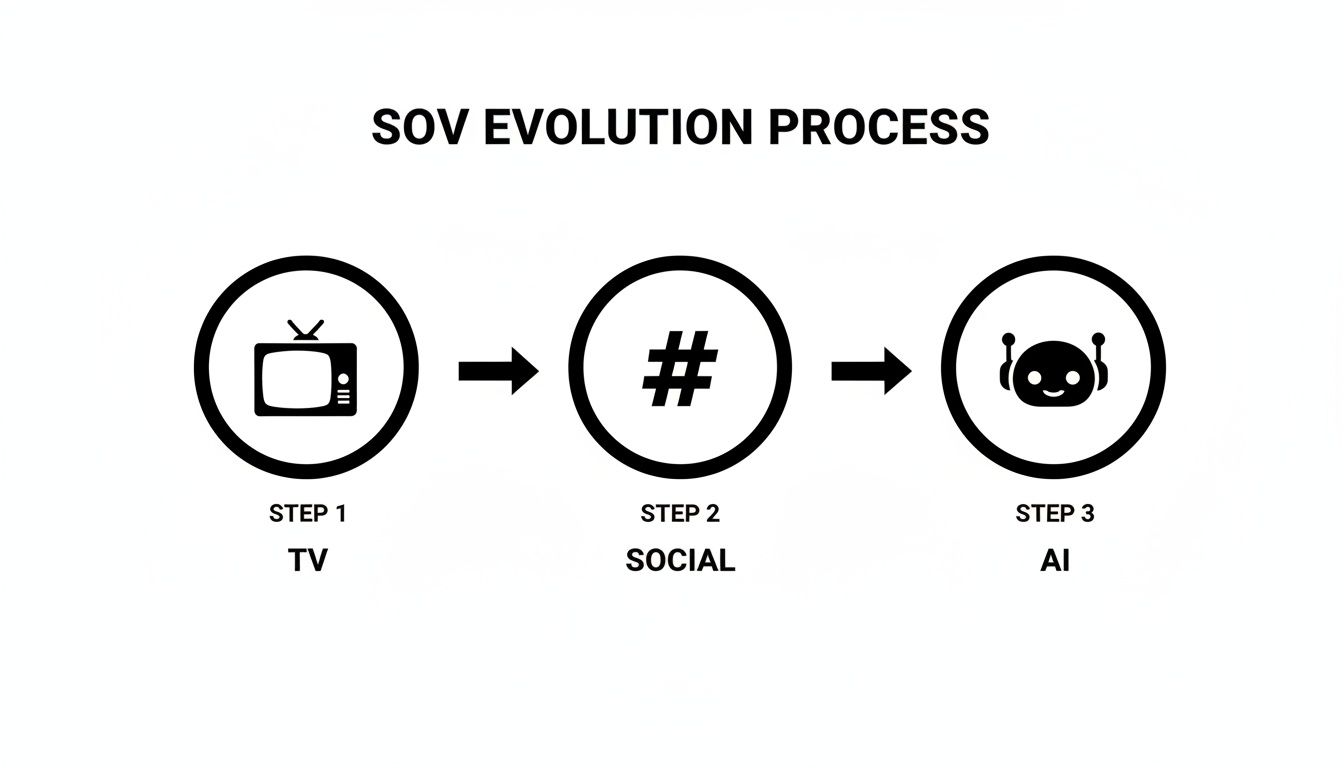
As you can see, capturing audience attention has journeyed from broadcast media to interactive digital platforms, and now to conversational AI. Each stage demands a new way of measuring who's winning the conversation.
Calculating SOV for Digital and Social Channels
For the channels we all know well, like SEO and social media, calculating SOV means tracking specific data points. This is where you’ll need tools that can pull together all the mentions and visibility metrics from across the web, giving you a clear picture of where you stand.
1. Define Your Competitive Set:
First things first, you need to know who you're up against. Who is fighting for the same eyeballs and keywords? Make a concrete list of your direct competitors, as they will define the "Total Market Metrics" in your calculation.
2. Gather Your Data Points:
Next, decide which metrics actually matter for each channel.
- For SEO: This is all about tracking your organic visibility for a core set of valuable keywords. Tools like Semrush or Ahrefs are great for measuring your "share of search" by comparing your rankings and estimated clicks against competitors for those key terms.
- For Social Media: You’ll want to use social listening tools to track every brand mention, key hashtag, and conversation. The goal is to tally up every relevant chat about your brand and your competitors.
3. Apply the Formula:
With your data in hand, just plug it into the universal formula. For example, if your brand was mentioned 500 times on social media last month and the total mentions for you and your key competitors hit 5,000, your social SOV is a solid 10%.
The New Challenge: Measuring AI Share of Voice
Calculating your share of voice in AI-generated answers is a whole new ballgame. It requires a more focused approach because the "conversation" is now a direct dialogue between a user and a model like ChatGPT or Gemini. Measuring your visibility here isn't just a vanity metric; it's essential for future-proofing your brand.
The process involves systematically tracking how often—and how well—your brand shows up in these AI answers. It’s about turning what feels like a black box into a clear performance indicator.
Step 1: Define Key Conversations to Monitor
You can't track everything, so don't try. Instead, start by identifying the high-intent prompts your target audience uses when they're looking for advice or recommendations. Think of these as your new keywords.
- Product discovery prompts: "What are the best running shoes for beginners?"
- Problem-solving prompts: "How can I improve my team's project management workflow?"
- Comparison prompts: "Compare Brand A vs. Brand B for CRM software."
Step 2: Systematically Track Brand Prominence
This is where you absolutely need specialized tools. An AI search analytics platform like promptposition is built to automate the heavy lifting of querying models at scale and making sense of the results. It looks at several layers of visibility:
- Frequency of Mentions: Out of hundreds of relevant prompts, how often does your brand get mentioned compared to everyone else?
- Positioning and Rank: Does the AI mention you first, last, or buried in the middle? Just like in search results, earlier mentions carry more weight.
- Sentiment Analysis: Is your brand described in a positive, neutral, or negative light? This qualitative layer adds crucial context.
By consistently monitoring these data points, you can calculate your AI Share of Voice. For instance, if your brand is mentioned 25 times across 100 key prompts, while your competitors are mentioned a total of 75 times, your AI SOV for that prompt set is 25%. This method transforms a fuzzy concept into a hard metric you can finally report on and actively improve.
Using Competitive Benchmarks to Set Winning SOV Goals
Getting a handle on your share of voice is just the first step. That number, whether it’s a tiny 5% or a dominant 50%, doesn't mean much on its own. It's just data. To make it useful, you have to add context by benchmarking it against your competitors and the market as a whole.
This is how you turn a simple metric into a powerful strategic tool. Benchmarking isn’t just about seeing who’s winning. It’s about understanding the gap between you and your rivals, figuring out who the real threats are, and spotting opportunities to jump ahead.
Establishing Your Competitive Framework
Before you can measure anything, you have to decide who you’re measuring against. There are a few different ways to slice this, and each gives you a unique angle on where you stand.
- Direct Rival Comparison: This is the classic head-to-head. You pit your share of voice in marketing directly against your top one-to-three competitors. It’s perfect for spotting immediate threats and setting clear performance goals.
- Industry Average: How do you stack up against the entire field? Measuring against the industry average tells you if you're a major player, a mid-tier contender, or an up-and-comer. If you're below average, your first goal is simple: get heard above the noise.
- Aspirational Leaders: It pays to look beyond your immediate rivals to the undisputed leaders in your space, even if you don't compete with them directly. See how they dominate the conversation. Their strategies can offer a blueprint for your own long-term growth.
Using this framework helps you see the bigger picture. You might find that while you're a hair ahead of your main competitor, you're both getting drowned out by the market leader. That's not a threat; it's a massive opportunity.
Leveraging ESOV for Market Growth
Once you know where you stand, you can start setting goals that actually push the needle. This is where a concept called Excess Share of Voice (ESOV) becomes your secret weapon. Simply put, ESOV is the gap between your share of voice and your share of the market.
Excess Share of Voice (ESOV) = Your Share of Voice (%) – Your Market Share (%)
If your SOV is higher than your market share, you have a positive ESOV—a strong indicator that you're poised for growth. If it's lower, your brand is in danger of losing ground. The goal is to keep your ESOV ahead of your competitors to build the momentum you need to grab more market share.
Diving into specific channels shows you exactly where to put your energy. For instance, one furniture study found Sleep Number owned the audio space with a massive ad spend, while Ashley Furniture led in digital channels and successfully captured younger buyers. This illustrates a principle proven over three decades and 171 campaigns: for every 10% ESOV, a brand typically sees a 0.5% gain in market share.
In the new world of AI search, the math is even more straightforward. If AI models mention brands 100 times for a key prompt and your brand shows up 25 times, you have a 25% SOV. That’s a crystal-clear KPI for your team to rally behind. You can find out more about these key findings and how top brands use channel-specific SOV to their advantage.
Setting Platform-Specific SOV Goals
Let's be clear: not all visibility is created equal. A 10% share of voice on a high-intent platform like ChatGPT could be exponentially more valuable than a 25% SOV on a noisy social media feed. A modern SOV strategy needs nuanced, platform-specific goals.
Think about the user's mindset. Someone asking an AI for a product recommendation is often very close to making a purchase. Being part of that conversation is incredibly powerful.
Your goals should reflect that reality.
- For AI Search: Aim to be mentioned in the top three for your most critical, bottom-of-funnel prompts.
- For Social Media: Focus on owning the conversation around awareness-stage topics and key industry hashtags.
- For SEO: Target a dominant share of search for a curated list of high-value, commercial-intent keywords.
By setting these granular benchmarks, you stop chasing a vague idea of "more visibility" and start executing a precise, actionable plan. A platform like promptposition makes this possible by tracking your brand’s prominence across different AI models, letting you set and monitor these goals in real-time. This approach turns benchmarking from a reactive report card into a proactive strategy for leading your market.
Actionable Strategies to Increase Your Share of Voice
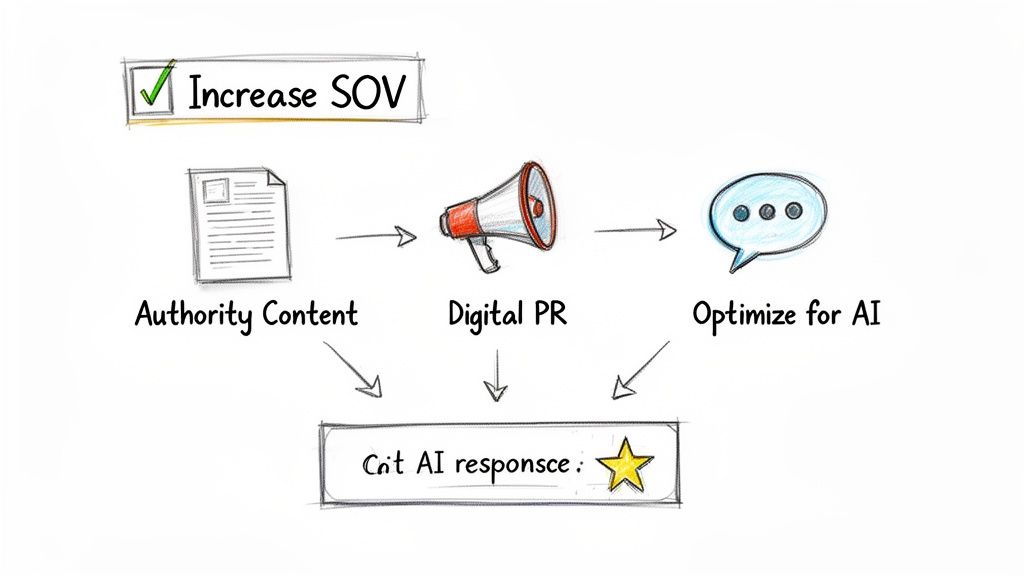
Alright, you've done the diagnostic work and have a handle on your current share of voice. Now for the treatment. Bumping up your visibility isn’t about just shouting louder; it’s about having a smart, multi-channel game plan that works for traditional search and the new world of AI-powered answers.
The real goal is to become the most credible, authoritative, and genuinely helpful voice in your space. This section is your playbook for getting there. We’ll start with the foundational marketing tactics that build the kind of authority AI models notice, then shift into specific methods for directly influencing the conversation in AI.
Create High-Authority Content LLMs Love to Cite
The bedrock of any solid SOV strategy today is creating genuinely exceptional content. In the age of AI, that means your content needs to be so thorough, well-researched, and clearly organized that Large Language Models (LLMs) can't help but use it as a primary source. Think of it as building the definitive reference library for your entire industry.
Focus your energy on creating pillar pages, deep-dive guides, and original research that explore your core topics from every possible angle. These pieces should be packed with data, expert commentary, and simple explanations that nail the fundamental questions your audience has. When an LLM scans the web for trustworthy info, you want your content to be the gold standard it finds.
Leverage Digital PR to Earn High-Value Mentions
Digital PR is a massive amplifier for your share of voice. When you land mentions and backlinks from reputable publications, you’re not just getting a bump in referral traffic. You’re sending powerful signals of authority to search engines and AI models alike. Every feature in a respected outlet acts as a vote of confidence in your brand's expertise.
Your digital PR efforts should zero in on a few key areas:
- Data-Driven Stories: Pitch journalists and bloggers compelling stories backed by your own unique data or original research.
- Expert Commentary: Position your team members as the go-to experts for quotes and insights on trending topics in your field.
- Strategic Partnerships: Team up with non-competing brands or influencers to create co-branded content that introduces you to new, relevant audiences.
This approach ensures your brand isn't just talking about itself—it’s being actively discussed by trusted sources, which dramatically boosts its perceived authority and SOV.
Optimize for the Informational Keywords Fueling AI
Commercial keywords are great for driving sales, but it's the informational keywords that fuel AI-generated answers. We’re talking about all the "how-to," "what-is," and "why" questions people ask when they're trying to learn something. If you can own the conversation for these queries, you position your brand as a helpful teacher, not just another seller.
Do your homework and find the long-tail informational questions your audience is asking. From there, create dedicated content—blog posts, FAQ pages, knowledge base articles—that gives a direct and comprehensive answer. This not only helps your SEO but also makes your content a prime candidate for being featured in AI responses. For a deeper look, check out our guide on how to use AI for SEO.
Analyze AI Conversations to Identify Content Gaps
To win in this new AI arena, you have to listen before you speak. By systematically analyzing the answers AI models give for your industry's most important prompts, you can uncover some incredibly valuable strategic insights. This is where a tool like promptposition becomes your secret weapon.
Monitoring these AI-generated responses lets you pinpoint exactly where your competitors are getting mentioned and you aren't. Those are your immediate content opportunities. If an AI consistently points to a competitor’s guide on "how to choose the right software," that’s your cue to build an even better, more authoritative resource on that very topic.
Share of voice is not a static metric—it is a dynamic predictor of competitive fate. Seminal research by Binet and Field's on 171 campaigns proved that every 10% of excess share of voice (ESOV) yields 0.5% in market share growth. In today's world, that translates to the AI frontier, where brands hitting 30% SOV in key category prompts are positioned to dominate tomorrow's purchases as models like Claude and Gemini become default search tools.
Address Negative Sentiment and Misinformation Head-On
One of the scariest risks in the AI era is how quickly bad information can spread. An AI model might surface an old, negative review or misrepresent one of your product's features, shaping a potential customer's opinion before you even have a chance to make your case.
Your best defense here is proactive monitoring. Using a platform like promptposition, you can keep tabs on the sentiment of your brand mentions within AI answers. If you spot something negative or just plain wrong, you can act immediately. That might mean updating the source content the LLM is citing, publishing a new piece to set the record straight, or launching a digital PR campaign to generate positive stories. By actively managing your narrative within AI, you protect both your reputation and your share of voice.
The Future of SOV in an AI-Powered World
If you're wondering where Share of Voice is heading, the answer is simple: it's becoming a central nervous system for smart businesses. For a long time, we treated SOV as a marketing-only metric. That's changing. Now, the insights we get from listening to the market are shaping everything from product roadmaps and sales strategies to big-picture corporate decisions.
This isn't just a trend; it's a fundamental shift driven by technology and how people discover information. Brands that can tap into the unfiltered conversations happening everywhere—especially in AI chat—are getting a direct line into what customers actually want, not just what we think they want.
Integrating Sentiment and Real-Time Monitoring
Two big developments are making SOV more potent than ever. First is the deeper integration of sentiment analysis. It’s no longer just about tracking mentions. The real gold is in understanding the context. Is an AI recommending your software enthusiastically, or is it adding a hesitant "but"? That nuance is everything.
The second piece is the move toward real-time monitoring. The conversation online moves at lightning speed. A static monthly report is a snapshot of the past. To stay ahead, you need a live pulse on your brand's visibility—a dynamic dashboard that lets you spot and react to a shift in competitor messaging or public sentiment the moment it happens. You can dive deeper into adapting your strategy in our comprehensive guide to AI search engine optimization.
The marketers and brand leaders who master the art and science of Share of Voice today will not just participate in tomorrow's conversations—they will lead them, securing their brand’s relevance for years to come.
Ultimately, the takeaway here is crystal clear. Getting a handle on SOV isn't just a nice-to-have anymore; it's essential for any brand with serious ambition. The companies investing in understanding and shaping their visibility across every single channel, from TikTok to AI assistants, are the ones building a real, lasting competitive edge. They aren't just playing the game; they're setting the rules.
FAQs: Putting Share of Voice to Work
Once you get the basics down, you’ll naturally have questions about how Share of Voice actually works in the real world. Let's tackle some of the most common ones that pop up when marketers start tracking their brand's visibility.
How Often Should I Be Measuring This?
There’s no one-size-fits-all answer here. The right cadence really depends on how fast your industry moves and which channels you’re watching.
If you’re in a fast-paced space like retail or consumer tech, you might want to check in weekly, or even daily, to catch what your competitors are doing in real time. For many B2B companies, a monthly pulse check is probably sufficient to track strategic shifts. The most important thing is to be consistent—that's how you turn a single snapshot into a meaningful trend.
What’s a "Good" Share of Voice to Aim For?
Everyone wants to know the magic number, but it simply doesn't exist. A "good" SOV is entirely relative to your market and your business goals.
Instead of chasing a universal benchmark, think about it in these terms:
- Get Ahead of Your Market Share: The classic rule of thumb is to aim for an SOV that's higher than your share of market. This is often called "excess share of voice" (ESOV) and is a strong predictor of growth.
- Beat Your Direct Rivals: Zero in on your top one or two competitors. Your goal should be to own a larger slice of the conversation than they do on the channels that matter most to your customers.
- Own a Niche: You don't have to win everywhere. Aim to completely dominate a specific, high-value conversation with an SOV of over 50%.
Can a Small Brand Actually Compete with a Giant?
Absolutely. You just can't play the same game. A smaller brand will never outspend the market leader across the board, so you have to be smarter and more focused.
Don't try to win the big, noisy conversations. Instead, pick your battles. Dominate a niche topic, a specific city or region, or a single social platform where your audience lives. A 70% SOV in a small but highly relevant pond is infinitely more valuable than a 2% SOV in a vast, crowded ocean.
How Is AI Share of Voice Different from SEO?
They're cousins, but they measure two very different things. Traditional SEO Share of Voice (often called "share of search") is all about visibility on a search results page. It asks, "How often does my blue link show up?"
AI Share of Voice, however, is about presence inside an AI-generated answer. It's not just about getting a link; it's about the AI recommending your brand, explaining your product, or comparing you favorably to a competitor. This is a much deeper level of influence, which is why platforms like promptposition are becoming so critical for tracking this new frontier.
Ready to stop guessing and start measuring your brand's true visibility in the age of AI search? promptposition gives you the data you need to understand your AI Share of Voice, see how you stack up against the competition, and start influencing how LLMs talk about you. Get your free demo of promptposition today!