What is rank tracking: Your SEO data that drives growth
At its heart, rank tracking is the simple act of monitoring where your website appears on a search engine results page (SERP) for the keywords that matter most to your business. It's the only way to get a real, data-backed picture of your visibility online and take decisive action.
Without it, you’re flying blind, simply hoping your SEO efforts are making a difference. Rank tracking shows you what's working, what's falling flat, and how your performance is trending over time, giving you the power to steer your strategy with confidence.
Your GPS for Digital Visibility
Think of your website as a ship on the vast, crowded ocean of the internet. Rank tracking is your navigation system. It gives you your exact coordinates, shows you which direction you’re heading, and even tracks all the other ships competing for the same destination. It’s what turns SEO from a guessing game into a predictable, measurable strategy.

This isn't just about chasing that number one spot, either. Modern rank tracking gives you a comprehensive dashboard, connecting the dots between your marketing activities and tangible business outcomes. It’s how you measure progress, spot problems before they get out of hand, and justify your SEO budget with cold, hard data.
For a quick overview, here are the core components of rank tracking.
Rank Tracking at a Glance
| Component | Description |
|---|---|
| Keyword Monitoring | The foundational practice of tracking your website's position for specific search queries. |
| SERP Analysis | Evaluating the entire search results page, including features like snippets, ads, and local packs. |
| Competitive Benchmarking | Comparing your rankings and visibility against key competitors for shared target keywords. |
| Performance Measurement | Using ranking data over time to gauge the success and ROI of your SEO campaigns. |
This table covers the basics, but the real value comes from putting these components into action.
Why Does Rank Tracking Matter?
Honestly, any business serious about growing online needs to be doing this. The insights you get from proper rank tracking guide your entire digital strategy, from the content you create to how you stack up against the competition.
Here’s why it’s so critical:
- Measure SEO Performance: It's the ultimate proof. You get clear, quantifiable data showing if your optimization efforts are actually working. See exactly how a new blog post or a backlink push moved the needle.
- Identify Growth Opportunities: Find those "striking distance" keywords lingering on the second page (positions 11-20). A little extra push on these can deliver some of the quickest and most satisfying wins.
- Monitor Competitors: SEO doesn’t happen in a vacuum. Tracking lets you see when a rival starts creeping up the rankings, giving you a chance to figure out what they’re doing right and adjust your own plan.
- Prove Your ROI: For anyone in marketing, this is huge. Rank tracking data gives you a simple, powerful way to show stakeholders the value of your work. You can draw a direct line from better visibility to more traffic, leads, and sales.
In essence, rank tracking gives you the clarity to make smarter, faster marketing decisions. It moves your strategy from reactive fixes to proactive growth, ensuring you’re not just creating content but actively steering your brand toward your target audience. This foundation is more important than ever as search evolves into the new frontier of AI-driven answers.
The Journey from Manual Checks to Automated Insights
It wasn't that long ago that "rank tracking" involved opening an incognito browser, typing in a keyword, and endlessly scrolling through search results to find your site. We’ve all been there. It was a time-consuming, frustrating, and, frankly, inaccurate way to measure anything.
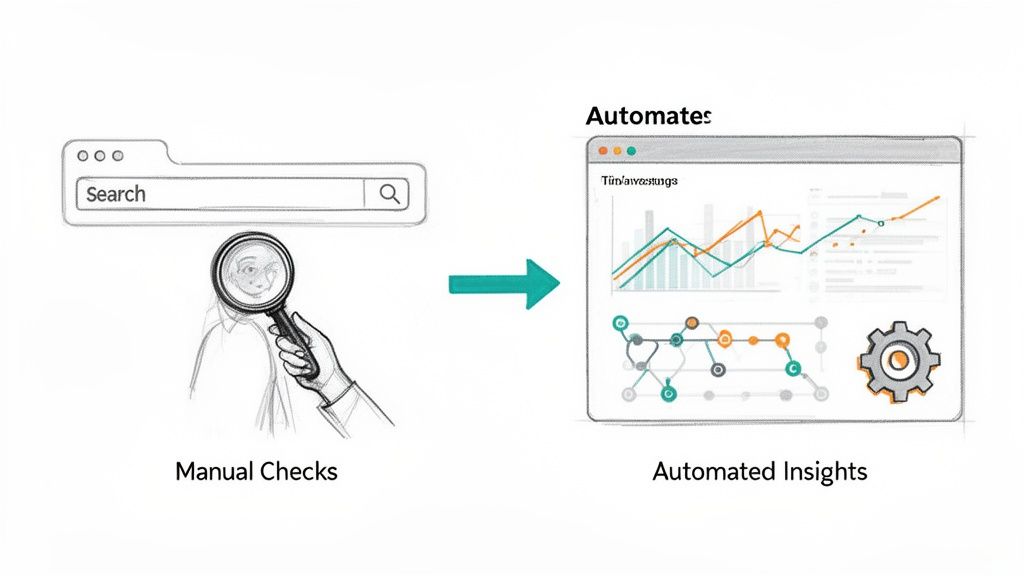
The biggest problem? The results you saw were almost never what your actual customers saw. Your search history, physical location, and even your device heavily skewed the rankings. Trying to get an objective measurement was like trying to measure a room with a rubber band—the numbers were different every single time.
The Rise of Automation
The game changed completely when automated tools came along. They transformed rank tracking from a frustrating guessing game into a real strategic discipline. These platforms didn't just check rankings; they recorded them day after day, building a historical log of performance that marketers had only dreamed of.
This was a defining moment for the SEO industry. Having a reliable record of ranking data gave us a whole new set of capabilities:
- Diagnostic Power: Did your rankings suddenly tank? Now you could pinpoint the exact day it happened and cross-reference it with a known Google algorithm update or a competitor's big move.
- Historical Context: Looking at your performance over months or years helped uncover seasonal trends, identify content decay, and see the real, long-term impact of SEO efforts.
- Proof of ROI: Finally, marketers could walk into a meeting with clear, data-driven reports and connect their optimization work directly to improved search visibility.
Automated rank tracking took the guesswork out of the equation. It killed the "I think we're doing better" conversations and replaced them with, "Our visibility for this keyword cluster is up 15% since last quarter."
Unlocking Strategic Insights
As search engines got more complicated, this data became even more essential. By the mid-2000s, tracking tools were collecting data on hundreds of millions of keywords, giving marketers access to years of performance history. When Google rolled out big updates like its "Caffeine" enhancement in May 2010, which sped up indexing, having a reliable tracker was the only way to diagnose immediate ranking shifts and figure out why they happened. You can get a great overview of this evolution from SpyFu's history of SEO ranking data.
Today’s sophisticated tracking tools are the direct result of that journey. They aren't just a convenience; they’re a necessity for any business that wants to compete online. They provide the clarity needed to navigate a constantly changing search environment, and that foundation is more important than ever as we move into a new world of AI-generated answers.
Understanding the Metrics That Actually Matter
Let’s be honest, effective rank tracking is about so much more than just seeing where you land on a results page. If you really want to understand how your SEO is performing, you have to look at metrics that turn raw data into smart business decisions. Moving past simple vanity rankings is how you start to see the bigger picture.
Think of it this way: knowing your basic keyword rank is like knowing your store's street address. It’s a start, but it tells you nothing about foot traffic, what your customers are actually looking for, or how you’re faring against the big-box store down the street. The right metrics give you that crucial context.
Moving Beyond Simple Position Numbers
Knowing you rank at position #7 is fine, but it’s just one piece of a much larger puzzle. Modern SEO strategy has moved past obsessing over single keywords. Instead, the smart money is on tracking keyword clusters—groups of related terms that reveal what users are actually trying to accomplish. This approach gives you a much clearer view of your authority on a whole topic, not just a single search term.
On top of that, you have to slice and dice your data. A user searching on their phone in downtown Chicago will see completely different results than someone on a desktop in rural Idaho. By analyzing performance by device and location, you can make sure your strategy actually connects with how real people are looking for you.
The goal is to stop asking, "Where do I rank?" and start asking, "How visible am I to my target audience, and what business is that visibility actually driving?" This shift in mindset is what finally connects your SEO work to tangible results.
Core Metrics for Strategic SEO
To measure what really moves the needle, you need metrics that quantify your overall presence in the market and its potential impact on your bottom line. These are the indicators that paint a complete, honest picture of your search performance.
Three of the most important metrics to keep your eyes on are:
- Share of Voice (SoV): This is essentially your brand's digital shelf space. SoV calculates how visible you are across a critical set of keywords compared to your competitors. It answers the question: "What percentage of the conversation do we own?" It's a fantastic way to benchmark your standing in the market.
- Search Visibility Score: Usually shown as a percentage, this score rolls up all your rankings across your entire keyword set into a single number. It gives you a high-level snapshot of your SEO health, making it simple to spot domain-wide trends and gauge the overall success of your campaigns.
- Estimated Traffic: This metric is where the rubber meets the road, translating your rankings into a tangible business outcome. It combines your keyword positions with their search volume and typical click-through rates to estimate how many visitors your SEO efforts are likely bringing to your site.
For any of this to be accurate, daily position updates are a must. They transform SEO from a guessing game into a precise science. You need to know about overnight gains or drops, especially when you consider that keywords in the top 3 positions get 54.4% of all clicks. A single jump from position 5 to 4 can boost your traffic by 20-30%. That’s the real-world value of precise, daily monitoring.
If you're looking to get a better handle on this, you can learn more about how to track these critical SEO rankings and their impact. Once you master these metrics, you can start talking about your SEO performance with real confidence.
The New Frontier: Tracking Visibility in AI Search
The classic rules of rank tracking are quickly becoming ancient history. For years, we obsessed over the "ten blue links," but as search engines morph into conversational AI platforms like ChatGPT and Gemini, that familiar SERP is fading away. This is a new field in the area of SEO, and so must our approach to measuring visibility.
Think about the difference between using a library's card catalog and having a chat with an expert librarian. The catalog gives you a list of books, each in a specific, numbered spot. The librarian, on the other hand, synthesizes information from dozens of sources to give you a complete, nuanced answer. In this new world of search, "ranking" isn't about a number anymore. It's about influence.
Redefining What It Means to Rank
Success in AI search isn't about clawing your way from position five to four. It's about becoming a trusted source that the AI model itself relies on to construct its answers. This means we need a whole new vocabulary—and a new set of metrics—to figure out how we're performing. So, what is rank tracking now? It's the art of measuring your brand's presence and impact within these AI-generated conversations.
This new reality forces us to think beyond simple positions and focus on brand performance, which flows from visibility to share of voice and, ultimately, to traffic.
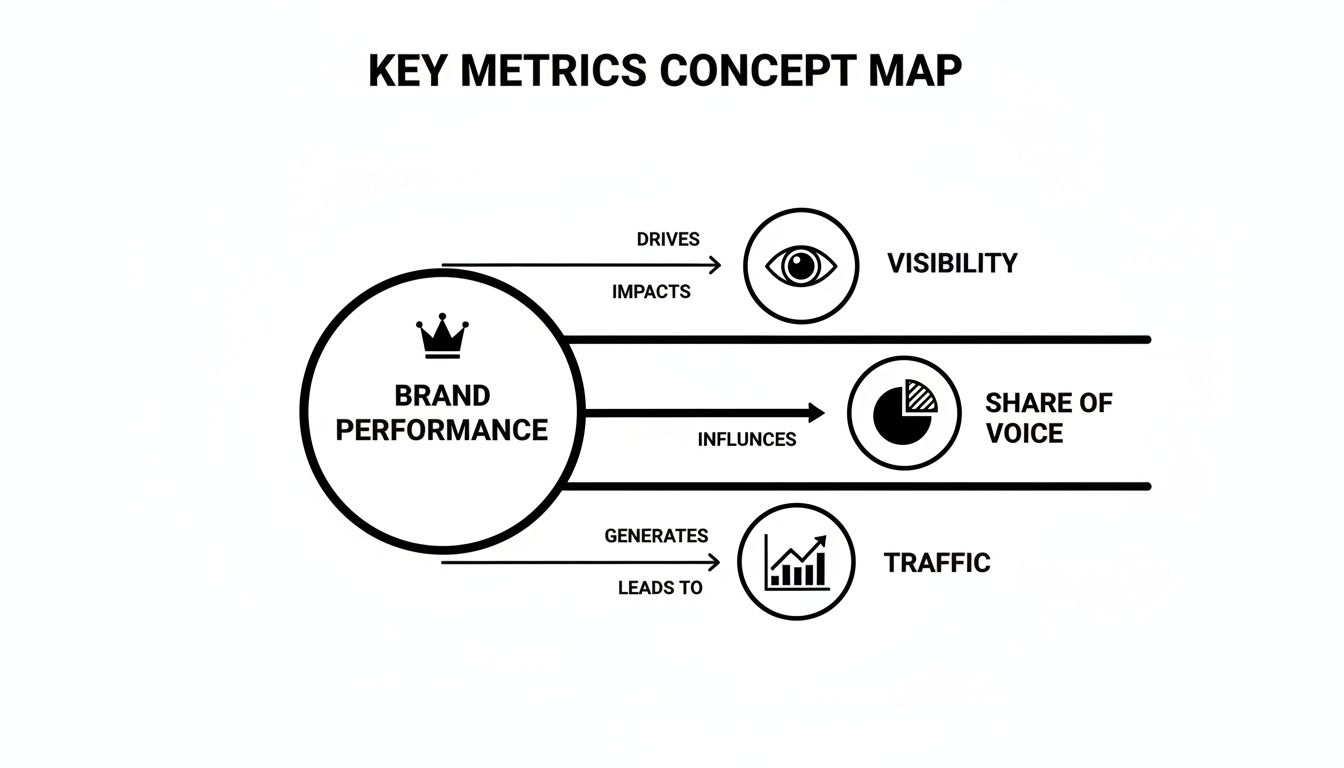
To get a real handle on your performance, you have to track these critical new metrics:
- Brand Visibility: This is the most basic yet crucial question: "How often does my brand even show up in AI answers?" It’s the starting point for understanding your footprint in this new channel.
- Sentiment Analysis: It's not just about being mentioned; it's about how you're mentioned. Sentiment tracking tells you if the AI is portraying your brand in a positive, negative, or neutral light, offering a real-time pulse on your reputation.
- Source Attribution: This is where things get truly actionable. Source attribution pinpoints the exact web pages, articles, or data points the AI is citing when it talks about you. When you know your sources, you know which content is hitting the mark and where you need to build more authority.
In the age of AI, visibility is nuanced. You're not just a link; you're part of a narrative. Tracking these new metrics is the only way to understand and shape that narrative effectively.
Gaining Clarity in the AI Landscape
Let's be honest—tracking this can feel like trying to measure a ghost. Thankfully, specialized platforms are already emerging to bring some much-needed clarity. Tools like PromptPosition, for example, are built specifically to measure a brand's presence in generated answers, turning what feels like an opaque black box into actionable data. You can dive deeper into this new discipline in our guide to AI search engine optimization.
By tracking your visibility, sentiment, and sources, you can stop guessing and start building a real strategy to win in the next era of search.
Putting Rank Tracking Into Action
Knowing the theory behind rank tracking is one thing, but the real magic happens when different teams actually use it to make smarter decisions. These metrics aren't just numbers on a screen; they’re signals that can guide your strategy across the entire company—from marketing to brand management to product development.
For the folks in the SEO and content trenches, rank tracking is their North Star. It helps them move from creating content they hope will work to building assets they know will grab attention and drive action.
SEO and Content Marketers
The main job here is to boost organic traffic by getting more eyes on your content. Rank tracking gives you a direct, actionable roadmap to make that happen. It helps you pinpoint exactly where to focus your energy for the biggest return, turning vague goals into sharp, tactical moves.
Here are a couple of high-impact workflows we see all the time:
Find Your 'Striking Distance' Keywords: Hunt for those valuable keywords lingering on the second page of Google (think positions 11-20). These are your quickest wins, without a doubt. A simple content refresh, a few new internal links, or a rewritten meta description can often be enough to bump these pages onto page one, where the real traffic is.
Uncover Your Content Gaps: When you analyze what your competitors are ranking for, you'll inevitably find keywords they own that you don't. Don't get discouraged—this is a strategic goldmine. These gaps show you exactly what topics your audience is searching for that you haven't covered yet, giving you a ready-made list of new content ideas.
Brand, PR, and Product Teams
Rank tracking isn't just for SEO anymore. Modern tools, especially those built for AI search, offer powerful insights for managing your brand's reputation. For brand and PR teams, understanding how an AI like ChatGPT or Perplexity talks about your company has become non-negotiable.
We saw a SaaS company use rank data to completely outmaneuver a competitor. By tracking keywords related to specific product features, they realized their main rival was consistently beating them for "enterprise-grade security." They took that insight and launched a laser-focused content and PR campaign all about their own top-tier security protocols. In just three months, they not only closed the ranking gap but also saw a 15% jump in demo requests that specifically mentioned security.
This is a perfect example of using this data proactively. A PR team can check if their latest press release is actually influencing AI-generated answers. A product team can monitor how the market is reacting to a new feature. As search continues to evolve, getting familiar with new concepts like Generative Engine Optimization is what will keep you ahead of the curve.
Building Your Rank Tracking Strategy
Now that we've covered the metrics, let's talk about putting it all together. A solid rank tracking strategy is more than just plugging keywords into a tool and hoping for the best. It's about building a roadmap that shows how your day-to-day efforts actually move the needle for the business and drive real action.
It all starts with getting crystal clear on your core keywords and who you're up against.
Defining Your Core Keywords
First things first, you need to identify the keywords that are most valuable to your business. This isn't about creating a massive, random list; it's about curating a strategic set of terms based on user intent and business value. I always recommend grouping them into distinct categories to keep everything organized and focused.
A well-rounded keyword list gives you a true sense of your performance. You need a mix of different types to make sure you're tracking queries that really impact your bottom line, not just vanity terms.
- Branded Keywords: These are simple—any search that includes your company name. Keeping an eye on these helps you monitor your brand’s reputation and see how strong your footprint is in search.
- High-Intent Keywords: Think of these as the "money" terms. They're queries that signal someone is close to making a decision, like "best software for small business" or "emergency plumber near me."
- Long-Tail Keywords: These are the longer, more specific phrases people use when they know exactly what they're looking for. They often have less competition and convert surprisingly well. A great example is tracking a full question like "how to use ai for seo" instead of just the broad term "AI SEO."
Once you’ve locked in your keywords, the next move is to pinpoint your main competitors. Who keeps popping up for the terms you want to own? Add them to your tracking so you can benchmark your own performance and spot opportunities where they're winning and you're not. You can dig deeper into this with our guide on how to use AI for SEO.
Connecting Tracking to Business Goals
This is the most important step, and it's where most people drop the ball. You have to tie your tracking data to real Key Performance Indicators (KPIs). This is how you shift the conversation from "we went up a few spots" to "we generated more business." Forget vague goals like "better rankings" and get specific.
A powerful KPI, for example, could be: "Increase our Share of Voice for non-branded, high-intent terms by 20% this quarter." Or, when thinking about AI search, a goal could be: "Achieve positive sentiment in 90% of our brand mentions within generated answers." A tool like PromptPosition is designed to help you track this.
When you frame it this way, rank tracking stops being a passive report and becomes a tool that actively drives growth. You can finally prove its value and make strategic decisions backed by hard data.
Frequently Asked Questions
Let's tackle some of the most common questions that come up when people first dive into rank tracking. These quick answers should help clear up any confusion and get you on the right track.
How Often Should I Check My Keyword Rankings?
In today's fast-moving search world, daily tracking is the new standard. You can't get away with weekly or monthly checks anymore.
Search results can change in the blink of an eye because of a Google algorithm update, a competitor's big move, or even a small technical glitch on your own site. Daily updates mean you can spot problems instantly and jump on opportunities before they disappear.
Can I Track Rankings for Different Locations and Devices?
Absolutely, and you really have to. The search results for someone on their phone in New York can be completely different from what someone on a desktop in London sees.
A solid rank tracking tool lets you slice and dice your data by location and device. This gives you a clear, accurate picture of how you're actually performing, which is crucial whether you're a local shop or a global brand.
Tracking rankings without segmenting by location and device is like looking at a blurry photo. You get the general idea, but you miss all the important details that could change your entire strategy.
How Is AI Search Tracking Different from Traditional SEO Tracking?
This is a big one. Traditional SEO tracking is all about where your website lands on a list of 10 blue links. AI search tracking, on the other hand, is about measuring your influence inside a conversation. It's a fundamental shift in thinking.
Instead of just looking for a number, you're now measuring things like:
- Visibility: Did the AI even mention your brand or website in its answer?
- Sentiment: When you were mentioned, was it in a positive, neutral, or negative light?
- Source Attribution: Which one of your articles or pages did the AI cite as a source?
This move away from a simple numbered list means you need new tools built for this new world. You need something that can make sense of the complex, conversational answers from AI models like ChatGPT and Gemini, because the old way of tracking just won't cut it anymore.
Ready to see how your brand is being represented in the new world of AI search? PromptPosition gives you the clarity to measure your visibility, sentiment, and sources across leading AI models. Start tracking your AI search performance today.