Seo Visibility Search Metrics: A Guide to Dominating Search

Ever wondered how easily customers can find you online? That’s what SEO visibility metrics are all about. They measure how often and how prominently your brand shows up in search results for the keywords you care about most. Think of it less as a simple ranking and more as your total potential reach—your slice of the digital shelf space. This is a new and critical field in SEO, and mastering it will drive real action and results.
What SEO Visibility Really Means
Let's use a real-world analogy. Picture your business as a shop in a bustling city. Is it a major storefront on the busiest street, with thousands of people walking by every day? Or is it tucked away on a side street, hoping someone happens to wander past?
Your SEO visibility is your location in this digital city. It's not just about having a website; it's about being seen in the right places, by the right people, exactly when they're looking for what you offer.
This idea goes deeper than just website traffic. Traffic tells you how many people actually came into your store. Visibility, on the other hand, tells you how many people had the chance to see your storefront in the first place. It’s the top-level indicator of your online health, measuring your presence before anyone even clicks.
To make this even clearer, let's compare how traditional business visibility concepts translate into the world of SEO.
Traditional Business vs Digital SEO Visibility
| Traditional Business Analogy | SEO Visibility Metric | What It Measures |
|---|---|---|
| Foot traffic past your store | Impressions | How many times your site appeared in search results. |
| People looking at your window display | Click-Through Rate (CTR) | The percentage of people who saw your listing and clicked. |
| Your store's size vs. the entire mall | Share of Voice (SOV) | Your brand's percentage of all potential clicks for a keyword set. |
| How close your store is to the main entrance | Average Ranking Position | Your typical placement on the search results page. |
This table shows that the principles are the same, whether on a physical street or a digital one. Being visible is the first, most critical step to attracting customers.
Why It Is Your Most Important Leading Indicator
Keeping a close eye on your visibility gives you a serious edge. Organic search isn't just a channel; it's a powerhouse, driving nearly 40% of all website visits across major industries in 2023. Even better, leads coming from SEO have an impressive 14.6% close rate, which is more than eight times higher than what you'd see from traditional outbound marketing. You can dig into the numbers yourself in this full report on SEO statistics.
SEO visibility is your early warning system. If your visibility dips today, you can bet that your traffic and leads will drop tomorrow. This gives you precious time to diagnose the problem and fix it before it hurts your bottom line.
On the flip side, a steady rise in visibility is the ultimate proof that your SEO efforts are paying off, often weeks or months before you see a corresponding jump in traffic and conversions.
By focusing on SEO visibility search metrics, you can get straight to what matters:
- Benchmark Against Competitors: See exactly how much of the digital "main street" you own compared to everyone else.
- Measure Brand Presence: Understand your true share of voice for the conversations and queries that drive your business forward.
- Predict Future Traffic: Use visibility trends as a reliable way to forecast your future organic performance.
In the rest of this guide, we'll break down the core metrics that turn this powerful concept into concrete data, giving you the tools you need to claim your prime digital location.
The 7 Core SEO Visibility Metrics You Must Track
If you're still laser-focused on just organic traffic, you're looking in the rearview mirror. While traffic tells you who showed up at your door, visibility metrics show you the entire crowd that could have walked in. That’s the real leading indicator for future growth. Think of this section as your command center for the seven core SEO visibility search metrics that paint the full picture of your search performance.
This simple diagram shows exactly why visibility is the foundation of everything else. It's the first domino that has to fall before you can get to traffic, leads, and sales.
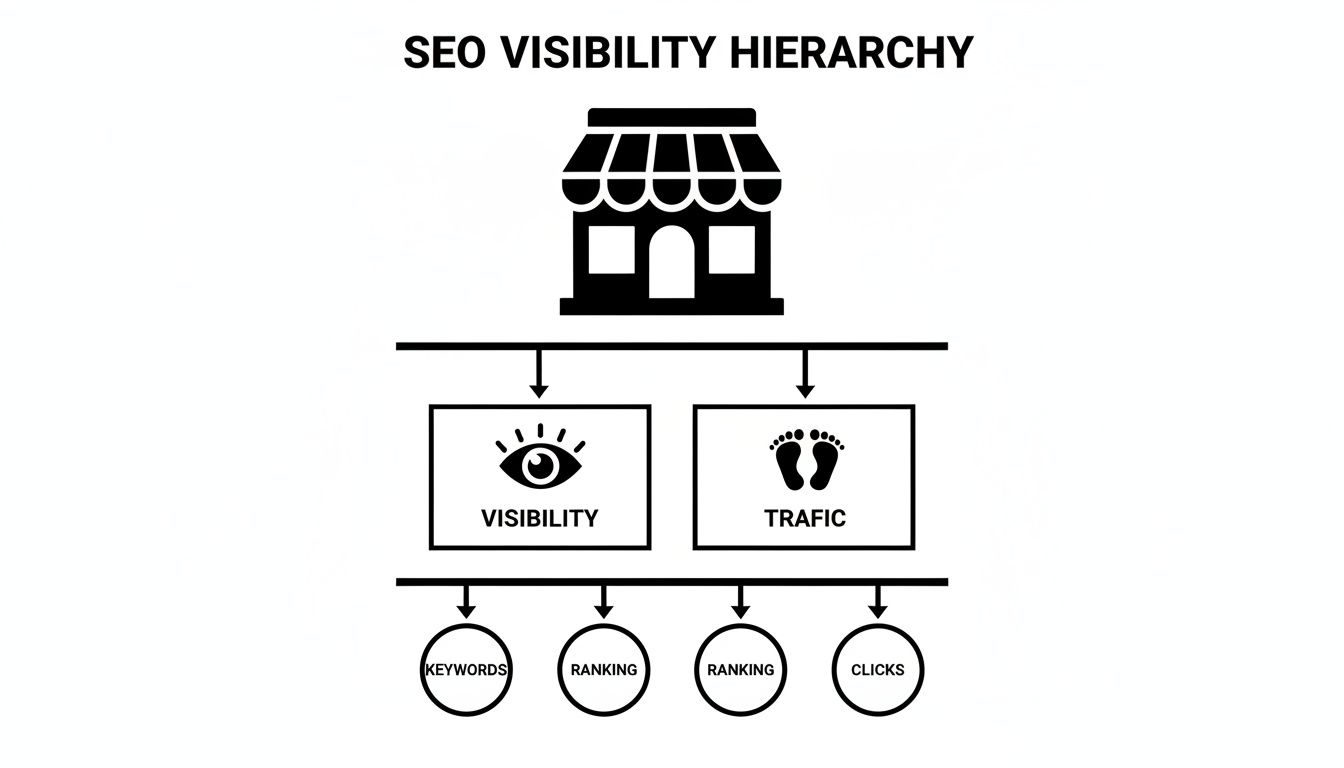
Before a single person can click on your site, they have to see it. Let's break down the metrics that truly define how visible you are.
1. Visibility Score
A Visibility Score is your all-in-one health check for SEO. It’s a single number that shows your overall presence in search results for a specific group of keywords you’re tracking. The magic is that it doesn't just count rankings; it weighs them by search volume. So, ranking #1 for a massive head-term contributes way more to your score than a top spot for a long-tail query nobody is searching for.
Think of it as your SEO’s S&P 500. Instead of tracking dozens of individual keyword movements, you get one clean metric to gauge your organic health at a glance. When the score is trending up, you know your efforts are paying off across the board.
For instance, a B2B SaaS company tracking 50 keywords around "project management software" could use this score as their north star KPI, watching it week-over-week to see if their strategy is gaining ground.
2. Impressions
Impressions are the purest measure of exposure. This metric simply counts every single time a URL from your website appeared in someone's search results. It's the digital equivalent of foot traffic past your storefront; they might not have looked in the window, but they walked by.
Why does this matter so much? Because impressions are a fantastic leading indicator. A sudden spike often means Google is testing your content for new queries, which usually comes right before a boost in clicks and traffic. On the flip side, a sharp drop can be the first warning sign of a technical glitch or an algorithm update that's hit your site.
Tracking impressions is vital because it separates potential reach from actual engagement. If your impressions are high but clicks are low, it points directly to an issue with your page titles, meta descriptions, or SERP snippet appeal.
SEO is never static, and visibility can swing wildly. In 2023, data from the SISTRIX Visibility Index showed some news sites like nbcnewyork.com and aljazeera.com saw their visibility skyrocket by over 100%. This is a perfect example of why you have to keep a close eye on this—major shifts can happen fast. You can dig into more of these 2023 SEO trends and shifts on amsive.com.
3. Click-Through Rate (CTR)
Click-Through Rate (CTR) tells you how many people who saw your listing actually clicked on it. It’s the bridge between being seen and getting a visitor, and the formula is simple: (Clicks ÷ Impressions) * 100.
A high CTR is proof that your search snippets are hitting the mark. It means your title is compelling, your meta description promises a solution, and your overall message aligns with what the searcher wants. A low CTR, especially for pages already on the first page, is a huge red flag that your pitch to the user is falling flat.
4. Share of Voice (SOV) / SERP Share
Share of Voice (SOV), sometimes called SERP Share, is where things get competitive. This metric moves beyond your own performance and measures how visible your brand is compared to your direct competitors for a shared set of keywords. It estimates what percentage of all potential clicks in your market you are actually capturing.
This is one of the most powerful competitive SEO visibility search metrics because it answers the critical question: "How much of the market do we actually own?"
- For example: Let's say the total monthly search volume for your keywords is 100,000. If your site gets an estimated 15,000 clicks from those searches, your Share of Voice is 15%.
Keeping an eye on SOV helps you benchmark your growth against rivals and spot opportunities where they might be dropping the ball.
5. Ranking Distribution
Instead of getting lost in the weeds of individual keyword rankings, Ranking Distribution gives you a bird's-eye view. It groups all of your tracked keywords into performance buckets, so you can see the big picture in seconds.
Most SEOs use buckets like these:
- Positions 1-3: The money-makers, driving the lion's share of clicks.
- Positions 4-10: On page one, with huge potential for growth.
- Positions 11-20: Your "striking distance" keywords, right on the cusp of page one.
- Positions 21+: Pages that need a serious content refresh or a new strategy altogether.
This metric is all about prioritization. A large chunk of keywords sitting in the 4-10 range is your low-hanging fruit—a small push could lead to a big jump in traffic.
6. Featured Snippet Share
That answer box at the very top of the search results? That's a Featured Snippet, also known as "Position Zero." Your Featured Snippet Share is simply the percentage of time your domain owns that prime real estate for your target keywords.
Winning a featured snippet doesn’t just put you at the top; it positions your brand as the definitive answer. Tracking who owns these—you or your competitors—shows who is doing the best job of creating content that directly and concisely answers a user’s question.
7. Branded vs. Non-Branded Visibility
Finally, a truly mature strategy separates visibility into two distinct buckets:
- Branded Visibility: This is how you show up for searches that include your brand name (like "promptposition pricing"). It's a measure of your brand equity and reflects interest from people who are already looking for you.
- Non-Branded Visibility: This is your performance for generic, problem-focused keywords (like "how to measure ai search visibility"). It reflects your ability to attract a completely new audience at the top of the sales funnel.
Analyzing the ratio between these two gives you incredible strategic insight. High branded visibility is great, but if your non-branded is weak, you're not growing your audience. A healthy SEO program works to grow both, nurturing existing interest while constantly bringing new people into your world.
Measuring Visibility In The New Era Of AI Search
The familiar world of blue links is being rapidly reshaped by AI. Search is evolving into a conversation, where engines like Perplexity and features like Google's AI Overviews give you direct, synthesized answers instead of just a list of websites. This shift completely changes how we measure success and visibility.
When there's no simple "ranking" to track, how can you tell if your audience is seeing you? While traditional SEO visibility search metrics still matter, we need a new way of thinking—a set of KPIs built for the era of Large Language Models (LLMs) like ChatGPT, Gemini, and Claude.
Success is no longer just about climbing a list. It’s about influencing the AI's narrative and becoming a trusted source it relies on to form answers.
The New KPIs For AI Search Visibility
In AI search, visibility is all about your brand's presence, authority, and the sentiment attached to it within the answers the AI generates. The goal is simple: become part of the AI's core "knowledge" so your perspective is included when people ask questions. To get there, we need to track a new breed of metrics.
Here are the emerging KPIs that truly matter:
- Brand Mention Frequency: This is the most straightforward metric. It’s a simple count of how often your brand, products, or key people are mentioned in AI-generated responses to a specific set of prompts.
- Source Attribution Rate: This is a powerhouse metric. It measures how often an AI model explicitly cites your website as a source for its information. A high attribution rate is a direct signal of your content's authority and influence.
- Sentiment Score: This goes beyond just being mentioned and analyzes how your brand is being portrayed. Is the AI talking about your company in a positive, negative, or neutral light? This is absolutely critical for managing your brand’s reputation in this new space.
Getting a handle on these metrics requires a new toolkit. Platforms are emerging, like promptposition, that are specifically designed to monitor this new conversational web. They give you a clear window into how your brand is being represented across different AI models.
This screenshot from promptposition shows exactly how a brand can track its visibility against competitors for specific AI prompts.
The dashboard doesn't just show you which brands are mentioned; it visualizes the sentiment, revealing whether the AI's language is positive or negative.
Traditional SEO vs AI Search Visibility
The move from algorithmic rankings to AI-powered answers demands a fundamental shift in both strategy and measurement. One approach is about winning a spot on a list; the other is about shaping a conversation. Getting smart on this topic is essential for any modern marketer, and you can dive deeper in our guide to AI search engine optimization.
To really see the difference, it helps to put them side-by-side.
Traditional SEO vs AI Search Visibility
| Aspect | Traditional SEO (Google) | AI Search (ChatGPT, Gemini) |
|---|---|---|
| Primary Goal | Rank on Page 1 | Be cited as an authoritative source |
| Core Metric | Keyword Ranking Position | Source Attribution Rate |
| User Interaction | User clicks a link to visit a site | User gets a direct answer in the interface |
| Content Focus | Optimized for keywords and snippets | Optimized for clarity, expertise, and facts |
| Success Signal | High Click-Through Rate (CTR) | Positive Brand Sentiment Score |
The key takeaway is that in AI search, visibility is about becoming a trusted, citable entity. Your content needs to be so clear and authoritative that LLMs adopt it as a foundational piece of knowledge to answer user queries.
This doesn't mean it's time to abandon traditional SEO. Far from it. Think of this as expanding your strategy. The same principles that build authority for Google—creating expert-level content, earning high-quality backlinks, and using structured data—are exactly what make your content so appealing to AI models. The challenge now is simply learning how to measure this new form of influence directly.
How to Build an Actionable SEO Visibility Dashboard
All the data in the world is just noise until you can make sense of it. The seven core metrics we’ve covered are powerful, but they really come to life when organized into a dashboard that tells a clear story. A good dashboard does more than just show numbers; it turns raw data into strategic insight, connecting your day-to-day SEO work to big-picture goals like growing brand awareness or generating qualified leads.
This isn't about making charts for the sake of it. It’s about building a command center for your team to make smarter, faster decisions.
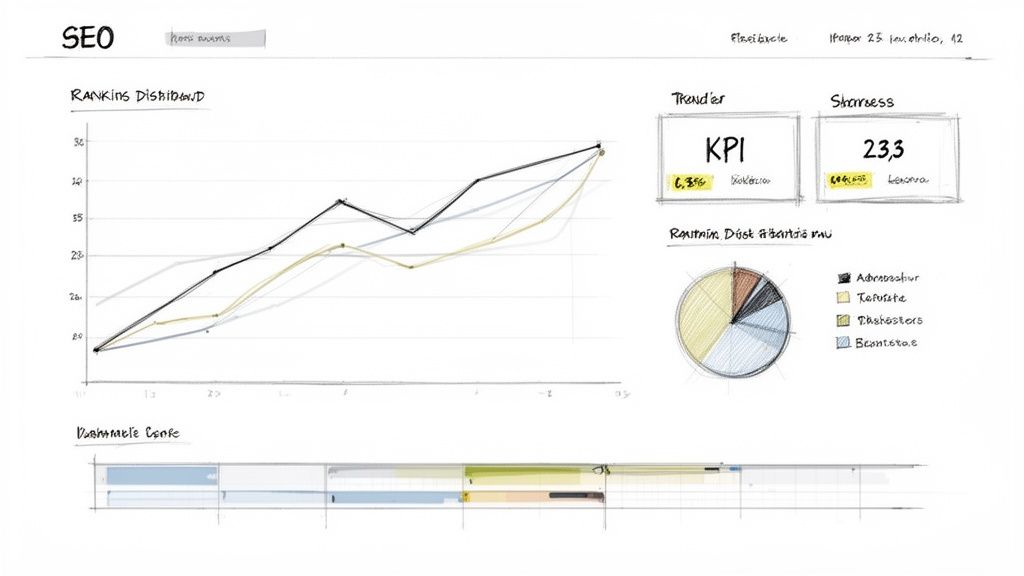
Selecting Your Primary and Secondary KPIs
First things first, you need to separate your primary and secondary Key Performance Indicators (KPIs). Think of your primary KPIs as your north stars—the handful of metrics that show if you're hitting your main objective. Secondary KPIs add the crucial context, explaining why those primary numbers are moving.
- Primary KPIs (The "What"): These are the high-level figures you share with stakeholders. They need to be simple, impactful, and tied directly to a business outcome.
- Secondary KPIs (The "Why"): These are your diagnostic metrics. When a primary KPI goes up or down, you dive into these to find the root cause.
Let's say your main goal is to capture more market share. In that case, your dashboard might look something like this:
- Primary KPI: Share of Voice (SOV)
- Secondary KPIs: Ranking Distribution, Visibility Score, Featured Snippet Share
If you see your SOV dip, you can immediately check your ranking distribution. Did you lose a bunch of top-three positions? Or did a competitor just snag a few more featured snippets? Your secondary KPIs give you the answer.
Designing a Sample Dashboard Layout
A great dashboard is intuitive. It should guide your eye from the 10,000-foot view right down to the nitty-gritty details, making trends and outliers pop off the screen.
Here’s a simple but incredibly effective layout to start with:
Top Row (The Big Picture): Put your primary KPIs front and center. Use large, clear scorecards for your overall Visibility Score and Share of Voice for the current period. A small trend line showing the change from the previous period is a nice touch.
Middle Row (Performance Trends): This is where you use line charts to visualize performance over time. A chart tracking your Visibility Score vs. Top 3 Competitors is fantastic for benchmarking. Another great one is Ranking Distribution over the last 90 days, which clearly shows your progress in pushing keywords onto page one.
Bottom Row (Opportunity Analysis): Now we get to the actionable part. A pie chart showing your current Ranking Distribution can instantly reveal your biggest opportunities (for example, a huge slice of keywords sitting in the "4-10" bucket). You could also include a simple table listing your top 10 "striking distance" keywords (those in positions 4-10) to make prioritization a breeze. You can even learn how to spot these opportunities by exploring new ways of using AI for SEO.
Setting The Right Reporting Cadence
You don't need to check every metric every day. In fact, over-reporting can cause you to make knee-jerk decisions based on normal, everyday fluctuations. A smart reporting cadence keeps your team agile without getting bogged down in the noise.
The search landscape is anything but stable, which makes continuous monitoring essential. Google holds a staggering 89.87% of the global search market, and its algorithm updates can create massive waves. A recent core update, for instance, caused 44% of websites to see a drop in rankings and traffic. This really drives home the need for a well-structured dashboard that helps you react quickly. You can explore more about these impactful SEO statistics on G2.com.
Here’s a balanced schedule that keeps everyone informed and focused:
- Daily: A quick check for major problems. A sudden, massive drop in impressions or visibility could be a sign of a critical technical issue that needs your immediate attention.
- Weekly: This is the perfect time to review high-level trends. Check your Visibility Score, Share of Voice, and Ranking Distribution against the previous week to make sure your strategy is still on the right path.
- Monthly: Time for a deep-dive analysis. Compare month-over-month performance, analyze how your latest content campaigns are doing, and present a summary of progress and key learnings to stakeholders.
Actionable Strategies to Boost Your Search Visibility
Knowing your SEO visibility search metrics is one thing, but actually moving the needle is a whole different ballgame. Turning all that data into real growth comes down to a deliberate strategy built on the three core pillars of modern SEO. Think of them as a three-legged stool: technical and on-page optimization, content strategy, and off-page authority. When all three are solid, they create a powerful engine for getting in front of the right customers.
This isn't just about chasing algorithms. It’s about building a solid digital presence that’s genuinely helpful to people, trusted by search engines, and even seen as a credible source by AI.
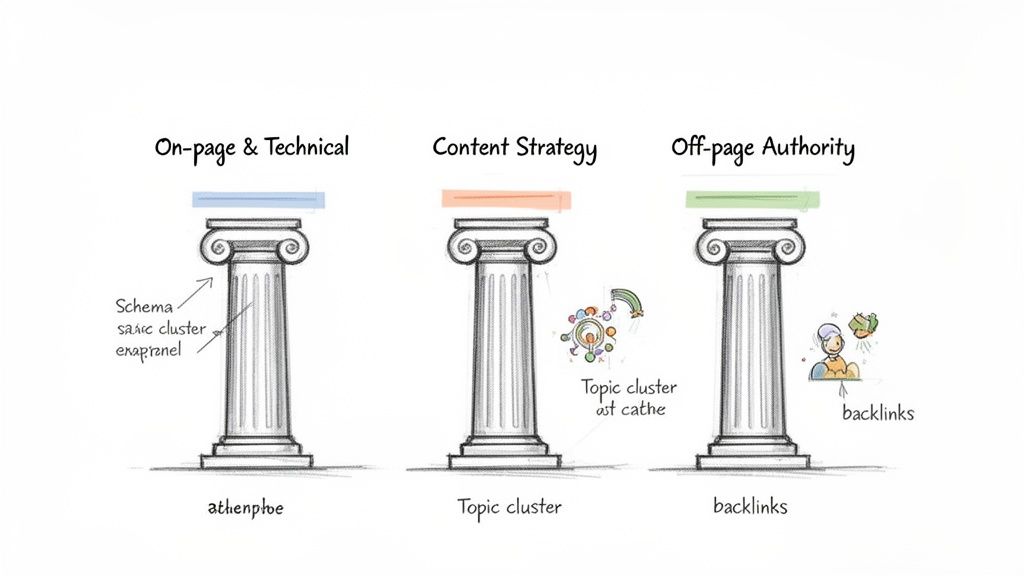
Pillar 1: On-Page and Technical Optimization
Your website's technical health is the foundation of everything. If search engines and users can't easily navigate and understand your site, even the best content in the world won't get found. This pillar is all about getting the fundamentals right so your hard work has a chance to shine.
First things first: make sure search engines can efficiently crawl and index your site. That means hunting down and fixing crawl errors, making sure your robots.txt file isn't blocking anything important, and submitting a clean XML sitemap. Once that's squared away, you can focus on making your content pop in the search results.
Implementing structured data, or schema markup, is one of the highest-impact technical SEO actions you can take. It's like adding a descriptive label to your content, telling search engines exactly what it is—a recipe, a product, an article, or a local business.
That extra clarity helps you earn rich results—things like star ratings, price information, and event listings right in the SERPs. Those little details can seriously boost your click-through rate.
Real-World Example:
A B2C e-commerce brand selling kitchenware had good visibility for "best non-stick pans" but their CTR was disappointing. They decided to add Product and Review schema to their product pages. Within a few weeks, their search listings started showing star ratings and pricing. This made them stand out from the competition and bumped their CTR by 18%.
Pillar 2: Strategic Content Creation
Content is how you actually show up and deliver value. But a strong content strategy isn't about publishing blog posts whenever you feel like it. It's about methodically building topical authority. You want to create comprehensive clusters of content around the topics that matter most to your business.
The goal here is to become the undeniable go-to resource for a specific subject. The "pillar and cluster" model is a fantastic way to do this:
- Pillar Page: Start with a long-form, comprehensive guide covering a broad topic (e.g., "The Ultimate Guide to Project Management").
- Cluster Content: Create several shorter, more focused articles that dive deep into related sub-topics (e.g., "How to Choose Project Management Software," "Agile vs. Waterfall Methods").
- Internal Linking: This is the magic. Each cluster article links back up to the main pillar page, signaling to Google that you have a ton of expertise on the entire subject.
This structure doesn't just organize your site for users; it creates a powerful network of internal links that proves your authority to search engines. It's a proven way to improve your ranking distribution across a whole host of related keywords. This is also a huge piece of what's now being called Generative Engine Optimization, as it gives AI models a clear, well-structured content hub to pull answers from.
Pillar 3: Off-Page Authority Building
Off-page authority is all about your reputation across the web. While your on-page and content efforts show search engines what you say about yourself, off-page signals show what other credible sources are saying about you. And the most powerful signal of all? Backlinks.
High-quality backlinks from reputable, relevant websites are basically a massive vote of confidence. They tell search engines—and increasingly, AI models—that your content is trustworthy and worth citing. The key is to chase quality, not quantity.
So, how do you earn these valuable links?
- Create Original Research: Publish unique data, surveys, or studies that others in your industry will want to cite.
- Develop Linkable Assets: Build free tools, templates, or infographics that people will naturally want to link to because they're so useful.
- Engage in Digital PR: Pitch your expert insights and unique stories to journalists and industry publications.
Think of each quality backlink as a referral from a trusted colleague. The more of those you have, the more authority you build, which directly lifts all your key SEO visibility search metrics. Platforms like promptposition can even show you which sources AI models are already citing, giving you a pre-vetted list of high-value sites to target for your outreach.
Got Questions About SEO Visibility? We've Got Answers.
As you start digging into SEO visibility, a bunch of practical questions are bound to pop up. It's totally normal. Measuring visibility is a bit more nuanced than just checking rankings, so let's clear up some of the most common questions we hear from marketing teams.
What’s the Real Difference Between SEO Visibility and Organic Traffic?
It’s helpful to think of it this way: SEO visibility is your potential, while organic traffic is the payoff.
Visibility tells you how often and how prominently you show up in search results for your target keywords. It’s a measure of opportunity—how many people could see your brand. Organic traffic, on the other hand, is the number of people who actually click through to your site.
If you have sky-high visibility but your traffic is flat, that's a huge red flag. It often means your page titles and meta descriptions aren't doing their job. They're not compelling enough to grab someone's attention and earn that crucial click.
How Often Should I Be Checking My SEO Visibility?
There's no single right answer—it really depends on what you're measuring and where. The goal is to stay on top of things without getting lost in the daily fluctuations.
For Traditional SEO: A weekly check-in on high-level metrics like your overall Visibility Score and Share of Voice is perfect. This gives you a good sense of the trendline and helps you spot major shifts from things like Google updates or a competitor making a big move.
For AI Search: Things move a lot faster in the AI world. AI-generated answers can change in an instant. You'll want to use a specialized tool to check for brand mentions and source citations daily or at least every few days. A tool like promptposition can help you stay on top of this.
For Big-Picture Strategy: Save the deep dives for monthly or quarterly reviews. This is when you'll connect the dots between your major content pushes or strategic changes and their impact on your core SEO visibility search metrics.
Splitting up your check-ins like this helps you stay agile. You can jump on urgent issues in AI search while giving your broader SEO efforts the time they need to mature. It's a balanced approach that keeps you focused on long-term growth instead of chasing every minor dip and spike.
Can I Actually Improve My AI Search Visibility Without a Massive Budget?
Yes, absolutely. This is one area where the little guy can win. AI search visibility often rewards deep, niche expertise more than just raw domain authority.
LLMs are on the hunt for clear, authoritative content that gives a direct, satisfying answer to a user's question. This is where smaller businesses can shine. If you can create the single best, most comprehensive piece of content on a very specific topic, publish original data, or get cited by other respected sources in your field, you can become the AI's go-to source.
This focused approach lets you bypass bigger, more generalist competitors who are trying to be everything to everyone.
What Are the Best Tools for Tracking SEO Visibility?
To get the full picture today, you really need a two-part toolkit: one for the classic search engines and another for the new world of AI search.
For traditional search, the old reliables are still fantastic. Tools like Semrush, Ahrefs, and Moz are the industry standard for a reason. They give you all the foundational data you need for Google and Bing—visibility scores, keyword rankings, SERP features, you name it.
But for AI search, those tools are flying blind. You need a platform built for this new environment. Tools like promptposition are designed from the ground up to measure how your brand shows up in ChatGPT and other LLMs. It tracks critical metrics like source attribution that traditional SEO tools completely miss.
Curious how your brand is really showing up in AI search? promptposition provides the clarity you need to measure and improve your visibility in ChatGPT, Gemini, and beyond. It’s time to stop guessing and start measuring. Get started with promptposition today.