Ai Brand Monitoring: A Practical Guide to Winning in the New Era of SEO
AI brand monitoring is the new frontier of search. It’s the process of tracking how your company, products, and competitors appear in the answers generated by Large Language Models (LLMs). With millions of people turning to AI chatbots for recommendations and advice, understanding your brand's presence in these new conversations is no longer optional—it's a critical part of any modern marketing strategy.
This guide will help you understand this new field and give you a clear, actionable plan to get started.
Your Brand Now Has a Life Inside AI Conversations
Imagine a massive, invisible focus group discussing your brand 24/7. That's what is happening inside AI models like ChatGPT, Gemini, and Claude. When someone asks for a product recommendation or a list of top companies, these AI systems synthesize information from across the web to form an opinion and deliver a confident answer.
For marketers, this is a seismic shift. For years, the objective was simple: climb to the top of Google's search results. Traditional SEO focused on ranking your website higher than everyone else's. While that's still important, it’s only half the story now.
The Shift from Search Rankings to AI Narratives
Your brand’s reputation has a second life—one that exists entirely within AI-generated responses. These AI-driven conversations are the new front line for brand perception, shaping customer decisions before they even click a link or visit your site.
This means we must look beyond keyword rankings and start paying attention to the story being told about our brands. The new frontier is about understanding and influencing how your company is portrayed in this constant, automated dialogue. The questions we need to ask have changed:
- Are we even mentioned? When a potential customer asks an AI for the "best software for project management," does your brand make the list?
- What’s the context? If you are mentioned, is it in a good light? Are you positioned as a premium leader or a budget-friendly option?
- Who are we compared to? Which competitors show up next to your brand, and how does the AI frame that comparison?
This new reality demands a new strategy. Relying solely on traditional SEO is like bringing a map to a conversation. It's the wrong tool for navigating a dynamic, fluid environment where narratives are formed in real-time.
A New Strategy for a New Era
This is precisely where AI brand monitoring comes in. It's the practice of systematically tracking and analyzing your brand’s presence within the outputs of these powerful language models. It gives you a window into this massive, ongoing conversation, letting you listen in, see where you stand, and start managing how your brand is perceived.
Without this visibility, you're flying blind, completely unaware of the reputation being built for you. By adopting an AI brand monitoring strategy, you can go from being a passive subject of the AI's opinion to an active participant in shaping it.
Understanding AI Brand Monitoring
Let's get straight to it. AI brand monitoring is the practice of keeping a close eye on how your brand, your products, and even your competitors show up in the answers generated by Large Language Models (LLMs). Think about platforms like ChatGPT or the new AI Overviews from Google—they're quickly becoming the first stop for information, shaping how people see you before they even click a link to your website.
Think of it like this: imagine there's a massive, non-stop focus group happening online where your industry is the main topic. You'd absolutely want to know what’s being said about you. AI brand monitoring is your one-way mirror into that conversation, showing you exactly how these AI models describe your company, stack you up against the competition, and summarize your reputation for millions of people.
How It’s Different from What You’re Already Doing
It’s easy to lump this in with older marketing tactics, but that's a mistake. While they might sound similar on the surface, their focus and the way they work are completely different. The old tools just don't give you the full picture anymore.
- Social Listening: This is all about tracking what real people are saying on public platforms like X (formerly Twitter), Reddit, or personal blogs. It’s about listening to raw, unfiltered public opinion as it happens.
- SERP Tracking: This is your classic SEO workhorse. It focuses on how your website ranks in a list of blue links on Google. The whole game is about getting to that #1 position.
AI brand monitoring is a different beast entirely. It tracks the final, synthesized answer a machine creates and presents as fact. It’s not about where you rank on a list; it’s about how you’re framed within the AI’s generated story. We're analyzing the authoritative-sounding summary the AI gives the user.
Why You Can’t Ignore This Anymore
The move to AI-generated answers creates new problems that your existing tools just aren't built to handle. For example, an LLM could dig up a negative review from 2018, treat it as current information, and bake it into an answer, quietly damaging your reputation without you ever knowing it happened.
The real shift is that we're now tracking a conclusion, not just a mention. An AI doesn't just name-drop your brand; it forms a judgment, summarizes sentiment, and makes direct comparisons—all inside a single, trusted answer.
This is exactly why specialized tools like promptposition have become so important. They’re built to go beyond simple mention counting and actually analyze the quality of how your brand is portrayed. That means tracking the sentiment, seeing how you're compared to rivals, and spotting factual errors or AI "hallucinations" before they become a real problem.
The market is already telling this story loud and clear. The AI in Branding market, currently valued at USD 2.64 billion, is expected to skyrocket to USD 7.9 billion by 2034, growing at a healthy 11.6% CAGR. This growth spurt shows just how much companies are starting to rely on AI-specific tools to manage their brand in this new search era. The cloud-based segment is leading the charge, making up over 59.6% of the market thanks to its flexibility. If you want to dig into the numbers, you can find more data on AI adoption in branding on market.us. This isn't just hype; it's a direct response to the new challenges and opportunities that generative AI has put on the table.
The New Metrics That Matter in AI Search
To really get a handle on this, we need to talk about measurement. The old playbook of SEO metrics—things like keyword rankings and domain authority—just doesn't cut it anymore. They aren't designed for a world where an AI is the one giving the answers.
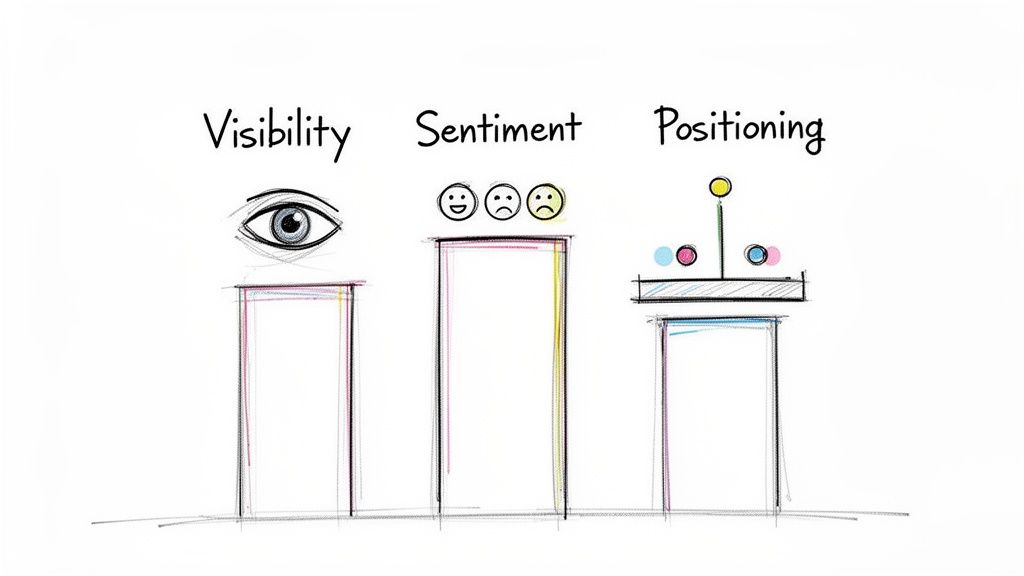
Instead, effective AI brand monitoring stands on three new pillars. These aren't about where you rank in a list of blue links, but how you show up in a conversation. They’re built to measure the quality of your brand's story as it's understood and retold by Large Language Models (LLMs).
Let’s dig into what you actually need to start tracking.
Pillar 1: Visibility
First up is Visibility. It’s the most basic but crucial question: how often does your brand even appear when someone asks a relevant question? Think of it as the new "share of voice," but for AI-generated answers.
When a potential customer asks a chatbot, "What are the best CRMs for a small business?", Visibility tells you if your company made the cut. If your score is low, you’re essentially invisible to a huge, growing audience that relies on these tools for quick answers. Tracking this shows you whether your awareness efforts are actually making a dent in the AI’s knowledge.
Pillar 2: Sentiment
Getting mentioned is one thing, but the context of that mention is everything. That’s where Sentiment comes in. This metric analyzes how an AI describes your brand, flagging the language as positive, negative, or neutral. It’s a huge leap beyond just scanning social media mentions.
An AI could bring up your product but frame it negatively, maybe by pulling from an old article about high prices. Or, it could praise your fantastic customer service. Monitoring sentiment gives you a real-time pulse check on your reputation and can help you spot a PR fire before it starts burning.
Tracking sentiment isn't just about spotting good or bad words. It's about understanding the AI’s authoritative summary of your brand, which millions of users may accept as fact without further research.
Pillar 3: Positioning
Finally, we have Positioning, which is arguably the most strategic metric of all. This reveals how your brand is framed against competitors and the market as a whole. It answers the critical question: "When we are mentioned, what story is the AI telling about us?"
Positioning tracks the specific labels and qualities the AI attaches to your brand. Are you the "market leader"? The "budget-friendly option"? An "emerging innovator"? This gives you direct feedback on whether your own brand messaging is landing as intended.
- A software company might want to be seen as the top choice for enterprise clients. If AI monitoring shows they are consistently positioned as a "great tool for startups," that’s a major disconnect they need to fix.
- An e-commerce brand is frequently mentioned with a key competitor. Positioning analysis reveals the AI describes the competitor as "more reliable" but their brand as "more innovative." That's a powerful insight that can shape both marketing and product development.
Comparing Traditional SEO Metrics to AI Brand Monitoring KPIs
This table shows just how much the focus has shifted. We're moving away from the technical signals of traditional search engines and toward the narrative-driven KPIs essential for the new AI-powered landscape.
| Focus Area | Traditional SEO Metric | AI Brand Monitoring KPI |
|---|---|---|
| Awareness | Keyword Rankings | Visibility Score (% of mentions in relevant answers) |
| Reputation | Backlink Profile Quality | Sentiment Analysis (Positive, Negative, Neutral ratio) |
| Market Fit | Organic Click-Through Rate (CTR) | Positioning Accuracy (Alignment with brand messaging) |
| Authority | Domain Authority (DA) | Attribute Association (e.g., "innovative," "reliable") |
Ultimately, it’s a whole new ballgame. While old metrics still have their place, these new KPIs are what will give you the clarity needed to succeed as AI continues to reshape how people find information.
By tracking these three pillars, you get a clear, multi-dimensional view of your brand’s life inside AI. You can turn what feels like a black box into concrete data for making smarter decisions. As you get deeper into this, you'll see how these concepts fit into the bigger picture, which you can explore in our guide to AI search engine optimization.
How AI Models Form Their Opinions About Your Brand
If you want to manage how your brand shows up in AI-generated answers, you have to get inside the model's head. It's easy to think of a Large Language Model (LLM) as a kind of digital brain that forms opinions, but the reality is much simpler—and much more manageable for marketers.
An AI model doesn't have beliefs or experiences. Its entire worldview is built from the massive library of text and data it was trained on. This training dataset is basically a giant snapshot of the public internet. Think Wikipedia, news articles, product reviews, forum threads, and, yes, your own website.
The Source Material Is Everything
When an AI like ChatGPT or Gemini gives you an answer, it’s not inventing something new. It's just predicting the most likely next word based on all the patterns it absorbed from its training data.
This is the single most important thing to understand in AI brand monitoring. You can't just "rank" your brand inside an AI the way you rank a webpage on Google. The model isn't a search engine you can optimize for.
The key takeaway is this: to change an AI’s output, you must first change its input. Influencing an AI is not about optimizing for the model itself, but about shaping the source material it learns from.
This completely shifts where you put your energy. Your goal is no longer just to create the perfect landing page. It's about making sure a strong, positive, and consistent story about your brand exists across all the different places an AI might learn from. This idea is the foundation of Generative Engine Optimization, a new field focused on influencing these source materials. You can dive deeper into this with our guide on what is Generative Engine Optimization.
Understanding Knowledge Cutoffs and Updates
Another crucial piece of the puzzle is the knowledge cutoff. Most LLMs have a "born on" date—a point in time after which they haven't been trained on new information. An AI might be working with data that stops in early 2023, leaving it completely blind to your latest product launch or that great article written about you last month.
This has two huge implications for your strategy:
- Old Information Can Linger: A negative review or outdated product detail from years ago can stick around if it was prominent in the training data. These "zombie narratives" can haunt your brand long after they've become irrelevant.
- New Information Takes Time: Your latest PR wins and content won't show up in AI answers overnight. Even when models are updated, it takes time for that new information to be absorbed and start shaping responses.
This is exactly why a dedicated monitoring platform is no longer a nice-to-have. A tool like PromptPosition, for instance, can help you see which specific sources an LLM is referencing when it talks about your brand. By figuring out if the AI is pulling from a three-year-old tech blog or a recent industry report, you can stop guessing and start focusing your efforts where they'll actually make a difference.
How to Build Your AI Brand Monitoring Strategy
Knowing what AI brand monitoring is and actually doing it are two different things. A solid strategy isn't about running a few random checks here and there; it's about building a repeatable process that turns what AI says about you into real-world business intelligence.
Let's break down a simple, five-step cycle that any marketing team can put into practice. This framework is designed to get you from that initial "what's out there?" phase all the way to taking concrete, measurable action. It’s how you get out of a reactive mode and start proactively shaping the conversation.
Step 1: Define Your Core Prompts
First things first, you need to figure out what questions your actual customers are asking these AI tools. We’re not talking about broad, generic queries. You need to get into the heads of your ideal customers and pinpoint the high-intent prompts they use when they're close to making a buying decision.
What would someone type into ChatGPT or Perplexity when they're seriously evaluating solutions like yours? A great place to start is brainstorming questions that fit into a few key buckets:
- Comparative: “What are the best alternatives to [competitor's product]?”
- Problem/Solution: “How do I solve [specific customer pain point]?”
- Best-in-class: “List the top software for [your category].”
These core prompts are the bedrock of your entire AI brand monitoring program. You can even use platforms like promptposition to uncover high-volume questions you might not have thought of on your own.
Step 2: Establish a Baseline
Once you know what to ask, you need a starting point. This is where you run your core prompts through the major AI models to establish a baseline. You’re measuring where you stand right now on your key metrics: Visibility, Sentiment, and Positioning.
Think of this initial audit as a snapshot of your current AI reputation. Are you even showing up? When you do, is the tone positive? Are you framed as a leader or just another option? Without this baseline, you have absolutely no way to tell if your future efforts are actually making a difference.
This is a good moment to remember how these AI models even form their "opinions" in the first place. They're not thinking; they're synthesizing. They ingest an unbelievable amount of data from across the web, process it all during training, and then generate answers based on the patterns they've learned.
The chart below gives you a simple look at how this all works, from the raw data all the way to the final answer.
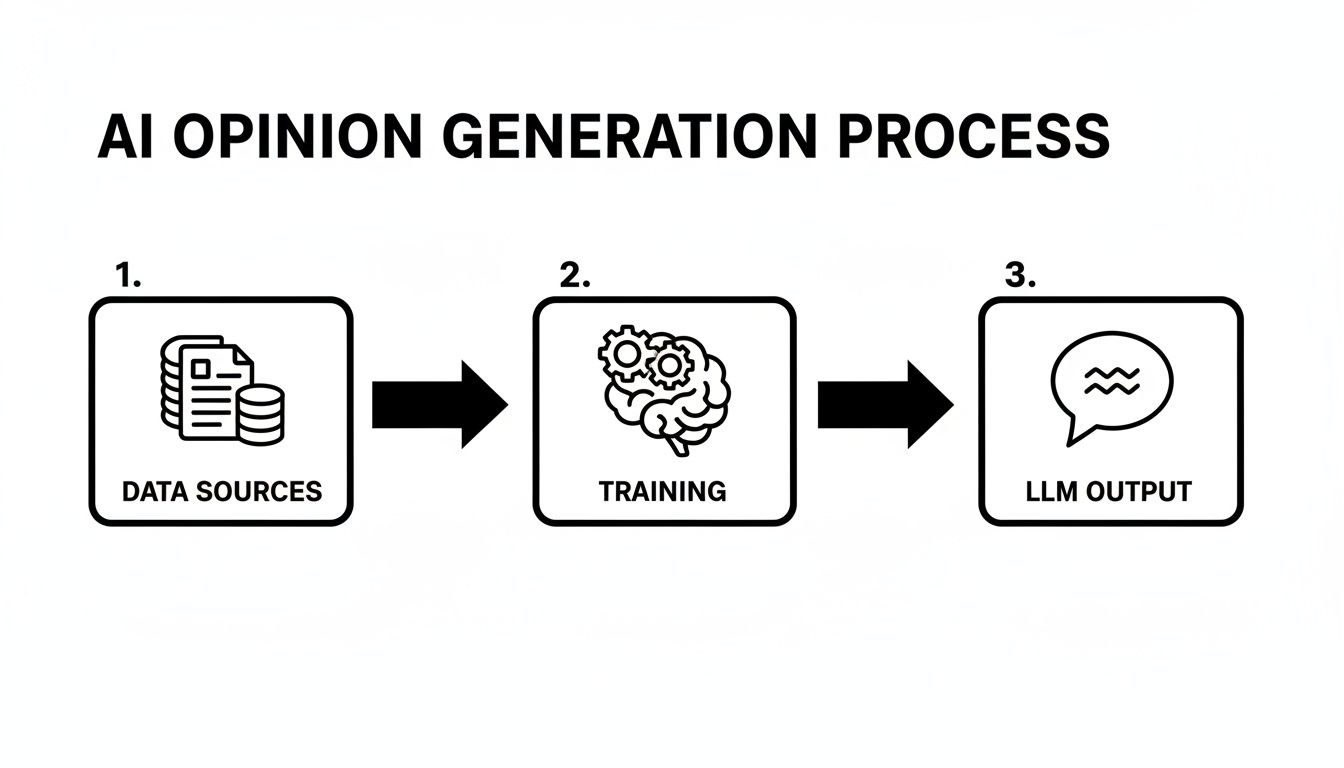
What this really shows is that if you want to influence the final output, you have to start by shaping the source material the AI is learning from.
Step 3: Benchmark Against Competitors
Your brand doesn't operate in a vacuum, and neither do AI responses. The next logical step is to run the exact same set of prompts, but this time for your top competitors. This is how you figure out your "share of voice" in AI-driven conversations and, more importantly, where the gaps and opportunities are.
You might find that a key competitor is consistently named as the top solution for a high-value prompt where you're completely invisible. That kind of intel is gold. It tells you exactly where to aim your content and PR efforts to start winning back that mindshare.
Step 4: Analyze Verbatims and Sources
Metrics are great, but the real magic is in the details. This step is all about digging into the "why" behind the numbers. You need to read the actual AI-generated responses—the verbatims—to understand the precise language being used to describe your brand.
An AI brand monitoring platform can trace a specific claim or sentiment back to its source—the specific article, review, or forum that the LLM learned from. This forensic analysis is the most actionable part of the process.
It’s what turns a vague problem like "our sentiment score is down" into a concrete task: "we need to address that negative review on a 2022 tech blog that the AI keeps referencing."
Step 5: Take Action and Measure
Finally, it's time to do something with all this information. Armed with insights from the previous four steps, you can launch highly targeted campaigns. Maybe that means creating a new piece of content to fill an obvious knowledge gap. Or it could be a PR push to generate more positive coverage, or even just reaching out to a third-party site to get an outdated article corrected. If you want to get into the nitty-gritty of implementation, check out our guide on how to use AI for SEO.
Once you've launched your initiative, the cycle starts over. You go back to Step 2, measure your baseline again, and see how your actions have shifted the AI's outputs over time. This continuous loop is what moves the needle.
Dedicated AI brand monitoring platforms are making this whole process wildly more efficient. Some tools are seeing an incredible 1500% average jump in AI mentions for their clients in just two weeks. But it's not just about visibility. These platforms are also helping drive 31% shorter sales cycles and 23% higher lead quality by making sure the brand story AI tells is accurate and compelling. While old-school monitoring tools completely miss these new conversations, platforms that offer real-time alerts and competitive tracking across models like ChatGPT and Google AI Overviews are quickly becoming must-haves.
Common Pitfalls to Avoid in AI Brand Monitoring
Diving into AI brand monitoring is exciting, but it’s also easy to get tripped up right out of the gate. I’ve seen many teams make the same initial mistakes, which unfortunately leads to wasted effort and missed opportunities. Knowing what to watch for helps you build a much stronger program from day one.
The most common error I see? Teams focus on broad, generic prompts instead of the specific, high-intent questions their customers are actually asking. Monitoring a query like "what is CRM software" is simply too wide to be useful. You're much better off tracking prompts like "best CRM for a real estate agency under $50 per month," because that's the language of someone who is ready to make a decision.
Another big mistake is treating AI monitoring as a set-it-and-forget-it project. These AI models aren't static. Their training data is constantly being updated, which means their answers can and will change. A one-off audit tells you where you stand today, but it won't alert you when your brand sentiment suddenly tanks next month. This needs to be an ongoing process.
Overlooking the Human Element in the Data
It’s tempting to get lost in all the charts and sentiment scores, but a huge pitfall is ignoring the qualitative gold hidden in the AI’s actual responses. The exact words a model uses to describe your product tell you so much about your brand's perceived strengths and weaknesses.
AI models are probability engines, not truth machines. Research shows that asking the same question 100 times will likely produce 100 unique variations in the list and order of recommendations. Tracking a single "ranking" is a fool's errand; focus on visibility across many queries instead.
This is where the real work—and the real value—lies. If a model consistently describes your software as "powerful but complex," that's a direct signal to your marketing and product teams. Ignoring that kind of feedback means you're missing the whole point.
Tracking Vanity Metrics Without Business Goals
So many teams fall into this trap. They track metrics that look good on a dashboard but have no real connection to business outcomes. Simply counting how many times your brand gets mentioned is a classic example of a vanity metric. Sure, it feels good to see that number go up, but it doesn't tell you anything about the quality or impact of those mentions.
A much smarter approach is to tie your AI brand monitoring directly to clear business goals. Instead of just counting mentions, shift your focus to metrics that actually mean something:
- Share of Voice for High-Intent Prompts: Are you mentioned more than your top competitor for questions asked by customers who are ready to buy?
- Sentiment on Key Features: Is the AI's description of your new feature positive, or is it highlighting a known bug?
- Positioning Accuracy: If your core brand message is being the "premium choice," does the AI's description reflect that?
By sidestepping these common mistakes, your monitoring program will start producing genuine, actionable intelligence instead of just another pile of data. Using a platform designed for this can help steer you toward the metrics that matter and away from the superficial ones, ensuring your strategy delivers real results.
Your Questions About AI Brand Monitoring, Answered
As AI brand monitoring becomes a must-have for marketing teams, a lot of questions pop up. It’s a new frontier, after all. Let’s walk through some of the most common ones to give you a clearer picture of how it all works.
Isn't This Just Another Name for Social Listening?
Not at all. While they’re related, they look at two very different parts of the information ecosystem.
Social listening tunes into what people are saying across public forums like Reddit, X (formerly Twitter), and news outlets. It’s the raw, human conversation. AI brand monitoring, on the other hand, focuses on the polished, synthesized answers that machines create for users.
Think of social listening as hearing all the individual ingredients and opinions that go into the recipe. AI monitoring is about tasting the final dish that the chef—the AI model—serves up.
Can't We Just Go to ChatGPT and Check It Ourselves?
You could, but you’d only be getting a tiny, unreliable snapshot. Manual checks are not a scalable or accurate way to measure your brand’s presence in AI.
AI models are non-deterministic, which means they can give slightly different answers every time you ask the same question. One search tells you almost nothing about the bigger picture.
Automated tools are designed to overcome this. They run hundreds or thousands of queries to calculate the probability of your brand showing up. This gives you a stable, bird's-eye view of your visibility that you could never get by hand.
How Do We Get Rid of Negative Information an AI Mentions?
This is a big one. You can't just hit a "delete" button on something an AI has learned, the way you would with a social media comment. The models are trained on the public web, so the only real solution is to go to the source.
The strategy involves finding the negative material the AI is learning from—maybe it's a scathing old review or an outdated, misleading article. The next step is to create a wave of new, positive, and authoritative content that eventually pushes the old information out of the AI's "memory." You essentially have to drown out the old noise with a better signal.
What Tools Do We Need to Start?
The right tool really depends on what you’re trying to track.
- If you want to monitor the human conversations that feed the AI models, a social intelligence platform is what you need.
- If your goal is to measure the final AI-generated answers that your audience sees, you’ll need a dedicated AI brand monitoring platform.
Many teams end up using both to get a complete picture. A tool like promptposition was built specifically to monitor what Large Language Models say, letting you measure your brand’s visibility and sentiment right inside these new AI-driven environments.
Where Is All of This Going?
The future here is directly linked to how fast AI is becoming the new search engine. The market for AI SEO tracking is expected to explode, growing from $1.99 billion to $4.97 billion by 2033.
Why such a big jump? Because user behavior is fundamentally changing. Some analysts even predict that 90% of human traffic could disappear from traditional websites as people increasingly rely on AI agents to get answers for them. You can read more about this market shift and what it means for businesses.
As this shift accelerates, understanding how AI models see and talk about your brand won't just be a nice-to-have. It will be as critical as traditional SEO is today.
Ready to see how your brand appears inside AI conversations? The team at promptposition can give you the visibility and insights you need to build a winning strategy. Learn more at https://www.promptposition.com.