Mastering Query Fan-Out to Win in AI Search

When you ask a question to an AI-powered engine like Google's Gemini, something incredible happens behind the scenes. Your single question is instantly transformed into a flurry of more specific, detailed questions. This process is called query fan-out, and it's the key to understanding the new world of SEO.
Instead of running just one search, the AI performs many searches at once to gather a complete picture before crafting its final, unified answer for you. For anyone in marketing or SEO, this is a fundamental shift in how search works, and mastering it is your new top priority.
The Hidden World of Query Fan Out
Think about it like this: if you asked a top-tier research analyst to find the "best laptop for a college student," they wouldn't just search for that one phrase. They would immediately break the problem down and send junior analysts to dig into specific aspects all at once.
One would investigate "top laptops under $1000 with long battery life." Another would look into "lightweight laptops for carrying across campus." Someone else would compare "student discounts on Apple MacBooks vs. Dell XPS," while a fourth would pull "performance benchmarks for running engineering software."
That's precisely what an AI does with query fan-out. The Large Language Model (LLM) acts like that senior researcher, breaking your request apart and firing off a whole set of internal sub-queries. In the blink of an eye, the AI is conducting a massive research project to explore the topic from every conceivable angle.
Why This Changes Everything for SEO
For years, SEO has been a straightforward game: identify the keywords people are typing and create content that ranks for those exact phrases. Query fan-out flips that model on its head. Now, your goal isn't just to rank for the user's initial prompt, but to be the best answer for the dozens of machine-generated questions that follow.
The real challenge? Most of these AI-generated sub-queries are completely invisible. They have zero monthly search volume because a human never types them. Yet, they are the very building blocks the AI uses to form its "opinion" and construct an answer.
This creates a brand new visibility problem. Your content might perfectly answer the main question and even rank #1 in traditional search, but if it doesn't address the nitty-gritty sub-queries the AI is exploring, you will be left out of the final AI Overview entirely.
To stay relevant, we must move past optimizing for single keywords. The new imperative is to build true topical authority. This means creating content so comprehensive that it answers not just the question a user asks, but all the related questions an AI thinks are important. Only then will your brand be seen as a credible and complete source, worthy of being included in the final answer.
How AI Multiplies Every User Search
When someone types a prompt into an AI, it doesn't just go looking for one single, perfect answer. Think of it more like an expert researcher who instantly breaks that initial request down into a whole bunch of smaller, more specific questions. This internal process is called query fan-out, and it's the engine that turns a simple search into a full-blown investigation.
The AI is smart enough to figure out what you really mean. It uses two key actions: semantic expansion and sub-query generation. Basically, it pulls out the core ideas from your prompt and then spins up a whole web of related questions to explore every possible angle, making sure nothing gets missed.
From One Prompt to Many Searches
Let's take a common business query: "best project management software." A traditional search engine would just spit back a list of pages that have been optimized for that exact phrase. An AI, on the other hand, digs deeper to understand the user's true intent and kicks off a fan-out.
That one little prompt can instantly splinter into a dozen or more internal searches that the AI runs behind the scenes.
- Feature Comparisons: "Trello vs Asana features"
- Pricing Models: "project management software pricing"
- Use Case Specificity: "software for small teams" or "agile project management tools for developers"
- Integration Capabilities: "project management software that integrates with Slack"
- User Sentiment: "Monday.com user reviews 2024"
This is a great way to visualize how a single user prompt tells the AI model to generate multiple, distinct sub-queries to pull together a comprehensive answer.
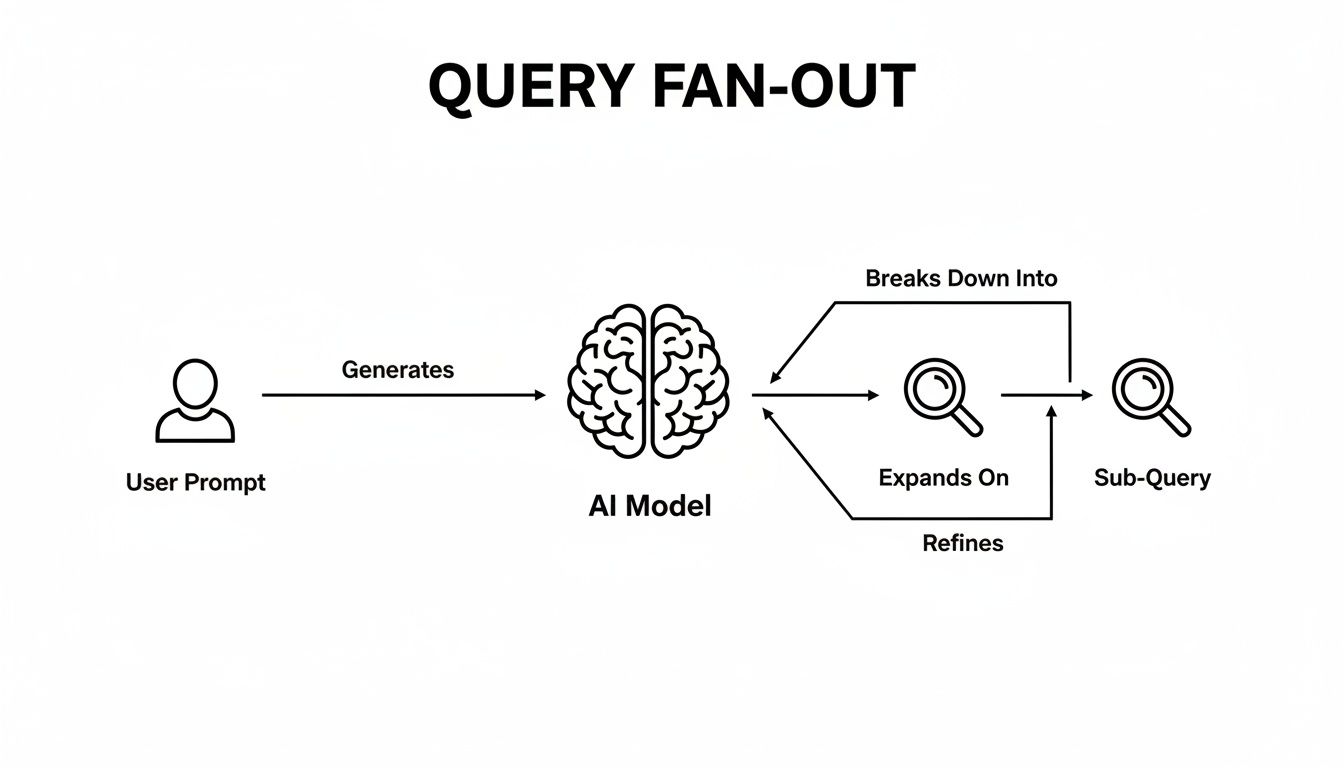
The big takeaway here is that the final answer you get from an AI isn't based on a single search. It's a carefully stitched-together summary of what it learned from all those different internal queries.
The Invisible Search Explosion
The scale of this process is mind-boggling. For every one question a user asks, the AI might be asking itself anywhere from 5 to 20 more. This creates a massive new layer of search activity that is completely hidden from public view.
This dramatic multiplication means a single user's search is now fragmented across dozens of micro-intents. The challenge for brands is that traditional SEO tools, which track what humans search for, are completely blind to all this machine-driven activity.
Recent research really puts the scale of this into perspective. An analysis of over 60,000 fan-out queries found that AI systems generate an average of 10.7 sub-queries for every initial prompt. Here's the kicker: an incredible 95% of these fan-out queries have zero monthly search volume, making them totally invisible to standard keyword tools. A single inquiry about your brand can easily spawn 8-12 highly targeted lookups that you can't see or track with old-school methods. You can read the full research on the new realities of AI search to dive deeper.
This creates a dangerous visibility gap. If your content only hits the main, high-volume keyword, you're missing the chance to influence the AI’s "thinking" as it explores all those fan-out queries. Your competitors, whose content answers these machine-generated questions, will get cited, and you'll be left out of the final answer.
This is where new tools designed for this reality come in. They help bridge that gap by showing you exactly what sub-queries are being generated for your most important prompts. By tracking these machine-generated queries, platforms like promptposition make the invisible visible, allowing you to see exactly where your content is falling short and failing to meet the AI's research needs.
The High Stakes of Being Invisible in AI Answers
The technical side of query fan-out is one thing, but what this means for your business is where it gets real. When an AI takes a single prompt and shatters it into a dozen internal searches, it’s creating a dozen new places where your brand has to compete. If you don't show up in these micro-searches, the consequence is brutal: you disappear from the final AI-generated answer.
This isn't some far-off future problem—it's happening today. Every time an AI crafts a response, it's effectively giving credit to its most trusted sources through what we call AI citations. If your content isn’t a direct hit for the very specific questions the AI is asking behind the scenes, you don’t get cited. You're just… gone.
The Real Cost of Being Left Out
Getting cut from an AI answer is far worse than a low ranking on a traditional search results page. Being omitted sends a powerful message: you're irrelevant. When a potential customer asks for recommendations and your brand is missing, the AI is essentially telling them you’re not even in the running.
The fallout from this is immediate and cuts deep:
- Lost Brand Mentions: Your name never even makes it to the user's list of options because the AI's internal research passed you by.
- Negative Perception by Omission: When all your competitors are cited as credible solutions, your absence makes you look inferior or incomplete by comparison.
- Competitors Hijack the Narrative: The brands that do show up for those fan-out queries get the recommendation, stealing market share right from the AI's mouth.
Here's a critical mistake brands are making: they assume their strong SEO performance will carry over. An AI couldn’t care less about your domain authority if your content doesn't have the granular details it needs to answer one of its hidden sub-queries.
This new reality demands a fundamental shift in how we think. It’s no longer enough to rank for a big keyword. You have to become indispensable to the AI's entire research process.
The Personalization Amplifier
To make things even trickier, AI models add a layer of personalization on top. The fan-out queries aren't the same for everyone, even if they type the exact same prompt. The AI adapts its internal questions based on a user's search history, location, and past conversations.
Think about a prompt like "best remote work software." For a startup founder, this might fan out into sub-queries like "affordable collaboration tools for small teams." For a corporate manager, it might trigger searches for "enterprise-grade security in remote software." Because this is always changing, you can't just optimize for one static set of questions.
The only way to defend against this is through exhaustive content coverage. Your job is to build a deep library of content that explores your topic from every possible angle, anticipating all the different needs that could fuel these personalized fan-out queries.
The Alarming Data on AI Invisibility
The risk here isn't just a theory; we have the data to prove it. Our original research, which analyzed 173,902 URLs, uncovered a shocking reality: 88% of brands are currently invisible in AI citations. They're being ignored because their content just isn't built to handle fan-out.
We found that AI models split a single user search into 8-12 sub-queries, and a whopping 73% of those sub-queries change dynamically from one session to the next. Most brands simply can't keep up. You can explore the full findings on why most brands are invisible in AI search.
But the research also found a silver lining. Brands that actively target fan-out queries see huge returns. A smart content strategy covering just 60% of the likely sub-queries can earn a brand up to 5 AI citations in a single answer. The message is clear: ignoring query fan-out is a fast track to becoming obsolete. The stakes are simply too high to leave it to chance.
Winning with Topical Authority in AI Search
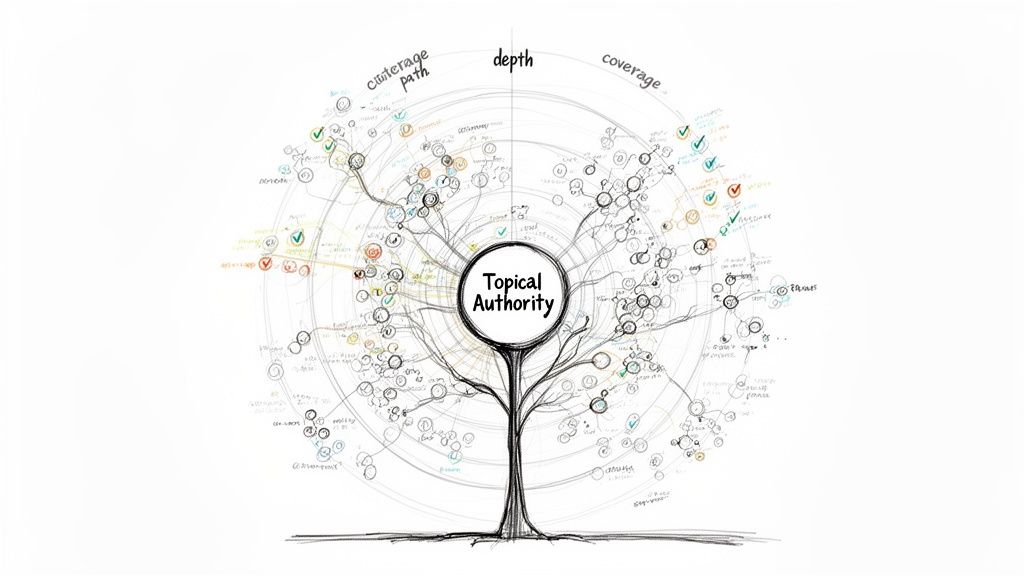
With the real risk of being completely left out of AI-generated answers, the old playbook just won't cut it. The way forward isn’t about chasing more keywords or stacking up backlinks; it's about building deep, undeniable topical authority.
Think about it from the AI's perspective. These models are designed to find and reward comprehensive knowledge. They don't just hunt for a single page that sort of matches a query. They scan the entire web, looking for the sources that cover a subject from every possible angle, proving they are true experts.
This changes the entire game for content strategy. The old goal of ranking for one keyword is officially obsolete. Your new mission is to become the definitive, go-to resource for an entire topic. You need to create a content ecosystem so thorough that an AI can't ignore you as a primary source.
Building Content for an AI Audience
To win in this new arena, you have to start thinking like an AI. Your content needs to be built not just for human eyeballs but for machine comprehension. That means anticipating the web of related questions—the fan-out—an AI will explore and having the answers ready.
Forget the single pillar page. You need to think in terms of content clusters. A central "hub" page can cover the broad topic, but it must be supported by dozens of "spoke" articles that dive deep into all the specifics: the features, the comparisons, the how-tos, and all the niche questions that fan-out queries bring up.
The big idea here is simple but incredibly powerful: If your website is the most complete and interconnected resource on a subject, an AI is far more likely to lean on it to build its answers. This is the core of Generative Engine Optimization (GEO), a new discipline focused on directly influencing AI models.
Following this approach turns your content from a random collection of articles into a powerful, cohesive knowledge base. Every piece supports the others, sending a clear signal to the AI that your brand truly understands the subject inside and out. To really dig into this, see our complete guide on what Generative Engine Optimization is and how it works.
The Data Is In: Topical Coverage Wins
This link between comprehensive content and AI visibility isn't just a theory—it's backed by solid data. The more fan-out sub-queries you can answer, the better your shot at earning those all-important AI citations.
A recent study analyzing over 173,000 URLs and 33,000 fan-out queries found a startlingly clear pattern. Websites that ranked for both a main query and its related fan-out queries were 161% more likely to be cited in Google AI Overviews.
The Spearman correlation was 0.77, which in statistical terms is a "pretty damn strong" link. It means that as your coverage of subtopics goes up, your visibility in AI answers goes up exponentially.
The message from the data couldn't be clearer. To win, you have to shift to a topic-ownership model that’s built from the ground up to be consumed and trusted by AI.
Making Topical Authority Actionable
So, how do you actually build this kind of authority? It takes a systematic approach, starting with mapping out every potential sub-query related to your core topics.
A great place to start is with the classic "5 Ws" (Who, What, When, Where, Why) and "How." From there, keep digging deeper.
- Comparisons: How does your product stack up against competitors A, B, and C?
- Use Cases: Who is this really for? Small businesses? Enterprise clients? Freelancers?
- Problem-Solving: What specific pain points does this solve for your audience?
- Technical Details: How does the underlying technology actually work?
- Pricing and Value: What are the different pricing tiers, and what's the real ROI?
By creating dedicated, in-depth content that answers each of these questions, you start building a fortress of topical authority. It’s a methodical process of leaving no stone unturned, ensuring that no matter what question an AI has, your website is there with the definitive answer.
Actionable Strategies to Optimize for Query Fan-Out
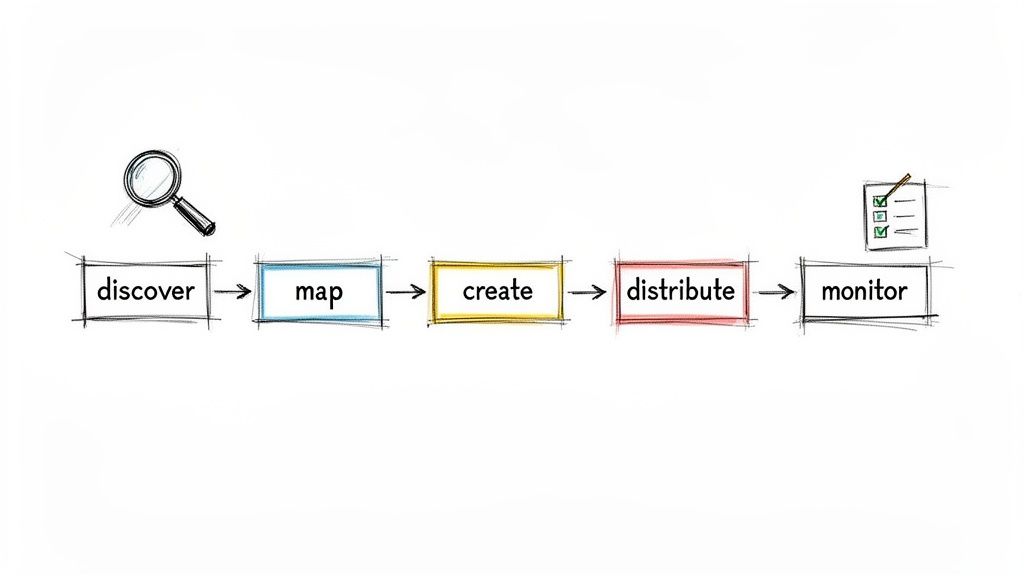
Knowing how query fan-out works is one thing. Actually turning that knowledge into a plan that gets results? That's what separates the brands that will thrive from those that will get left behind. You have to adapt, and that means shifting your focus from chasing a handful of keywords to building a deep, comprehensive knowledge base that AI models learn to trust.
The goal here is simple: become the most reliable and thorough source for every possible question related to your core topics. This isn't just a tweak to your old SEO strategy; it requires a new way of thinking about how you create, distribute, and monitor your content. It’s a methodical process of figuring out what questions AI is asking, creating the best answers, and tracking your performance so you can keep getting better.
Step 1: Discover and Map Your Fan-Out Landscape
Before you write a single word, you have to understand the questions AI models are actually asking behind the scenes. Your traditional keyword research tools won't cut it here, because over 95% of fan-out queries have zero human search volume. You're flying blind without the right approach.
So, where do you start? Begin by identifying your most important business prompts. Think like a customer evaluating your space. What would they ask an AI? Queries like, "Is [Your Brand] a good choice for small businesses?" or "alternatives to [Your Competitor]" are perfect examples.
From there, you need to uncover the fan-out. You could do this manually by plugging those prompts into different AIs and meticulously analyzing the responses for common themes and follow-up questions. Or, you can get smart about it. Specialized tools like our own promptposition are designed for exactly this, constantly monitoring AI outputs to pinpoint the sub-queries being generated for your key topics. This gives you a data-driven map of your fan-out landscape, showing you exactly where your content efforts will have the most impact.
Step 2: Create Content Built for Machine Comprehension
Once you have your fan-out map, it's time to create content that directly answers those machine-generated questions. The trick is to structure it in a way that’s dead simple for an AI model to parse, understand, and cite. This is a foundational principle of modern AI search engine optimization.
Here are a few ways to put this into practice:
- Build Topic Clusters: Structure your content around a central "pillar" page covering a broad topic. Then, create dozens of "spoke" pages that each dive deep into a specific fan-out query you discovered—things like pricing comparisons, specific feature breakdowns, or niche use cases.
- Use Clear and Structured Formatting: AI models absolutely love well-organized information. Use clean headings (H2s, H3s), bullet points, numbered lists, and even tables to break down complex ideas into bite-sized, digestible chunks. This makes it incredibly easy for the AI to pull out specific facts and credit your site.
- Adopt an "Answer Every Facet" Mentality: For any topic you cover, put yourself in the shoes of a curious AI. What are all the potential angles it might explore? Think about comparisons, technical specs, customer reviews, and common troubleshooting scenarios. Create dedicated content for each of these to build undeniable authority.
The most powerful shift you can make is to stop thinking in terms of single articles and start building a comprehensive knowledge hub. When an AI model sees that your domain is the most complete and well-structured resource on a subject, it's far more likely to trust and reference your content.
Step 3: Distribute and Amplify Your Authority
Creating fantastic content is just step one. To really influence AI models, you have to make sure your expertise is recognized across the entire web, not just on your own site. LLMs build their understanding from the whole digital ecosystem, and you need to be part of that conversation.
This is all about getting your data, your insights, and your brand mentioned in high-authority places that LLMs already trust.
- Digital PR and Link Building: Go after placements and mentions in reputable industry publications, news sites, and influential blogs. Every authoritative link and citation reinforces your credibility in the eyes of the AI.
- Structured Data and Knowledge Graphs: Use schema markup on your website to explicitly label your content for search engines. It's like giving the AI a cheat sheet, helping it understand entities, relationships, and facts without any guesswork.
- Third-Party Review Sites and Forums: Be active on platforms like G2, Capterra, Reddit, and Quora. AI models frequently pull real-world user sentiment from these sources to answer fan-out queries about customer satisfaction or common problems.
Step 4: Monitor, Measure, and Iterate
Finally, you can't improve what you don't measure. The AI search world is constantly in flux. Models get updated, and fan-out queries evolve. If you’re not continuously monitoring your performance, you’re just guessing.
This is where a dedicated AI search analytics platform becomes a non-negotiable part of your toolkit. Using a platform like our own, you can automate the tracking of your brand’s performance across all the major AI models. You can see your share of voice, benchmark your visibility against competitors, and analyze the sentiment of how your brand is being portrayed. This data is gold—it lets you spot content gaps, refine your messaging, and continuously iterate on your strategy to stay ahead.
Your Roadmap to AI Search Dominance
The change we're seeing with AI search isn't just another trend—it's a complete overhaul of how people find information. Getting a handle on query fan-out is no longer a "nice to have" skill. It’s the ticket to the game for any brand that wants to stay relevant and visible.
The old playbook of chasing specific keywords? It's officially obsolete.
This new environment demands a totally different way of thinking. Winning is no longer about snagging the top spot for a single search term. It's about building such deep topical authority that AI models turn to you as the trusted source when they construct their answers.
For anyone in SEO, marketing, or brand leadership, this is your cue to shift from a keyword tactician to a topic strategist. The goal is to own the entire conversation, thinking through every possible question an AI might ask on behalf of a user.
The biggest edge you have at this very moment is time. Most of your competitors are still buried in traditional SEO reports, completely oblivious to the visibility they are hemorrhaging in AI-generated answers every single day.
This is your window of opportunity. Start by taking a hard look at how your brand shows up on the major AI platforms. Pinpoint where you’re invisible, where your competitors are getting cited, and where your content simply doesn’t cut it for the new machine-generated queries that are driving discovery.
If you're looking for a starting point, our guide on how to use AI for SEO can help you build that initial foundation.
The brands that move now—the ones who start measuring their AI search footprint and creating content for this new reality—are the ones who will own the next decade of digital discovery. The path forward is clear. The time to start is today.
Frequently Asked Questions About Query Fan-Out
When we start talking about how AI is changing search, a lot of questions pop up. It's a new frontier for all of us. Getting a handle on what query fan-out is and how it works is the first real step to building a brand strategy that won’t get left behind. Here are some plain-English answers to the questions we hear most often.
How Is Query Fan-Out Different From Long-Tail Keywords?
This is a great question because on the surface, they can seem alike. But they’re two completely different animals.
Long-tail keywords are what we’re all used to—those specific, longer phrases people actually type into a search engine. They might not get a ton of traffic, but they have a real, measurable search volume.
Query fan-out, on the other hand, happens behind the scenes. An AI model takes a simple human query and generates its own set of internal, more detailed questions to research the topic thoroughly. The key difference? These sub-queries are almost never searched by a real person. In fact, a staggering 95% of them have zero search volume.
Think of it like this: a user asks for "best running shoes." The AI might internally search for things like "cushioning technology in running shoes" or "heel-to-toe drop explained." You're not optimizing for existing human searches anymore; you're building topical authority for the AI's own research process.
Can I Find Fan-Out Queries Using My Current SEO Tools?
Unfortunately, the short answer is no. Your standard SEO tools—think Semrush or Ahrefs—are brilliant at what they do, which is tracking massive databases of human search queries. Their entire model is built on search volume.
Since the vast majority of fan-out queries are created by machines and have no human search history, they're completely invisible to these platforms. They simply don't exist in those databases.
So, how do you find them? You could try to reverse-engineer AI answers by hand, but it’s a slow, frustrating process that’s impossible to scale. A much better way is to use a tool built for this new world, like our own promptposition. It's designed to monitor LLM behavior directly, revealing the hidden questions the AI is asking. This is a fundamental shift from keyword-centric tools to AI-native analytics.
The core challenge is that you can't optimize for what you can't see. Without visibility into the sub-queries an AI is running, you're essentially guessing what information it needs to consider your brand a credible source.
What Is The First Step to Address Query Fan-Out?
The most important thing you can do right now is benchmark your current visibility. You can't fix a problem you haven't measured.
Start by picking 5-10 of the most critical prompts related to your brand or products. Get inside your customer's head. What would they ask an AI?
- "Is [Your Brand] worth it?"
- "Best alternatives to [Your Product]"
- "[Your Brand] vs [Competitor A]"
Take these prompts and run them through the big AI models like ChatGPT, Gemini, and Perplexity. Meticulously document what you find. Note every mention of your brand, whether it's positive or negative, what sources the AI cites, and which of your competitors show up.
This simple audit will give you an immediate, eye-opening look at your biggest content gaps and strategic opportunities. Of course, for a more scalable approach, a dedicated platform can automate this tracking and give you the solid data you need to build a winning plan.
Ready to stop guessing and start measuring your AI search performance? promptposition gives you the visibility you need to understand how AI models see your brand. Discover your AI search visibility and get ahead of the competition.