The 12 Best AI Brand Visibility Tools for Marketers in 2026
Tracking your brand's presence in search is no longer just about Google rankings. As millions of people turn to ChatGPT, Gemini, and other AI models for answers and recommendations, a new, critical blind spot has emerged for marketers: AI visibility. How is your brand being described? Are you recommended over competitors? Or are you completely invisible in these new conversational search results? Ignoring this shift means missing a massive opportunity to influence high-intent buyers at the moment of consideration. This guide cuts through the noise to help you find the best AI brand visibility tools for your specific needs.
We've compiled a detailed resource list covering the current market, from traditional SEO platforms adding AI tracking features to new, purpose-built solutions designed specifically for this challenge. You will find a straightforward analysis of each tool, complete with screenshots, direct links, and an honest look at its capabilities. We examine key features like cross-model coverage, update frequency, source attribution, and sentiment analysis. For each option, we've included pros and cons, ideal use cases, and pricing details to help marketing, PR, and SEO teams make an informed decision. Our goal is to provide a practical roadmap for turning "Are we showing up in AI?" anxiety into a measurable strategy. This will help you not only monitor your brand’s AI presence but also identify the sources you need to influence for better visibility. As you delve into the power of AI for marketing, you can also explore other valuable resources such as a guide to the best AI tools for content creation.
1. promptposition
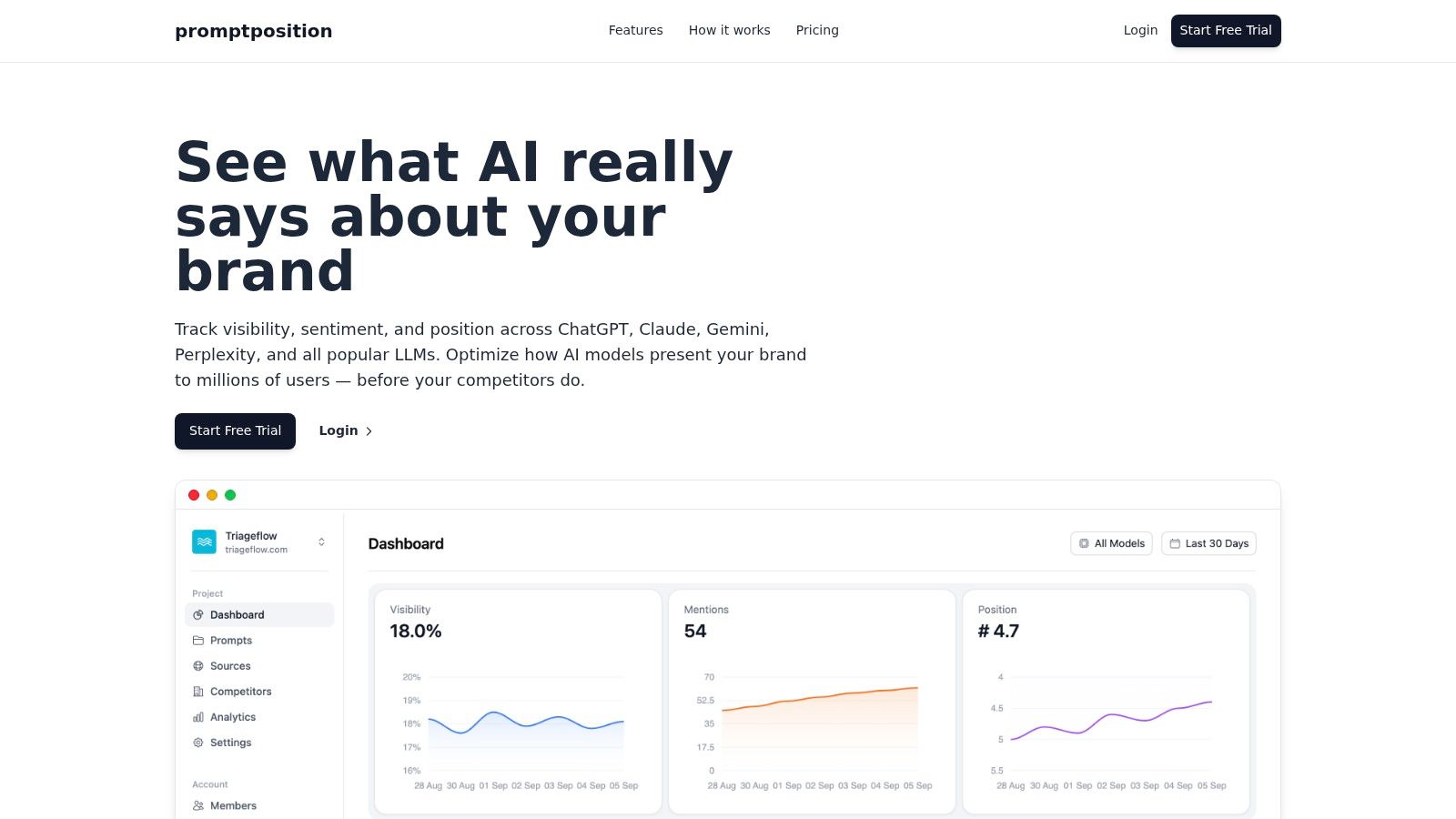
As the landscape of search shifts from traditional engines to AI-driven conversations, PromptPosition emerges as a purpose-built platform designed specifically to measure and influence brand presence within large language models (LLMs). Unlike legacy SEO suites that have bolted on limited AI tracking as an afterthought, PromptPosition provides a dedicated solution for marketers, brand managers, and PR professionals who need to understand exactly how their company is portrayed across the AI ecosystem. It moves beyond simple keyword tracking to answer the critical questions: Are we being mentioned? Is the sentiment positive? And which sources are shaping the AI's opinion?
This platform is engineered to turn the opaque, "black box" nature of AI responses into a clear set of measurable KPIs. It offers a direct line of sight into your brand’s performance across a wide array of models, including ChatGPT, Claude, Gemini, Perplexity, and even newer ones like Grok and DeepSeek. This cross-model coverage is a significant advantage, providing a complete picture of your AI footprint rather than an isolated snapshot from a single platform. For teams looking to understand this new frontier, PromptPosition provides the data needed to build an actionable strategy. You can learn more about how to approach this with their guide on AI brand visibility.
Key Features and Strengths
The standout capability of PromptPosition is its source attribution. The platform doesn't just tell you if you were mentioned; it shows you the exact sources (e.g., specific Reddit threads, tech articles, or YouTube videos) that the LLMs cited. This is a game-changer for content and PR teams, as it provides a direct roadmap for where to focus their efforts to influence future AI responses.
Real-World Impact: One B2B SaaS client discovered they had 0% visibility in prompts like "best project management tools for remote teams," despite strong traditional SEO rankings. Source analysis in PromptPosition revealed that competitors were dominating conversations on niche blogs and forums that fed the LLMs. A targeted digital PR campaign aimed at these sources lifted the client's AI visibility to over 40% in just three months.
Other core strengths include:
- Comprehensive Metrics: Tracks visibility percentage, sentiment scores (0-100), verbatim quotes, and share of voice against competitors.
- Prompt-Centric Workflow: Organize high-impact queries, get AI-suggested prompts with search volume data, and identify gaps where competitors are winning.
- Daily Updates: Data is refreshed daily, allowing for real-time monitoring of campaign impact and competitor movements.
- Scalability: With unlimited seats, global country targeting, and API access on higher tiers, the platform supports everyone from small teams to enterprise-scale programs.
Pricing Structure
PromptPosition offers transparent, accessible pricing that allows teams of any size to get started.
- Starter: $49/month for 25 prompts and 2,250 monthly responses.
- Pro: $119/month for 100 prompts and 9,000 monthly responses.
- Enterprise: Custom plans starting from $299/month for 300+ prompts.
A free trial is available, making it easy to test the platform’s value before committing.
Ideal Use Case and Final Assessment
This tool is ideal for marketing and communications teams who want to proactively manage their brand's narrative in the age of AI. It is one of the essential ai brand visibility tools for organizations that recognize search is no longer just about a list of blue links. While it complements traditional SEO and brand tracking, its true power lies in demystifying AI-generated answers and providing a data-driven path to influencing them. The pricing is also remarkably accessible, making it a standout option for teams that need deep AI monitoring without a massive budget.
The primary limitation is that its effectiveness relies on a well-defined prompt strategy; poorly chosen queries can yield incomplete data. However, for teams ready to invest in shaping their AI presence, PromptPosition offers an unmatched level of depth, specificity, and actionable intelligence.
Website: https://www.promptposition.com
2. Semrush (Semrush One with AI Visibility)
For teams seeking an all-in-one platform, Semrush expands its formidable SEO and competitive intelligence suite with AI visibility tracking. Packaged within its Semrush One bundle, the platform now monitors brand mentions and positioning within Google’s AI Overviews and major LLMs like ChatGPT, Gemini, and Perplexity. This makes it an excellent choice for marketing departments that want to integrate next-generation AI monitoring with their existing, traditional search engine optimization workflows without adding another standalone tool.
The primary advantage is its consolidation. You can manage classic SEO tasks like keyword research, backlink analysis, and site audits alongside tracking your brand's presence in AI-generated answers. This unified approach simplifies reporting and helps connect your content optimization efforts directly to outcomes in both standard search and AI responses. For a deeper understanding of how these two disciplines are merging, it's worth reading about the new rules for SEO for LLM environments.
However, Semrush's power comes with a steeper learning curve, and the AI Visibility features are part of the premium Semrush One tier, which can be a significant investment. As an "add-on" to a massive SEO suite, the AI tracking capabilities, while useful, may not offer the same depth or daily refresh rate as a purpose-built solution.
Key Details
- Best For: Marketing teams wanting to combine classic SEO, competitive research, and new AI visibility tracking in a single, powerful platform.
- Core Features: AI Visibility tracking for Google AI Overviews and LLMs, extensive keyword and backlink databases, position tracking, and content optimization tools.
- Pros: A single platform for both search and AI visibility, backed by strong competitive data and a massive ecosystem of documentation and support.
- Cons: AI features are part of a premium tier; as a bolted-on feature, it may lack the specificity and daily update frequency of dedicated tools.
- Pricing: AI features are included in the Semrush One bundle. Contact Semrush for specific pricing, as it's tailored to enterprise needs.
- Website: https://www.semrush.com
3. BrightEdge
For large enterprises prioritizing deep analysis of Google’s AI Overviews, BrightEdge offers a powerful, research-driven platform. As a long-standing leader in enterprise SEO, its focus is less on broad LLM tracking and more on surgically dissecting how, when, and why AI Overviews appear in Google Search. Its Generative Parser technology is designed to give large organizations granular data on where their brand and competitors are cited within these new search features, making it a critical tool for protecting and growing visibility in a high-stakes environment.
The platform stands out by providing early, in-depth research and guidance specifically on AI Overviews (formerly SGE). This allows marketing teams to build a content and citation strategy aimed directly at influencing these AI-generated answers. Rather than being a bolt-on feature, this analysis is integrated into its existing enterprise SEO workflows, helping teams connect their optimization efforts to measurable outcomes within Google's evolving interface.
However, BrightEdge is built for the enterprise, and its pricing and implementation reflect that. Access is not self-serve, and the cost can be substantial, often requiring significant stakeholder buy-in and a formal onboarding process. Its narrow focus on AI Overviews means teams looking for cross-model tracking on platforms like ChatGPT or Perplexity will need a separate, specialized ai brand visibility tool.
Key Details
- Best For: Enterprise marketing teams needing deep, specialized intelligence on Google’s AI Overviews to inform their content and SEO strategy.
- Core Features: AI Overviews tracking via Generative Parser, research on AIO/SGE triggers, enterprise-level SEO and content optimization workflows.
- Pros: Highly specialized, in-depth research on AI Overviews; actionable insights for content strategy; strong enterprise-grade support and integration.
- Cons: Enterprise focus means high cost and limited pricing transparency; implementation requires a formal onboarding process; lacks tracking for other major LLMs.
- Pricing: Custom enterprise pricing. Requires contacting the BrightEdge sales team for a quote.
- Website: https://www.brightedge.com
4. seoClarity
For enterprise-level organizations, seoClarity delivers a robust SEO platform that now integrates advanced monitoring for Google's AI Overviews. It is built for large-scale operations that need to track brand visibility, citations, and content layouts within AI-generated search results. The platform’s focus extends beyond simple mentions to include bot and crawl optimization, which helps ensure your content is discoverable and accurately represented by the AI engines that power modern search.
Its core strength lies in its enterprise-grade depth. seoClarity offers scaled tracking of AI Overviews, identifying not just if your brand is mentioned, but also how it's framed. The platform also provides tools to diagnose and correct AI "hallucinations" or inaccuracies related to your brand, a critical function for maintaining brand integrity. This makes it one of the more thorough ai brand visibility tools for companies that view AI search as a central pillar of their organic strategy and have the resources to manage a feature-rich environment.
However, its power is tailored specifically for the enterprise market. This means pricing is quote-based and the platform can be complex, often requiring dedicated teams or significant training to use effectively. It is an SEO suite with added AI features rather than a dedicated AI visibility platform, so its scope may be broader and less specific than a purpose-built tool.
Key Details
- Best For: Enterprise‑level teams with significant resources needing to integrate deep AI Overview monitoring with a broad, traditional SEO toolkit.
- Core Features: Scaled tracking of Google AI Overviews, bot and crawl optimization for AI engines, hallucination and accuracy monitoring, rank tracking, and schema tools.
- Pros: Deep AIO tracking with a unique focus on AI bot visibility and accuracy; a single platform for a broad set of enterprise SEO needs.
- Cons: Primarily designed for large, enterprise-level organizations; access and pricing are available only by requesting a direct quote.
- Pricing: Custom quote-based pricing. Contact seoClarity directly for a demonstration and pricing details tailored to your organization.
- Website: https://www.seoclarity.net
5. STAT Search Analytics (by Moz)
For enterprise-level organizations needing to quantify the impact of Google's AI Overviews at a massive scale, STAT Search Analytics (by Moz) provides the necessary horsepower. This is not a broad-spectrum AI visibility tool covering multiple LLMs; instead, it is a specialized, deep-dive platform for tracking search engine results pages (SERPs). It excels at daily, large-scale rank reporting, now with dedicated tracking for when and where AI Overviews appear across immense keyword sets and precise geographic locations.
The core strength of STAT is its data-centric approach. It empowers large brands and agencies to measure the encroachment of AI answers on their traditional organic search real estate. You can see exactly how often AI Overviews are triggered for your most valuable terms and whether your brand is being cited. This focus on search-specific AI makes it an ideal addition for teams that already have a mature SEO program and need granular data to justify strategic shifts in content and optimization in response to Google's changes.
However, STAT is a premium, specialized tool. Its volume-based pricing is built for large-scale operations and can be a significant investment. It is also squarely focused on search, meaning any brand or social listening across other AI models like ChatGPT or Claude will require different tools.
Key Details
- Best For: Enterprise companies and digital agencies needing to track AI Overviews' impact on organic search performance across thousands of keywords and multiple locations.
- Core Features: Daily top-100 SERP collection at scale, dedicated AI Overviews tracking, share-of-voice and competitor trendlines, and granular geo/device segmentation.
- Pros: Highly scalable for multi-location and large keyword sets; provides the data depth needed to quantify the business impact of AI Overviews over time.
- Cons: Volume and quote-based pricing can be expensive at scale; strictly focused on search, requiring other tools for social, PR, or broader LLM monitoring.
- Pricing: Custom quote-based pricing, tailored to the volume of keywords tracked.
- Website: https://getstat.com
6. Yext
For brands that manage a physical presence across many locations, Yext takes an infrastructure-level approach to AI brand visibility. Instead of directly tracking mentions in LLMs, its AI-enabled platform focuses on ensuring the foundational data that AI systems reference is accurate, consistent, and verified. Yext distributes brand information like addresses, hours, and services to a vast network of listings, directories, and data aggregators. This foundational work is critical, as AI models often pull from these sources to answer location-based or fact-based user queries.
The main benefit of Yext is its ability to centralize and control brand facts at scale. By ensuring your official data is the "single source of truth" across the web, you indirectly influence AI-generated answers and reduce the risk of them citing outdated or incorrect third-party information. This makes Yext an excellent tool for improving the accuracy of your brand's citations in AI answers, particularly for multi-location businesses like retail chains, healthcare providers, or financial institutions.
However, Yext's model is focused on data distribution, not direct AI response monitoring. It is a preventative tool, not a reactive tracking one. You are influencing the training data, not measuring the output. The pricing is also quote-based and tailored for enterprises, which can be a significant investment, especially for businesses without a large number of physical locations to manage.
Key Details
- Best For: Multi-location enterprises seeking to ensure factual accuracy and consistency across the data sources that AI systems use for information.
- Core Features: Centralized brand data distribution, reputation management, and tools to maintain verified information across hundreds of online services.
- Pros: Excellent for establishing a consistent and verified data foundation; helps increase citation accuracy in AI responses by controlling the source information.
- Cons: Does not directly track mentions or sentiment in LLMs; pricing is quote-based and high for businesses without many physical locations.
- Pricing: Yext offers custom, quote-based pricing. Contact their sales team for a plan tailored to your business needs.
- Website: https://www.yext.com
7. Sprinklr (Unified‑CXM)
For large enterprises requiring a single command center for all digital customer interactions, Sprinklr's Unified-CXM platform is a formidable option. It extends beyond simple monitoring to cover the entire customer experience across more than 30 channels, including social media, messaging apps, and review sites. Sprinklr uses AI to power its social listening, anomaly detection, and engagement features, making it ideal for global brands that need to manage brand visibility, sentiment, and crisis response with strict governance and compliance controls.
The platform's main appeal is its consolidation of functions, from listening and publishing to customer care and advocacy, all within one ecosystem. This integrated approach allows teams to connect public conversations directly to internal workflows, using AI copilots and agents to generate insights and guide engagement. For organizations focused on managing reputation at scale, understanding the nuances of AI-driven public perception is crucial. You can find more on the strategic importance of AI brand monitoring and how it impacts modern marketing.
However, Sprinklr's enterprise-grade power means it is not a plug-and-play solution. Its focus is on social and owned channels, not direct LLM response tracking. The implementation can be complex, and its quote-based pricing model is tailored for large corporations, often placing it out of reach for small or medium-sized businesses.
Key Details
- Best For: Large enterprise teams needing a unified platform for managing brand visibility, sentiment, and customer care across dozens of digital channels with strong governance.
- Core Features: AI-powered social listening, anomaly detection, engagement copilots, enterprise-grade governance and compliance workflows, and analytics across 30+ channels.
- Pros: A single platform that connects listening with engagement and care; broad channel coverage and robust support for enterprise security and workflows.
- Cons: Quote-based enterprise pricing may be prohibitive for SMBs; does not directly track responses in major LLMs like ChatGPT or Gemini.
- Pricing: Available upon request. Pricing is quote-based and tailored to specific enterprise needs and scale.
- Website: https://www.sprinklr.com
8. Brandwatch (Consumer Intelligence)
For organizations that need a deep understanding of online conversations beyond just AI models, Brandwatch offers a mature consumer intelligence platform. It excels at social listening and uses a combination of its proprietary AI and LLMs to analyze brand mentions, sentiment shifts, and emerging trends across a massive dataset. This makes it a powerful tool for PR and marketing teams who need to track brand visibility and narrative control across the entire web, from social media to forums and news sites.
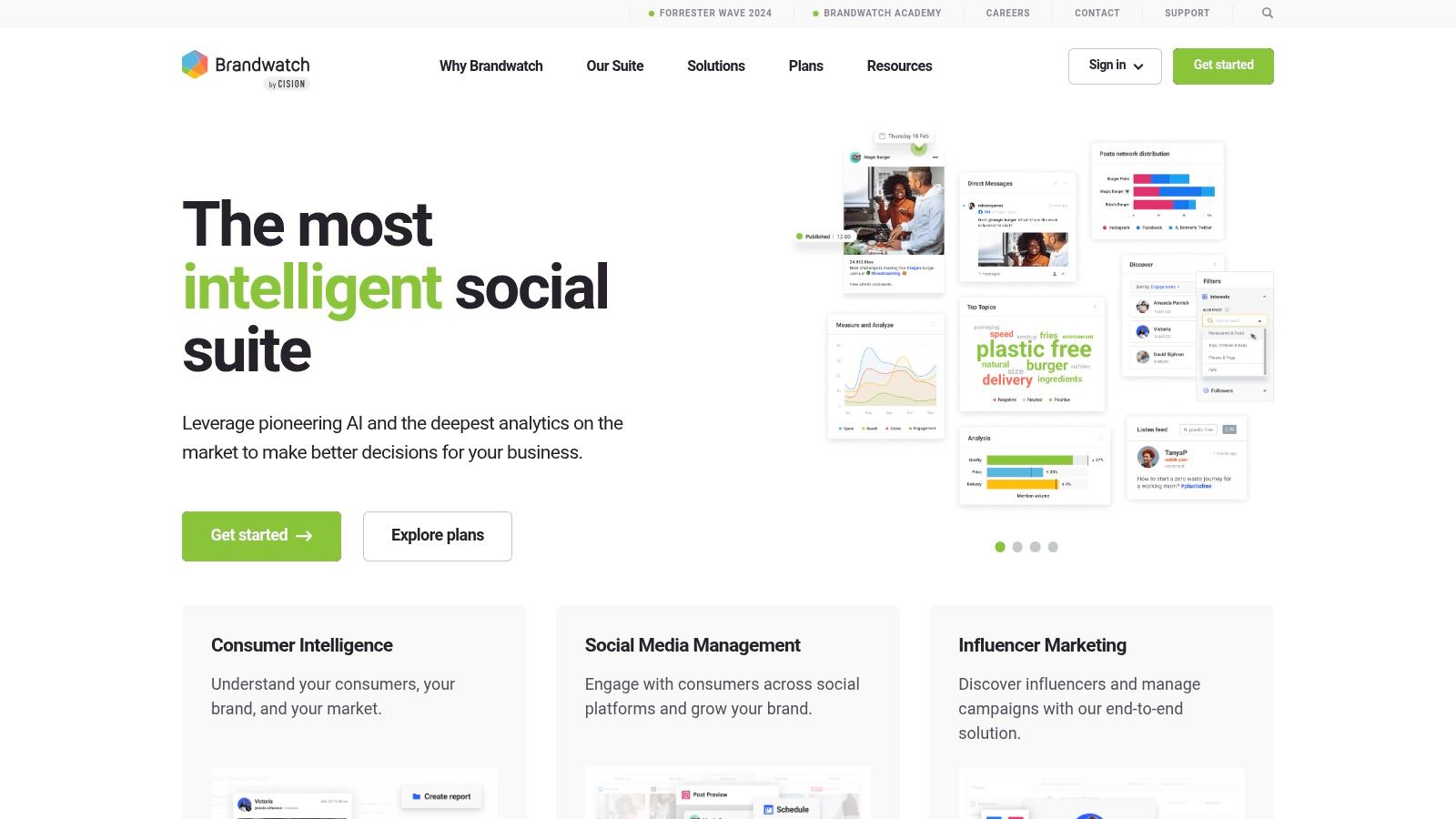
The platform’s strength is its depth. You can move beyond simple mention tracking to dissect audience demographics, identify key opinion leaders, and get alerts on potential crises. Monitoring your brand's standing is crucial for overall brand visibility, as a strong Brand Reputation can significantly enhance consumer perception. While it isn’t a purpose-built LLM visibility tool like PromptPosition, its insights are invaluable for informing the content strategy that ultimately feeds those models. A better understanding of public conversation gives you the source material to improve AI outputs. For teams wanting to master this, a detailed guide on understanding brand sentiment in AI provides critical context.
However, Brandwatch's extensive capabilities come with a matching learning curve and enterprise-level pricing. It monitors the sources of LLM training data, not the LLM outputs themselves. The platform is best suited for larger organizations with dedicated analysts, and its sales process requires a demo, meaning you can't simply sign up and start exploring.
Key Details
- Best For: Large enterprises and PR agencies needing deep consumer intelligence and social listening to inform their broader brand strategy.
- Core Features: Cross-channel social and web listening, AI-powered query building, customizable dashboards and alerts, and detailed audience segmentation.
- Pros: Highly mature listening capabilities with deep analytical power, extensive data coverage across social media, forums, and news.
- Cons: Opaque, enterprise-focused pricing model; requires a significant time investment to master its advanced features; does not track LLM outputs directly.
- Pricing: Custom enterprise pricing. A demo is required to get a quote.
- Website: https://www.brandwatch.com
9. Meltwater
For large communications and PR teams, Meltwater offers a broad media intelligence platform that now incorporates GenAI-assisted analytics. While not a purpose-built AI visibility tool focused on LLM responses, its strength lies in monitoring a massive volume of data across online news, print, broadcast, podcasts, and social media. It is best suited for organizations that need to manage brand reputation, track media coverage, and discover influencers within a single, enterprise-grade ecosystem.
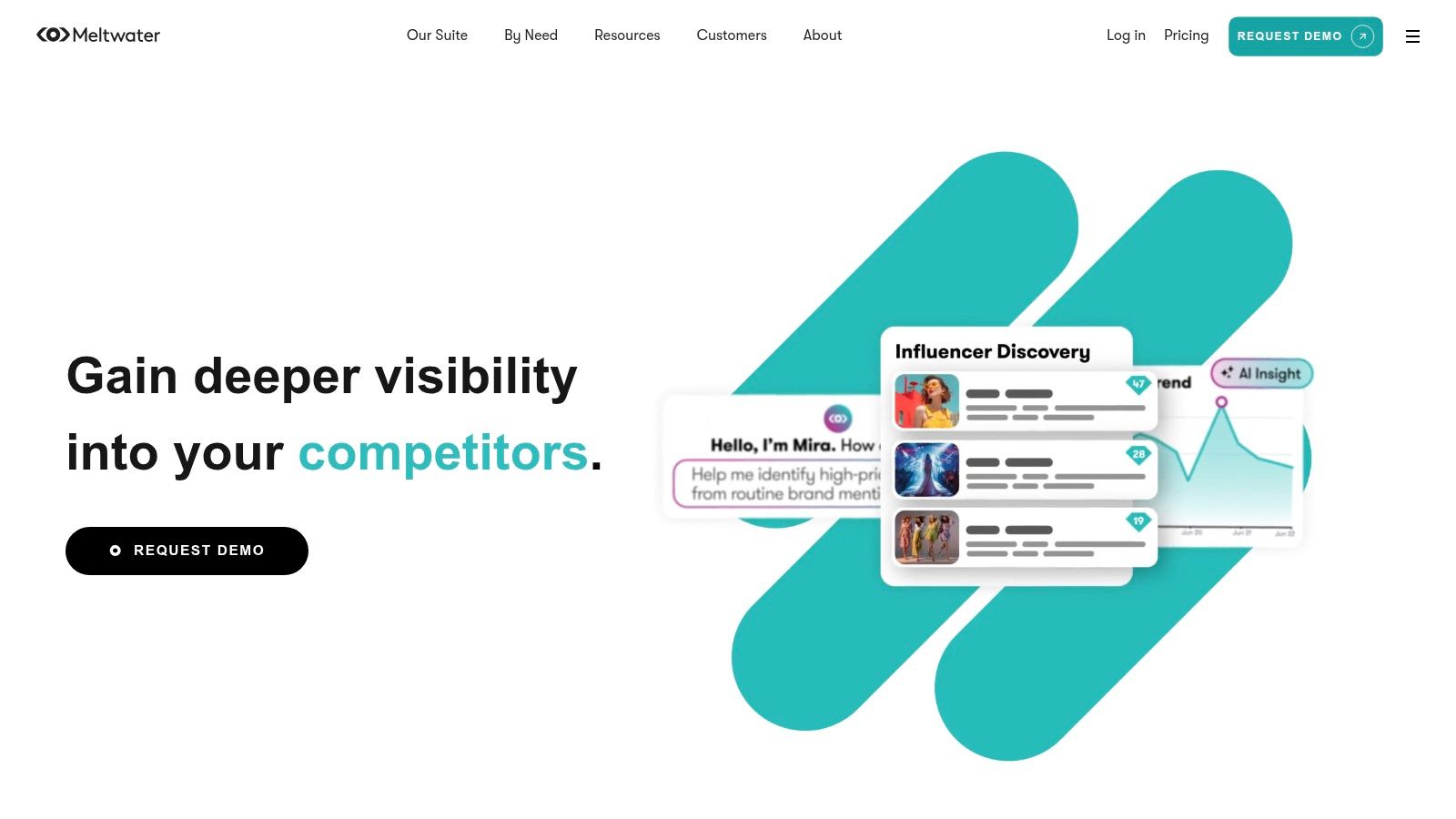
Meltwater's AI features are primarily used for analysis and summarization. For example, it can generate executive summaries of media coverage trends or distill key themes from thousands of social media mentions. This helps teams quickly understand sentiment and conversation drivers without manual analysis. It acts more as a high-level aggregator and listening post, giving a wide-angle view of brand presence that can indirectly inform how a brand might appear in AI models, which are often trained on this same public data.
The main trade-off is the platform's focus. It excels at traditional media and social listening but does not directly track how your brand is represented within specific AI models like ChatGPT or Gemini. The pricing is quote-based and tailored for enterprise budgets, making it a significant investment that may not be practical for teams solely focused on cracking the code of AI search visibility.
Key Details
- Best For: Enterprise PR and communications teams needing a comprehensive media monitoring and social listening solution with AI-powered summarization.
- Core Features: Global media and social listening, real-time alerting, influencer discovery and management, and GenAI-assisted analytics for summaries and insights.
- Pros: Extremely broad monitoring across news, web, and social media in one place; powerful enterprise integrations and API access.
- Cons: Does not directly track brand mentions inside LLMs; quote-based pricing can be a substantial expense for the full product suite.
- Pricing: Custom-quoted based on specific needs and product modules. Contact Meltwater for a quote.
- Website: https://www.meltwater.com
10. Talkwalker (with Blue Silk AI)
For large brands operating across multiple global markets, Talkwalker offers a powerful consumer intelligence platform amplified by its Blue Silk AI engine. Its core strength lies in its extensive social listening and data analysis capabilities, which monitor brand health, competitive positioning, and emerging trends across a massive dataset of social media, news, blogs, and forums. This makes it a go-to for enterprise-level teams needing to understand brand perception and manage potential crises at a global scale.
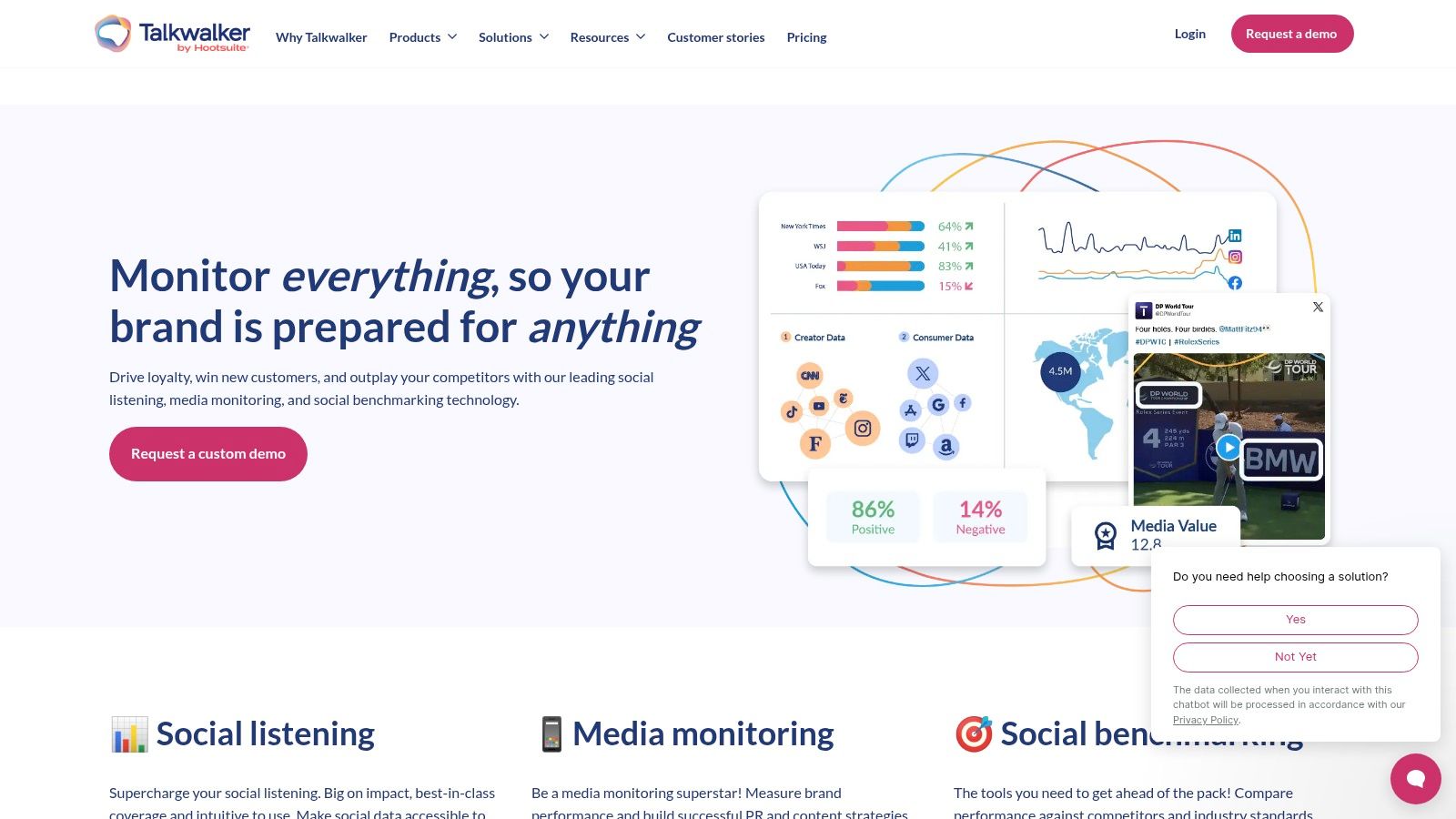
The platform’s AI helps distill billions of data points into actionable insights, identifying shifts in consumer sentiment, flagging potential PR issues with crisis alerts, and benchmarking performance against competitors. While its primary focus is on social and digital media rather than direct LLM response tracking, its ability to analyze the sources that feed AI models makes it a valuable, if indirect, ai brand visibility tool. By understanding the conversations happening online, you gain insight into the data shaping future AI-generated answers.
However, Talkwalker is an enterprise-grade solution with a corresponding price tag and feature set. The platform is complex, and its depth may be overkill for smaller teams or those with simpler monitoring needs. Pricing is not publicly listed and requires a sales consultation, reinforcing its focus on large organizations with significant budgets.
Key Details
- Best For: Global enterprise marketing and PR teams needing deep consumer intelligence and crisis monitoring across multiple markets.
- Core Features: AI-powered social listening, real-time trend detection and crisis alerts, cross-channel coverage, customizable dashboards, and enterprise-level reporting.
- Pros: Excellent AI-assisted insights for brand health and competitive analysis; well-suited for large, multi-market US and global teams.
- Cons: Pricing is enterprise-oriented and requires a direct sales conversation; does not directly track LLM answers, only the source material.
- Pricing: Custom enterprise pricing available upon request.
- Website: https://www.talkwalker.com
11. Pulsar Platform
For teams focused on the "who" and "why" behind brand conversations, Pulsar Platform offers a powerful audience intelligence and social listening tool. It moves beyond simple keyword monitoring to map the communities, narratives, and content engagement that shape brand visibility. This makes it ideal for creative, PR, and strategy teams who need to understand the human element driving their brand's presence in online discourse, including the discussions that eventually inform AI models.
The platform's primary strength is its audience-centric approach. Instead of just showing you mentions, Pulsar helps you see the networks of people having those conversations, segmenting them by interests and influence. This provides the foundational research needed to shape narratives proactively. By identifying key communities and trendsetters, you can create targeted content and PR campaigns that resonate with the very sources LLMs use for training, making it a strategic first step in building a strong foundation for your AI brand visibility tools to measure.
However, Pulsar is an enterprise-grade solution with custom pricing, placing it out of reach for smaller teams or those with limited budgets. Like other social listening tools, it provides insights into the sources of LLM knowledge but does not directly track the final AI outputs. Its value is unlocked when marketing and PR departments are equipped to act on its deep audience segmentation insights.
Key Details
- Best For: Mid-market to enterprise creative, PR, and brand strategy teams needing to understand and influence the communities shaping brand narratives online.
- Core Features: Community and audience mapping with conversation clustering, social listening, creative planning tools, and campaign performance analysis.
- Pros: Rich, audience-centric insights that go deeper than mention tracking; helps teams proactively shape narratives with actionable segmentation.
- Cons: Custom pricing is geared toward larger organizations; does not track brand mentions within LLM responses themselves.
- Pricing: Custom pricing based on specific enterprise requirements. Contact Pulsar Platform for a quote.
- Website: https://www.pulsarplatform.com
12. YouScan
For brands whose visibility is often measured in images and videos, YouScan offers a distinct advantage by moving beyond text-based mentions. This social listening platform specializes in visual recognition, making it an ideal choice for monitoring brand exposure in user-generated content (UGC) across social media. It tracks how your logo, packaging, or products appear in photos and videos, giving you a picture of your brand's presence that text-only tools would miss.
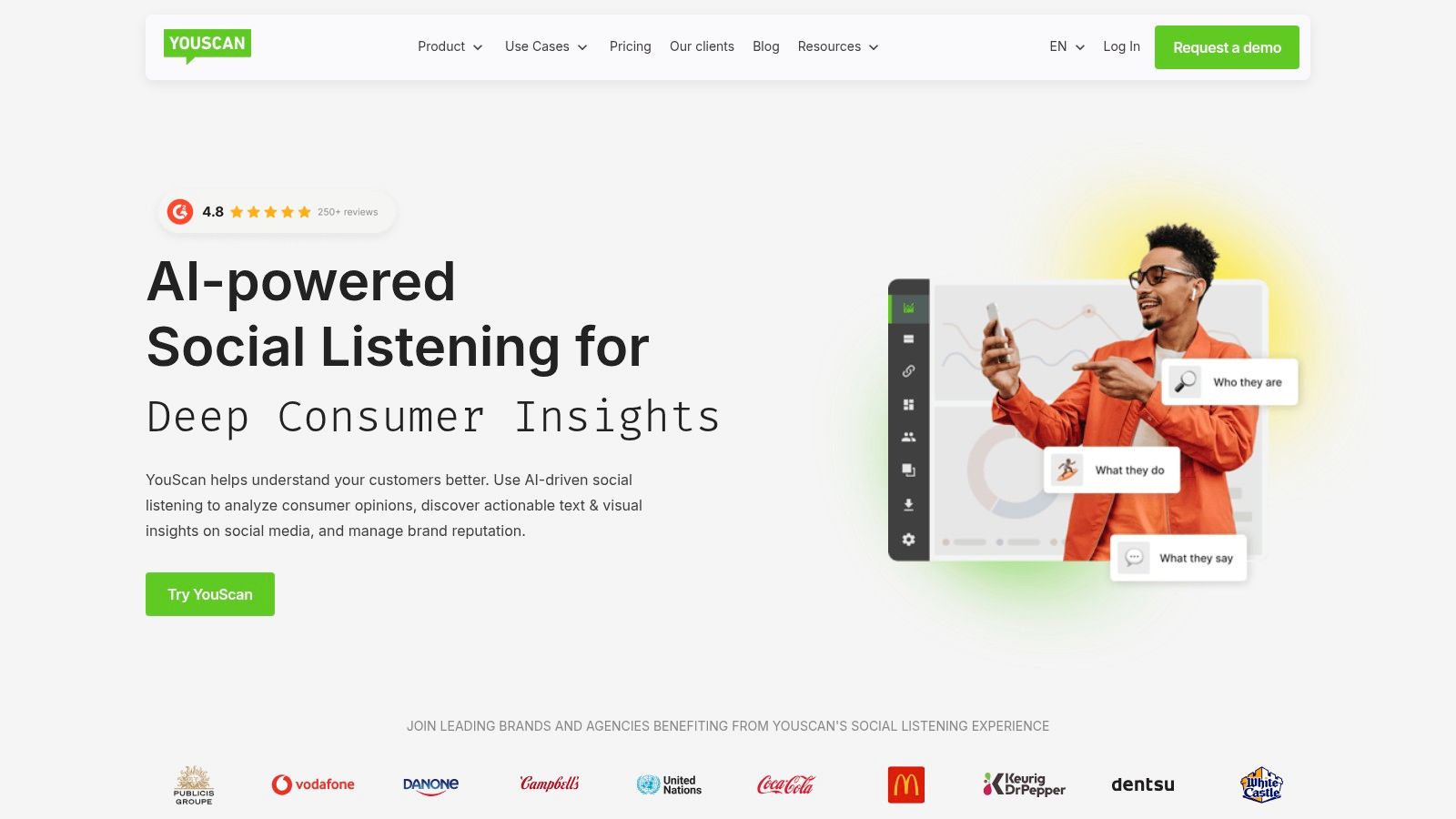
The platform's standout feature is its AI-powered visual insights, which can identify specific scenes, objects, and customer demographics from images. This helps marketing teams understand the context in which their brand appears without manual analysis. Its AI Insights Copilot further distills this data, providing quick summaries and identifying trends. This functionality is particularly useful for consumer packaged goods (CPG) companies, fashion brands, and event marketers who need to track visual engagement and campaign impact.
While it excels at visual analytics, its core focus is on social media listening rather than the broader LLM and AI chat environment that other ai brand visibility tools cover. Therefore, it is best used as a complementary tool for teams that heavily prioritize visual brand health on social platforms. The pricing structure requires a demo, which allows for customization but adds a step to the procurement process.
Key Details
- Best For: Consumer brands and marketing teams needing to track visual brand presence (logos, products) in user-generated images and videos on social media.
- Core Features: Visual insights with logo and image recognition, sentiment analysis, AI Insights Copilot, and unlimited alerts on paid tiers.
- Pros: Excellent for tracking visual brand exposure in UGC where text mentions are absent; a competitive option for teams prioritizing image analytics.
- Cons: Pricing details require a demo and are not publicly listed; social media source coverage can vary by region and subscription plan.
- Pricing: Custom pricing based on a required demo. Plans are tailored to specific needs for mention volume and features.
- Website: https://youscan.io
Top 12 AI Brand Visibility Tools Comparison
| Tool | Core features/characteristics | Quality ★ | Price/value 💰 | Target audience 👥 | Unique selling points ✨ |
|---|---|---|---|---|---|
| PromptPosition 🏆 | LLM visibility & sentiment (ChatGPT, Claude, Gemini, Perplexity); prompt‑centric workflow; daily verbatim quotes & source mapping; API | ★★★★★ | 💰 Starter $49/mo · Pro $119/mo · Enterprise from $299+/mo · Free trial | 👥 Marketing, brand & PR teams | ✨ Purpose-built for LLMs; source attribution; daily updates; accessible pricing |
| Semrush (Semrush One with AI Visibility) | All‑in‑one SEO + AI Visibility; keywords, backlinks, audits, GA4/GSC integrations | ★★★★☆ | 💰 Tiered plans; add‑ons may increase cost | 👥 SEO teams & agencies | ✨ Unified classic SEO + AI Overviews + large datasets |
| BrightEdge | Enterprise SEO with AIO/SGE tracking; generative parser & trend research | ★★★★☆ | 💰 Quote‑based (enterprise) | 👥 Large enterprises & enterprise SEO teams | ✨ Deep AIO research & enterprise workflows |
| seoClarity | Scaled AIO tracking; bot discoverability, schema & accuracy monitoring | ★★★★☆ | 💰 Quote‑based (enterprise) | 👥 Enterprise SEO & technical teams | ✨ Bot/crawl optimization & hallucination monitoring |
| STAT Search Analytics (by Moz) | Daily top‑100 SERP collection at scale; AI Overviews; share‑of‑voice & geo/device tracking | ★★★★☆ | 💰 Volume/quote‑based; premium at scale | 👥 Agencies & large SEO programs | ✨ High-scale SERP + AIO tracking with granular exports/API |
| Yext | Centralized brand data distribution, listings, reviews & on‑site search | ★★★★☆ | 💰 Quote‑based; best ROI for multi‑location brands | 👥 Multi‑location brands & local teams | ✨ Verified data distribution to surfaces AI references |
| Sprinklr (Unified‑CXM) | Unified CXM: social listening, engagement, care, AI agents & governance | ★★★☆☆ | 💰 Enterprise quote‑based | 👥 Large enterprises needing governance & care | ✨ Broad channel coverage + governance and AI copilots |
| Brandwatch (Consumer Intelligence) | Cross‑channel listening, audience insights, LLM assistance & dashboards | ★★★☆☆ | 💰 Enterprise pricing (demo required) | 👥 Brands needing deep audience & trend insights | ✨ Mature analytics with audience segmentation |
| Meltwater | Media monitoring, social listening, influencer discovery & GenAI summaries | ★★★☆☆ | 💰 Quote‑based, modular | 👥 PR, comms & media teams | ✨ Broad cross‑media coverage + influencer workflows |
| Talkwalker (with Blue Silk AI) | AI‑powered listening, trend detection, crisis alerts & benchmarking | ★★★☆☆ | 💰 Enterprise pricing | 👥 Multi‑market brand teams | ✨ Strong AI-assisted trend detection and crisis monitoring |
| Pulsar Platform | Audience & community mapping, narrative clustering, campaign analysis | ★★★☆☆ | 💰 Custom pricing | 👥 Insights, creative & PR teams | ✨ Community mapping & narrative-driven insight |
| YouScan | Visual/image recognition, sentiment, AI Insights Copilot & alerts | ★★★☆☆ | 💰 Demo/quote‑based | 👥 Brands prioritizing visual UGC & packaging | ✨ Logo/image recognition for visual brand exposure |
Final Thoughts
Navigating the new frontier of AI-driven search requires a shift in mindset and a new class of tools. We've explored a dozen different platforms, from sprawling enterprise suites with recently added AI features to purpose-built solutions designed specifically for this new environment. The key takeaway is clear: what worked for traditional Google SEO is no longer sufficient. Your brand's visibility, sentiment, and competitive standing are now being decided within the black boxes of large language models, and ignoring this reality means leaving a massive blind spot in your marketing strategy.
The platforms we've reviewed fall into two distinct camps. On one side, you have established SEO players like Semrush, BrightEdge, and seoClarity, which are extending their powerful marketing intelligence capabilities to include some form of AI tracking. These are excellent for teams who want to consolidate their tech stack and view AI visibility as another channel within their existing framework. On the other side are specialized ai brand visibility tools like PromptPosition, which are built from the ground up to address the unique challenges of LLM monitoring. These tools often provide deeper, more specific insights because their entire focus is on this single, critical area.
Choosing the Right AI Brand Visibility Tool for Your Team
Making the right choice depends entirely on your team's maturity, budget, and strategic priorities. As you evaluate the options, move beyond feature lists and focus on the practical criteria that drive real-world results.
- Cross-Model Coverage: Does the tool track your brand across all the major LLMs people actually use, including ChatGPT, Gemini, Claude, and Perplexity? The single feature that separates the best tools from the rest is cross-model tracking. A tool limited to a single model provides a dangerously incomplete picture. As our client example showed, a brand can have zero presence on one model while competitors dominate another.
- Update Frequency: How often is the data refreshed? The AI space moves quickly, and weekly or monthly updates can leave you acting on outdated information. Daily tracking is the new standard for agile marketing and PR teams who need to react to changes in brand perception promptly.
- Source Attribution: Can the tool tell you why the AI is saying what it's saying? The single most actionable feature of any of these platforms is source analysis. Knowing which articles, Reddit threads, or forum discussions are feeding the LLM's knowledge base gives you a direct roadmap for your content and digital PR efforts.
- Actionable Metrics & Pricing Accessibility: Look for platforms that go beyond simple mention counting and offer accessible pricing. Key KPIs should include Visibility Rate, Sentiment Score, and Share of Voice. A tool that provides these metrics at a price point that small and mid-sized teams can afford, like PromptPosition's $49/month starting plan, opens the door for any business to compete.
Ultimately, investing in one of these ai brand visibility tools is about moving from anxiety to action. It’s about transforming the vague question, "Are we showing up in AI?" into a data-backed strategy. You can start small, tracking a core set of 20-30 high-intent prompts related to your products, brand, and competitors. The insights from even this initial step can uncover critical gaps and opportunities that traditional SEO tools will completely miss, allowing you to secure your brand’s reputation for the next era of search.
Ready to stop guessing and start measuring your brand's true visibility in AI? PromptPosition was built specifically for this purpose, offering daily, cross-model tracking with detailed source attribution. See exactly where you stand against competitors on ChatGPT, Gemini, Claude, and more, and get the actionable data you need to build a winning AI visibility strategy. Start your free trial of PromptPosition today.