How to Choose the Right AI SEO Agency for Tomorrow’s Search
What exactly is an AI SEO agency? Think of it as a specialized team that looks beyond traditional Google rankings. Their focus is on making sure your brand shows up—and looks good—not just in search results, but also in the answers generated by AI tools like ChatGPT and Perplexity.
They use a different playbook, one designed to influence how AI models talk about your business. It's a shift from just chasing keywords to actively shaping your brand's narrative in this new conversational search world.
The New Search Landscape Beyond Google Rankings
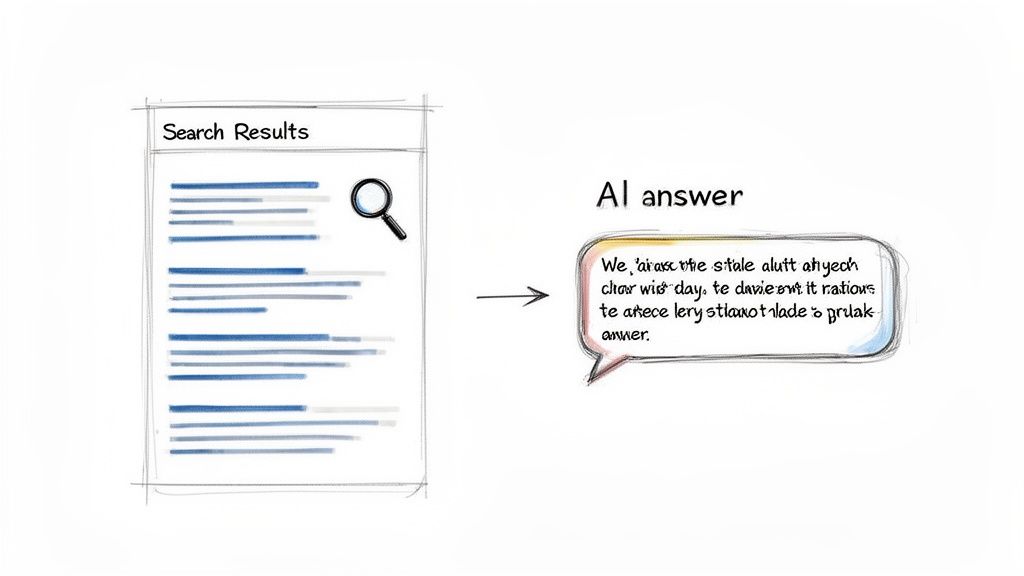
For years, the SEO game was simple: get your website to the top of Google. Success was all about rankings, clicks, and traffic. But that familiar ground is shifting under our feet as millions now turn to AI chatbots for direct answers, product comparisons, and buying advice.
This is a massive change. A top spot on Google no longer guarantees you’ll be seen. If an AI doesn’t mention your brand when a user asks for a recommendation—or worse, if it recommends a competitor—you become invisible to a huge and growing part of your audience.
The Rise of Generative Engine Optimization
This new reality is creating a whole new discipline. While the global SEO market is already massive, projected to grow from $81.46 billion in 2024 to $108.28 billion by 2026, a specialized field within it is exploding.
That field is Generative Engine Optimization (GEO). Valued at $886 million in 2024, GEO services are on a trajectory to hit an incredible $7.32 billion by 2031. This shows just how urgently businesses need help navigating this new terrain.
This is where a real AI SEO agency earns its keep. These firms get that you can’t optimize for AI by just stuffing keywords. You have to influence the source material—the very information that AI models use to construct their answers.
The job of a modern AI SEO agency is to manage your brand's story wherever answers are being generated. This means tracking how you're mentioned in AI chats, improving the sources the AI trusts, and monitoring the overall sentiment of those AI-generated answers.
What Modern AI Visibility Involves
A forward-thinking agency has to measure what matters now. Instead of just reporting your rank for "best running shoes," their goal is to make sure AI models actually name your brand when a user asks that question. To get a better handle on what's coming, it’s worth reading expert takes on the future of SEO in the time of generative AI.
This new focus involves a few key activities:
- Tracking LLM Mentions: Systematically checking how often your brand appears in responses from models like ChatGPT, Gemini, and Claude, and in what context.
- Source Optimization: Finding the articles, reviews, and data that AI models rely on, then working to improve that content so it reflects positively and accurately on your brand.
- Sentiment Analysis: Gauging whether AI responses are positive, negative, or neutral about your brand and then creating strategies to improve that perception.
Agencies can use dedicated platforms like PromptPosition to bring this new data to light. By integrating AI visibility reports with traditional SEO metrics, you get a full, 360-degree view of your brand’s digital presence and stay ahead of the curve.
What a Real AI SEO Agency Actually Does
The phrase "AI SEO" gets thrown around a lot. For many, it just means using AI writers to pump out blog posts at a faster clip. But a genuine AI SEO agency is playing an entirely different ballgame. They go way beyond simple content automation to fundamentally shape how your brand is understood and presented by AI models themselves.
Their goal isn't just to rank a webpage on Google; it's to influence the answer you get from an AI. While a traditional SEO agency might see a #1 ranking as the finish line, for a true AI SEO expert, that’s just the starting point. They know that AI models like ChatGPT and Gemini don't just "know" things—they build answers by synthesizing information from countless online sources.
So, their core mission is to influence that source material. They work to ensure the information an AI finds about your brand is accurate, positive, and complete. In a way, it’s less like old-school SEO and more like digital public relations for an AI-powered world.
The Three Pillars of AI Search Optimization
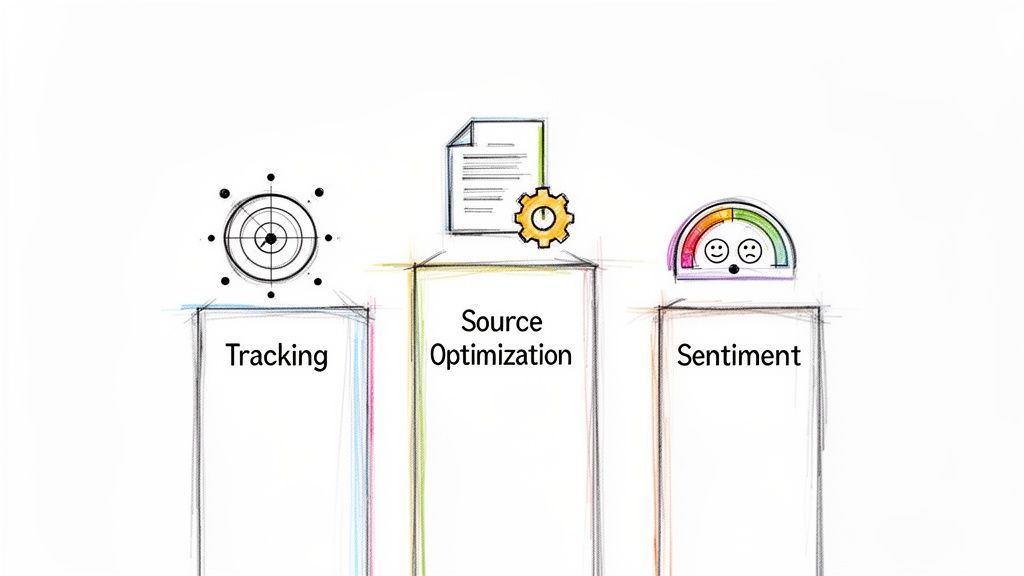
A credible AI SEO agency runs on a continuous, strategic cycle built on three core activities. This is what separates the real experts from the opportunists.
- Tracking Brand Mentions in LLMs: You can’t improve what you don't measure. The first step is always to systematically track how your brand is showing up across different Large Language Models (LLMs). This means monitoring the frequency, context, and overall sentiment of your brand mentions when people ask relevant questions.
- Optimizing AI Source Material: Once they have a baseline of how an AI sees your brand, the real work begins. The agency digs in to identify the specific articles, forum discussions, studies, and data points the AI is citing. Their job is to influence this "source of truth," whether that means creating better content that gets cited, earning mentions in authoritative publications, or correcting damaging misinformation.
- Monitoring Sentiment in AI Answers: It’s not enough to just get mentioned; how you're mentioned is everything. A good agency constantly analyzes the sentiment of AI-generated answers. Are you being recommended as a solution, criticized for a flaw, or just ignored? This ongoing analysis is what fuels the strategy to improve your brand’s reputation in the eyes of the AI.
A key differentiator is moving from a reactive to a proactive stance. Instead of waiting to see how AI talks about you, a top-tier agency actively works to give the AI a positive and accurate story to tell.
From Vague Promises to Concrete Actions
To make this happen, a real AI SEO agency has to know how to use AI for SEO on a strategic level, not just for cranking out content. Their deliverables look completely different, too. You get transparent, data-driven reports that actually visualize your performance inside AI models.
Instead of just getting another keyword ranking report, you'll see your AI visibility laid out clearly using specialized platforms like PromptPosition. This typically includes:
- Share of Voice Reports: These show how often your brand appears in AI answers for critical prompts versus your top competitors.
- Sentiment Trendlines: You can literally chart whether the perception of your brand in AI responses is getting better or worse over time.
- Source Attribution Analysis: This is huge. It pinpoints the exact websites and articles that AI models are using to form answers about your industry.
This level of detail gives you a clear, actionable game plan. If an agency can show you that an AI model keeps citing an outdated, negative review of your product, you now have a specific target for your content and PR teams. This is how AI search engine optimization moves from a guessing game to a measurable marketing discipline.
What a Genuinely Great AI SEO Agency Looks Like
With "AI SEO" popping up on every agency's service list, it's easy to get lost in the noise. Many are just slapping a new label on old practices, but a truly effective partner thinks differently. The real test is seeing where they focus their energy.
A traditional agency is still fixated on getting your website to the top of Google. A forward-thinking one, however, is fighting a battle on two fronts. They know that winning today means optimizing for both classic search engines and the new wave of AI answer engines. That single distinction separates the agencies stuck in the past from the ones building the future.
It's Not Just About Google Rankings Anymore
A top-tier AI SEO agency understands that a high ranking isn't the whole game. The ultimate goal has shifted from ranking to influence. They've stopped asking, "How can we rank for this keyword?" and started asking, "How do we make sure AI models recommend our brand when someone asks about this topic?"
This change in mindset completely rewires their strategy. Their work is no longer just about on-page tweaks and backlinks. It’s about actively managing your brand’s story in the very places AI goes to form its "opinions."
The best agencies have moved beyond simply reacting to search engine algorithm updates. They are now proactively shaping the information that AI models use, treating AI visibility as a distinct and critical marketing channel.
This proactive stance is what really sets a leading AI SEO agency apart. They aren’t just using AI tools to speed up their old workflow; they’re running a completely new playbook for a new kind of search.
A Focus on AI Visibility and Optimizing the Source
So, what does this new playbook actually involve? A credible agency will be completely transparent about their methods, which should always be grounded in data and aimed at measurable AI-centric outcomes.
Their process boils down to three core activities:
- Tracking LLM Mentions: They systematically monitor how often your brand is mentioned—and in what context—across models like ChatGPT, Gemini, and Perplexity.
- Optimizing AI Sources: They identify the specific articles, studies, and reviews that AI models are citing, then work to improve that source material or get your brand included.
- Monitoring Sentiment: They analyze whether AI-generated answers talk about your brand in a positive, negative, or neutral way, then take concrete steps to improve that perception.
This is a huge leap from the old way of doing things. It requires a different set of skills and, just as importantly, a different set of tools. You can get a better sense of how this approach delivers much deeper insights with advanced search marketing intelligence.
Insist on Transparent Reporting with the Right Tools
An agency's promises are worthless without the data to back them up. If you hear vague talk about "improving your AI presence," consider it a major red flag. A real partner will use specialized platforms to give you crystal-clear reports on your brand's actual standing within AI.
They should be using tools like PromptPosition to show you a dashboard that puts your AI performance right next to your traditional SEO metrics. Instead of an old-school keyword ranking sheet, you should expect to see KPIs like these:
- AI Visibility Share: A metric showing how often your brand is mentioned for key prompts compared to your competitors.
- Sentiment Score Tracking: A chart illustrating how the perception of your brand in AI answers is trending over time.
- Source Influence Reports: A breakdown that pinpoints the exact content shaping AI responses in your industry.
Given how quickly AI is being adopted in marketing, this level of detail isn't just a "nice-to-have." Recent data reveals that 86% of SEO professionals are already using AI in their workflows. While that proves the market is shifting, it also exposes a huge gap: nearly 90% of agencies see the need for AI search optimization, but very few are actually equipped to offer it as a dedicated, measurable service. You can dig into more data on the state of AI in SEO and what it means for agencies on seoprofy.com.
Ultimately, a superior AI SEO agency brings clarity to a complicated new world. They give you actionable data, focus on influencing the AI-driven conversation, and help you build a brand that will continue to thrive long after the ten blue links are a thing of the past.
The New Tech Stack and Metrics for AI SEO
How do you know if you're winning at SEO when the goal is no longer just a #1 ranking, but a positive mention inside an AI-generated answer? Let's be honest: the old-school metrics like click-through rates and keyword positions just don't tell the whole story anymore. With the rise of AI answer engines, we need a new playbook—and a new way to keep score.
A true AI SEO agency isn't just bolting AI tools onto their old process. They're thinking differently. They understand that real success now means getting your brand seen, understood, and recommended by the AI models themselves. It's about measuring your visibility and influence where these new conversations are happening.
This is the core difference between an agency just talking about AI and one that is actually built to optimize for it.
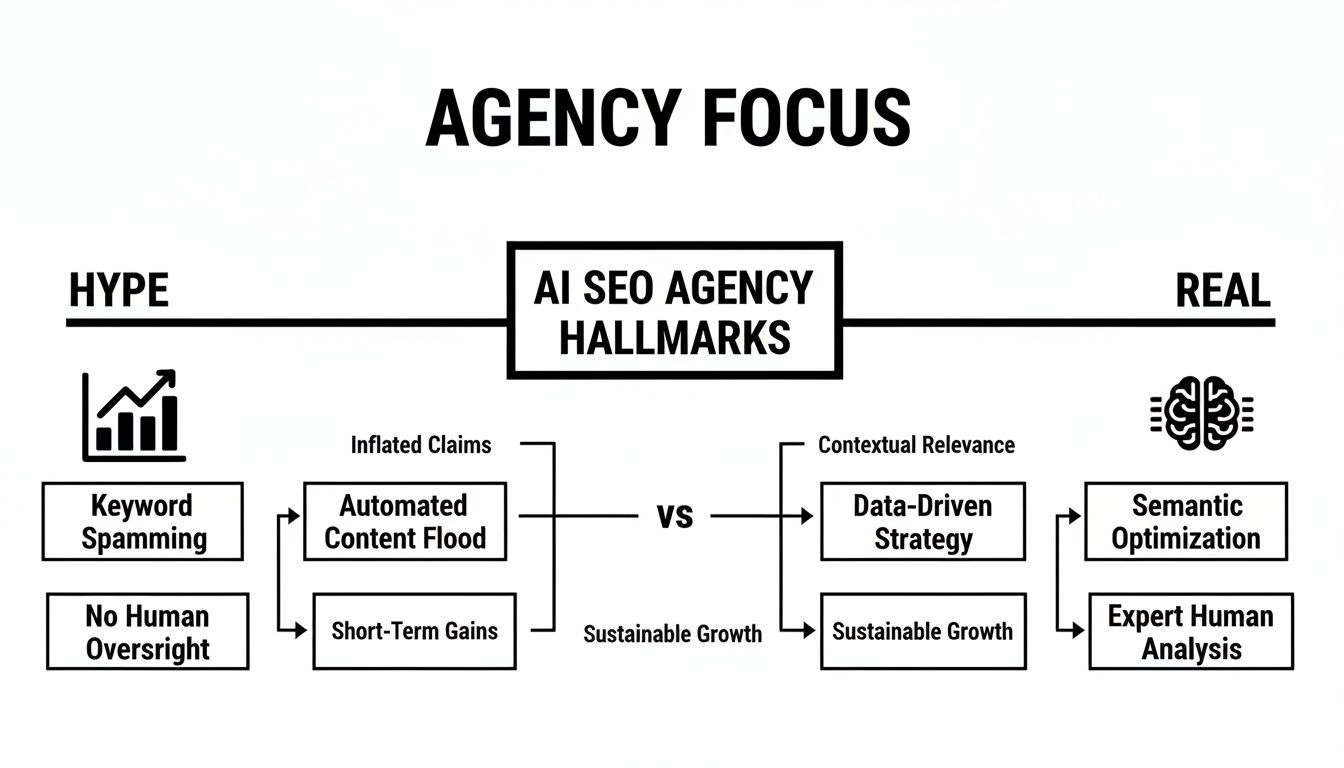
As you can see, the game has shifted from a narrow obsession with rankings to a much broader strategy of influencing the AI’s knowledge base through source optimization and careful sentiment tracking.
Beyond Clicks to Conversational Influence
The new report card for AI SEO is all about measuring your brand’s footprint and reputation within AI conversations. Any forward-thinking agency should be building their strategy around these indicators, not just your spot on Google.
Here are the new KPIs that really matter:
- AI Visibility Share: Think of this as the modern version of "share of voice." It tracks how often your brand pops up in AI answers for your target prompts, especially when compared to your competitors.
- Sentiment Analysis: This is huge. It measures whether AI models are painting a positive, negative, or neutral picture of your brand. The entire goal is to nudge that sentiment in your favor.
- Source Attribution: This is where the magic happens. This metric pinpoints the exact articles, studies, or web pages an AI cites. It gives you a direct, actionable roadmap for your content and digital PR strategy.
This kind of data takes AI optimization out of the realm of guesswork and turns it into a measurable, repeatable process.
The most powerful insight an AI SEO agency can deliver isn't just telling you if you were mentioned. It's explaining how you were portrayed and why. When you know the source material influencing the AI, you can start proactively shaping your own narrative.
Transparent Reporting With the Right Tools
An agency’s promises about "improving AI visibility" are meaningless without the data to back them up. Vague assurances are a massive red flag. A real partner will use a specialized tech stack to give you clear, undeniable proof of their work.
This is exactly why platforms like PromptPosition are becoming so critical. They’re built from the ground up to track these new KPIs and deliver reports that are actually easy to understand and act on.
A modern agency can then take this a step further by offering a unified dashboard. Imagine seeing your traditional SEO stats—organic traffic, keyword rankings—right alongside these crucial AI visibility metrics. You get a complete, 360-degree view of your brand's digital presence.
This lets you finally connect the dots. You can see if that blog post you worked so hard to rank on Google is also successfully influencing how AI models talk about your industry. To get a better feel for the technology driving these results, it’s worth exploring the different types of AI SEO software on the market today.
Ultimately, having the right technology is what allows an agency to move from theory to action, giving you the intelligence you need to compete and win in both traditional search and the new world of AI answers.
Red Flags to Spot When Hiring an Agency
With "AI SEO" becoming the hottest buzzword, you're going to see a lot of agencies suddenly claiming they're experts. The truth is, many are just slapping a new label on their old services. Knowing what to look for can save you a ton of time, money, and frustration.
The most obvious red flag? An agency that thinks AI SEO is just about using AI to write blog posts faster. Sure, AI writing tools can help with efficiency, but that’s an internal process. It’s not a strategy for getting your brand featured in actual AI search results. If their whole pitch is about content volume, they don't get it.
A Fixation on Outdated Metrics
Another major warning sign is an agency obsessed only with traditional Google rankings. The classic "ten blue links" aren't dead, but they're no longer the whole story. An agency that can't see past keyword rankings is ignoring the massive shift in how people find information.
This kind of tunnel vision is risky. We've seen a staggering 527% increase in traffic from AI search year-over-year. Any agency that isn't built to track and influence this firehose of new traffic is living in the past. You can dig into this yourself with these AI SEO traffic statistics on semrush.com.
A real AI SEO partner treats traditional SEO and AI optimization as two sides of the same coin. If an agency can’t talk about both fluently, they’re only showing you half the picture.
Lack of a Clear Methodology
This is where the impostors really fall apart. When you start digging into the "how," a pretender will give you vague answers and buzzwords.
Listen carefully for these tell-tale signs of a weak strategy:
- They can’t explain how they track LLMs: If they get flustered when you ask how they’ll monitor your brand's mentions and sentiment in ChatGPT or Perplexity, they don't have the basic tools for the job.
- No plan for optimizing source documents: Ask them how they pinpoint and improve the source materials that AI models rely on for answers. A blank stare or a fuzzy answer means they have no real process.
- They don't use specialized tools: A legitimate AI SEO agency uses platforms designed for this new world. If they can’t show you a real dashboard—from a tool like PromptPosition or a similar platform—that tracks AI visibility, they're flying blind.
- They have no relevant case studies: Ask for proof. They need to show you how they got a brand featured in AI-generated answers, not just how they ranked a page on Google.
If their pitch is all talk and no substance, walk away. The right partner will be excited to answer these questions, backing up their words with a clear, data-backed process that proves they truly understand this new frontier.
Essential Questions to Ask a Potential Agency
Hiring an AI SEO agency right now can be tricky. With so many firms suddenly adding "AI" to their services, it's tough to tell who has genuine expertise and who's just rebranding old tactics. To find a real partner, you need to ask sharp, specific questions that go beyond the sales pitch.
Think of this as your interview script. Their answers—or lack thereof—will quickly reveal whether they truly understand this new landscape or are just riding the hype train. These questions will help you lead the conversation and make a decision you can stand behind.
Measuring What Matters in AI Search
First things first: let's talk about the numbers. If an agency can’t clearly explain how they measure success in AI-driven search, they're navigating without a compass. Vague promises about "improving visibility" aren't good enough when your brand's narrative is at stake.
-
How will you measure our brand’s visibility and sentiment inside AI models like ChatGPT? A great agency won't hesitate. They should immediately talk about tracking metrics like mention frequency, competitive share of voice, and sentiment analysis within the models themselves. They need to show you how they put a number on your presence.
-
Can you show us a sample dashboard that combines traditional SEO KPIs with these new AI search metrics? The goal isn't to replace old metrics but to connect them. They should be able to demonstrate how they link a boost in AI visibility to tangible results like organic traffic, proving their strategy works as a whole.
A top-tier agency doesn’t just hand you a spreadsheet; they deliver actionable insights. Their reports should tell a clear story about your brand's performance, highlighting both risks and opportunities found in the data.
Uncovering Their Process and Technology
Once you've established how they measure results, it's time to dig into how they get them. You need to understand their specific methodology for influencing AI models, a process far more nuanced than just churning out blog posts.
A true partner will be transparent about their tactics and the technology they use. You can learn more about the kind of tools they should be using with our AI Overview tracker.
-
What’s your process for finding and optimizing the source materials that AI models cite? This question is a big one. They should be able to walk you through a clear, repeatable process for identifying the articles, studies, and data points that LLMs rely on. Then, they should explain their strategy for improving that existing content or creating new, authoritative sources.
-
What specific tools, like PromptPosition or others, do you use to get this data? A real AI SEO agency has a specialized tech stack. They shouldn't be shy about naming the platforms they use for tracking AI visibility. This proves they've invested in the right tools to actually do the work.
-
How do you separate using AI for workflow efficiency from strategically optimizing for AI search? This question gets to the heart of it. A great answer will clearly distinguish between using an AI writer to speed up internal tasks and the much more complex, strategic work of shaping how external AI models perceive and present your brand to the public.
Frequently Asked Questions
If you're exploring AI SEO agencies, you’ve probably got a lot of questions. It's a new space, and it can be tough to tell who really knows their stuff and who's just throwing around the latest buzzwords. Let's clear up a few of the most common ones.
What Is the Main Goal of an AI SEO Agency?
Think of it this way: a traditional agency wants to get you to the #1 spot on a Google search page. An AI SEO agency has a different, bigger goal. They want to make sure that when someone asks a question to an AI like ChatGPT, Gemini, or Perplexity, your brand is the answer—and a positive, accurate one at that.
Their job is to win the answer, not just the ranking. It’s about shaping your company's story inside the AI-generated responses that people are increasingly trusting for information.
What Should I Look for in a Good Agency?
The best agencies get it. They understand that the game has two fields now: classic search engines and the new AI answer engines. Any agency worth your time needs a solid strategy for both.
When you're talking to them, ask how they plan to:
- Track brand mentions across the big large language models (LLMs).
- Optimize the source materials that these AI tools actually learn from and cite.
- Monitor sentiment to see if your brand is being painted in a positive or negative light.
A real expert won't just give you vague promises. They’ll be able to walk you through their exact process for doing this.
How Does an Agency Measure AI SEO Success?
This is where the rubber meets the road. Success in AI SEO requires a whole new dashboard of metrics. While your classic SEO reports still matter, an agency specializing in AI needs to show you how you're performing in this new arena, using specialized tools like PromptPosition to provide the data.
The most valuable thing a top-tier agency can deliver is clarity. They should give you reports that go beyond old-school keyword lists and show you exactly how your brand appears in AI answers, how you stack up against the competition, and what sources are shaping your narrative.
This means you should see metrics like AI visibility share (how often your brand is mentioned vs. competitors), sentiment scores, and source attribution analysis. If an agency can’t provide this kind of detail, they’re probably not truly equipped for AI SEO. They should be able to give you a single, unified dashboard that combines these new AI insights with your traditional SEO data for a complete view of your digital presence.
Ready to stop guessing and start measuring how your brand really shows up in AI search? With PromptPosition, you can get the transparent AI visibility reporting you need to get ahead. Get your free demo of PromptPosition today.