How to Build Search Engine Marketing Reports That Actually Drive Decisions
Effective search engine marketing reporting isn't about logging what happened last month. It’s a practical guide to building a document that forces a strategic conversation. The goal is to translate a sea of data—clicks, costs, impressions—into a clear and compelling narrative that answers the most important question: "What should we do next?" This guide will show you how to build an SEM report that actually drives decisions.
Transform Reporting From Historical Data To Strategic Insights
For too long, SEM reports have been treated like a rearview mirror. We look at them, nod at the numbers, and then move on. It's a necessary task, sure, but it's rarely inspiring. This kind of reporting is a massive missed opportunity.
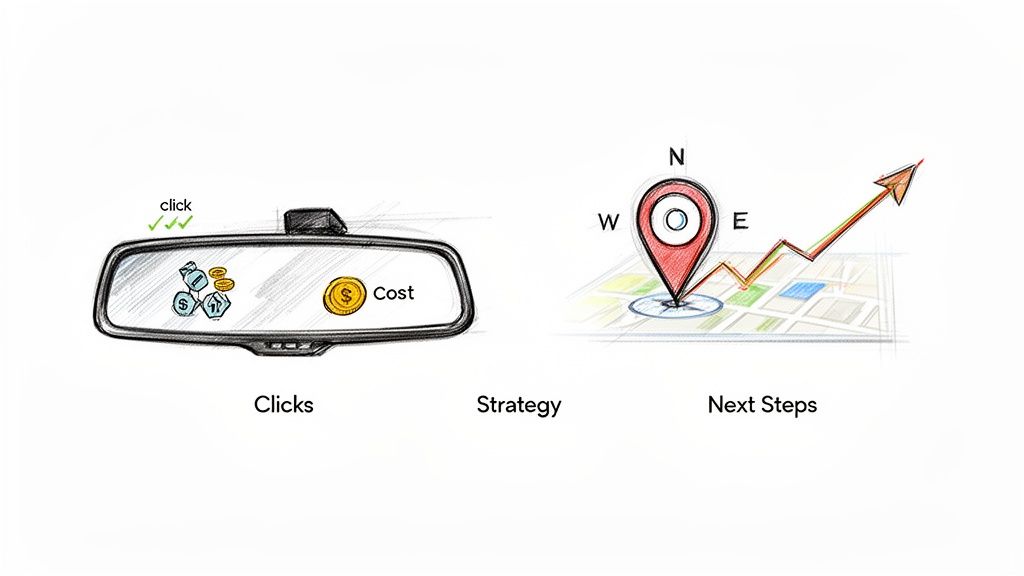
The real power of a report is its ability to shape the future, not just document the past. It’s about reframing the dialogue you have with your team and your stakeholders. Instead of just presenting a dashboard of metrics, you need to connect those numbers directly to business objectives and, most importantly, highlight where the next big growth opportunity is hiding.
Shifting your mindset from data-logger to strategic guide is the first step. Understanding how to measure marketing effectiveness using Excel and AI is a great way to start building that muscle.
The Limits of Traditional Reporting
Let's be clear: the standard SEM metrics are the foundation of any good report. You absolutely need them. Without tracking the basics, you're just guessing.
The table below breaks down these core metrics and, more importantly, the strategic questions they should be forcing you to ask.
Connecting Core SEM Metrics to Strategic Questions
| Metric | What It Measures | Strategic Question It Answers |
|---|---|---|
| Impressions | How many times your ad was shown. | Are we visible to the right audience, or are we just making noise? Is our budget getting us in front of enough people? |
| Click-Through Rate (CTR) | The percentage of people who clicked your ad after seeing it. | Is our ad copy and creative compelling enough to stand out? Does our messaging resonate with what users are searching for? |
| Cost Per Click (CPC) | The average price you pay for each click. | Are we paying a sustainable price for traffic? How is auction competition affecting our budget efficiency? |
| Conversion Rate | The percentage of clicks that result in a desired action (e.g., a sale, a lead form submission). | Is our landing page effectively turning traffic into value? Does the user journey from ad to conversion have friction? |
While these are all essential, a report that only contains these metrics tells an incomplete story. It answers "what happened" but almost never explains "why" it happened or "what we should do about it."
A great report doesn't just state that CTR dropped by 5%. It digs deeper, connecting that drop to potential ad fatigue from creative that's been running for months. It then proposes a new set of ad variations to test and outlines the expected impact on both click volume and downstream conversion rates. It turns a simple data point into a clear action plan.
The New Frontier: AI-Powered Search
The very definition of a "search engine" is expanding beyond what we’ve known. It’s not just about Google and Bing anymore. AI-powered search engines like ChatGPT, Gemini, and Perplexity are quickly becoming primary channels for how people discover brands and research products.
This shift has created a massive blind spot for most marketers. If your brand gets a glowing mention in an AI-generated answer, that's a huge win. If it's ignored—or worse, mentioned negatively—that's a direct hit to your brand's perception and a lost opportunity. The problem is, none of this activity shows up in your Google Ads or Search Console reports.
This is why forward-thinking search engine marketing reporting absolutely must account for this new reality. Forward-thinking SEM reports should include an AI visibility section that tracks how your brand appears in ChatGPT, Gemini, and Perplexity. This section tracks a new breed of metrics, including:
- How often your brand appears in AI answers for your most important keywords.
- The sentiment of those mentions—is the AI portraying your brand positively, negatively, or just neutrally?
- Your share of voice within these new platforms compared to your key competitors.
Tools like PromptPosition can feed this data into your reporting alongside your existing Google and paid search metrics. By integrating AI search analytics directly into your reports alongside your traditional paid and organic metrics, you create a truly holistic picture of your brand's full-funnel search presence.
If you'd like to explore this further, check out our complete guide on how to measure marketing performance. This unified approach is what elevates your reporting from a simple record of the past into a powerful GPS for the future.
Getting the SEM Reporting Fundamentals Right
Before you start building out a sophisticated report, you have to get the basics down cold. Solid search engine marketing reporting always starts with the core metrics. But knowing what they are is one thing; knowing how to read between the lines to see the real story is where the expertise comes in.
Every good report is built on these fundamentals. Think of them as the vital signs for your campaigns, giving you a quick pulse check on performance.
- Impressions: How many times your ad was shown. This is your total potential audience or reach.
- Clicks: The number of people who actually clicked on your ad. This is your first layer of engagement.
- Click-Through Rate (CTR): The simple formula is Clicks ÷ Impressions. This percentage tells you how compelling and relevant your ad is to the people seeing it.
- Cost Per Click (CPC): The average price you’re paying every time someone clicks. It’s your primary efficiency metric.
- Conversion Rate: The percentage of clicks that turn into a meaningful action, like a sale or a lead. This tells you if your landing page and offer are actually working.
On their own, these are just numbers on a spreadsheet. Their real power comes to life when you start asking why and connecting them to what’s happening in the real world.
From Numbers on a Page to Smart Decisions
A great SEM report doesn't just list data; it translates those data points into clear next steps. This means slicing your data by campaign, ad group, or even specific keywords to find trends that tell you what’s working and, more importantly, what’s broken.
Let’s say you’re looking at your monthly numbers and see the CTR for a key campaign suddenly dropped by 20%. A basic report just flags the drop. A truly useful report investigates it.
Is the CTR drop happening across the board? If it’s just in one or two ad groups, you might be dealing with ad fatigue—your audience is just tired of seeing the same creative. The fix is straightforward: rotate in some fresh ad copy or new images. But if that drop is happening everywhere, it could be a sign that a new competitor just entered the auction, driving your ad position down and hurting visibility.
The point of search engine marketing reporting isn't just to look at the numbers; it's to challenge them. A high CPC isn't necessarily a bad thing if it’s for a high-intent keyword that converts like crazy. On the flip side, a dirt-cheap CPC is a total waste if those clicks never, ever convert.
The Search World Is Bigger Than It Used to Be
For years, SEM reporting lived in a neat little world focused on the dance between paid ads and organic search results. We all learned how to analyze the synergy—how good SEO could lower CPCs or how paid campaigns could plug the gaps in our organic rankings. That relationship is still critical, but the definition of "search" has blown wide open.
AI chat engines like ChatGPT, Gemini, and Perplexity aren't niche tools anymore. They are now mainstream channels where your customers are discovering products, doing their research, and forming opinions about your brand. The catch? All of this is happening completely outside of your Google Ads and Analytics dashboards.
Any modern SEM report has to account for this new reality. It’s no longer enough to report on your visibility in Google's paid and organic results. You now have to ask how your brand shows up when a potential customer asks an AI for a recommendation.
Adding an AI Visibility Section to Your Reports
To build a report that tells the whole story, you should consider adding a dedicated AI Visibility section. This is where you’ll track how your brand is being portrayed in the generative AI ecosystem, which is a major blind spot for most marketing teams right now. This section should answer questions like:
- How often does our brand get mentioned when users ask AI about our products or industry?
- Is the tone of those mentions positive, neutral, or negative?
- Are our competitors getting recommended in our place?
This is where you need a specialized tool. A platform like PromptPosition is built specifically to track brand presence and sentiment across the big AI models. By pulling this data into your reports, you can put AI visibility metrics right next to your traditional CPC and conversion data.
This approach gives you a single, unified view that truly reflects the modern customer journey. As you start improving your SEO visibility through key search metrics, you’ll see that blending traditional and AI data paints a far more accurate picture of your true market presence. It’s how you create reports that don't just look backward but help you build a smarter strategy for the future.
Crafting a Compelling Narrative With Your Data
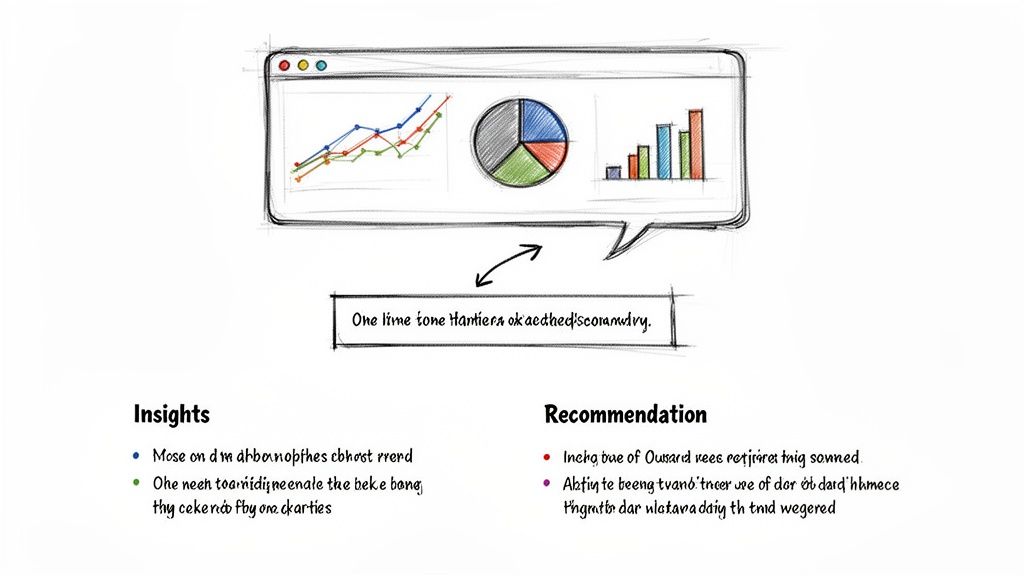
Let’s be honest: a spreadsheet packed with CPC and CTR data isn't going to make a stakeholder sit up and take notice. Numbers on their own are just noise. The real skill in search engine marketing reporting lies in transforming that raw data into a clear story that drives decisions.
It’s about moving past a simple list of metrics. Your report should guide your audience from a high-level summary right down to specific, actionable insights. When you get this right, your report stops being a passive document and becomes the catalyst for meaningful change.
Beyond Standard Metrics: Building a Unified View
The way people search has fundamentally changed, and our reports need to catch up. It’s no longer just a two-horse race between Google Ads and organic results. The rise of AI-powered answer engines has carved out a new, essential channel for discovery that most traditional reporting completely ignores.
While the fundamentals still matter, layering in new data points is what will give you—and your stakeholders—a complete picture of what's happening.
- Paid Search: This is your core performance engine. You’re tracking Impressions, CTR, and CPC to see how efficiently you’re buying traffic and converting customers. It’s your direct line to immediate results.
- Organic Search: Using tools like Google Search Console, you’re measuring brand visibility, rankings, and organic traffic. This is the pulse of your long-term content strategy and brand authority.
- AI Search: This is the new frontier. Monitoring your brand's visibility, share of voice, and sentiment within AI answers on platforms like ChatGPT and Gemini shows you where you stand on a rapidly growing discovery channel.
Weaving these three threads together is how you tell a compelling story. Imagine showing that while paid search CPCs are climbing, your brand is simultaneously earning positive mentions in AI answers, driving high-quality referral traffic that costs you nothing. That’s a powerful narrative.
Why You Need an AI Visibility Section
A forward-thinking SEM report absolutely needs an AI visibility section. This isn't just a "nice-to-have" anymore; it's a critical piece of the puzzle for understanding your full search footprint. Right now, most marketers are flying blind here, which gives you a huge opportunity to provide insights they can't get anywhere else.
This section should track how your brand shows up when people ask questions to AI assistants like ChatGPT, Gemini, or Perplexity. You’re essentially measuring what used to be unmeasurable. The goal is to answer crucial questions for your team:
- Does AI recommend our products when users ask for solutions we provide?
- What’s the sentiment of these mentions? Are they positive, negative, or just neutral?
- Which competitors are capturing the conversation in AI answers where we’re not even mentioned?
A report that shows a 15% drop in organic traffic is alarming. But a report that shows a 15% organic drop alongside a 20% increase in high-converting traffic from AI search tells a story of successful adaptation to a changing user landscape.
This kind of integrated analysis proves you're not just reacting to old data but proactively managing your brand’s reputation across the entire modern search ecosystem.
Tying It All Together With the Right Tools
Trying to manually track your brand’s presence across every major AI model is a losing battle. It’s simply not scalable. This is where specialized platforms become indispensable.
A tool like PromptPosition is built specifically to monitor how your brand is being portrayed across different AI engines, day in and day out. By pulling that data into your main reporting dashboard, you can place AI visibility metrics right next to your trusted Google Ads and Search Console data. This creates the single, unified view you need to make genuinely informed strategic decisions.
Are Your SEM Reports Missing the New AI-Powered Search?
If your SEM reports are still focused exclusively on Google and Bing, you're missing a huge, and rapidly growing, piece of the user journey. The old definition of "search" is obsolete. Today, people aren't just typing keywords into a search bar; they're asking complex questions to AI assistants like ChatGPT, Gemini, and Perplexity.
This isn't some niche trend for tech enthusiasts anymore. These AI platforms are now mainstream tools for discovery and research. Ignoring them means you're flying blind to a massive shift in how people find and interact with brands. Frankly, it's the biggest change in search behavior we've seen in more than a decade.
Looking Beyond Clicks and Conversions
Of course, your core metrics—impressions, CTR, CPC, and conversion rate—are still the foundation of paid search analysis. They tell you how your campaigns are performing. But they tell you nothing about how your brand is being represented in this new world of AI-driven answers.
This is a serious intelligence gap. A modern SEM reporting strategy has to include AI visibility metrics to answer some pretty fundamental questions your current reports can't touch.
Adding an AI Visibility Section to Your Reports
When you add a section on AI visibility, your report stops being just a performance recap and becomes a truly strategic document. It shows you're not just tracking last month's results but are actively monitoring the channels that will define tomorrow. This section should be built around a new set of KPIs that measure your brand's presence and perception within AI-generated content.
You should be asking questions like:
- Brand Mentions: How often does our brand pop up when users ask high-intent questions related to our products or services?
- Share of Voice: When our industry is discussed, what percentage of the conversation do we actually own versus our key competitors?
- Sentiment Analysis: Are the AI's mentions of us positive, negative, or just neutral? Is it recommending us or telling people to stay away?
- Source Attribution: What specific articles, blog posts, or reviews are the AI models citing when they mention us? This is gold for guiding your content and PR strategy.
Getting answers to these questions adds a powerful layer of context to all your other data.
Imagine you see your paid search CPCs climbing because of new competition. That's a problem. But what if you also discovered that your brand is being positively recommended in 70% of AI responses for your top commercial queries? That completely reframes the ROI conversation, revealing a new, high-trust channel that's building brand preference before anyone even gets to Google.
This is the kind of insight that turns a standard report into a strategic weapon. You can get a much deeper look into this by reading our full breakdown of AI search visibility and its impact on marketing today.
How to Actually Track This "Invisible" Data
Let's be clear: this data isn't hiding in your Google Ads or Search Console accounts. To track this, you need a specialized tool. This is exactly why platforms like PromptPosition exist. It's built to monitor your brand's visibility and sentiment across all the major AI models, turning those abstract AI conversations into hard data you can actually use.
With a tool like PromptPosition, you can pull this previously hidden data right into your existing reports. You can literally chart your AI Brand Sentiment trend line next to your CPC or compare your AI Share of Voice against your organic search rankings. It creates one unified, comprehensive view of your entire search presence.
And this isn't a "nice-to-have" for the future; the need is here now. AI search traffic has exploded, surging 527% year-over-year. The 2025 Previsible AI Traffic Report found that sessions from LLMs like ChatGPT and Perplexity skyrocketed from 17,000 to 107,000 in early 2024. For some sites, that's already over 1% of their total sessions. If you want to understand the sheer scale of this shift, you can discover more insights about these AI SEO statistics for yourself. Building this capability into your reporting now is what will keep your brand ahead of the curve.
Building Your Unified SEM Reporting Dashboard
Alright, let's get practical. We’ve talked about the why; now let’s get into the how. It’s time to ditch the siloed spreadsheets and build a single, unified dashboard that merges your classic SEM metrics with the new reality of AI search. This is how you create one source of truth that tells the whole story.
A unified report is where the real magic happens. When you stop looking at data in isolation, you start uncovering insights that were invisible before. Imagine seeing your Google Ads conversion data right next to brand sentiment from Gemini. You might notice your paid CPCs are creeping up, but at the same time, positive mentions in AI answers are driving a wave of higher-quality organic leads. That’s a connection you’d completely miss otherwise.
The Anatomy of a Unified Report
To build a dashboard that people actually use, structure is everything. You need a logical flow that guides stakeholders from the 30,000-foot view down to the nitty-gritty details. It’s all about making the data’s story clear and actionable.
Instead of just listing metrics, think in terms of distinct but connected sections. A good report tells a story, starting with the big picture and then drilling down into the specific channels that contribute to it.
Here’s a look at how you can structure a modern, unified report that blends traditional and AI-driven insights. This table provides a solid blueprint.
Example Structure for a Unified SEM Report
| Report Section | Key Metrics | Data Sources | Strategic Purpose |
|---|---|---|---|
| Executive Summary | Top-line KPIs vs. Targets, Overall ROAS, Key Wins/Challenges | All Sources (Synthesized) | Provide a quick, digestible narrative for leadership. What's the bottom line? |
| Paid Search Performance | Impressions, CTR, CPC, Conversion Rate, ROAS, Quality Score | Google Ads, Microsoft Ads | Analyze ad spend efficiency and direct ROI. Are we getting the most from our budget? |
| Organic Search Health | Keyword Rankings, Organic Traffic, Organic CTR, Branded vs. Non-Branded Traffic | Google Search Console, Bing Webmaster Tools | Monitor non-paid presence and search visibility. Are we building long-term authority? |
| AI Search Visibility & Sentiment | AI Visibility Score, Share of Voice, Brand Mentions, Sentiment Analysis (Positive/Negative/Neutral) | PromptPosition | Track brand presence and perception in AI answers. How is AI shaping our reputation? |
This structure helps you tell a multi-faceted story, acknowledging that a customer's journey is messy and rarely linear. It might start with a ChatGPT query and end with a click on a paid ad, and your report needs to reflect that. For more ideas on organizing these data streams, checking out different marketing intelligence platforms can offer some great frameworks.
Bringing Traditional and AI Metrics Together
The real power of a unified report comes from placing these different data streams side-by-side. This means integrating data from your core channels—paid search, organic search, and now, AI-generated answers.
This is what that integration looks like in practice.
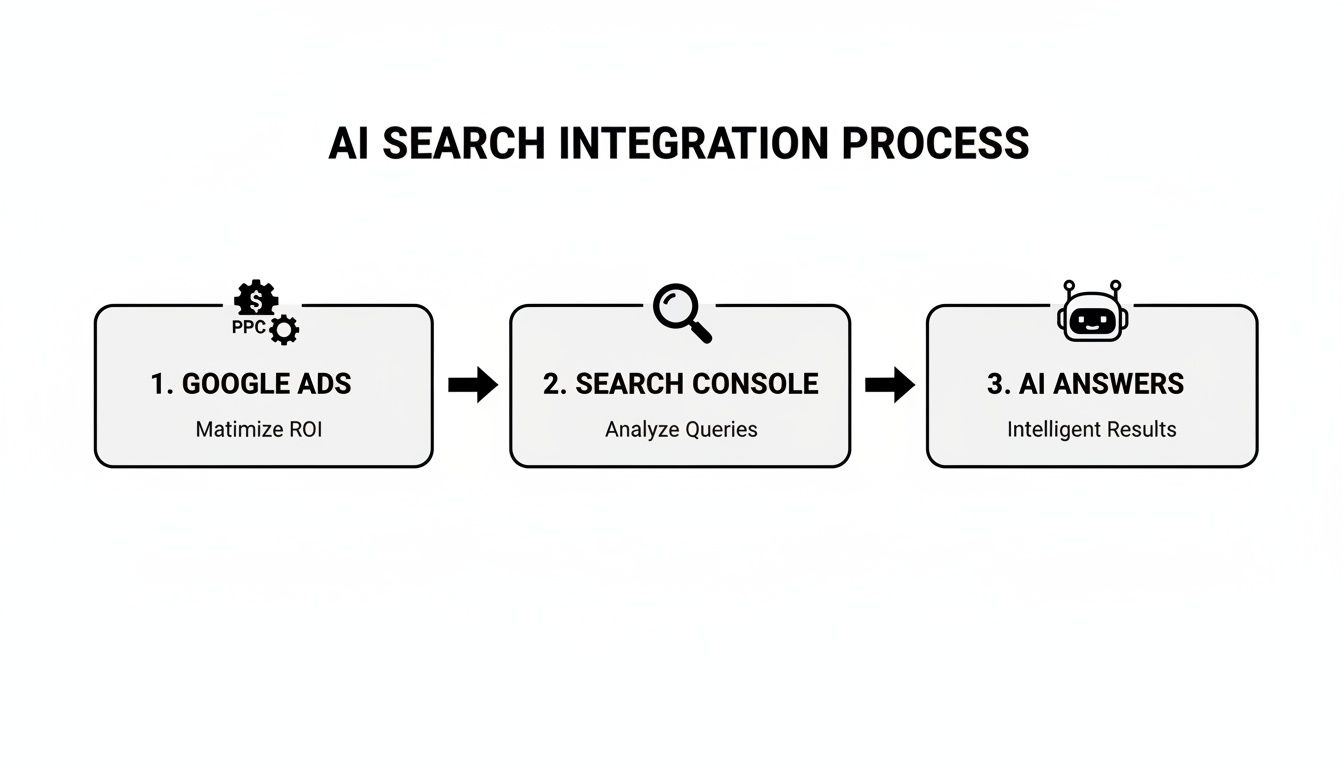
The visual makes it clear: modern search is a three-part ecosystem. Your reporting has to mirror this reality if you want it to be genuinely useful.
The financial stakes make this integrated approach non-negotiable. Global search advertising spend is projected to soar to $483.5 billion by 2029. With Google holding a staggering 89.57% market share, platforms like Google Ads are obviously central. But justifying that spend requires looking beyond just clicks and conversions.
A truly unified dashboard doesn’t just report on metrics; it contextualizes them. It shows that while you’re spending on paid search, you’re also building brand equity in AI conversations, which in turn boosts organic consideration and lowers future customer acquisition costs.
Automate Your Data for a Cohesive View
Let's be honest, nobody has time to manually pull reports from Google Ads, Search Console, and then try to track down AI mentions. It's a recipe for burnout and mistakes. The only sustainable way to manage this is through automation.
This is where the right tools become your best friend. While Google’s native tools have your paid and organic data covered, they leave a huge blind spot when it comes to AI. This is precisely the gap a platform like PromptPosition was built to fill, automatically tracking your brand’s visibility and sentiment across every major AI model.
Using its API or other integrations, you can pipe this critical AI data directly into your dashboard of choice, whether that’s Looker Studio (formerly Google Data Studio), Tableau, or something else. Suddenly, you can create charts that place "AI Brand Sentiment" and "Share of Voice" right next to your "Cost Per Conversion" and "Organic CTR."
This automated, unified view ensures your team and stakeholders get timely, comprehensive intelligence that reflects the entire search landscape today. It’s how you graduate from just reporting numbers to delivering strategic insights that actually drive the business forward.
Answering Your Toughest SEM Reporting Questions
As we move past basic data dumps and into more strategic reporting, a lot of new questions are popping up. It's a big shift, and it means rethinking our tools, our dashboards, and even the conversations we have with leadership.
Let's tackle some of the most common questions I hear from teams navigating this new world of SEM reporting.
How Often Should I Generate SEM Reports?
This is a classic "it depends" scenario, and it depends entirely on who's looking at the report.
Your in-the-weeds campaign managers need data now. They live inside live dashboards, making daily, sometimes hourly, tweaks to bids, budgets, and ad copy. For them, a report that's even a day old is ancient history. Their focus is purely tactical.
Your leadership team, on the other hand, doesn't need that level of detail. In fact, it's counterproductive. For executives, a bi-weekly or monthly summary is perfect. They want the big picture: high-level trends, bottom-line ROI, and how your SEM efforts are pushing larger business goals forward. The trick is to automate the daily data grind so you can dedicate your brainpower to crafting that high-impact executive story.
My Organic Traffic Is Dropping but AI Search Referrals Are Up. How Do I Report This?
First off, don't panic. This is the exact scenario where a unified reporting strategy proves its worth. This isn't a story about failure; it's a story about evolution.
You need to present this as a deliberate shift in user behavior that you're successfully navigating. In your report, show the two data points side-by-side. Start with a chart showing the dip in traditional organic sessions, but immediately follow it with a chart showing the exciting growth in AI search referrals.
The key to making this narrative stick is to add context on the quality of that new traffic. This is where a tool like PromptPosition becomes invaluable. Pull in metrics that tell the rest of the story. Is the bounce rate from AI search lower? Are users spending more time on the site? Are they converting at a higher rate? Suddenly, you're not explaining a loss; you're demonstrating how the brand is winning in the next generation of search.
Key Takeaway: A dip in one metric is not a failure when it's tied to growth in a newer, potentially more valuable channel. The story is about smart adaptation, not isolated decline. This is the heart of modern search engine marketing reporting.
How Do I Convince My Boss to Invest in an AI Analytics Tool?
You have to frame this around the risk of flying blind. It's not about a shiny new toy; it's about plugging a massive and growing hole in your visibility.
Explain that a huge chunk of your audience is now finding products and services through AI, and without a specialized tool, you have absolutely no idea how your brand shows up there. It's like trying to manage a Google Ads campaign without access to the Google Ads platform. It's unthinkable.
Arm yourself with stats on AI search adoption to create a sense of urgency. I've found it effective to position the investment as a competitive necessity: "Our competitors are almost certainly looking at this data. Right now, we have a complete blind spot." If you can swing it, run a small pilot or free trial with a tool like PromptPosition. Then, present a mini-report showing exactly what you found—maybe some negative brand sentiment you can now fix or a competitor's advantage you've just uncovered. Concrete examples make the investment feel real and necessary.
What Is the Single Most Important SEM Metric?
This is a trick question. The answer is, there isn't one. Anyone who tells you otherwise is oversimplifying things.
The "most important" metric is whatever ties directly to the specific goal of your business or campaign. If you're running an e-commerce site, that metric is almost certainly Return on Ad Spend (ROAS). If you're a B2B company focused on lead gen, you're probably obsessed with Cost Per Qualified Lead (CPQL).
The real magic of good reporting isn't about finding one number to rule them all. It's about connecting the dots and telling a story. It's showing how a better Click-Through Rate (CTR) led to a higher Quality Score, which then lowered your Cost Per Click (CPC), and ultimately drove a stronger ROAS. The best reports show how all the pieces work together to create business impact.
Ready to close the visibility gap in your reporting? PromptPosition gives you the data you need to track your brand’s presence and sentiment across all major AI search engines. Learn more about PromptPosition.