Digital Marketing Best Practices for 2026: The New Playbook

For years, mastering Google was the core of digital marketing. Strong rankings, targeted ads, and a solid email list were the pillars of success. But the ground is shifting. While those fundamentals still matter, a new, powerful channel has emerged: AI search. Customers are now asking ChatGPT, Perplexity, and Claude for brand recommendations, product comparisons, and solutions to their problems. Ranking number one on Google no longer guarantees you'll be mentioned in these critical conversations.
This guide outlines the essential digital marketing best practices that blend timeless strategies with the new imperative of monitoring and optimizing your brand's presence in AI models. We will explore a modern playbook that covers everything from source-driven content and competitive benchmarking to the most critical new discipline: AI search visibility. You will learn how to ensure your hard-won authority and meticulous marketing efforts translate into favorable mentions within generative AI answers.
Success today requires a dual focus. You must maintain your edge in traditional search while pioneering your visibility where customers are increasingly turning for advice. We'll show you how to track if your brand is recommended by AI, using tools like PromptPosition to measure this new form of visibility. This isn't about abandoning what works; it's about expanding your strategy to include the AI-powered conversations that are already shaping your brand's reputation and customer decisions. These updated best practices will ensure you're not just visible, but influential, wherever your audience seeks answers.
1. Monitor How AI Models Present Your Brand (The New Imperative)
As customers increasingly turn to AI models like ChatGPT, Perplexity, and Gemini for answers, a new frontier of digital marketing has emerged. The most critical new digital marketing best practice is monitoring how AI models present your brand. This goes beyond traditional SEO; strong Google rankings alone no longer guarantee your brand shows up when customers use ChatGPT or Perplexity for recommendations.
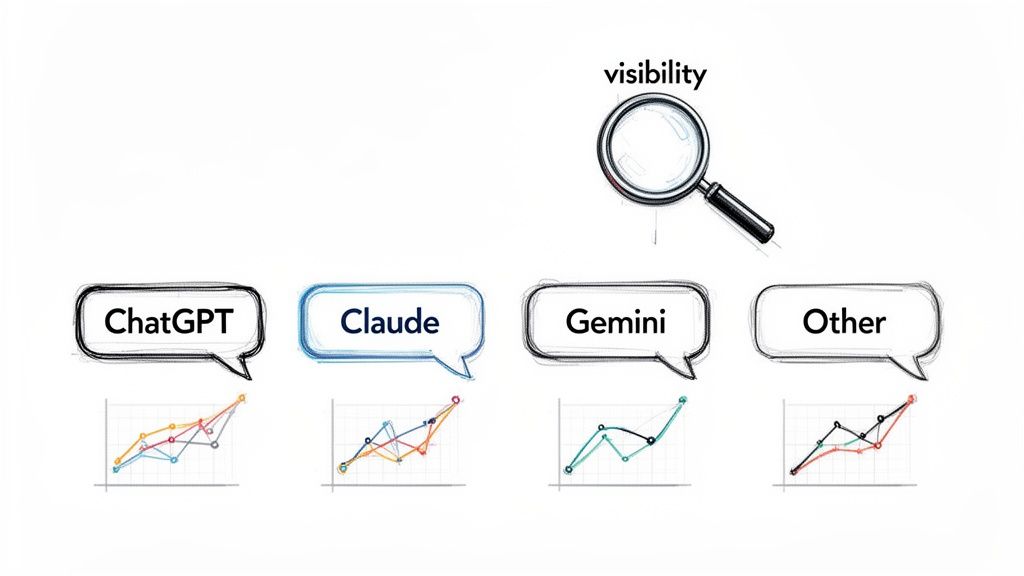
This new discipline is a critical digital marketing best practice because LLMs form opinions and provide direct answers, often without citing all their sources. An inaccurate mention, a negative sentiment, or a complete omission can directly influence purchasing decisions before a user ever reaches a search engine results page.
Why It Matters
Monitoring AI visibility allows you to understand your brand's narrative in this new information channel. Are you being recommended over competitors? Is the information about your services accurate? What is the overall sentiment? Answering these questions helps protect your brand reputation and uncover new opportunities for growth. Teams can use a tool like PromptPosition to track whether their digital marketing efforts translate into AI recommendations.
Actionable Steps for Implementation
- Establish a Baseline: Before making any changes, measure your brand's current visibility across major LLMs. Document how often you are mentioned for key queries, the sentiment of those mentions, and how you are positioned against competitors.
- Analyze Your Information Diet: Identify the primary sources AI models cite when discussing your industry or products. Prioritize updating and optimizing content on these high-influence domains.
- Track Competitive Gaps: Compare your visibility metrics against your top three competitors. This analysis will reveal where they are outperforming you and highlight priority areas for your content and PR strategies.
- Monitor Verbatim Outputs: Regularly collect the exact quotes and language AI models use to describe your brand. This provides direct insight into your AI-driven brand perception. To learn more about this process, you can explore detailed guides on improving AI brand visibility.
2. Build a Source-Driven Content Strategy
A Source-Driven Content Strategy involves creating and refining content specifically to become a preferred source for AI language models. This practice bridges traditional SEO and AI optimization by focusing on what AI models prioritize for information. It’s about understanding which websites, articles, and data formats LLMs trust and then strategically building content that meets those criteria to influence their responses.

This approach is one of the most important digital marketing best practices today because it directly impacts your visibility in AI-generated answers. When an AI like Perplexity or Claude cites your content, it positions your brand as an authority, shaping user perception before they even see a search result. Becoming a primary source ensures your brand's narrative is accurately represented and recommended.
Why It Matters
By creating content that AI models favor, you can directly influence how your brand is described and recommended. This strategy moves beyond simply ranking for keywords; it aims to become part of the foundational knowledge that AIs use to form answers. This allows you to control your brand’s story, correct misinformation at its origin, and build authority in a channel that is rapidly becoming a primary touchpoint for consumers.
Actionable Steps for Implementation
- Analyze AI Source Patterns: Use AI models to ask questions about your industry. Document the sources they cite and analyze the structure, depth, and format of that content to identify what they value.
- Create Comprehensive, Structured Content: Develop detailed articles, guides, and technical documentation that cover topics thoroughly. Use clear headings, lists, and data tables to make the information easy for AI models to parse and understand.
- Build Credibility Signals: Ensure all content includes clear authorship, publication dates, and references. Regularly updating your evergreen content also signals to AI models that your information is current and reliable.
- Optimize for Topic Authority: Instead of focusing only on keywords, aim to become the definitive resource for a specific topic. You can explore a complete content strategy example to see how this is put into practice.
3. Modernize Competitive Benchmarking for AI Search
While monitoring your own brand's visibility in AI is a crucial first step, understanding the competitive context is where true strategic advantage is born. Competitive benchmarking in AI search results is the systematic process of comparing your brand's visibility, sentiment, and positioning against key rivals across multiple AI models. It moves beyond simple self-assessment to answer the question: "How do we stack up?"
This practice is one of the most important digital marketing best practices today because AI models often present a curated, single-answer reality. If a competitor is consistently named as the top solution for a high-intent query, your brand may be excluded from the consideration set entirely. For example, a financial services firm would want to track which institutions are recommended for "best retirement investment advice," while a B2B software company would compare which features of its product are mentioned versus competitors in AI-generated comparisons.
Why It Matters
Benchmarking reveals your brand's relative strength and weaknesses in the AI ecosystem. It uncovers gaps where competitors are outperforming you, identifies their core messaging, and exposes opportunities to refine your own positioning. Insights from this analysis should be shared across marketing, product, and PR teams to build a cohesive, data-driven competitive strategy. Understanding how rivals are portrayed is just as important as knowing how you are.
Actionable Steps for Implementation
- Define Your Competitor Set: Identify 3-5 direct competitors and 2-3 indirect competitors to track. This provides a focused yet comprehensive view of the competitive environment.
- Use Consistent Queries: To ensure comparable data, use a standardized set of high-intent, industry-specific queries for all benchmarking activities. Monitor these on a monthly basis to detect competitive shifts early.
- Analyze Competitor Messaging: Scrutinize the language AI models use to describe your competitors. This will reveal their perceived strengths and positioning, offering clues for how you can differentiate your brand.
- Integrate Social and AI Insights: To effectively benchmark against competitors in an AI-driven landscape, a deep dive into how they present themselves on other channels is essential. A detailed social media competitive analysis guide can help you correlate their social messaging with their AI visibility.
- Build a Review Cadence: Make competitive AI benchmarking a standard part of your regular marketing reviews. You can explore a deeper dive into modernizing your benchmarking strategies for marketing to structure these cycles effectively.
4. Analyze AI-Generated Queries and Trends
Just as SEO professionals study Google search trends, a modern digital marketing best practice involves analyzing the questions users ask AI models. AI-generated query and trend analysis is the process of using AI-powered tools to identify high-volume prompts, emerging search topics, and question variations that people use when researching your industry in systems like ChatGPT, Gemini, and Perplexity. It provides direct insight into customer curiosity and intent before they ever reach a traditional search engine.
This discipline is crucial because the nature of AI queries differs from keyword-based searches. Users ask complex, conversational questions, and understanding these queries allows brands to align their content and messaging with what customers actually want to know. A healthcare brand might discover common patient research questions, while a B2B company could find emerging use cases for its software by analyzing industry-specific prompts.
Why It Matters
Analyzing AI query trends reveals the unvarnished voice of the customer. It shows you the exact language, concerns, and needs driving your audience, allowing you to create content that provides direct answers. This proactive approach helps you capture demand in a new channel and positions your brand as a helpful authority. By identifying underserved questions where competitors are not mentioned, you can find and dominate new conversational niches.
Actionable Steps for Implementation
- Identify High-Intent Queries: Start by focusing on questions that signal a strong intent to purchase or solve a specific problem. Tools with AI-suggested query features, like those offered by PromptPosition, can help surface prompts like "best accounting software for small retail business" versus broader, top-of-funnel questions.
- Monitor Query Trends Weekly: Customer questions in AI can shift rapidly. Set up a weekly monitoring process to track changes in query volume and new questions that appear. This agility allows you to catch emerging trends and adapt your content strategy quickly.
- Map Queries to the Sales Funnel: Categorize the questions you discover into awareness, consideration, and decision stages. This mapping helps you create targeted content that guides potential customers through their buying journey within AI environments.
- Analyze for Underserved Topics: Look for relevant, high-intent questions where your brand and your competitors have low visibility. These represent valuable opportunities to create content that fills an information gap and establishes you as the primary answer.
5. Optimize PR and Earned Media for AI Citation
A powerful way to influence how AI models perceive your brand is through public relations and earned media. This practice involves strategically generating press coverage, thought leadership, and expert commentary designed specifically to be cited by large language models (LLMs). The goal is to create newsworthy stories and publishable data that establish your brand as an authoritative source that AIs like ChatGPT and Claude will reference in their answers.
This approach is one of the most important new digital marketing best practices because LLMs build their knowledge base from reputable, widely distributed content. When a tech executive's research in TechCrunch or a healthcare company's study in a medical journal gets picked up, it directly feeds the AI's understanding, positioning the brand as a credible leader. A well-placed article can become the foundation for hundreds of AI-generated recommendations.
Why It Matters
Securing high-quality earned media gives your brand a defensible and authoritative voice within AI ecosystems. Unlike owned content, which can be viewed as self-promotional, citations from respected third-party publications act as a strong signal of credibility to an AI. This helps ensure that when users ask for expert opinions or data, the AI cites your brand's contribution, directly influencing perception and building trust.
Actionable Steps for Implementation
- Identify High-Authority Sources: Research which publications and domains AI models most frequently cite for your industry. Focus your PR outreach on these high-influence media outlets.
- Create Original Research: Develop unique data, surveys, or studies that provide genuine news value. AIs are drawn to specific statistics and novel insights, making original research a prime candidate for citation.
- Optimize Press Releases: Structure your press releases with clear, citable claims and specific data points. Make it easy for journalists and AI models to pull exact quotes and figures.
- Track PR-to-AI Impact: Use a monitoring platform to track which of your press placements successfully appear in AI model outputs. This feedback loop helps you refine your media strategy and focus on outlets that deliver tangible AI visibility.
6. Conduct Multi-Model Testing and Prompt Optimization
As marketers adapt to AI-driven search, it’s not enough to simply check your brand's visibility. Multi-Model Testing is the practice of systematically evaluating how different prompts, question phrasings, and contexts produce varied brand mentions across a range of AI models like ChatGPT, Claude, and Gemini. This is a crucial digital marketing best practice because each model has distinct training data, operational biases, and response tendencies.
A prompt that generates a strong recommendation on one AI might yield a negative mention or complete omission on another. For instance, a brand might find that Claude highlights its sustainability efforts more prominently than ChatGPT, or a B2B company could discover that Perplexity surfaces a completely different set of competitors. Understanding these differences allows for precise and effective optimization strategies.
Why It Matters
This disciplined testing reveals how your brand narrative shifts across different AI platforms, which are quickly becoming primary information sources for consumers. By identifying which models favor your brand and why, you can pinpoint specific content gaps and messaging opportunities. This process transforms your AI visibility efforts from a passive monitoring exercise into an active strategy for shaping brand perception.
Actionable Steps for Implementation
- Build a Prompt Library: Create a repository of 20-50 high-value prompts specific to your industry and brand. Focus on questions with commercial intent, such as "best software for…" or "top-rated services for…".
- Test Variations Systematically: Use a structured template to test prompt variations across multiple AI models. Document how minor changes in phrasing ("eco-friendly" vs. "sustainable") alter the outputs for your brand.
- Identify Model-Specific Opportunities: Track results to find outliers where one model represents your brand exceptionally well. Analyze the underlying content sources to understand why and replicate that success across your digital assets.
- Inform Your Content and PR Strategy: Share surprising findings with content and public relations teams. If a specific data point or case study is consistently cited in positive AI mentions, amplify it. To maximize the reach and impact of your PR efforts in the age of AI, consider leveraging the best AI press release distribution services.
- Retest and Iterate: The information influencing these models is constantly changing. Retest your highest-performing prompts monthly to track shifts in visibility and ensure your optimization efforts remain effective.
7. Monitor Sentiment and Perception Across AI Models
Beyond simply appearing in AI search, a critical aspect of brand management is understanding how you are portrayed. Sentiment and Perception Monitoring is the practice of continuously analyzing the emotional tone, descriptive attributes, and overall narrative that AI models associate with your brand. This goes deeper than visibility, focusing on the quality and context of each mention.
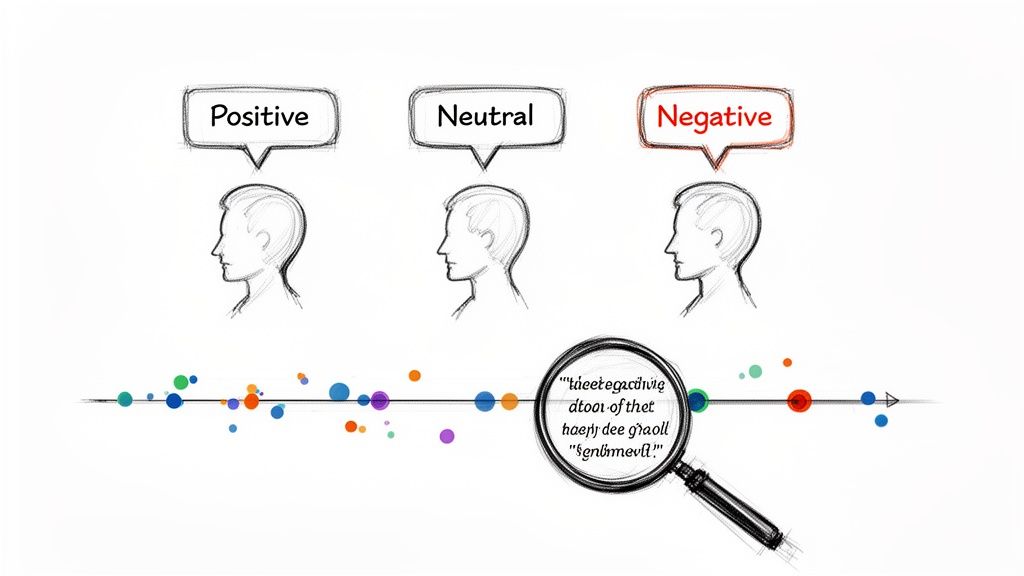
This discipline has become a necessary digital marketing best practice because AI outputs directly shape user perception. For instance, a brand might discover that an LLM associates its products with outdated business practices or consistently frames it negatively in certain industry contexts. Identifying and addressing these perception issues is vital for protecting your brand's reputation.
Why It Matters
Monitoring sentiment allows you to gauge the AI-driven narrative around your brand and measure the effectiveness of your public relations and marketing campaigns. Positive sentiment can be amplified in marketing materials, while negative patterns can be shared with product and communications teams to address root causes before they become widespread problems. This proactive approach helps maintain a strong, positive brand image in a channel where first impressions are formed instantly.
Actionable Steps for Implementation
- Review Verbatim Outputs: On a weekly basis, collect and review the exact quotes AI models use to describe your brand. This qualitative data is key to understanding the specific drivers behind positive or negative sentiment.
- Compare Across Contexts: Analyze how sentiment changes when users ask different types of questions. Is your brand viewed positively for price but negatively for customer service? This contextual analysis reveals specific strengths and weaknesses.
- Track Sentiment Trends: Measure sentiment scores over time, just as you would track visibility metrics. This allows you to see if your efforts to improve brand perception, like a recent PR campaign, are having a measurable impact on AI-generated responses.
- Identify Negative Patterns: Look for recurring negative words or themes associated with your brand. Isolating these patterns helps you develop a targeted response strategy to correct misinformation or address valid customer concerns reflected by the AI. You can explore a full guide on how to measure brand perception to build a more formal process.
8. Identify Knowledge Gaps for Targeted Content Creation
Even with robust digital marketing, AI models may not fully understand your business. Knowledge Gap Identification is the process of finding topics, features, or company details that LLMs either misrepresent or completely ignore. It involves methodically analyzing AI responses about your brand to uncover what’s missing and then developing a content roadmap to fill those informational voids. This is a critical practice because omissions are a form of misinformation; if an AI doesn't mention your key features, for a potential customer, they don't exist.
This focused approach ensures that your content strategy directly addresses and corrects blind spots in AI-generated answers. For instance, a SaaS company might discover its new enterprise security features are never mentioned in AI responses about their platform. By creating targeted content, they can educate the models and ensure this crucial information appears for relevant user queries.
Why It Matters
Identifying and filling these knowledge gaps is a proactive form of reputation management and a key component of modern digital marketing best practices. It allows you to directly influence your AI-driven narrative, ensuring that the information presented to users is complete and accurate. By closing these gaps, you prevent competitors from controlling the conversation and make sure your most valuable selling points are part of the discussion.
Actionable Steps for Implementation
- Create a Coverage Matrix: Map your key product features, services, and value propositions against major AI models (like Gemini, ChatGPT, and Perplexity). This visual matrix will quickly reveal which topics are underrepresented and where.
- Prioritize Based on Commercial Impact: Not all gaps are equal. Prioritize filling gaps that relate to high-value features, address major customer pain points, or counter a competitor's strength.
- Develop Targeted Content: Create specific blog posts, detailed guides, or FAQ pages designed to fill the highest-priority gaps. For example, if your pricing isn't mentioned, create a comprehensive pricing guide. If a specific product category is missing from recommendations, write a detailed article about it.
- Monitor and Re-evaluate: After publishing new content, use a platform like PromptPosition to track whether it successfully fills the identified gap in AI responses. AI models are constantly updating, so revisit your gap analysis quarterly to stay ahead of changes.
9. Integrate AI Search Metrics into Marketing KPIs
To truly manage your brand’s presence in AI search, you must measure it. Integrating AI search visibility metrics into your core marketing KPIs and performance dashboards transforms this new discipline from a niche experiment into a measurable business driver. This practice involves treating AI visibility as a key performance indicator alongside traditional metrics like organic traffic, conversion rates, and social media engagement.
This is a vital digital marketing best practice because what gets measured gets managed. Without dedicated KPIs, AI visibility efforts remain disconnected from broader business goals. By adding metrics like "ChatGPT Share of Voice" or "AI Sentiment Score" to executive dashboards, marketing leaders can directly track the impact of their content and PR strategies on this emerging channel, justifying resource allocation and demonstrating ROI.
Why It Matters
Formalizing AI search metrics holds teams accountable and provides a common language for success. When a CMO can see a direct correlation between a content initiative and a 15% increase in positive AI mentions, the value becomes undeniable. It moves the conversation from abstract awareness to concrete performance, allowing teams to set targets, track progress, and make data-driven decisions about where to invest for the greatest impact on AI-driven brand perception.
Actionable Steps for Implementation
- Define Your Core AI Metrics: Start with a focused set of 3-5 key metrics. Examples include Share of Voice (how often you're mentioned vs. competitors), Sentiment Score (the ratio of positive to negative mentions), and Visibility for Core Queries (your mention frequency for high-value user prompts).
- Establish a Performance Baseline: Before setting goals, use a tool like PromptPosition to measure your current performance across key LLMs. Document this baseline to accurately track improvements over time.
- Integrate into Dashboards: Add your chosen AI metrics as a new module in your existing marketing dashboards (e.g., in Google Data Studio, Tableau, or your internal BI tool). Place them alongside related metrics like organic search traffic and brand mentions to see the full picture.
- Set Clear, Benchmarked Targets: Use your baseline and competitive analysis to set realistic quarterly goals. For example, aim to "Increase positive AI sentiment by 10%" or "Overtake Competitor X in Share of Voice for 'best project management tool' queries."
10. Unify PR, Content, and SEO for AI Search Dominance
To effectively build authority in the eyes of both search engines and AI models, siloed marketing functions are no longer sufficient. An integrated strategy combines Public Relations, content marketing, and SEO into a unified effort. Instead of running separate campaigns, this approach aligns all three disciplines to create a powerful, reinforcing loop that maximizes brand presence across traditional search, news media, and AI-generated answers.
This fusion is one of the most important digital marketing best practices because AI models like ChatGPT and Gemini construct their knowledge from a wide array of public information, including press mentions, in-depth articles, and authoritative website content. A coordinated product launch, for instance, might involve a press release (PR), a detailed "how-to" guide (content), and an optimized landing page (SEO), all launched simultaneously with consistent messaging to dominate the information space.
Why It Matters
Aligning these functions creates a signal of authority that is difficult to ignore. When a press release is amplified by a high-quality blog post and supported by strong on-page SEO, it sends a clear message to Google and AI models that the information is credible, relevant, and important. This unified front helps secure better rankings, increases the likelihood of being cited in AI responses, and ensures brand messaging is consistent everywhere customers look for answers.
Actionable Steps for Implementation
- Create a Unified Content Calendar: Merge PR, content, and SEO schedules into a single master calendar. This ensures that a new research report, for example, has a coordinated press release, a detailed blog guide, and executive bylines all timed for maximum impact.
- Establish a Single Source of Truth: Develop a central document or repository for all brand messaging, key terminology, and target keywords. This ensures every team, from PR to SEO, uses the same language, reinforcing your desired positioning.
- Coordinate Publication Timing: Strategically time the release of all related assets. Publishing a press release, a supporting article, and social media announcements in close succession creates a concentrated burst of activity that search algorithms and AI data scrapers are more likely to notice.
- Share Insights Across Teams: Hold regular coordination meetings where PR, content, and SEO leads share performance data, competitive intelligence, and AI visibility reports. Insights from one team, such as a competitor's successful media placement, can inform the strategy for the others.
AI Search Marketing: 10-Point Best Practices Comparison
| Item | Implementation complexity 🔄 | Resource requirements ⚡ | Expected outcomes 📊 | Ideal use cases 💡 | Key advantages ⭐ |
|---|---|---|---|---|---|
| AI Search Visibility Monitoring | 🔄 Medium–High; ongoing model integrations and updates | ⚡ Continuous tooling, cross-model connectors, analyst time | 📊 Improved visibility metrics, source attribution, competitive insights | 💡 Enterprises tracking brand presence across LLMs | ⭐ Turns LLM outputs into measurable KPIs; proactive mitigation |
| Source-Driven Content Strategy | 🔄 Medium; content audits and AI/SEO alignment required | ⚡ Content production, subject experts, regular updates | 📊 Higher likelihood of being cited by LLMs; defensible authority | 💡 Brands aiming to become primary sources cited by AI | ⭐ Direct influence on AI representations; measurable ROI |
| Competitive Benchmarking in AI Search Results | 🔄 Medium; set up competitor queries and tracking | ⚡ Monitoring tools, competitor datasets, analyst effort | 📊 Identify messaging gaps, threats, and opportunity areas | 💡 Market leaders benchmarking rivals across models | ⭐ Reveals competitor tactics and positioning to exploit |
| AI-Generated Query and Trend Analysis | 🔄 Medium; needs query datasets and trend modeling | ⚡ Analytics tools, data analysts, frequent monitoring | 📊 Early detection of high-impact prompts and emerging trends | 💡 Content and product teams seeking demand signals | ⭐ Uncovers long-tail and nascent query opportunities |
| PR and Earned Media Optimization for AI Citation | 🔄 High; PR workflows tailored for AI citation needed | ⚡ PR teams, original research, media relationships, time | 📊 Creation of authoritative sources that LLMs prefer to cite | 💡 Organizations seeking third‑party validation and authority | ⭐ Builds durable credibility and multiple citation points |
| Multi-Model Testing and Prompt Optimization | 🔄 High; extensive A/B testing across models and prompts | ⚡ Large prompt library, testing framework, analyst hours | 📊 Model-specific prompt insights and optimized phrasing | 💡 Teams targeting specific models for improved mentions | ⭐ Identifies prompts that consistently surface your brand |
| Sentiment and Perception Monitoring Across AI Models | 🔄 Medium; sentiment pipelines plus qualitative review | ⚡ NLP tooling and human analysts for nuance | 📊 Early detection of perception shifts and tone issues | 💡 Brands prioritizing reputation management in AI outputs | ⭐ Actionable signals for PR, product, and comms teams |
| Knowledge Gap Identification and Targeted Content Creation | 🔄 Medium; gap analysis followed by prioritized content | ⚡ Content creators, SMEs, prioritization framework | 📊 Reduced misrepresentations and improved topic coverage | 💡 Firms fixing missing product/feature mentions or errors | ⭐ Efficiently targets highest-impact content gaps |
| Integration of AI Search Metrics into Marketing KPIs and Dashboards | 🔄 Medium; KPI design and dashboard integration required | ⚡ BI tools, data pipelines, cross-team buy-in | 📊 AI visibility becomes measurable and actionable at exec level | 💡 Organizations operationalizing AI visibility as a metric | ⭐ Aligns AI metrics with business goals and accountability |
| Integrated PR, Content, and SEO Strategy | 🔄 High; cross-functional planning and coordinated execution | ⚡ Multi-team collaboration, content + PR + SEO investment | 📊 Reinforced visibility across web and AI responses | 💡 Companies launching major campaigns or seeking broad dominance | ⭐ Maximizes ROI by aligning channels and messaging |
Integrating Tomorrow's Tactics Into Today's Strategy
We've explored a detailed roadmap for modern digital marketing, moving from foundational principles to the next frontier of AI search. The central theme is clear: success no longer comes from executing siloed tactics. It demands a unified approach where SEO, content, PR, and a new, critical focus on AI visibility work together. The digital marketing best practices of yesterday are still relevant, but they now serve as the foundation for a much larger structure.
Mastering classic SEO and creating high-quality content gets your brand onto the field. But winning the game in this new era requires understanding how AI models like ChatGPT, Perplexity, and Gemini interpret and present that content. The shift from a list of blue links to a single, authoritative AI-generated answer is the most significant change to information discovery in a generation. Ignoring it means risking complete invisibility to a growing segment of your audience.
Key Takeaways for Immediate Action
To turn the insights from this article into tangible results, concentrate on these core principles:
- Audit Your AI Presence First: Before you create another piece of content, you must establish a baseline. Where does your brand appear in AI-generated answers for your most important queries? What is the sentiment? Are competitors being recommended instead? This initial audit provides the "why" for all subsequent actions.
- Embrace Source-Driven Content: The quality and authority of your sources are paramount. AI models are becoming more transparent, often citing the content they use to form answers. Your strategy must prioritize creating citable, data-backed assets that position your brand as a primary source of truth.
- Merge PR and SEO: Your earned media strategy is now a direct-ranking factor for AI search. Every press mention, industry feature, and expert quote serves as a powerful signal of authority to these models. Your PR and SEO teams must be fully aligned, targeting publications that AI models already trust and cite.
- Treat AI Visibility as a Core KPI: Metrics like Share of Voice and keyword rankings are incomplete without their AI counterparts. Integrating AI presence monitoring into your marketing dashboards is no longer optional; it's essential for a complete picture of your brand's performance.
Building a Resilient, Future-Proof Strategy
The practices outlined, from multi-model testing to competitive benchmarking in AI results, are not just about chasing a new trend. They are about building a resilient marketing function. By adopting these digital marketing best practices, you are future-proofing your brand against the next wave of technological disruption. You are moving from a reactive stance, simply producing content and hoping it ranks, to a proactive one where you strategically influence the information ecosystems that shape customer decisions.
This requires a mental shift within your organization. Your content is no longer just for human readers; it's also for machine interpretation. Your analytics must extend beyond Google to include platforms like PromptPosition, where you can track whether your efforts translate into valuable AI recommendations. The ultimate goal is to create a powerful feedback loop: you create authoritative content, secure high-value PR placements, track your improved visibility in AI models, and use that data to refine your strategy further. This integrated approach ensures your brand is not just seen, but trusted and recommended, securing your relevance for years to come.
Ready to see where your brand stands in the new world of AI search? The first step in applying these digital marketing best practices is to establish your baseline. PromptPosition offers the tools you need to track how your brand, products, and executives are represented across key AI models like ChatGPT and Gemini, turning opaque systems into actionable data. Visit promptposition to start monitoring your AI visibility today.