The Ultimate Guide to Enterprise SEO SaaS
For a large enterprise, managing SEO isn't just about tweaking a few pages. It's a massive undertaking, often involving millions of URLs, multiple product lines, and global markets. This is where Enterprise SEO SaaS comes in—it’s the heavy-duty software built to handle the sheer scale and complexity that would overwhelm standard SEO tools. This guide is for enterprise SEO teams exploring how these tools can streamline their workflow in a rapidly changing search landscape.
These platforms are the command centers for corporate search visibility. They do more than just track keywords; they integrate deep into a company's business intelligence stack and, crucially, are now evolving to monitor performance across both traditional search engines and the new wave of AI assistants.
The New Battlefield for Enterprise SEO

The ground has fundamentally shifted under our feet. For years, enterprise SEO was a clear-cut mission: secure the top organic spot on Google. But today, winning means being visible wherever potential buyers start their journey, and that landscape has fractured into two distinct fronts. The new frontier is dominated by AI search engines like ChatGPT and Perplexity, which are fundamentally changing how enterprise buyers discover and evaluate software.
This reality forces your team to fight a dual-front visibility war. You still need to master the art of ranking on traditional search engines, but now you must also battle for influence within the conversational AI models that are increasingly shaping buyer perceptions.
Instead of just "searching" for lists of links, enterprise buyers are now "asking" for synthesized answers. This changes everything.
The Rise of Dual-Front Visibility
This split in the search world presents a massive challenge. The strategies that earn you a top Google ranking don't automatically guarantee you'll be cited or recommended by an AI. They are two different beasts, with different data sources, algorithms, and user behaviors.
To put it simply, we've moved from a single objective to a dual mandate: achieve both traditional rankings and AI visibility. The table below breaks down just how different these two ecosystems are.
The Shifting Enterprise Search Landscape
| Attribute | Traditional Search Engines (e.g., Google) | AI Search Engines (e.g., ChatGPT, Perplexity) |
|---|---|---|
| User Interaction | Keyword-based queries, browsing lists of links | Conversational prompts, direct questions |
| Output Format | Ranked list of "10 blue links" | Synthesized, narrative answer |
| Source of Truth | A vast index of web pages | A curated training dataset and real-time data sources |
| Goal of SEO | Achieve high ranking for a specific URL | Become a cited source in the generated answer |
| Key Metric | Keyword rankings, organic traffic | Brand/product mentions, share of AI voice |
As you can see, the game has changed entirely. Failing to show up in these new AI-driven conversations is like being invisible during the most critical, early-stage discovery phase of a buyer's journey. This is precisely why a modern enterprise SEO SaaS platform has become an organization's unified command center.
The core challenge for today's enterprise is managing visibility across two distinct ecosystems. One is a structured world of rankings and links; the other is a conversational world of narratives and mentions. A modern strategy must address both to survive.
Mastering the New Search Ecosystem
This need for a unified strategy is underscored by the explosive growth of the market. The global enterprise SaaS market was valued at $317.55 billion in 2024 and is on a steep upward trajectory, fueled largely by the integration of artificial intelligence.
With 82% of SaaS companies already building AI into their products, buyers are becoming far more deliberate in their software choices. Visibility in these AI-powered channels isn't just a nice-to-have; it's essential for defining your brand's position in the market.
This is where a true enterprise SEO SaaS platform proves its worth. It gives you the tools to manage this new, complex reality by combining traditional metrics like rank tracking with novel analytics for AI search. For instance, newer breeds of SaaS tools like PromptPosition are designed specifically to help enterprise teams track their brand's presence across LLMs alongside traditional search metrics.
This gives you a complete, 360-degree view of your digital presence, ensuring you have the intelligence needed to fight—and win—on both fronts of the new visibility war. To dig deeper into how these elements work together, you can learn more about search marketing intelligence and its evolution.
What Really Makes an SEO Platform Enterprise-Grade?
So, what’s the real difference between a standard SEO tool and a true enterprise platform? It's not just the bigger price tag. I like to think of it this way: a standard tool is like a reliable sedan—it gets you where you need to go for everyday tasks. An enterprise SEO SaaS platform, on the other hand, is a commercial airliner. It’s built from the ground up to handle immense scale, complexity, and mission-critical operations.
These platforms are designed to manage the sprawling digital footprint of a global corporation. They provide a kind of strategic oversight that simply isn't optional when you're dealing with hundreds of thousands or even millions of pages across different markets. Let's get past the buzzwords and look at what "enterprise-grade" actually means day-to-day.
The Core Capabilities That Define 'Enterprise'
A genuine enterprise platform isn't just a bigger box of features. It’s a sophisticated system built for operational excellence when you’re dealing with massive, complex websites. The difference really comes down to a few non-negotiable capabilities that allow huge teams to work together effectively without stepping on each other's toes.
Think of a multinational company trying to coordinate a global SEO strategy while still giving regional teams the freedom to execute. That’s what these core functions make possible.
Massive Data Processing: Enterprise sites are huge. We're talking millions of pages to crawl and millions of keywords to track. An enterprise platform has to chew through all that data without breaking a sweat, giving you accurate insights quickly.
Granular User Permissions: When you have teams spread across different countries, business units, and roles (like content, technical SEO, and PR), you can't have a free-for-all. You need precise control over who can see, edit, and export what. This prevents costly mistakes and keeps sensitive data secure.
Robust API & Integrations: SEO data is most powerful when it’s not stuck in a silo. A true enterprise platform has a strong API that lets you pipe SEO metrics directly into your company’s business intelligence tools, like Tableau or Power BI. This is how you start connecting rankings and traffic to sales, revenue, and customer lifetime value.
Bank-Level Security & Compliance: Large companies operate under strict security and data governance rules. Any platform they use must meet these standards. This means things like SOC 2 compliance, single sign-on (SSO) for easy and secure logins, and detailed audit logs to track every action. For more on how large teams manage their data, you can learn about the unique needs of agency rank tracking for enterprise companies.
It's No Longer Just About Traditional Search Rankings
While those core capabilities are the foundation, the definition of "enterprise-grade" is already expanding. The way people find information is changing right before our eyes. The journey doesn't always start on Google anymore; often, it begins with a question posed to an AI assistant like ChatGPT, Gemini, or Perplexity.
This shift means a modern enterprise SEO platform has to do more than just track keyword rankings on search engine results pages. It must also give you visibility into this new world of conversational, AI-driven search.
An enterprise platform must deliver a dual perspective. You need deep analytics for traditional search engines, but you also need clear insights into how your brand appears in AI-generated answers. If you’re missing one half of that picture, you're flying blind in a huge and growing part of the market.
This is where a new generation of tools is stepping in. For example, platforms like PromptPosition are built specifically to tackle this challenge. They allow enterprise teams to monitor their brand's visibility and sentiment inside Large Language Models (LLMs), right alongside their traditional SEO metrics. This isn’t some far-off idea for the future—it’s a very real need for any large company that wants to understand and protect its brand across its entire digital footprint.
The Dual Capabilities Your SEO Platform Needs Today
Any enterprise SEO platform worth its salt has to fight a war on two fronts. It's no longer enough to just dominate the traditional search results we all know. Your strategy now has to account for the conversational, answer-driven world of AI assistants. This new reality demands a different playbook and a new class of tools built to win on both fronts.
To put it simply, your platform’s capabilities must fall into two buckets: mastering traditional search and conquering AI visibility. If you're weak in either area, you're leaving a gaping hole in your digital footprint—one that your competitors will be more than happy to drive a truck through.
Mastering Traditional Search at Enterprise Scale
First things first, an enterprise SEO SaaS platform has to nail the fundamentals, but at a scale that would break standard tools. These are the foundational features that form the bedrock of any serious SEO program, but they're supercharged to handle corporate-level complexity.
For a large organization, this goes way beyond just tracking a few keywords.
- Large-Scale Rank Tracking: We're talking about the ability to monitor millions of keywords across different countries, languages, and search engines. The platform must deliver accurate, daily rank updates to give you a clear picture of performance for every single product line and business unit.
- Comprehensive Technical Auditing: Enterprise websites, often with millions of pages, are breeding grounds for technical gremlins that can kill performance. A true enterprise-grade platform automates site-wide crawls to hunt down problems like indexation errors, broken internal links, and JavaScript rendering issues long before they hit your bottom line.
- Content Optimization for Thousands of Pages: The platform should be your guide for creating and optimizing content across your entire digital estate. This involves spotting content gaps, making sure pages match user intent, and verifying that every piece of content is structured for both people and search crawlers. Our guide on AI-driven content optimization strategies offers deeper insights into this process.
These core features are non-negotiable for holding your ground and growing your visibility in established search engines like Google.

As the map shows, a real enterprise solution has to be built on a foundation of massive scale, robust security, and deep integration to actually be effective.
Conquering the New Frontier of AI Visibility
While traditional SEO is as important as ever, the new battle is for visibility inside AI models. More and more, enterprise buyers are firing up tools like ChatGPT and Gemini for their initial research. They're asking complex questions and getting synthesized answers. If your brand isn't mentioned—and mentioned favorably—in those AI-generated conversations, you're losing the game at the very first touchpoint.
Future-proofing your SEO means looking beyond ranked links. It's about actively tracking and shaping how your brand shows up in the narrative answers generated by Large Language Models (LLMs).
This is where a whole new class of analytics comes into play. You suddenly need to track metrics that didn't even exist a few years ago.
- Brand & Product Mentions: How often does the AI mention your company and products compared to the competition?
- Sentiment Analysis: Are those mentions positive, neutral, or negative? Understanding the tone and context is critical for managing your brand's reputation.
- Competitive Positioning: When a user asks for "the best software for X," does your solution make the cut? Where do you land in the AI's "opinion"?
This is precisely the shift we're seeing in the market. Modern tools like PromptPosition can now turn these opaque AI responses into actionable data, giving enterprise teams a clear view of their brand’s visibility and sentiment within LLMs. By combining classic SEO metrics with this new layer of AI visibility tracking, you get a complete, 360-degree view of your digital presence and can confidently navigate both sides of the search ecosystem.
Connecting SEO Investment to C-Suite Metrics
So, how do you get buy-in for a multi-year, six-figure enterprise SEO SaaS platform? The key is learning to speak the language of the C-suite. Your leadership team doesn't think in terms of keyword rankings or traffic spikes; they care about revenue, market share, and sales pipeline. It's our job as marketers to translate our daily SEO work into those outcomes.
This is where a true enterprise platform shines. It’s the tool that helps you move past tactical reports and build a rock-solid business case for SEO. It’s how you prove the strategic value of your work and secure the budget you need to win.
From Vanity Metrics to C-Suite KPIs
The first and most important shift is in your reporting. You have to stop leading with SEO jargon and start connecting your efforts to the metrics that matter to the bottom line. An integrated enterprise SEO platform makes this possible by pulling data from different sources into a single, reliable view.
With that consolidated data, you can finally report on the high-level KPIs that get an executive's attention.
Total Share of Voice (Traditional & AI): Forget just tracking ranks on Google. A modern enterprise platform calculates your visibility across traditional search and AI engines like ChatGPT. This gives leadership a clear picture of how much of the digital conversation your brand actually owns compared to competitors.
Organic-Influenced Sales Pipeline: When your SEO platform talks to your CRM, you can finally connect the dots. You can show precisely how many qualified leads—and how much pipeline value—came directly from your team's organic search initiatives.
Competitive Displacement: Use the platform’s competitive intelligence to show, not just tell, how your gains are directly chipping away at your rivals' market share. Presenting a side-by-side view of where you’ve knocked them out of top spots in crucial SERPs is a powerful way to frame your success.
Building the Business Case
A crucial part of this process is the ability to measure marketing ROI in a way that provides undeniable proof of performance. When you consolidate your tech stack onto a single platform, you also create immediate operational wins that strengthen your business case before the long-term SEO results even fully kick in.
The strongest business case combines efficiency gains with strategic advantage. Showcasing how a single platform eliminates tool redundancy and data silos proves immediate financial return, while analytics for AI visibility demonstrate you're prepared for the future.
Modern enterprise platforms like PromptPosition are built for exactly this kind of dual reporting. They track your traditional rankings while also quantifying your brand’s footprint in AI models—a vital metric as more buyers use LLMs to discover and research software. You can dive deeper into this by learning how to measure your marketing performance effectively.
For any B2B SaaS company, SEO is a proven revenue engine. Research shows SEO delivers an incredible average return on investment of 702%. What's more, 70% of online marketing pros agree that SEO is more effective at generating sales than PPC.
Considering the top result on Google captures nearly 27.6% of all clicks, a strategic investment in a comprehensive enterprise SEO SaaS platform isn't just a cost center—it's a direct path to measurable returns.
How to Choose the Right Enterprise SEO Partner
Picking an enterprise SEO platform isn't like buying a new laptop. You're not just getting a piece of software; you're bringing on a strategic partner that will have a direct hand in your organic traffic, market share, and bottom line. Get it right, and you can see incredible growth. Get it wrong, and you could be stuck with years of bad data, disconnected tools, and missed opportunities.
This choice is even more loaded now that the search landscape is changing under our feet. Your potential customers aren't just starting their journey on Google anymore. They're asking AI assistants like ChatGPT and Perplexity for recommendations, product comparisons, and initial research. The right partner has to help you win in traditional search and in this new conversational AI world.
A Structured Evaluation Framework
You can't make this decision based on a slick sales demo alone. You need a solid framework to dig deep and see how a platform really works under the pressure of enterprise-level demands. It's about figuring out if the vendor's roadmap truly aligns with where your business is headed.
Getting a feel for what the top platforms can do is a great starting point. Checking out reviews like this ultimate SEO tool showdown will give you a good baseline of the features you should be looking for as you start your search.
Here are the big areas you need to press vendors on:
- Data Scalability and Processing: Can the platform actually handle your data? We're talking millions of pages and keywords. Ask for proof, like case studies or performance benchmarks from companies your size.
- API Flexibility and Integration: A powerful, well-documented API is non-negotiable. Your SEO data becomes infinitely more valuable when you can pipe it into your own business intelligence tools like Tableau or Power BI and connect it to your CRM.
- True Customer Support: What does their "support" really look like in practice? Are you just getting a login to a generic help desk, or will you have a dedicated strategist who gets to know your business and helps you squeeze every drop of value from the tool?
It's easy to get lost in feature lists. The most important question you can ask a potential vendor is about their vision for the future of search. A real partner isn't just selling you today's software; they're actively building the solution you'll need tomorrow.
Future-Proofing for an AI-Driven World
Honestly, the biggest thing separating modern enterprise SEO SaaS platforms from the old guard is how they're tackling the shift to AI-powered search. Tools built exclusively for a world of "10 blue links" are already showing their age. Your next platform partner must have a clear plan and working features for tracking how your brand shows up in Large Language Models (LLMs).
This is where a new generation of tools is really shining. Platforms like PromptPosition, for example, were built specifically to help enterprise teams see and influence their brand's visibility inside LLMs. It’s not an afterthought feature—it's what they do.
To properly vet a vendor's AI readiness, ask about these specifics:
- Comprehensive AI Model Tracking: Are they just tracking one model, or do they cover a range of important LLMs like ChatGPT, Gemini, and Perplexity?
- Actionable AI Analytics: Can the tool do more than just show you a mention? You need to be able to quantify brand presence, analyze the sentiment of how you're being described, and see how you stack up against the competition.
- Source Identification: This is huge. Does the platform help you trace an AI's answer back to the original sources it used? Knowing which articles, reviews, or data points are shaping the AI's opinion is the key to influencing your brand's narrative.
Choosing an enterprise SEO partner is a major commitment. If you focus your evaluation on data scalability, deep integration, and—above all—a forward-thinking vision for AI search, you’ll find a vendor that doesn't just support your strategy but actively accelerates it.
Enterprise SEO SaaS Vendor Evaluation Checklist
To help your team systematically assess potential vendors, use this checklist to guide your conversations and ensure you cover all the critical bases.
| Evaluation Criteria | Key Questions to Ask | Why It Matters for Enterprises |
|---|---|---|
| Data Architecture & Scalability | – Can you process and report on our 5M+ keywords and 10M+ pages daily? – What is your average data refresh time for a dataset of our size? – Share a case study from a client with a similar data load. |
Your SEO strategy lives or dies by the freshness and completeness of your data. Performance bottlenecks at scale can render a platform useless. |
| AI & LLM Visibility | – Which LLMs do you currently track (e.g., ChatGPT-4, Gemini, Perplexity)? – How do you identify the source URLs that inform an AI's answer? – Can you show us how your tool measures brand sentiment within AI responses? |
The future of search is conversational. If your vendor can't provide visibility into AI answers, you're flying blind in a rapidly growing channel. |
| API & Integration Capabilities | – Is your API rate-limited? What are the limits? – Provide documentation for connecting to BI tools like Tableau/Power BI. – Can we create custom dashboards by pulling data from your API? |
SEO data shouldn't be trapped in a silo. A flexible API allows you to integrate SEO insights into your core business reporting and workflows. |
| Support & Strategic Partnership | – What is the background of your dedicated account managers? Are they former SEOs? – Describe your onboarding and training process for a large, distributed team. – How do you handle urgent, off-hours support requests? |
An enterprise tool requires an enterprise-level support partner. You need strategic advice from experts, not just technical help from a call center. |
| Roadmap & Future Vision | – What are the top 3 items on your product roadmap for the next 12 months? – How is your company investing in R&D for the future of search? – How do you incorporate customer feedback into your product development? |
You're not just buying a tool; you're investing in a vendor's vision. Ensure their future aligns with your long-term strategic goals. |
Using a structured checklist like this moves your team beyond the sales pitch and into a substantive discussion about whether a vendor can truly meet your needs today and grow with you tomorrow.
Implementing Your Platform for Maximum Impact
So you’ve invested in a top-tier enterprise SEO SaaS platform. That's the easy part. The real work—and the real payoff—comes from getting your entire organization to actually use it. A successful rollout isn't about sending a mass email with login details; it’s about having a smart plan for adoption and team alignment from the get-go.
Think of it as moving from a collection of isolated tools to creating a central nervous system for your entire search strategy. This requires a carefully staged rollout, a fresh look at team roles, and a company culture that turns data into action. When you get this right, you start seeing the value of your investment on day one.
Structuring a Phased Rollout
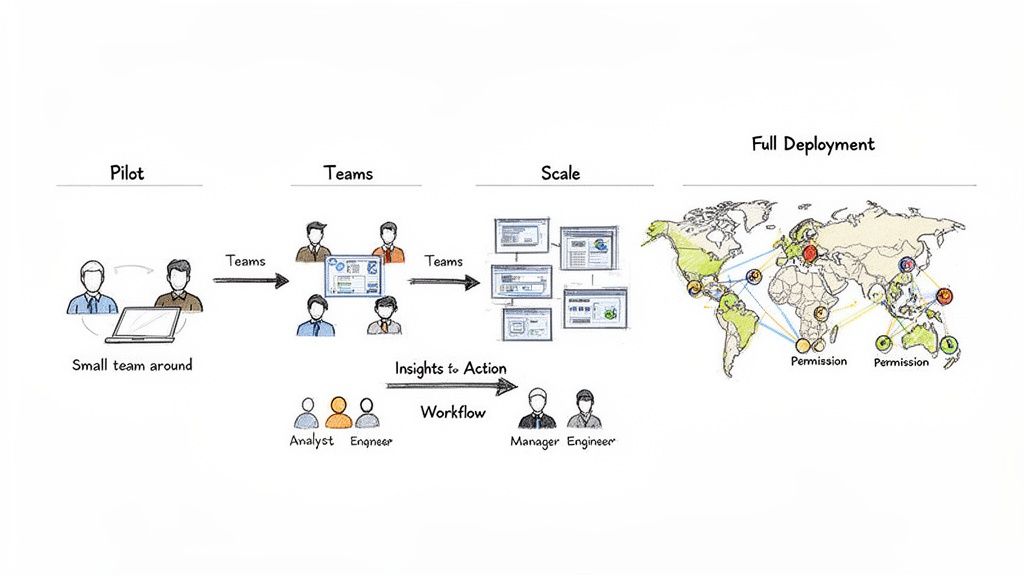
In a large company, a "big bang" launch where everyone gets access at once is a recipe for chaos. It’s much smarter to go with a phased rollout. This approach minimizes disruption, lets you work out the kinks in a controlled environment, and builds momentum with early wins.
You want to start small. Kick things off with a focused pilot project involving a single, high-stakes business unit or product line. This gives your team a chance to master the new workflows, create some internal success stories, and prove the platform’s value with hard numbers.
From that initial success, you can expand access in logical steps:
- Pilot Group: Start with a core team of 5-10 SEO specialists and content strategists focused on a single, critical project.
- Expanded Teams: Next, bring in adjacent teams like technical SEO and digital PR, expanding across a few more business units.
- Full Deployment: Finally, open up access to the wider company, including marketing leaders and regional teams who might only need dashboard-level views.
Redefining Roles for a New Era of Search
As search itself changes, so must your team structure. Bringing in a modern enterprise platform, especially one built to track AI search, naturally creates a need for roles that didn't exist a few years ago.
Your team's structure should mirror your platform's capabilities. If you’re tracking visibility on two fronts—traditional search and AI search—you need roles dedicated to mastering each one.
This is a great opportunity to redefine positions to make the most of your platform's dual focus on traditional and AI search:
- Technical SEO Analyst: This person lives in the platform’s deep crawling and auditing tools, ensuring the technical integrity of millions of pages at scale.
- Content & Intent Strategist: Goes beyond keywords to analyze performance data from both classic search and AI, finding opportunities to optimize content and create new assets that meet user intent.
- AI Visibility Manager: A new-breed specialist who tracks brand mentions, sentiment, and competitive positioning within large language models using tools like PromptPosition. This person owns the strategy for influencing AI-generated answers.
- SEO Data Analyst: The bridge between SEO and the C-suite. They connect platform data with your company's business intelligence tools to tie SEO efforts directly to revenue and other key business goals.
By defining these roles with clear ownership, you guarantee every feature of your new enterprise SEO SaaS platform has an expert responsible for turning its data into results. It empowers your people and ensures no part of your investment gathers dust.
Your Questions About Enterprise SEO SaaS, Answered
Making the leap to a full-blown enterprise platform always brings up a few questions. It’s a big decision, so let’s walk through some of the most common ones we hear from teams who are weighing their options.
What's the Real Difference Between a Standard SEO Tool and an Enterprise SaaS Platform?
Think of it this way: standard SEO tools are like a high-performance personal car. They're fantastic for individuals or small teams working on one or maybe a handful of websites. They get you where you need to go, quickly and efficiently.
But enterprise SEO SaaS platforms are more like a commercial shipping fleet. They’re built from the ground up for massive scale—we’re talking about global companies managing millions of pages across hundreds of domains. They solve problems you only encounter at that level, like setting detailed user permissions for different teams, connecting with your business intelligence tools through powerful APIs, and crunching huge datasets for both traditional and AI search analytics.
Why Should We Care About Tracking Our Visibility in AI Search Engines Like ChatGPT?
It’s simple: your future customers are already using AI assistants like ChatGPT and Perplexity to do their initial research. If your brand doesn’t show up in those answers—or worse, shows up with inaccurate information—you’re invisible during one of the most important stages of their buying journey.
Tracking your visibility in AI gives you a direct line of sight into how these models perceive your brand. You can see what they're saying, measure it against your competitors, and start influencing the source materials that train these AI-generated responses. In this new search landscape, it's a non-negotiable for protecting your brand and your sales pipeline.
This is a brand new challenge, and specialized tools like PromptPosition are emerging to tackle it head-on. They’re designed to help you see how you rank inside Large Language Models (LLMs), turning what feels like a black box into a clear set of performance metrics.
How Long Does It Realistically Take to See an ROI From an Enterprise SEO Platform?
You’ll see some benefits almost immediately. Things like having all your reporting in one place or your team no longer tripping over each other's work are day-one wins.
But for the big-ticket SEO results—think significant ranking improvements and a real jump in organic traffic—you should plan on a runway of 6-12 months. That’s the typical timeframe for strategic efforts to gain traction and deliver measurable results. The ROI, however, isn't just about rankings; it's about making smarter, faster decisions with integrated data and getting a leg up by understanding new channels like AI search.
Can an Enterprise Platform Actually Replace Our Entire SEO Tool Stack?
For the most part, yes. In fact, that's one of the main selling points. A good enterprise SEO SaaS platform is designed for tool consolidation. The goal is to bring your rank tracking, site auditing, backlink analysis, and content strategy into one unified system.
This does more than just cut down on your monthly subscription bills. It gives everyone on the team a single source of truth, which eliminates the classic "my data says this, but your data says that" argument and makes the entire operation more efficient.
Ready to see how your brand shows up in the new world of AI search? PromptPosition gives you the data-driven insights you need to monitor and influence your visibility across models like ChatGPT, Gemini, and Perplexity. Start tracking your AI presence today.