How to Measure Brand Perception in the AI Era
If you want to understand how people truly see your brand, you'll need to look far beyond a simple annual survey. Measuring brand perception today means piecing together a mosaic of quantitative data, qualitative feedback, and a new, crucial element: AI search analytics. It’s about tracking everything from your Net Promoter Score to your sentiment on social media and your visibility in ChatGPT’s answers.
This guide provides a complete, actionable framework for measuring—and improving—your brand's perception in this new landscape.
Your Modern Toolkit for Brand Perception
Gone are the days when you could rely on a few focus groups and a yearly questionnaire to get a pulse on your brand. Perception is now a living, breathing thing, shaped in real-time across dozens of touchpoints. A viral TikTok can change public opinion overnight, a thread of G2 reviews can define your B2B reputation, and an AI-generated answer in Gemini can become the new source of truth for potential customers.
To get a real grip on where your brand stands, you need a modern toolkit that captures all these signals as they happen.
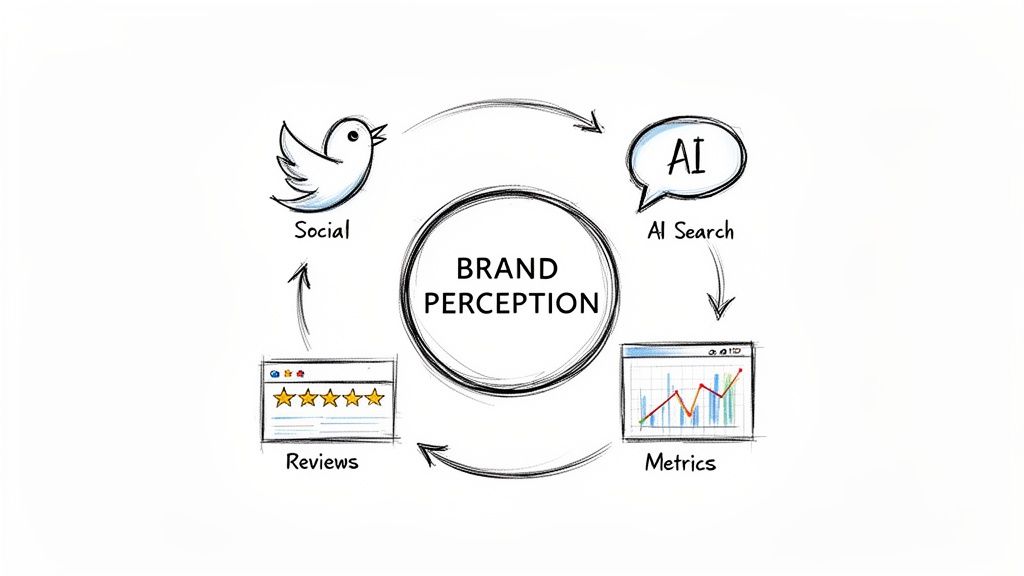
This isn't just about collecting disparate data points. It’s about understanding the feedback loop that connects them. What people say about you on X directly influences the tone of product reviews, and both of these sources are vacuumed up by Large Language Models (LLMs) to form their knowledge base. Each channel feeds the next, creating a powerful cycle that constantly reshapes your public image.
Blending the Old with the New
A truly effective measurement strategy doesn't throw out the old rulebook—it adds new chapters. You need to combine proven, traditional metrics with today's more dynamic analytics. The goal is to understand not only what people think but also why they think it, so you can take clear, decisive action.
To do this well, you’ll be pulling from three core areas:
-
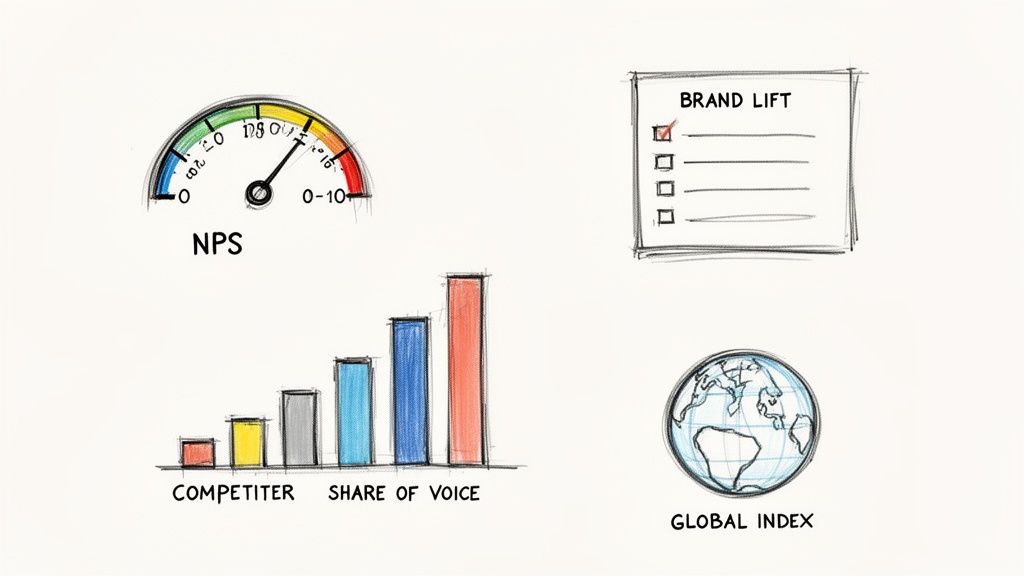
Quantitative Metrics: These are your hard numbers, the bedrock of brand tracking. Think Net Promoter Score (NPS) to gauge customer loyalty, Share of Voice (SoV) to benchmark against competitors, and brand lift studies to measure the direct impact of your campaigns.
-
Qualitative Insights: This is the context, the story behind the numbers. It’s what you get from social media listening to understand the nuances of conversations, sentiment analysis of customer reviews, and one-on-one interviews that dig into the emotions driving behavior.
-
AI Search Analytics: This is the newest and arguably most disruptive piece of the puzzle. It involves actively tracking how often—and in what light—your brand is mentioned in answers from AI tools like ChatGPT, Perplexity, and Google's AI Overviews.
When you integrate these three pillars, you start connecting the dots. For instance, a sudden drop in your NPS score might seem confusing on its own. But when you pair it with social listening data showing a spike in negative comments on Reddit, which you then see being summarized in AI search results, you have a full, actionable picture.
Your brand is no longer just what you say it is. It's a living entity defined by countless daily interactions across the digital world. The goal is to listen to, measure, and understand these interactions at scale to drive meaningful action.
The Rise of AI in Shaping Perception
Without a doubt, the biggest shift in brand management recently is the emergence of AI as a primary information gatekeeper. As more users bypass traditional search and ask questions directly to AI, your presence (or absence) in those answers becomes critical. It's a new kind of brand exposure that you can't afford to ignore.
Tools are now available to help you navigate this new terrain. For example, our AI Overview Tracker is designed specifically to bring clarity to this blind spot, showing you exactly how LLMs are presenting your brand.
In the sections that follow, we'll dive deeper into each of these measurement methods, giving you actionable steps and real-world examples to build a robust, real-time view of your brand perception.
Getting a Grip on the Numbers: Your Quantitative Framework
While the stories and feelings people share about your brand are incredibly valuable, hard numbers give you the blueprint for your brand’s health. Without data, you’re just guessing. A solid quantitative framework is what allows you to stop guessing and start knowing precisely where you stand in the market.
Think of these metrics as your brand’s vital signs. They might not capture every nuance of your audience’s emotions, but they provide a clear, objective snapshot of your brand's strength and positioning. This is the data you’ll use to track progress, justify your marketing budget, and make truly informed strategic moves.
Net Promoter Score: The Litmus Test for Loyalty
Net Promoter Score (NPS) has stood the test of time for a simple reason: it's a remarkably effective way to gauge customer loyalty. It all boils down to one straightforward question: "On a scale of 0 to 10, how likely are you to recommend our brand to a friend or colleague?"
The responses immediately sort your customers into three distinct camps:
- Promoters (9-10): These are your champions. They're loyal, enthusiastic, and actively spread positive word-of-mouth.
- Passives (7-8): They're satisfied, but not thrilled. This group is susceptible to being poached by competitors with a better offer.
- Detractors (0-6): These are unhappy customers who can actively damage your brand's reputation through negative feedback.
To get your score, just subtract the percentage of Detractors from the percentage of Promoters. Anything positive is a start, and a score above 50 is generally considered excellent. The real magic of NPS, however, isn't just the number itself—it's in tracking the trend over time and asking follow-up questions to understand the "why" behind the score.
Brand Lift Studies: Proving Your Campaigns Actually Work
Did your latest ad campaign actually move the needle on perception, or did it just burn through the budget? That's the million-dollar question that brand lift studies are designed to answer. These studies measure the direct impact of your campaigns on key metrics like awareness, favorability, and purchase intent.
It works by surveying two distinct groups:
- A test group that was exposed to your advertising campaign.
- A control group that was not.
By comparing the results, you can isolate the "lift"—the increase in positive perception that is directly tied to your marketing. This gives you concrete proof of your campaign’s ROI and helps you sharpen your messaging for the future.
Tracking brand perception isn't a one-and-done project; it's a continuous process. A quantitative framework provides the consistent data you need to identify trends, react to changes in the market, and see the long-term results of your efforts.
Share of Voice: Sizing Up Your Presence
You aren't operating in a bubble. Understanding how you stack up against the competition is crucial, and Share of Voice (SoV) is the classic metric for this. Traditionally, SoV was about your share of advertising spend, but today, it’s all about your share of the conversation.
In our digital world, you can calculate SoV by tracking mentions of your brand across social media, news sites, forums, and even in AI chatbot responses. If your brand is mentioned 20 times in a pool of 100 total industry mentions, your SoV is 20%. Analyzing this is a core part of any modern AI brand monitoring strategy. Monitoring SoV shows you whether your visibility is growing or shrinking and where competitors might be getting more attention.
Global Brand Indices: The Big Picture Context
For a bird's-eye view, it’s useful to see how you measure up against global benchmarks like Brand Index Scores. These indices track consumer recognition and brand strength on a massive scale. For instance, in 2023, WeChat scored an incredible 95.2 on its Brand Index Score, which is based on consumer surveys about familiarity and how likely they are to recommend the brand.
When you see titans like Apple on track to reach a $1 trillion brand valuation by 2025, it’s clear that measuring perception is a fundamental KPI for both survival and massive growth.
Uncovering the 'Why': Qualitative Insights and Audience Sentiment
While your quantitative KPIs tell you what’s happening, they almost never explain why. This is where qualitative data comes in. It’s the context, the emotion, and the stories that give your numbers meaning and reveal how people genuinely experience your brand.
To get these insights, you have to move beyond the clean world of spreadsheets and get your hands dirty with the messy, unstructured reality of human conversation. We're talking about tuning into the discussions happening right now on social media, in forums, and across review sites. These are the front lines where your brand perception is being shaped every single day.
Set Up Your Social Listening Command Center
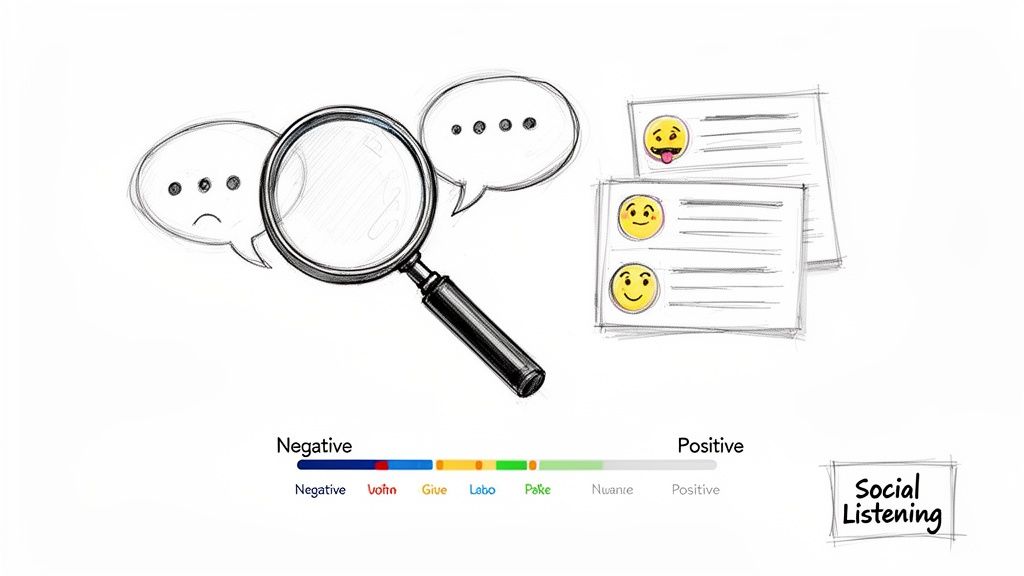
A solid social listening program is your best friend here. Think of it as your brand’s early-warning system, giving you a real-time feed of conversations about your company, your competitors, and your industry on platforms like X (formerly Twitter), Reddit, LinkedIn, and TikTok.
But good social listening isn't just about tracking mentions. It’s about spotting the signals in the noise.
- What are the emerging narratives? Are people buzzing about your new feature, or is a complaint about customer service starting to gain traction?
- Who are the key voices? Identify the people who hold influence in your niche and pay close attention to what they're saying.
- What's the competitor chatter? Are customers complaining about a rival's pricing or a missing feature? That's an opportunity.
Setting up a system to monitor these threads gives you an unfiltered look into what your audience actually thinks. This raw feedback is pure gold for everything from tweaking your marketing copy to informing your next product launch.
The most powerful brand insights I've ever seen came from unsolicited, candid feedback. Social listening lets you tap into those honest conversations as they happen, giving you an authentic pulse on how people feel.
Go Deeper with Sentiment Analysis
Just counting how many times your brand is mentioned is a rookie mistake. The real magic is in sentiment analysis, which is all about understanding the emotion behind the words. Modern tools go way beyond a simple "positive," "negative," or "neutral" tag. They can now pick up on nuance, sarcasm, and specific feelings like joy, anger, or confusion.
For instance, a comment like, "Wow, I can't believe how easy your software is to use," is obviously positive. But what about, "Your software is so easy to use… if you have a PhD in computer science"? Advanced analysis helps you tell the difference between genuine praise and a sarcastic jab, giving you a far more accurate picture of your brand perception. You can explore our complete guide on brand sentiment to really get a handle on how to gauge these feelings correctly.
https://www.promptposition.com/blog/brand-sentiment/
To get a full grasp on audience sentiment and effectively steer your brand's public image, you might also find it helpful to look into whether your business needs online reputation management services.
Mine for Gold on Review Platforms
For any business, but especially those in B2B SaaS or e-commerce, review platforms like G2, Capterra, and TrustRadius are absolute gold mines. This is where your actual customers leave incredibly detailed, structured feedback about their entire journey with your product.
When you're digging through these reviews, look for the patterns. Are five different people praising your smooth onboarding but complaining about the lack of a specific integration? That's not just an opinion—it's a signal pointing to a clear strength and a potential weakness. By categorizing this feedback, you can easily prioritize what to fix and what to feature in your next marketing campaign.
It's also fascinating to see how these perceptions extend to broader topics, like corporate responsibility. A powerful metric here is the Sustainability Perceptions Value, which estimates the financial worth tied to a brand’s green image. In 2024, Apple topped the charts with a perception value of €33.3 billion, and tech companies made up six of the top ten spots. This shows a direct line between how people perceive your values and your brand's bottom-line equity. You can find more data on this in the 2024 Sustainability Perceptions Index on Statista.
Measuring Perception in the New Frontier of AI Search
Let's be blunt: you don't completely control your brand's story anymore. It's now being co-authored by artificial intelligence. Every time someone asks ChatGPT, Gemini, or Perplexity for a product recommendation or a list of top companies in your industry, their perception of your brand is being shaped. This isn't some far-off future; it's happening right now, at a massive scale.
All those conversations on social media, the comments on Reddit, and the customer reviews you've been collecting? Large Language Models (LLMs) are hoovering them up, synthesizing them, and using them to form definitive-sounding answers. As AI becomes the new search engine, understanding concepts like Generative Engine Optimization (GEO) isn't just a good idea—it's essential for survival. Ignoring this channel is like ignoring Google 15 years ago.
From Social Listening to AI Monitoring
For years, we've relied on social listening to get a pulse on what people are saying. Think of AI search monitoring as the next crucial step in that evolution. Social listening shows you what individual people are saying, which is great. But AI monitoring shows you how machines are packaging all those individual opinions into a single, authoritative summary.
And that’s a huge difference. One negative tweet is a customer service issue. But when that sentiment gets absorbed by an LLM and repeated as a core fact about your brand's reputation, its impact multiplies.
What was once a messy, unstructured conversation is now being neatly distilled into a structured, credible-sounding response by AI. Measuring what these models say about you has become just as important as measuring what your customers say directly.
To get a real handle on this, you need to look beyond traditional analytics and start tracking KPIs that are specific to how LLMs work. This is a whole new ballgame.
The Three Pillars of AI Brand Perception
When you dig into how your brand shows up in AI-generated answers, you’re really trying to answer three core questions. Getting these right gives you a complete picture of your visibility and reputation in this new space.
-
Visibility: How often does your brand even get mentioned? Are you showing up for the money-making, high-intent queries like "best software for project management," or are you only appearing when someone types in your exact brand name? This is your foundation.
-
Sentiment: When you are mentioned, what's the vibe? Is the AI singing your praises and highlighting your strengths? Or is it bringing up that one product flaw from two years ago that still haunts your review pages?
-
Positioning: How is the AI framing you against your competitors? Are you the "market leader," the "budget-friendly choice," or the "niche solution for experts"? This positioning is incredibly powerful and often goes unnoticed.
Tracking these three elements turns the "black box" of AI into a dashboard you can actually read and act on. You're not just seeing if you're mentioned, but how.
Turning Opaque Answers into Measurable KPIs
Sure, you could open up a chatbot and ask it a few questions about your brand. But that’s not a strategy. The answers change, you can’t track them over time, and it’s impossible to do at scale. It’s not a repeatable, scientific process.
This is where dedicated AI search analytics platforms, like PromptPosition, become your new best friend. They automate the work of querying these models thousands of times and turn the unstructured text into clean, actionable data.
With the right tool, you can start measuring things that were previously invisible.
- Verbatim Quote Tracking: See the exact phrases LLMs are using to describe you and your competition. This tells you precisely what narratives are being built around your brand.
- Source Identification: Pinpoint the specific articles, reviews, or forum threads the AI is using as its source material. This gives you a clear roadmap for what content you need to create or improve.
- Competitive Gap Analysis: Instantly find the high-value prompts where your competitors are showing up, but you're nowhere to be found. These are your most immediate opportunities.
By tracking these metrics, you can finally set a baseline and see how your efforts are paying off over time. Is your sentiment score ticking up? Are you gaining visibility for those crucial non-branded keywords? For a deeper dive into benchmarking, our guide on how to calculate share of voice is a great next step.
Taking control of your brand's story on these new platforms is the big challenge—and the biggest opportunity—for marketers today. It’s about making sure your voice is heard in a world where AI has the microphone.
Turning Brand Perception Data Into an Action Plan
You’ve done the hard work of gathering all this data—quantitative scores, qualitative feedback, and even those new AI search metrics. That's a huge step. But a spreadsheet full of numbers is just that—a spreadsheet. It has no inherent value until you connect the dots and use it to make smart decisions.
This is where you shift from measuring brand perception to actively shaping it. It's time to transform those insights into a concrete plan that drives real business outcomes.
Synthesizing Metrics Into a Unified Dashboard
First things first, you have to break down the silos. Your NPS trends, social sentiment scores, and AI visibility metrics can't live on separate islands. A unified dashboard is the only way to see the full story and understand how these different channels influence each other.
Let's walk through a real-world scenario. Your dashboard flags a 5% dip in your Net Promoter Score this quarter. On its own, that’s concerning, but it doesn't tell you why. But when you view it alongside your other metrics, a clear picture emerges:
- Social media sentiment has tanked, with a sudden spike in comments mentioning a "buggy update" and "slow support."
- Review sites like G2 and Capterra show an influx of one-star reviews echoing the same complaints.
- AI search results now surface a negative snippet about your software's reliability when people ask about it.
Suddenly, you have a narrative. The quantitative dip in NPS is directly explained by the qualitative feedback from users, which is now being amplified and solidified by AI. This holistic view points straight to the root cause—a problematic software update—and lets you see its full, damaging impact on your brand.
Prioritizing Threats and Opportunities
With that unified picture in hand, you can start prioritizing. Not all insights carry the same weight. You need a system to sort through the noise and focus your energy where it will make the biggest difference. I find a simple urgency/impact matrix works wonders here.
Here are a few examples of how to turn data points into specific actions:
-
High-Urgency Threat: Your social listening tool picks up a surge of angry comments about customer support wait times. The immediate action? You alert the head of customer service, armed with specific data and customer quotes. This isn't just complaining; it's flagging a potential resource or process failure that needs immediate attention.
-
High-Impact Opportunity: While analyzing AI search results, you notice a competitor is consistently named the "best for small businesses"—a market you're desperate to win. Your action plan is now clear: develop a targeted content and digital PR strategy focused on getting your brand cited in the high-authority articles and sources that LLMs rely on.
-
Emerging Trend: You spot a growing number of positive mentions about a minor product feature you’ve barely promoted. Don't ignore it. This is an opportunity to double down on a strength your customers already love. The next step could be to build a small marketing campaign around that feature, amplifying what already resonates.
This approach flips the script. You stop being a reactive brand manager just putting out fires and become a proactive strategist, spotting the smoke before it becomes a blaze.
This flowchart illustrates how to think about the key metrics for tracking your brand's journey in AI-powered search—from getting noticed to becoming the top recommendation.
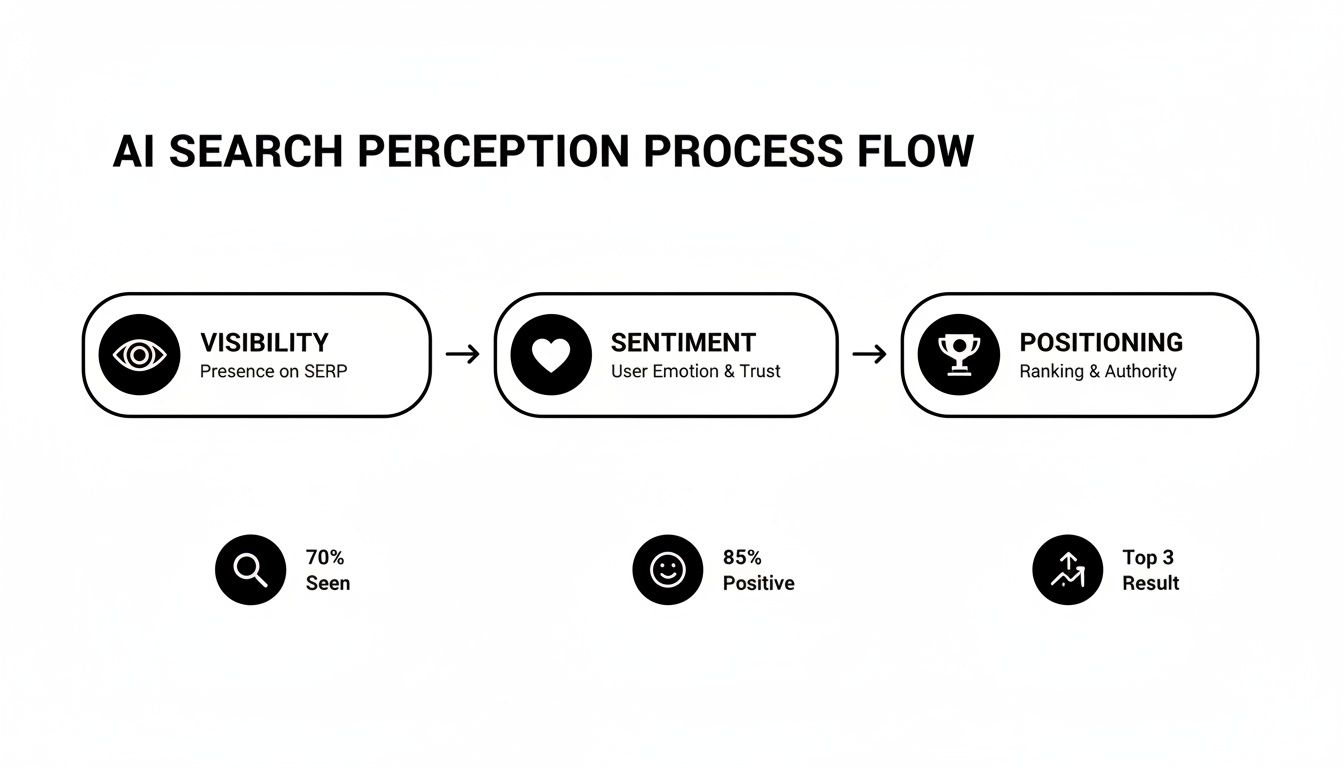
As you can see, winning in this new search era means you first have to be visible, then be seen in a positive light, and finally, be positioned as a leading choice against competitors.
Building a Report to Demonstrate ROI
Your leadership team and stakeholders need to understand why this matters. A brand perception report is your chance to communicate your findings and, most importantly, show a return on investment. This isn't a data dump. It's a strategic document that tells a story.
A powerful report always connects perception metrics to tangible business goals.
Instead of saying, "Our positive sentiment went up by 15%," frame it with impact: "Our initiative to improve customer onboarding led to a 15% increase in positive sentiment, which correlated with a 10% reduction in first-month customer churn."
Your report should always include these key elements:
- An executive summary that gets straight to the point with key findings and top-line recommendations.
- A KPI scorecard tracking your core metrics (NPS, Share of Voice, AI visibility, etc.) over time.
- Qualitative highlights like powerful customer quotes from social media, reviews, or AI summaries that make the data feel real.
- Competitive analysis showing how you stack up against your main rivals across these same perception channels.
- A clear action plan outlining what's next, who owns each task, and what outcomes you expect.
By presenting your work this way, you elevate the conversation from "How do people feel about us?" to "How are we using brand perception to drive growth?" It proves that this isn't just a fluffy marketing exercise—it's a core business function that directly impacts the bottom line.
Common Questions About Measuring Brand Perception
Getting started with measuring brand perception always brings up a few key questions. It's a complex process, so let's walk through some of the most common ones I hear from marketing and brand leaders.
How Often Should I Measure Brand Perception?
This is a big one, and the right answer isn't a single number. I've found the most effective approach is a hybrid model that blends constant monitoring with less frequent, deeper analysis.
Think of things like social media sentiment, brand mentions, and your visibility in AI search as your real-time dashboard. These should be watched continuously because they’re your earliest indicators of a shift in public opinion. For the bigger, more formal studies like NPS surveys or a full brand lift analysis, a quarterly or bi-annual cadence is usually perfect for tracking long-term trends and seeing if your major campaigns are actually moving the needle.
What Is the Best First Step for a Small Business with a Limited Budget?
You absolutely don't need a huge budget to get started. The secret is to focus on free or low-cost tools that provide rich, qualitative feedback first.
Here's a simple, powerful way to begin:
- Set up Google Alerts for your brand name, products, and even your executives. It's free and surprisingly effective.
- Get in the habit of monitoring your social media mentions and DMs manually. You can also use a freemium tool to help.
- Actively read and start categorizing customer reviews on Google, Yelp, G2, or wherever your customers are talking.
These steps won't cost you much more than your time, but they deliver raw, honest feedback straight from your audience. The insights you'll find there are pure gold.
How Can I Prove the ROI of Measuring Brand Perception?
Getting buy-in from leadership always comes down to ROI. The trick is to draw a straight line from your perception metrics to concrete business results.
Don't just report that positive sentiment went up. Instead, show how that increase directly correlated with a jump in sales or a drop in customer churn. For example, a good brand lift study can directly attribute a 5% increase in purchase intent to a specific ad campaign, giving you a crystal-clear ROI calculation.
Another great tactic is to track your Share of Voice against your competitors. When you can put a chart in front of your leadership team showing that as your Share of Voice grew, so did your market share, the value of this work becomes impossible to ignore.
My Brand Is Not Appearing in AI Search Results. What Can I Do?
It’s definitely unsettling to see a competitor pop up in an AI-generated answer when your brand is nowhere to be found. But the good news is, you can fix this.
Your first move is to figure out which sources the Large Language Models (LLMs) are actually citing. Our own tool, PromptPosition, was built to do exactly this—pinpoint the high-authority articles, forums, and publications an AI trusts for your industry. Once you have that list, you can focus your SEO and digital PR efforts on getting your brand mentioned and linked to within that exact content.
Ultimately, the best long-term strategy is creating genuinely helpful, expert-driven content that answers the questions your audience is asking.
Ready to take control of your brand's narrative in the new era of AI search? PromptPosition gives you the tools to monitor your visibility, sentiment, and positioning across ChatGPT, Gemini, and more. See exactly how AI perceives your brand and get the actionable insights you need to stay ahead. Learn more about how we can help at promptposition.com.