Your Guide to Mastering AI Brand Visibility
If it feels like your brand is slowly fading from search, you're not wrong. The old playbook of ranking on a page of ten blue links is quickly becoming obsolete. The new gatekeepers are AI models like ChatGPT, and if you’re not showing up in their synthesized answers, you’re essentially invisible to a growing wave of users.
This is the new reality of AI Search Engine Optimisation, a completely different game from what we're used to. This guide is designed to help you understand this new field and give you actionable steps to take control of how AI perceives your brand.
Why Your Brand Is Invisible in AI Search
The core problem is simple: AI doesn't just rank websites; it consumes information from them to create a single, consolidated answer. If your brand isn't part of that informational diet, you won't be mentioned. For many marketing and PR leaders, this has been a jarring realization.
It’s no longer enough to have great content on your own site. You now have to ensure that content is trusted, cited, and influential across the entire ecosystem of sources the AI relies on. If a competitor is seen as a more authoritative source, they’ll get the mention, and you’ll be left out.
The Vanishing Act of Brand Mentions
And the data backs this up with some startling numbers. We've been tracking this closely, and what we've seen is nothing short of a rapid decline in brand presence.
In early 2026, we tracked a drop in brand visibility across major AI platforms from 1.92% to a mere 1.23%. That’s a 35.9% decline in just five weeks.
The number of times an AI actually cited its sources with a link back to a brand’s website also fell by 34.4% in that same period. Those few citation slots are becoming incredibly valuable real estate.
This trend isn't slowing down. Gartner's forecast is that by 2026, a massive 25% of what we now consider organic search traffic will have shifted over to AI chatbots.
The New Rules of Discovery
So what does this mean in practice? Unlike a traditional search engine that evaluates your website as a whole, AI models use a process called “query fan-out.” They break down a user's question and hunt for pieces of the answer across many different trusted sources simultaneously.
We explain this in detail in our guide on how query fan-out impacts brand mentions.
This changes everything. Your visibility is no longer determined just by your own domain authority. It’s now a reflection of your presence across the entire information landscape—from major news publications and industry reports to niche forums and academic papers.
For any brand leader in marketing, PR, or SEO, understanding this fundamental shift is the critical first step. The game has changed, and ignoring it means risking your brand being forgotten completely.
How to Audit Your AI Brand Visibility
You can't fix what you can't see. Before you can even think about improving how AI models talk about your brand, you need a clear, honest look at where you stand right now. This is where an AI brand visibility audit comes in—it’s the crucial first step that takes you from guessing to knowing.
Think of this audit as creating a baseline report. The goal is to systematically probe the major large language models (LLMs) to see how they perceive your company, your products, and your competitors. What you uncover will show you exactly where you’re winning, where you’re invisible, and which specific sources are shaping the AI’s opinion.
Designing Your Audit Prompts
To get the full picture, you have to ask questions the way real people do. That means going far beyond just typing in your brand name. A thorough audit requires a mix of prompts that cover the different ways a potential customer might look for a solution like yours.
I’ve found that a solid audit covers four main categories of prompts:
Branded Prompts: These are the obvious ones, directly asking about your brand. Think, "What are the pros and cons of using our tool?" or "Is [Your Company Name] a good solution for enterprise teams?"
Non-Branded Prompts: Here, you’re targeting your product category without mentioning your own name. For instance, "What are the best platforms for tracking AI brand visibility?" This shows you if you’re even in the conversation.
Competitor Prompts: Time to see how you stack up. Use prompts that directly pit you against your rivals, like "How does our tool compare to [Competitor X]?"
Problem-Focused Prompts: These get to the heart of your customer's pain points. A great example is, "How can I measure my brand's sentiment in ChatGPT?" If you show up here, you’re being positioned as a solution.
If you neglect this process, your brand's hard-won visibility in traditional search can quickly fade into obscurity in AI-generated answers. It's a silent decline that many companies aren't even aware is happening.
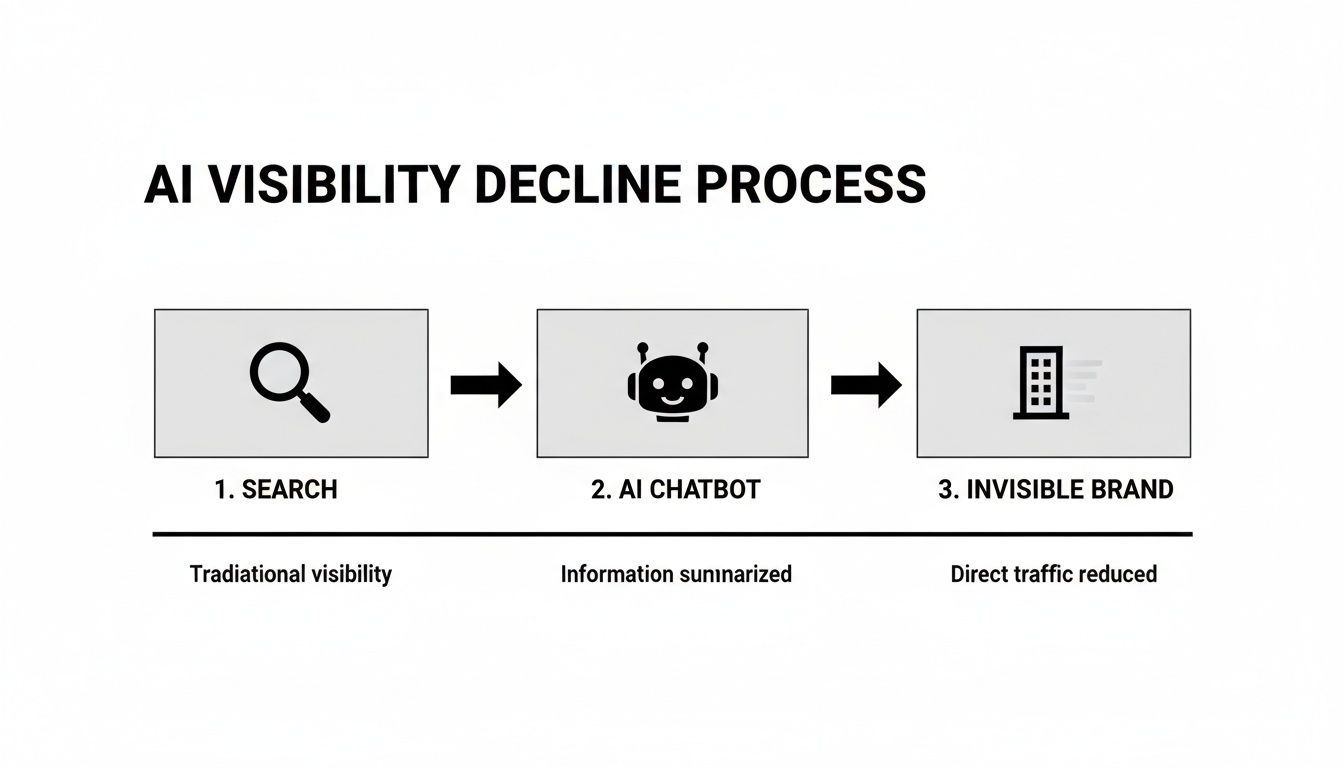
This new reality means relying on your old SEO playbook isn't enough. You have to actively fight for your place within the AI's response to stay visible to your audience.
Documenting and Analyzing the Results
As you start feeding these prompts into models like ChatGPT, Gemini, and Claude, you need to be meticulous about recording what comes back. You could try tracking this manually in a spreadsheet, but honestly, it’s a huge time sink. This is why automated tools exist—they are built to run these queries and track the shifts in responses daily.
A quick pro tip: LLMs don't always give the same answer twice. To get a truly reliable baseline, I recommend running your most important prompts a few times. This helps you understand the typical response and exposes any wild inconsistencies.
When you're sifting through the outputs, you’re looking for three key things:
- Visibility and Position: Are you mentioned at all? If you are, is the framing positive, neutral, or negative? Are you listed first or buried at the bottom?
- Sentiment: What's the overall tone? Is the AI echoing your key strengths, or is it dredging up some outdated criticism from a two-year-old forum post?
- Cited Sources: This is your roadmap. What articles, reviews, or data is the AI referencing to form its answer? These are the exact sources you need to influence with your future PR and content efforts. To dive deeper into this, see our guide on how to use an AI Overview tracker.
Once you've completed this audit, you'll have a data-backed report showing precisely where you stand. This clarity is everything—it gives you the solid foundation you need to build a smart, effective optimization plan.
Setting KPIs to Measure Your AI Performance
So, you’ve done the audit. You have a snapshot of how AI models see your brand right now. But a snapshot is just a starting point. To make any real progress, you need a way to measure what’s working, what isn’t, and how your efforts are impacting the bottom line.
This is where most teams get stuck. They track mentions, but a simple mention count is a vanity metric. It doesn't tell you the whole story. You need to know how and where your brand is appearing in AI-generated answers. Without that context, you're flying blind.
Forget Vanity Metrics, Focus on Influence
Let's be real: not all AI visibility is created equal. A mention in a response to a vague, top-of-funnel question is nice, but it's not going to move the needle like a recommendation in an answer to a high-intent, problem-solving prompt.
To truly gauge your influence, you need to zero in on the metrics that reflect genuine authority. From my experience, there are three KPIs that give you a strong, foundational view of your performance:
Share of Voice: This is your market share within AI conversations. It measures how often your brand is mentioned for a key set of prompts compared to your competitors. A growing Share of Voice means you're becoming the dominant answer in your niche.
Citation Rate: This is a direct measure of authority. It tracks how often AI models cite your domain as a source for their answers. High citation rates are gold—they show that the models trust your content.
Sentiment Score: This goes beyond just being mentioned and asks, "Was it a good mention?" It quantifies whether your brand is being portrayed positively, negatively, or just neutrally. This is your early warning system for reputational issues.
Finding the Prompts That Actually Matter
Your resources are finite, so you can't chase every possible prompt. The key is to identify and prioritize what we call high-impact prompts.
These aren't just any questions. They are the specific, non-branded queries your ideal customers are asking right before they make a decision. Think about the difference between someone asking, "what is AI brand visibility?" versus "which platform offers real-time AI sentiment tracking?" The second person is ready to buy. You have to win that conversation.
Platforms built for Generative Engine Optimization can help teams uncover and continuously monitor these make-or-break prompts automatically.
One thing I've learned is that AI models are notoriously inconsistent. You can run the same prompt five times and get five different answers, or at least a different order of recommendations. That's why tracking a "ranking" is a fool's errand. Instead, focus on your appearance rate—the percentage of times you show up over dozens or hundreds of runs. It's a much more stable and meaningful metric.
Putting It All Together: A KPI Framework
To make this all actionable, it helps to organize these metrics into a clear framework. This table breaks down the essential KPIs, what they measure, and why they are critical for your AI optimization strategy.
| KPI | What It Measures | Why It Matters | How to Track It |
|---|---|---|---|
| Share of Voice | Your brand's mention frequency vs. competitors for target prompts. | Indicates your dominance in key conversations and market presence. | Use an AI visibility tool to track appearance rates over time. |
| Citation Rate | The percentage of responses that cite your domain as a source. | Signals to AI that your website is an authoritative source, boosting trust. | Monitor AI-generated answers for your target prompts and log source URLs. |
| Sentiment Score | The positive, neutral, or negative tone of your brand mentions. | Protects brand reputation and ensures the narrative is favorable. | Run brand mentions through a sentiment analysis tool or use a platform with it built-in. |
| Appearance in Key Prompts | Your visibility for high-intent, bottom-of-funnel queries. | Connects your AI visibility directly to potential leads and sales. | Manually test or use a platform to monitor your most valuable prompts. |
By defining these KPIs, you're building a scorecard for your AI strategy. It allows you to set clear, realistic targets—for example, a goal to increase your Share of Voice by 15% for your top 10 high-impact prompts next quarter.
This data-driven approach turns your AI efforts from a guessing game into a measurable, strategic part of your marketing mix. As you get more advanced, you'll see how this thinking connects directly with concepts around traditional SEO visibility and modern search metrics.
Fine-Tuning Your Digital Ecosystem for LLMs
Think of large language models as voracious information sponges. To get your brand noticed in AI-generated answers, you have to feed them a steady diet of high-quality, authoritative information from sources you own and control. This means turning your website, blog, and official online profiles into the definitive sources that AI models will learn from, trust, and ultimately cite.
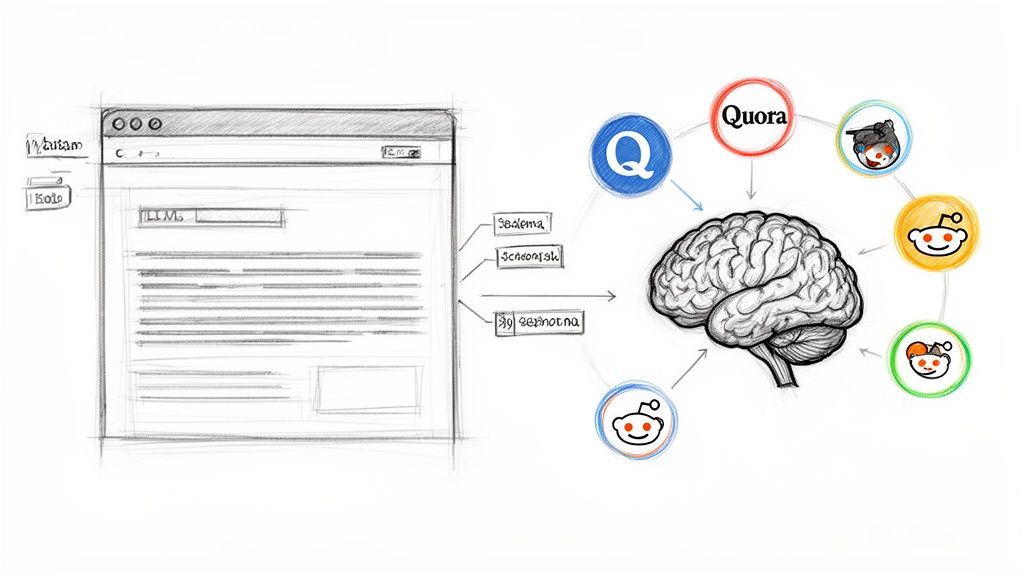
Your brand’s digital footprint is essentially its knowledge base for AI. If that knowledge is a mess—incomplete, outdated, or self-contradictory—the AI will simply look elsewhere for answers. More often than not, that "elsewhere" is your competition. The mission here is to make your owned properties the most reliable and thorough source on any topic touching your brand.
To do this right, you need a solid content engine. Consistently producing the sheer volume of authoritative content needed to make a dent is a huge challenge, which is why many teams are looking into an AI-powered system for content creation to keep up.
Building Authority Signals an AI Can’t Ignore
LLMs don't just read your content; they judge the credibility of where it comes from. One of the strongest signals they look for is raw website traffic. It’s a powerful proxy for authority. In fact, recent data indicates that websites pulling in over 190,000 monthly visitors are twice as likely to get cited by ChatGPT.
Social proof is another massive amplifier. For instance, ChatGPT seems to favor sites with strong community validation. One study found a 3x boost in citations for brands that had racked up 26,000 mentions on a platform like Quora.
But here’s the most important takeaway: research has found that an overwhelming 86% of AI citations can be traced back to controllable, brand-owned sources. This is your proof point. Your own digital assets are the most powerful tool in your arsenal. The directive is clear: build a digital ecosystem that AI models simply have to pay attention to.
Speak the AI’s Language with Structured Data
One of the most direct and effective ways to help an AI understand your brand is to implement structured data, specifically Schema markup. Schema is a shared vocabulary of tags you can embed in your website’s HTML to explicitly tell search engines and AI models what your content is all about.
Instead of leaving an AI to guess that a page is about a product, you can use
Productschema to clearly label its name, price, and reviews. This cuts through the ambiguity and feeds the model clean, organized facts.
Implementing the right schema helps an AI clearly identify and understand key entities like your company, your products, your services, and even the key people on your team.
Here are a few ways to put this into practice:
OrganizationSchema: Use this to clearly state your company's official name, logo, social profiles, and contact details. This is your best defense against an AI pulling incorrect information from some random third-party directory.ProductSchema: For every single product you offer, detail its name, description, ratings, and price. This structured data is far easier for an AI to parse and use accurately in comparative answers.FAQPageSchema: If you have an FAQ section, mark it up. Those question-and-answer pairs become prime candidates to be lifted directly into an AI-generated response.
This entire practice is a cornerstone of a new discipline called Generative Engine Optimization. You can get a deeper understanding of this field in our guide on what Generative Engine Optimization is. By structuring your data, you’re essentially pre-packaging your brand’s information in a format that’s perfect for an AI to consume and repeat.
Executing Targeted Content and PR Campaigns
Okay, you've done the hard work of auditing your brand's presence in AI. You know what the large language models are saying and, more importantly, where they're getting their information. Now it's time to go on the offensive. Instead of just listening, you can start proactively shaping the narrative with smart content and PR campaigns designed specifically for an AI audience.
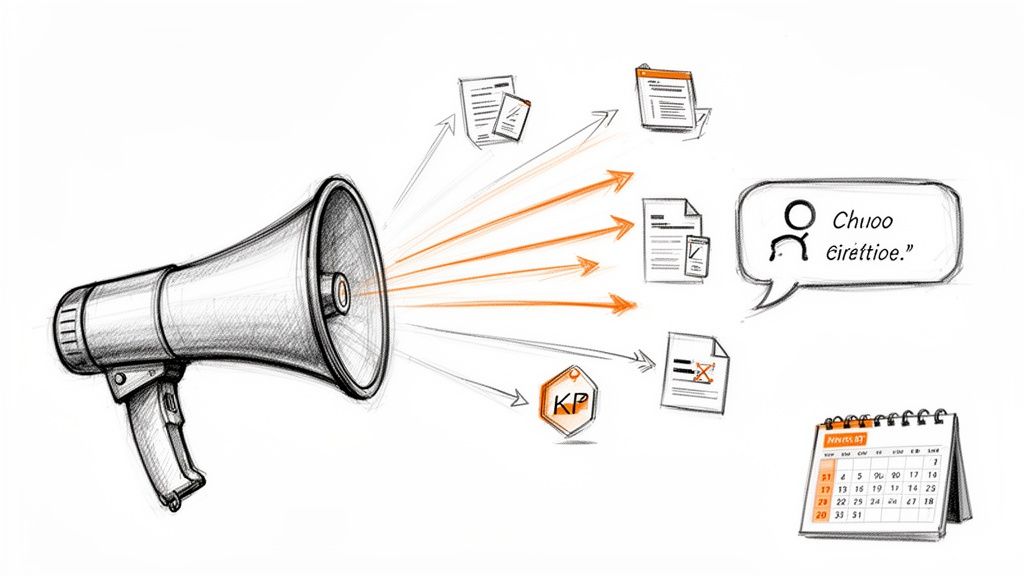
This isn't just a 'nice to have' strategy; the stakes are getting higher every day. We've seen sessions from AI platforms jump an incredible 527% in just five months. The great news is that you have more control than you think. Yext's 2025 AI Citations Study found that 86% of AI citations come from brand assets you can directly manage. If you want to dive deeper, there's a great piece on brand visibility in the age of AI that really unpacks this shift.
Pinpoint the Publications That Matter to AI
Your first move is to figure out which third-party publications the AI models already trust in your industry. Your audit is your treasure map here. Did you notice a particular industry journal, tech blog, or market research firm being cited again and again when you asked about your competitors?
Those are your golden geese. A single mention, guest post, or even a simple quote in one of those publications is worth more than a dozen placements in outlets the AI doesn't care about. An AI visibility tool can be a huge help, as it can quickly show which sources are repeatedly used for your most important prompts.
This completely removes the guesswork. You can stop the "spray and pray" PR approach and focus your team's energy on a shortlist of sources you know will have a massive impact on your ai brand visibility.
Create "Counter-Content" to Fix the Narrative
Did the audit turn up some skeletons? Maybe an LLM is referencing an old, negative review, or quoting from an article with outdated product specs. You can't just hope it goes away. You need to create new, authoritative "counter-content" to systematically bury the old information.
Let's walk through a real-world scenario:
- The Problem: An AI chat mentions your software is "hard to set up," pulling from a single forum comment made back in 2022.
- The Fix: Your content team immediately publishes a detailed blog post, "Get Started with [Your Product] in Under 10 Minutes." Simultaneously, your PR team pitches guest articles to your high-impact publications, highlighting the product's surprisingly simple onboarding process.
By creating a fresh wave of positive, accurate content, you're giving the AI models much better, more current sources to learn from. Over time, this new information will dilute and eventually push out the old, negative narrative.
This surgical approach to content and PR means you can stop just reacting to what AI says. You start strategically feeding its knowledge base, making sure the story it tells about your brand is the one you want told.
Your Top Questions About AI Brand Visibility, Answered
As marketers and brand leaders, we're all grappling with this new world of AI-driven search. It's a huge shift, and it’s completely normal to have a lot of questions. Let's tackle some of the most common ones I hear from teams just starting to navigate this space.
How Is AI Brand Visibility Different from Traditional SEO?
That's a great question, and it gets to the core of the strategic shift we're all facing. While they're definitely related, the game has fundamentally changed.
Think of it this way: traditional SEO is about winning a spot on a list of blue links. You're fighting to climb the rankings. AI brand visibility, on the other hand, is about becoming part of the single, authoritative answer the AI generates. You’re not just a link; you're woven into the narrative.
SEO has always been about signals like keywords and backlinks. But for AI visibility, the model weighs things differently. It puts a much heavier emphasis on source authority, the clarity of your information, and the overall sentiment it finds about you across the entire web.
How Often Should We Be Monitoring Our AI Visibility?
Given how quickly these models learn and update, the only real answer is constantly. If you're not checking at least weekly, you're flying blind. The information an AI uses can change literally overnight based on a new competitor launch, a single news article, or even a Reddit thread that goes viral.
I've seen it happen. A single negative review or a sudden shift in the sources an AI decides to trust can instantly tank a brand's portrayal. Using a platform that gives you daily tracking isn't a luxury; it's the only way to stay ahead of these shifts and respond before a small issue becomes a full-blown crisis.
Can We Just Tell an AI What to Say About Our Brand?
The short answer is no, you can't. There's no back-end portal or submission form for major LLMs like ChatGPT or Gemini where you can edit your brand's profile. Your influence has to be indirect.
The entire strategy is about building a strong, factual, and positive information ecosystem around your brand. You need to feed the machine with the right ingredients. This means focusing your efforts on:
- Your own website, especially your blog and "About Us" sections.
- Getting featured in reputable industry publications.
- Engaging in knowledge bases and forums like Quora and specific, high-authority subreddits.
By doing this, you're strategically shaping the library of information the AI learns from. You're making your preferred narrative the most credible, consistent, and accessible one it can find.
What Is the Very First Step Our Team Should Take?
Before you do anything else, you need a baseline. You can't map out a route until you know your starting point. The most critical first step is a simple, manual audit.
Don't try to boil the ocean. Just start by asking 10-20 important prompts about your brand, your key products, and your top competitors. Run these prompts across two or three of the major AI models.
Document everything you see—the exact answers, the overall tone, and most importantly, the sources the AI cites. This initial snapshot is gold. It will immediately highlight your biggest vulnerabilities and give you the concrete data you need to build a smart, effective plan.
Ready to stop guessing and start measuring your AI brand visibility? With promptposition, you can automate your audit, track daily changes, and uncover the sources shaping your brand’s narrative. See exactly how you stack up against competitors and turn AI insights into actionable strategy. Start tracking your AI presence today at https://www.promptposition.com.